Results by title
23 books match the query 'Singing'
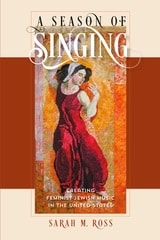
A Season of Singing
Creating Feminist Jewish Music in the United StatesSarah M. Ross
Brandeis University Press, 2016
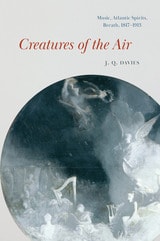
Creatures of the Air
Music, Atlantic Spirits, Breath, 1817–1913J. Q. Davies
University of Chicago Press, 2023
Often experienced as universal and incorporeal, music seems an innocent art form. The air, the very medium by which music constitutes itself, shares with music a claim to invisibility. In Creatures of the Air, J. Q. Davies interrogates these claims, tracing the history of music’s elemental media system in nineteenth-century Atlantic worlds. He posits that air is a poetic domain, and music is an art of that domain.
From West Central African ngombi harps to the European J. S. Bach revival, music expressed elemental truths in the nineteenth century. Creatures of the Air tells these truths through stories about suffocation and breathing, architecture and environmental design, climate strife, and racial turmoil. Contributing to elemental media studies, the energy humanities, and colonial histories, Davies shows how music, no longer just an innocent luxury, is implicated in the struggle for control over air as a precious natural resource. What emerges is a complex political ecology of the global nineteenth century and beyond.

Engendering Song
Singing and Subjectivity at Prespa Albanian WeddingsJane C. Sugarman
University of Chicago Press, 1997
Combining photographs, song texts, and vibrant recordings of the music with her own evocative descriptions, ethnomusicologist Jane C. Sugarman focuses her account of Prespa weddings on notions of gendered identity, demonstrating the capacity of singing to generate and transform relations of power within Prespa society. Engendering Song is an innovative theoretical work, with a scholarly importance extending far beyond southeast European studies. It offers unique and timely contributions to the analysis of music and gender, music in diaspora cultures, and the social constitution of self and subjectivity.
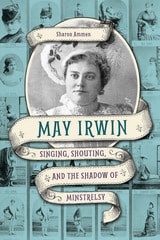
May Irwin
Singing, Shouting, and the Shadow of MinstrelsySharon Ammen
University of Illinois Press, 2017
Sharon Ammen's in-depth study traces Irwin's hurly-burly life. Irwin gained fame when, layering aspects of minstrelsy over ragtime, she popularized a racist "Negro song" genre. Ammen examines this forgotten music, the society it both reflected and entertained, and the ways white and black audiences received Irwin's performances. She also delves into Irwin's hands-on management of her image and career, revealing how Irwin carefully built a public persona as a nurturing housewife whose maternal skills and performing acumen reinforced one another. Irwin's act, soaked in racist song and humor, built a fortune she never relinquished. Yet her career's legacy led to a posthumous obscurity as the nation that once adored her evolved and changed.

Phonetics and Diction in Singing
Italian, French, Spanish, GermanKurt Adler
University of Minnesota Press, 1967
Phonetics and Diction in Singing was first published in 1967. Minnesota Archive Editions uses digital technology to make long-unavailable books once again accessible, and are published unaltered from the original University of Minnesota Press editions.
This book provides rules and illustrative examples for the study of songs and operas in the leading foreign languages of musical literature. The author is conductor and chorus master of the Metropolitan Opera. He has drawn the material from his larger book, The Art of Accompanying and Coaching,to provide a handbook or textbook especially suitable for use by voice teachers, singers, students in high schools, colleges, and schools of music, and members of choruses, church choirs, and opera workshops and their directors. Following a general discussion of phonetics and diction in singing there are separate chapters on Italian, French, Spanish, and German phonetics and diction. The text is illustrated with drawings and diagrams of vocal techniques and musical examples.
Poetic Investigations
Singing the Holes in HistoryPaul Naylor
Northwestern University Press, 1999
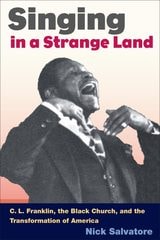
SINGING IN A STRANGE LAND
C. L. Franklin, the Black Church, and the Transformation of AmericaNick Salvatore
University of Illinois Press, 2000
Sensing Sound
Singing and Listening as Vibrational PracticeNina Sun Eidsheim
Duke University Press, 2016
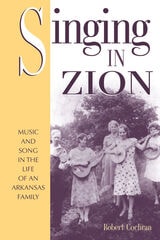
Singing in Zion
Music and Song in the Life of One Arkansas FamilyRobert Cochran
University of Arkansas Press, 1999
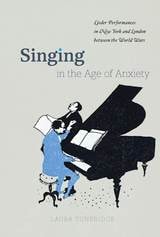
Singing in the Age of Anxiety
Lieder Performances in New York and London between the World WarsLaura Tunbridge
University of Chicago Press, 2018
Laura Tunbridge explores the renewed vitality of this refugee musical form between the world wars, offering a fresh perspective on a period that was pervaded by anxieties of displacement. Through richly varied case studies, Singing in the Age of Anxiety traces how lieder were circulated, presented, and consumed in metropolitan contexts, shedding new light on how music facilitated unlikely crossings of nationalist and internationalist ideologies during the interwar period.

Singing in the Wilderness
Music and Ecology in the Twentieth CenturyWilfrid Mellers
University of Illinois Press, 2001
Beginning with two turn-of-the-century operas--Frederick Delius's A Village Romeo and Juliet and Claude Debussy's Pelléas et Mélisande -- that present humankind as lost in a tangled wood that is at once internal and external, Mellers develops the theme of wilderness in sociological, psychological, ecological, and even geological terms. He discusses Leoš Janá ek's Cunning Little Vixen ("the ultimate ecological opera") as a parable of redemption and explores the delicate yet dangerous equilibrium between civilization and the dark forest in works by Charles Koechlin and Darius Milhaud. Elements of wilderness and the city combine to infuse the music of Heitor Villa-Lobos and Carlos Chávez with a blend of primitivism and sophistication, while a creative tension between desert landscape and industrial mechanization inspires the works of Carl Ruggles, Harry Partch, Steve Reich, and Australia's Peter Sculthorpe. The volume culminates in a discussion of two American urban folk musicians, Duke Ellington and George Gershwin.
By suggesting how the "musicking" of ecological issues articulates twinned perspectives on music and our place in the world, Mellers raises intriguing questions about the links among tradition, talent, learning, and instinct. Brimming over with fresh ideas and unexpected cross-pollinations, Singing in the Wilderness is a stimulating addition to the oeuvre of a distinguished and inventive scholar.
Singing the Chaos
Madness and Wisdom in Modern PoetryWilliam Pratt
University of Missouri Press, 1996
Singing the Chaos: Madness and Wisdom in Modern Poetry combines both a historical and a critical approach toward the works of major British, American, French, German, and Russian poets. Comprehensive in scope and arranged chronologically to survey a century of high poetic achievement, the study is unified by Pratt's overriding argument that "modern poets have endowed a disintegrating civilization with humane wisdom by 'singing the chaos' that surrounds them, making ours a great age in spite of itself."
In developing this central theme, Pratt brings alive the energy, the freshness, and the originality of technique that made Baudelaire, Pound, Yeats, Rilke, Eliot, and others the initiators of the revolution in poetry. He brings a more complete, clearer perspective to other major themes: modernism as an age of irony; poets as both madmen and geniuses; the modern poet as tragic hero; the dominance of religious or visionary truths over social or political issues; and the combination of radical experiments in poetic form with an apocalyptic view of Western civilization. His detailed treatment of the Fugitive poets and his recognition of their prominent role in twentieth-century literature constitute an important historical revision.
Brilliantly informed, insightful, and, above all, accurately sympathetic to the points of view of the poets Pratt presents, Singing the Chaos is that rare book that belongs on all shelves devoted to modernist poetry.
Singing the Classical, Voicing the Modern
The Postcolonial Politics of Music in South IndiaAmanda J. Weidman
Duke University Press, 2006
Combining ethnographic observation derived from her experience as a student and performer of South Indian music with close readings of archival materials, Weidman traces the emergence of this politics of voice through compelling analyses of the relationship between vocal sound and instrumental imitation, conventions of performance and staging, the status of women as performers, debates about language and music, and the relationship between oral tradition and technologies of printing and sound reproduction. Through her sustained exploration of the way “voice” is elaborated as a trope of modern subjectivity, national identity, and cultural authenticity, Weidman provides a model for thinking about the voice in anthropological and historical terms. In so doing, she shows that modernity is characterized as much by particular ideas about orality, aurality, and the voice as it is by regimes of visuality.
Singing the Land
Hebrew Music and Early Zionism in AmericaEli Sperling
University of Michigan Press, 2024
Exploring the history, events, contexts, and tensions that comprised what may be termed the ‘Zionization’ of American Jewry during the first half of the twentieth century, Eli Sperling analyzes primary sources within the historical contexts of Zionist national development and American Jewish life. Singing the Land offers insights into how and why musical frameworks were central to catalyzing American Jewry’s support of the Zionist cause by the 1940s, parallel to firm commitments to their American locale and national identities. The proliferation of this widespread American Jewish-Zionist embrace was achieved through a variety of educational, religious, economic, and political efforts, and Hebrew music was a thread consistent among them all.
Singing the Lord's Song in a Strange Land
Hymnody in the History of North American ProtestantismEdith L. Blumhofer
University of Alabama Press, 2008
Music and song are important parts of worship, and hymns have long played a central role in Protestant cultural history. This book explores the ways in which Protestants have used and continue to use hymns to clarify their identity and define their relationship with America and to Christianity. Representing seven groups—Baptists, Presbyterians, Lutherans, Mennonites, Holiness, Hispanics, and Evangelicals—the nine essays reveal how hymns have helped immigrants to establish new identities, contributed to the body of worship resources, and sustained ethnic identity.
Individual essays address the music of the Old-Fashioned Revival Hour, America’s longest running and most successful independent radio program; singing among Swedish evangelicals in America; the German hymn tradition as transformed by Mennonite immigrants; the ways hymnody reinforces themes of the Wesleyan holiness movement; the history of Mercer’s Cluster (1810), a southern hymnal that gave voice to slaves, women, and native Americans; and the Presbyterian hymnal tradition in Canada formed by Scottish immigrants.
Singing the Self
Guitar Poetry, Community, and Identity in the Post-Stalin PeriodRachel S. Platonov
Northwestern University Press, 2012
This book is a study of a Soviet cultural phenomenon of the 1950s through the 1980s known as guitar poetry—songs accompanied by guitar and considered poetry in much the same way as those of, for example, Bob Dylan. Platonov’s is the most comprehensive book in English to date to analyze guitar poetry, which has rarely received scholarly attention outside of Russia. Going well beyond the conventional, text-centered view of guitar poetry as a form of political or artistic dissent, largely a function of the Cold War climate in which it began, Platonov argues for a more complex understanding of guitar poetry as a means of self-invention and community formation. Although grounded in literary studies, the book effectively brings historical, anthropological, and musicological perspectives to bear on an understudied phenomenon of the post-Stalin period.
Singing with Invisible Worlds
Fermenting Sake on Microbial TimeMaya Hey
University of Minnesota Press, 2026
Rethinking life with microbes through the art of natural fermentation
Within us and around us, microbes are everywhere, constantly reshaping what it means to be human as we interact with them—sometimes knowingly, sometimes not. Singing with Invisible Worlds theorizes human–microbe relationships through a rare ethnographic account of the fermentation process at the 350-year-old Terada Honke, one of only two natural sake breweries in Japan.
Painting a vivid picture of how sake brewers collaborate with bacteria, molds, and yeasts, Maya Hey reveals that ambient microbes are not controlled but courted, cultivated, and deliberately choreographed. As the brewers adapt to shifting microbial dynamics, they engage in what Hey calls an “improvisational ethic”—a way of responding to the unknown with care and attentiveness through each phase of blooming and waning across weeks, months, and even centuries. In documenting these remarkable practices, Singing with Invisible Worlds offers an intimate, situated understanding of how we can come to know and live with microbial life, with implications for feminist theory, science and technology studies, and multispecies ethnography.
Unsettling simplistic notions of “good” or “bad” microbes, this book presents a compelling vision for planetary coexistence—one that starts not with grand solutions but with small, rhythmic acts of microscopic attunement.
Retail e-book files for this title are screen-reader friendly with images accompanied by short alt text and/or extended descriptions.
The Race of Sound
Listening, Timbre, and Vocality in African American MusicNina Sun Eidsheim
Duke University Press, 2018
The Sound of Dove
Singing in Appalachian Primitive Baptist ChurchesBeverly Bush Patterson
University of Illinois Press, 1995
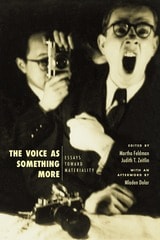
The Voice as Something More
Essays toward MaterialityEdited by Martha Feldman and Judith T. Zeitlin
University of Chicago Press, 2019
Using Mladen Dolar’s influential A Voice and Nothing More as a reference point, The Voice as Something More reorients Dolar’s psychoanalytic analysis around the material dimensions of voices—their physicality and timbre, the fleshiness of their mechanisms, the veils that hide them, and the devices that enhance and distort them. Throughout, the essays put the body back in voice. Ending with a new essay by Dolar that offers reflections on these vocal aesthetics and paradoxes, this authoritative, multidisciplinary collection, ranging from Europe and the Americas to East Asia, from classics and music to film and literature, will serve as an essential entry point for scholars and students who are thinking toward materiality.
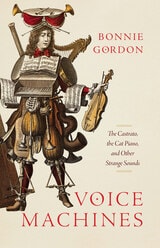
Voice Machines
The Castrato, the Cat Piano, and Other Strange SoundsBonnie Gordon
University of Chicago Press, 2023
Italian courts and churches began employing castrato singers in the late sixteenth century. By the eighteenth century, the singers occupied a celebrity status on the operatic stage. Constructed through surgical alteration and further modified by rigorous training, castrati inhabited human bodies that had been “mechanized” to produce sounds in ways that unmechanized bodies could not. The voices of these technologically enhanced singers, with their unique timbre, range, and strength, contributed to a dramatic expansion of musical vocabulary and prompted new ways of imagining sound, the body, and personhood.
Connecting sometimes bizarre snippets of history, this multi-disciplinary book moves backward and forward in time, deliberately troubling the meaning of concepts like “technology” and “human.” Voice Machines attends to the ways that early modern encounters and inventions—including settler colonialism, emergent racialized worldviews, the printing press, gunpowder, and the telescope—participated in making castrati. In Bonnie Gordon’s revealing study, castrati serve as a critical provocation to ask questions about the voice, the limits of the body, and the stories historians tell.
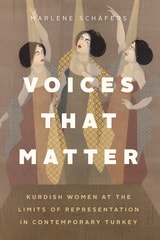
Voices That Matter
Kurdish Women at the Limits of Representation in Contemporary TurkeyMarlene Schäfers
University of Chicago Press, 2023
A fine-grained ethnography exploring the sociopolitical power of Kurdish women’s voices in contemporary Turkey.
“Raise your voice!” and “Speak up!” are familiar refrains that assume, all too easily, that gaining voice will lead to empowerment, healing, and inclusion for marginalized subjects. Marlene Schäfers’s Voices That Matter reveals where such assumptions fall short, demonstrating that “raising one’s voice” is no straightforward path to emancipation but fraught with anxieties, dilemmas, and contradictions. In its attention to the voice as form, this book examines not only what voices say but also how they do so, focusing on Kurdish contexts where oral genres have a long, rich legacy. Examining the social labor that voices carry out as they sound, speak, and resonate, Schäfers shows that where new vocal practices arise, they produce new selves and practices of social relations. In Turkey, recent decades have seen Kurdish voices gain increasing moral and political value as metaphors of representation and resistance. Women’s voices, in particular, are understood as potent means to withstand patriarchal restrictions and political oppression. By ethnographically tracing the transformations in how Kurdish women relate to and employ their voices as a result of these shifts, Schäfers illustrates how contemporary politics foster not only new hopes and desires but also create novel vulnerabilities as they valorize, elicit, and discipline voice in the name of empowerment and liberation.
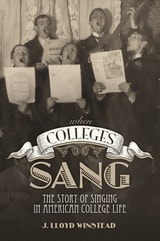
When Colleges Sang
The Story of Singing in American College LifeJ. Lloyd Winstead
University of Alabama Press, 2013