56 books match the query 'Jurisprudence' and 9 start with l
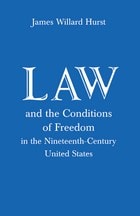
cover of Law and the Conditions of Freedom in the Nineteenth-Century United States

Law and the Conditions of Freedom in the Nineteenth-Century United States

James Willard Hurst

University of Wisconsin Press, 1964

In these essays J. Willard Hurst shows the correlation between the conception of individual freedom and the application of law in the nineteenth-century United States—how individuals sought to use law to increase both their personal freedom and their opportunities for personal growth. These essays in jurisprudence and legal history are also a contribution to the study of social and intellectual history in the United States, to political science, and to economics as it concerns the role of public policy in our economy. The nonlawyer will find in them demonstration of how "technicalities" express deep issues of social values.

[more]
cover of Law and the Conditions of Freedom in the Nineteenth-Century United States

Law and the Conditions of Freedom in the Nineteenth-Century United States

J. Willard Hurst

University of Wisconsin Press, 1956

In these essays J. Willard Hurst shows the correlation between the conception of individual freedom and the application of law in the nineteenth-century United States—how individuals sought to use law to increase both their personal freedom and their opportunities for personal growth. These essays in jurisprudence and legal history are also a contribution to the study of social and intellectual history in the United States, to political science, and to economics as it concerns the role of public policy in our economy. The nonlawyer will find in them demonstration of how "technicalities" express deep issues of social values.
[more]
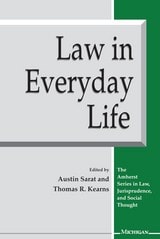
cover of Law in Everyday Life

Law in Everyday Life

Austin Sarat and Thomas R. Kearns, Editors

University of Michigan Press, 1995
"Sarat and Kearns . . . have edited a truly marvelous work on the impact of the law on daily life and vice versa. . . . the essays are all exemplary, thought- provoking works worthy of a long, contemplative read by scholars, lawyers, and judges alike." --Choice
"The subject of law in everyday life is timely in theory and in practice. The essays collected here are stimulating for the very different ways in which they reconfigure the meanings of 'the law' as cultural practice, and 'the everyday' as a cultural domain in which the state expresses a range of interests and engagements. Readers looking for an introduction to this topic will come away from the book with a clear sense of the varied voices and modes of inquiry now involved in sociolegal studies, and what distinguishes them. More experienced readers will appreciate the book's meticulous reconsideration of the instrumentalities, agencies, and constructedness of law." --Carol Greenhouse, Indiana University
Contributors include David Engel, Hendrik Hartog, Thomas R. Kearns, David Kennedy, Catharine MacKinnon, George Marcus, Austin Sarat, and Patricia Williams.
Austin Sarat is William Nelson Cromwell Professor of Jurisprudence and Political Science, and Chair of the Department of Law, Jurisprudence, and Social Thought, Amherst College. Thomas R. Kearns is William H. Hastie Professor of Philosophy and Professor of Law, Jurisprudence, and Social Thought, Amherst College.
[more]
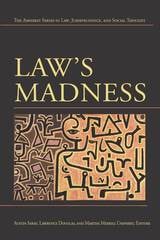
cover of Law's Madness

Law's Madness

Austin Sarat, Lawrence Douglas, and Martha Merrill Umphrey, Editors

University of Michigan Press, 2006

Law and madness? Madness, it seems, exists outside the law and, in principle, society struggles to keep these slippery terms separate. From this perspective, madness appears to be law's foil, the chaos that escapes law's control and simultaneously justifies its existence. Law's Madness explores the gray area between the realms of reason and madness.
The distinguished contributors to Law's Madness propose a fascinating interdisciplinary approach to the instability and mutual permeability of law and madness. Their essays examine a variety of discursive forms—from the literary to the historical to the psychoanalytic—in which law is driven more by narrative than by reason. Their studies delineate the ways in which the law takes its definition in part from that which it excludes, suppresses, or excises from itself, illuminating the drive to enforce barriers between non-reason and legality, while simultaneously shedding new light on the constitutive force of the irrational in legal doctrine.
Law's Madness suggests that the tense and paradoxical relationship between law and madness is precisely what erects and sustains law. This provocative collection asks what must be forgotten in order to uphold the rule of law.
Austin Sarat is William Nelson Cromwell Professor of Jurisprudence and Political Science at Amherst College. Lawrence Douglas is Associate Professor of Law, Jurisprudence, and Social Thought at Amherst College. Martha Merrill Umphrey is Associate Professor of Law, Jurisprudence, and Social Thought at Amherst College.
[more]
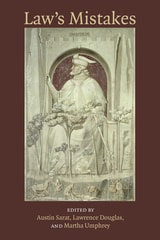
cover of Law's Mistakes

Law's Mistakes

Austin Sarat

University of Massachusetts Press, 2016

From false convictions to botched executions, from erroneous admission of evidence in a criminal trial to misunderstandings that arise in the process of creating contracts, law is awash in mistakes. These mistakes can be unintentional deviations from expected practices or the result of intentional actions that produce unintended negative consequences. They may become part of a process of response and correction or be accepted as an inevitable cost of action. Some mistakes are external to law itself, such as errors in an agreement made by two private parties. Others are made by legal actors in the course of their work; for example, a police officer's failing to obtain a search warrant when one was required.

The essays in Law's Mistakes explore the things that law recognizes as errors and the way it responds to them. They identify the jurisprudential and political perspectives that underlie different understandings of what is or is not a legal mistake, and examine the fraught, contested, and evolving relationship between law and error. And they offer templates for thinking about what mistakes can tell us about the aspirations and limits of law, and for understanding how our imagining of law is enabled and shaped by its juxtaposition to a condition labeled mistake.

In addition to the volume editors, contributors include Paul Schiff Berman, Sonali Chakravarti, Jody L. Medeira, Stewart Motha, Kunal Parker, and Jordan Steiker.
[more]
cover of Law's Violence

Law's Violence

Austin Sarat and Thomas R. Kearns, Editors

University of Michigan Press, 1995
"In bringing together accomplished and thoughtful scholars of different disciplines, with a command of literature ranging from the legal to the literary, and in relating the works to the central arguments of the late Professor Robert Cover, Sarat and Kearns have created a first-rate up-to-date exposition of this important and complicated issue, namely, how to understand better the violence implicit and explicit in law."--Legal Studies Forum
The relationship between law and violence is made familiar to us in vivid pictures of police beating suspects, the large and growing prison population, and the tenacious attachment to capital punishment in the United States. Yet the link between law and violence and the ways that law manages to impose pain and death while remaining aloof and unstained are an unexplored mystery. Each essay in this volume considers the question of how violence done by and in the name of the law differs from illegal or extralegal violence--or, indeed, if they differ at all.
Each author draws on a distinctive disciplinary tradition-- literature, history, anthropology, philosophy, political science, or law. Yet each reminds us that law, constituted in response to the metaphorical violence of the state of nature, is itself a doer of literal violence.
Austin Sarat is William Nelson Cromwell Professor of Jurisprudence and Political Science and Chair of the Program in Law, Jurisprudence, and Social Thought, Amherst College. Thomas R. Kearns is William H. Hastie Professor of Philosophy, Amherst College.
[more]
cover of Legal Modernism

Legal Modernism

David Luban

University of Michigan Press, 1997
Modernism in legal theory is no different from modernism in the arts: both respond to a cultural crisis, a sense that institutions and traditions have lost their validity. Some doubt the importance of the rule of law, others question the objectivity of legal reasoning. We have lost confidence in the justice of our legal institutions, and even in our very capacity to identify justice.
Legal philosopher David Luban argues that we cannot escape the modernist predicament. Accusing contemporary legal theorists of evading rather than confronting the challenge of modernity, he offers important and original objections to pragmatism, traditionalism, and nihilism. He argues that only by weaving together the broken narrative and forgotten voices of history's victims can we come to appreciate the nature of justice in modern society. Calling a trial the embodiment of the law's self-criticism, Luban demonstrates the centrality of narrative by analyzing the trial of Martin Luther King, the Nuremberg trials, and trial scenes in Homer, Hesiod, and Aeschylus. With these examples, Luban explores several of the tensions that motivate much more contemporary legal theory: order versus justice, obedience versus resistance, statism versus communitarianism.
". . . an illuminating account of how contemporary legal theory can be understood as an expression of 'the modernist predicament' by exploring the analogy between modernism in the arts and modernism in law, politics, and philosophy. . . . a valuable critical discussion of modern legal theory." --Choice
David Luban is Morton and Sophia Macht Professor of Law at the University of Maryland and Research Scholar at the Institute for Philosophy and Public Policy. His other books include Lawyers and Justice: An Ethical Study.
[more]
cover of Legal Rights: Historical and Philosophical Perspectives

Legal Rights

Historical and Philosophical Perspectives

Austin Sarat and Thomas R. Kearns, Editors

University of Michigan Press, 1997
The idea of legal rights today enjoys virtually universal appeal, yet all too often the meaning and significance of rights are poorly understood. The purpose of this volume is to clarify the subject of legal rights by drawing on both historical and philosophical legal scholarship to bridge the gap between these two genres--a gap that has divorced abstract and normative treatments of rights from an understanding of their particular social and cultural contexts.
Legal Rights: Historical and Philosophical Perspectives shows that the meaning and extent of rights has been dramatically expanded in this century, though along with the widespread and flourishing popularity of rights, voices of criticism have increasingly been raised. The authors take up the question of the foundation of rights and explore the postmodern challenges to efforts to ground rights outside of history and language. Drawing rich historical analysis and careful philosophical inquiry into productive dialogue, this book explores the many facets of rights at the end of the twentieth century. In these essays, potentially abstract debates come alive as they are related to the struggles of real people attempting to cope with, and improve, their living conditions. The significance of legal rights is measured not just in terms of philosophical categories or as a collection of histories, but as they are experienced in the lives of men and women seeking to come to terms with rights in contemporary life.
Contributors are Hadley Arkes, William E. Cain, Thomas Haskell, Morton J. Horwitz, Annabel Patterson, Michael J. Perry, Pierre Schlag, and Jeremy Waldron.
Austin Sarat is William Nelson Cromwell Professor of Jurisprudence and Political Science, Amherst College. Thomas R. Kearns is William H. Hastie Professor of Philosophy, Amherst College.
[more]
cover of Legal Secrets: Equality and Efficiency in the Common Law

Legal Secrets

Equality and Efficiency in the Common Law

Kim Lane Scheppele

University of Chicago Press, 1988

Does the seller of a house have to tell the buyer that the water is turned off twelve hours a day? Does the buyer of a great quantity of tobacco have to inform the seller that the military blockade of the local port, which had depressed tobacco sales and lowered prices, is about to end? Courts say yes in the first case, no in the second. How can we understand the difference in judgments? And what does it say about whether the psychiatrist should disclose to his patient's girlfriend that the patient wants to kill her?

Kim Lane Scheppele answers the question, Which secrets are legal secrets and what makes them so? She challenges the economic theory of law, which argues that judges decide cases in ways that maximize efficiency, and she shows that judges use equality as an important principle in their decisions. In the course of thinking about secrets, Scheppele also explores broader questions about judicial reasoning—how judges find meaning in legal texts and how they infuse every fact summary with the values of their legal culture. Finally, the specific insights about secrecy are shown to be consistent with a general moral theory of law that indicates what the content of law should be if the law is to be legitimate, a theory that sees legal justification as the opportunity to attract consent.

This is more than a book about secrets. It is also a book about the limits of an economic view of law. Ultimately, it is a work in constructive legal theory, one that draws on moral philosophy, sociology, economics, and political theory to develop a new view of legal interpretation and legal morality.
[more]