527 books match the query 'Labor' and 45 start with l
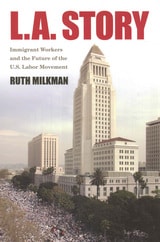
cover of L.A. Story: Immigrant Workers and the Future of the U.S. Labor Movement

L.A. Story

Immigrant Workers and the Future of the U.S. Labor Movement

Ruth Milkman

Russell Sage Foundation, 2006
Sharp decreases in union membership over the last fifty years have caused many to dismiss organized labor as irrelevant in today's labor market. In the private sector, only 8 percent of workers today are union members, down from 24 percent as recently as 1973. Yet developments in Southern California—including the successful Justice for Janitors campaign—suggest that reports of organized labor's demise may have been exaggerated. In L.A. Story, sociologist and labor expert Ruth Milkman explains how Los Angeles, once known as a company town hostile to labor, became a hotbed for unionism, and how immigrant service workers emerged as the unlikely leaders in the battle for workers' rights. L.A. Story shatters many of the myths of modern labor with a close look at workers in four industries in Los Angeles: building maintenance, trucking, construction, and garment production. Though many blame deunionization and deteriorating working conditions on immigrants, Milkman shows that this conventional wisdom is wrong. Her analysis reveals that worsening work environments preceded the influx of foreign-born workers, who filled the positions only after native-born workers fled these suddenly undesirable jobs. Ironically, L.A. Story shows that immigrant workers, who many union leaders feared were incapable of being organized because of language constraints and fear of deportation, instead proved highly responsive to organizing efforts. As Milkman demonstrates, these mostly Latino workers came to their service jobs in the United States with a more group-oriented mentality than the American workers they replaced. Some also drew on experience in their native countries with labor and political struggles. This stock of fresh minds and new ideas, along with a physical distance from the east-coast centers of labor's old guard, made Los Angeles the center of a burgeoning workers' rights movement. Los Angeles' recent labor history highlights some of the key ingredients of the labor movement's resurgence—new leadership, latitude to experiment with organizing techniques, and a willingness to embrace both top-down and bottom-up strategies. L.A. Story's clear and thorough assessment of these developments points to an alternative, high-road national economic agenda that could provide workers with a way out of poverty and into the middle class.
[more]
cover of Labor Histories: Class, Politics, and the Working-Class Experience

Labor Histories

Class, Politics, and the Working-Class Experience

Edited by Eric Arnesen, Julie Greene, and Bruce Laurie

University of Illinois Press, 1998

Is class outmoded as a basis for understanding labor history? This collection emphatically answers, "No!" These thirteen essays delve into subjects like migrant labor, religion, ethnicity, agricultural history, and gender. Written by former students of preeminent labor figure and historian David Montgomery, the works advance the argument that class remains indispensable to the study of working Americans and their place in the broad drama of our shared national history.
[more]
cover of Labor Leaders in America

Labor Leaders in America

Edited by Melvyn Dubofsky and Warren Van Tine

University of Illinois Press, 1987

Here are the life stories of the men and women who led the labor movement in America from Reconstruction to recent times, from William H. Sylvis, the first major labor leader, to Cesar Chavez, who organized California's farm workers in the 1960s. In each profile, a leading authority provides a profile of the figure's life and work. Taken together, these short biographies provide a broad overview of the American labor movement that will appeal to students, interested readers, and specialists. Profiles include: William H. Sylvis, Terence V. Powderly, Samuel Gompers, Eugene V. Debs, William D. "Big Bill" Haywood, William Green, Rose Schneiderman, John L. Lewis, Sidney Hillman, Philip Murray, A. Philip Randolph, Walter Reuther, Jimmy Hoffa, George Meany, and Cesar Chavez
[more]
cover of Labor Markets and Firm Benefit Policies in Japan and the United States

Labor Markets and Firm Benefit Policies in Japan and the United States

Edited by Seiritsu Ogura, Toshiaki Tachibanaki, and David A. Wise

University of Chicago Press, 2003

This volume, the fourth to result from a remarkably productive collaboration between the National Bureau of Economic Research and the Japan Center for Economic Research, presents a selection of thirteen high-caliber papers addressing issues in the employment practices, labor markets, and health, benefit, and pension policies of the United States and Japan.

After an opening chapter assessing the recent ascendance of the U.S. economy, papers diverge to tackle a range of specific issues. Focusing less on international comparison than on the assembly of high-quality research, contributors hone in on a variety of individual topics. Chapters delve into issues of youth employment, participatory employment, information sharing, fringe benefits, and drug coverage in Japan, as well as the dynamics of medical savings accounts, private insurance coverage, and benefit options in the U.S.

Like previous volumes stemming from NBER/JCER collaboration, this book represents a valuable mass of empirical data on some of the most notable employment and benefits issues in each nation, information that will both anchor and provoke scholarly analysis of these topics well into the future.

[more]
cover of Labor Of Dionysus: A Critique of the State-Form

Labor Of Dionysus

A Critique of the State-Form

Michael Hardt

University of Minnesota Press, 1994

“Labor is the living, form-giving fire,” Marx wrote. “It is the transitoriness of things, their temporality, as their transformation by living time.” How is it, then, that labor, with all its life-affirming potential, has become the means of capitalist discipline, exploitation, and domination in modern society? The authors expose and pursue this paradox through a systematic analysis of the role of labor in the processes of capitalist production and in the establishment of capitalist legal and social institutions. Critiquing liberal and socialist notions of labor and institutional reform from a radical democratic perspective, Hardt and Negri challenge the state-form itself.

In the twentieth century, labor has become central to the material and formal constitution of the State, as a complex nexus of value and right. And yet, in living labor and social cooperation, which cut across the divisions of workdays and wage relations, the authors identify a total critique of capitalist practice as well, presenting not only the negation of the present social order but also the affirmation of an alternative system of value, norms, and desires. The forms in which this potential is expressed, from the social movements of the 1960s to those of the 1990s, are the “prerequisites of communism” already existing in contemporary society.
[more]
cover of Labor Statistics Measurement Issues

Labor Statistics Measurement Issues

Edited by John Haltiwanger, Marilyn E. Manser, and Robert H. Topel

University of Chicago Press, 1998

Rapidly changing technology, the globalization of markets, and the declining role of unions are just some of the factors that have led to dramatic changes in working conditions in the United States. Little attention has been paid to the difficult measurement problems underlying analysis of the labor market. Labor Statistics Measurement Issues helps to fill this gap by exploring key theoretical and practical issues in the measurement of employment, wages, and workplace practices.

Some of the chapters in this volume explore the conceptual issues of what is needed, what is known, or what can be learned from existing data, and what needs have not been met by available data sources. Others make innovative uses of existing data to analyze these topics. Also included are papers examining how answers to important questions are affected by alternative measures used and how these can be reconciled. This important and useful book will find a large audience among labor economists and consumers of labor statistics.
[more]
cover of Labor and Community: Mexican Citrus Worker Villages in a Southern California County, 1900-1950

Labor and Community

Mexican Citrus Worker Villages in a Southern California County, 1900-1950

Gilbert G. González

University of Illinois Press, 1994

The emergence, maturity, and decline of the southern California citrus industry is seen here through the network of citrus worker villages that dotted part of the state's landscape from 1910 to 1960.  Labor and Community shows how Mexican immigrants shaped a partially independent existence within a fiercely hierarchical framework of economic and political relationships. González relies on a variety of published sources and interviews with longtime residents to detail the education of village children; the Americanization of village adults; unionization and strikes; and the decline of the citrus picker village and rise of the urban barrio. His insightful study of the rural dimensions of Mexican-American life prior to World War II adds balance to a long-standing urban bias in Chicano historiography.
 
[more]
cover of Labor and Democracy in Namibia, 1971–1996

Labor and Democracy in Namibia, 1971–1996

Gretchen Bauer

Ohio University Press, 1998

In this compelling study of labor and nationalism during and after Namibia's struggle for liberation, Gretchen Bauer addresses the very difficult task of consolidating democracy in an independent Namibia. Labor and Democracy in Namibia, 1971-1996 argues that a vibrant and autonomous civil society is crucial to the consolidation of new democracies, and it identifies trade unions, in particular, as especially important organizations of civil society. In Namibia, however, trade unions have emerged from the liberation struggle and the first years of independence in a weakened state. Dr. Bauer gives a lucid explanation for this phenomenon by tracing the origins and evolution of the trade unions in Namibia and discusses the implications thereof for the future of democracy in Namibia.

Based on material not widely available before independence in 1990, this study takes a critical look at the nationalist movement in Namibia. Through the use of dozens of interviews with political leaders, trade unionists, community activists, and others, Bauer offers the controversial suggestion that there are many within the nationalist movement (now the ruling party in government) who would rather not see a strong trade union movement (or any other potential rival) emerge in independent Namibia.
[more]
cover of Labor and the Chinese Revolution: Class Strategies and Contradictions of Chinese Communism, 1928–1948

Labor and the Chinese Revolution

Class Strategies and Contradictions of Chinese Communism, 1928–1948

S. Bernard Thomas

University of Michigan Press, 1983

In the two-decade period from 1928 to 1948, the proletarian themes and issues underlying the Chinese Communist Party’s ideological utterances were shrouded in rhetoric designed, perhaps, as much to disguise as to chart actual class strategies. Rhetoric notwithstanding, a careful analysis of such pronouncements is vitally important in following and evaluating the party’s changing lines during this key revolutionary period. The function of the “proletariat” in the complex of policy issues and leadership struggles which developed under the precarious circumstances of those years had an importance out of all proportion to labor’s relatively minor role in the post-1927 Communist led revolution. [1, 2]
[more]
cover of Labor in Crisis: THE STEEL STRIKE OF 1919

Labor in Crisis

THE STEEL STRIKE OF 1919

David Brody

University of Illinois Press, 1965

Conceived as a prologue to the 1930s industrial-union triumph in steel, Labor in Crisis explains the failure of unionization before the New Deal era and the reasons for mass-production unionism's eventual success.
Widely regarded as a failure, the great 1919 steel strike had both immediate and far-reaching consequences that are important to the history of American labor. It helped end the twelve-hour day, dramatized the issues of the rights to organize and to engage in collective bargaining, and forwarded progress toward the passage of the Wagner Act, which, in turn, helped trigger John L. Lewis's decision to launch the CIO.
 
[more]
cover of Labor in State-Socialist Europe, 1945–1989: Contributions to a History of Work

Labor in State-Socialist Europe, 1945–1989

Contributions to a History of Work

Marsha Siefert

Central European University Press, 2020

Labor regimes under communism in East-Central Europe were complex, shifting, and ambiguous. This collection of sixteen essays offers new conceptual and empirical ways to understand their history from the end of World War II to 1989, and to think about how their experiences relate to debates about labor history, both European and global.

The authors reconsider the history of state socialism by re-examining the policies and problems of communist regimes and recovering the voices of the workers who built them. The contributors look at work and workers in Albania, Bulgaria, Czechoslovakia, the German Democratic Republic, Hungary, Poland, Romania, and Yugoslavia. They explore the often contentious relationship between politics and labor policy, dealing with diverse topics including workers’ safety and risks; labor rights and protests; working women’s politics and professions; migrant workers and social welfare; attempts to control workers’ behavior and stem unemployment; and cases of incomplete, compromised, or even abandoned processes of proletarianization. Workers are presented as active agents in resisting and supporting changes in labor policies, in choosing allegiances, and in defining the very nature of work.
[more]
cover of Labor in the New Economy

Labor in the New Economy

Edited by Katharine G. Abraham, James R. Spletzer, and Michael Harper

University of Chicago Press, 2010

As the structure of the economy has changed over the past few decades, researchers and policy makers have been increasingly concerned with how these changes affect workers. In this book, leading economists examine a variety of important trends in the new economy, including inequality of earnings and other forms of compensation, job security, employer reliance on temporary and contract workers, hours of work, and workplace safety and health.

In order to better understand these vital issues, scholars must be able to accurately measure labor market activity. Thus, Labor in the New Economy also addresses a host of measurement issues: from the treatment of outliers, imputation methods, and weighting in the context of specific surveys to evaluating the strengths and weaknesses of data from different sources. At a time when employment is a central concern for individuals, businesses, and the government, this volume provides important insight into the recent past and will be a useful tool for researchers in the future.
[more]
cover of Labor of Fire: The Ontology of Labor between Economy and Culture

Labor of Fire

The Ontology of Labor between Economy and Culture

Bruno Gullì

Temple University Press, 2005

In Labor of Fire, Bruno Gullì offers a timely and much needed re-examination of the concept of labor. Distinguishing between "productive labor" (working for money or subsistence) and "living labor" (working for artistic creation), Gullì convincingly argues for a definition of work that recognizes the importance of artistic and social creativity to our definition of labor and the self.

Gullì lays the groundwork for his book by offering a critique of productive labor, and then maps out his productive/living labor distinction in detail, reviewing the work of Marx and others.

[more]
cover of Labor of Love: Gestational Surrogacy and the Work of Making Babies

Labor of Love

Gestational Surrogacy and the Work of Making Babies

Jacobson, Heather

Rutgers University Press, 2016

While the practice of surrogacy has existed for millennia, new fertility technologies have allowed women to act as gestational surrogates, carrying children that are not genetically their own. While some women volunteer to act as gestational surrogates for friends or family members, others get paid for performing this service. The first ethnographic study of gestational surrogacy in the United States, Labor of Love examines the conflicted attitudes that emerge when the ostensibly priceless act of bringing a child into the world becomes a paid occupation.  
 
Heather Jacobson interviews not only surrogate mothers, but also their family members, the intended parents who employ surrogates, and the various professionals who work to facilitate the process. Seeking to understand how gestational surrogates perceive their vocation, she discovers that many regard surrogacy as a calling, but are reluctant to describe it as a job. In the process, Jacobson dissects the complex set of social attitudes underlying this resistance toward conceiving of pregnancy as a form of employment. 
 
 
[more]
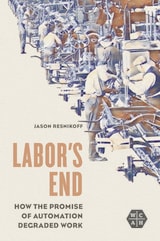
cover of Labor's End: How the Promise of Automation Degraded Work

Labor's End

How the Promise of Automation Degraded Work

Jason Resnikoff

University of Illinois Press, 2022

Labor's End traces the discourse around automation from its origins in the factory to its wide-ranging implications in political and social life. As Jason Resnikoff shows, the term automation expressed the conviction that industrial progress meant the inevitable abolition of manual labor from industry. But the real substance of the term reflected industry's desire to hide an intensification of human work--and labor's loss of power and protection--behind magnificent machinery and a starry-eyed faith in technological revolution. The rhetorical power of the automation ideology revealed and perpetuated a belief that the idea of freedom was incompatible with the activity of work. From there, political actors ruled out the workplace as a site of politics while some of labor's staunchest allies dismissed sped-up tasks, expanded workloads, and incipient deindustrialization in the name of technological progress.

A forceful intellectual history, Labor's End challenges entrenched assumptions about automation's transformation of the American workplace.
[more]
cover of Labor's Outcasts: Migrant Farmworkers and Unions in North America, 1934-1966

Labor's Outcasts

Migrant Farmworkers and Unions in North America, 1934-1966

Andrew J. Hazelton

University of Illinois Press, 2022
In the mid-twentieth century, corporations consolidated control over agriculture on the backs of Mexican migrant laborers through a guestworker system called the Bracero Program. The National Agricultural Workers Union (NAWU) attempted to organize these workers but met with utter indifference from the AFL-CIO. Andrew J. Hazelton examines the NAWU's opposition to the Bracero Program against the backdrop of Mexican migration and the transformation of North American agriculture. His analysis details growers’ abuse of the program to undercut organizing efforts, the NAWU's subsequent mobilization of reformers concerned by those abuses, and grower opposition to any restrictions on worker control. Though the union's organizing efforts failed, it nonetheless created effective strategies for pressuring growers and defending workers’ rights. These strategies contributed to the abandonment of the Bracero Program in 1964 and set the stage for victories by the United Farm Workers and other movements in the years to come.
[more]
cover of Labor's Story In The United States

Labor's Story In The United States

Philip Nicholson

Temple University Press, 2004
In this, the first broad historical overview of labor in the United States in twenty years, Philip Nicholson examines anew the questions, the villains, the heroes, and the issues of work in America. Unlike recent books that have covered labor in the twentieth century, Labor's Story in the United States looks at the broad landscape of labor since before the Revolution. In clear, unpretentious language, Philip Yale Nicholson considers American labor history from the perspective of institutions and people: the rise of unions, the struggles over slavery, wages, and child labor, public and private responses to union organizing. Throughout, the book focuses on the integral relationship between the strength of labor and the growth of democracy, painting a vivid picture of the strength of labor movements and how they helped make the United States what it is today. Labor's Story in the United States will become an indispensable source for scholars and students.
[more]
cover of Labor's Time: Shorter Hours, The Uaw, And The

Labor's Time

Shorter Hours, The Uaw, And The

Jonathan Cutler

Temple University Press, 2004
The movement for a shorter workweek that once defined the labor movement in the United States was largely displaced by the new corporatist structure of organized labor in the post-New Deal era. Labor's Time examines the changes that occurred within organized labor and traces their influence on the decline of the shorter hours movement. Focusing on the internal union politics of the influential United Automobile Workers and Local 600, its chapter at Henry Ford's massive River Rouge factory, Jonathan Cutler demonstrates how an all-but-forgotten interracial movement for a shorter workweek during the 1950s and 1960s became a casualty of an increasingly top-heavy union bureaucracy that lost touch with the desires, fears, and aspirations of rank and file workers and dug its own grave in the process. Jonathan Cutler examines the political context in which the shorter hours movement emerged within Local 600 in the 1940s, then chronicles the attempts by Walter Reuther, the head of the UAW, to suppress it. Cutler also reviews the role the Communist Party played in the controversy. Finally, he documents the UAW response to rank and file pressure for a shorter workweek, and how the local's own organizational flaws allowed Reuther and the national union to wrest control from the dissidents. Fresh and boldly written, Labor's Time recreates a moment when unions—as a movement, not as an amalgam of leaders—could have transformed the landscape of work in the United States.
[more]
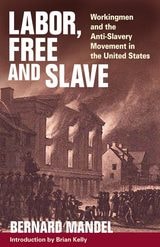
cover of Labor, Free and Slave: Workingmen and the Anti-Slavery Movement in the United States

Labor, Free and Slave

Workingmen and the Anti-Slavery Movement in the United States

Bernard Mandel.Introduction by Brian Kelly

University of Illinois Press, 2006

A classic piece of Old Left scholarship made available to a new generation of students and activists

Bernard Mandel's classic study provides a concise overview of the relationship between organized abolitionism and the fledgling labor movement in the period before the Civil War. Mandel argues that slavery reinforced the powerlessness of white workers North and South, and the racial divisions that it upheld rendered effective labor solidarity impossible. Deep distrust between abolitionists and the working classes, however, compelled Northern workers to find their own way into the antislavery ranks.
[more]
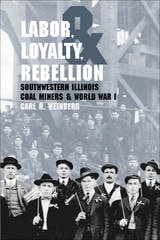
cover of Labor, Loyalty, and Rebellion: Southwestern Illinois Coal Miners & World War I

Labor, Loyalty, and Rebellion

Southwestern Illinois Coal Miners & World War I

Carl R. Weinberg

Southern Illinois University Press, 2005

On April 5, 1918, as American troops fought German forces on the Western Front, German American coal miner Robert Prager was hanged from a tree outside Collinsville, Illinois, having been accused of disloyal utterances about the United States and chased out of town by a mob. In Labor, Loyalty, and Rebellion: Southwestern Illinois Coal Miners and World War I, Carl R. Weinberg offers a new perspective on the Prager lynching and confronts the widely accepted belief among labor historians that workers benefited from demonstrating loyalty to the nation.

The first published study of wartime strikes in southwestern Illinois is a powerful look at a group of people whose labor was essential to the war economy but whose instincts for class solidarity spawned a rebellion against mine owners both during and after the war. At the same time, their patriotism wreaked violent working-class disunity that crested in the brutal murder of an immigrant worker. Weinberg argues that the heightened patriotism of the Prager lynching masked deep class tensions within the mining communities of southwestern Illinois that exploded after the Great War ended.
[more]
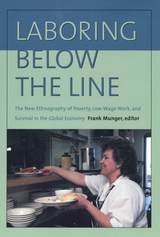
cover of Laboring Below the Line: The New Ethnography of Poverty, Low-Wage Work, and Survival in the Global Economy

Laboring Below the Line

The New Ethnography of Poverty, Low-Wage Work, and Survival in the Global Economy

Frank Munger

Russell Sage Foundation, 2002

As the distribution of wealth between rich and poor in the United States grew more and more unequal over the past twenty years, this economic gap assumed a life of its own in the popular culture. The news and entertainment media increasingly portrayed the lives of the poor with such stereotypes as the lazy welfare mother and the thuggish teen, offering Americans few ways to learn how the "other half" really lives. Laboring Below the Line works to bridge this gap by synthesizing a wide range of qualitative scholarship on the working poor. The result is a coherent, nuanced portrait of how life is lived below the poverty line, and a compelling analysis of the systemic forces in which poverty is embedded, and through which it is perpetuated. Laboring Below the Line explores the role of interpretive research in understanding the causes and effects of poverty. Drawing on perspectives of the working poor, welfare recipients, and marginally employed men and women, the contributors—an interdisciplinary roster of ethnographers, oral historians, qualitative sociologists, and narrative analysts—dissect the life circumstances that affect the personal outlook, ability to work, and expectations for the future of these people. For example, Carol Stack views the work aspirations of an Oakland teenager for whom a job is important, even though it strains her academic performance. And Ruth Buchanan looks at low-wage telemarketing workers who are attempting to move up the economic ladder while balancing family, education, and other important commitments. What emerges is a compelling picture of low-wage workers—one that illustrates the precarious circumstances of individuals struggling with the economic conditions and institutions that surround them Each chapter also explores the capacity for economic survival from a different angle, with ancillary commentary complementing the ethnographies with perspectives from other fields of study, such as economics. At this moment of governmental retrenchment, ethnography's complex, nonstereotypical portraits of individual people fighting against poverty are especially important. Laboring Below the Line reveals the ambiguities of real lives, the potential for individuals to change in unexpected ways, and the even greater intricacy of the collective life of a community.
[more]
cover of Laboring For Rights

Laboring For Rights

edited by Gerald Hunt

Temple University Press, 1999

How do unions around the world respond to issues raised by sexual minorities? Much as been written on labor's response to issues raised by women and racial minorities, but there has been little work done on labor's engagement with gays, lesbians, bisexuals, and the transgendered. The original essays in this collection attempt to fill that void by bringing together a group of experts who examine labor's response to such issues as benefits for same-sex partners, anti-discrimination language in collective agreements, and education. Speaking from a variety of racial backgrounds, sexual orientations, and political views, the contributors bring their unique personal perspectives and scholarly approaches to this groundbreaking book.

The chapters included in Laboring for Rights give a global vision to the increasingly important subject of equity in the workplace. They offer a much-needed look at labor's involvement with current international workplace conditions from such diverse countries as the United States, Canada, Australia, Germany, Britain, France, the Netherlands, and South Africa, as well as parts of the South Pacific. Some of these countries have strong and progressive labor unions; some, like the U.S., have relatively weak labor organizations. But whatever the context, as these articles demonstrate, there seems to be a growing and in some instances prospering gay/lesbian labor alliance in many parts of the world.

Laboring for Rights is a pioneering text in an important new area of labor study. It will engage readers interested in equality in the workplace, labor and organizational studies, gay and lesbian activism, and international, comparative studies.
[more]
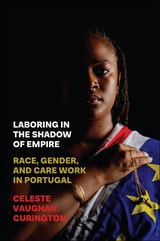
cover of Laboring in the Shadow of Empire: Race, Gender, and Care Work in Portugal

Laboring in the Shadow of Empire

Race, Gender, and Care Work in Portugal

Celeste Vaughan Curington

Rutgers University Press, 2024

Winner of the ASA Race, Gender, and Class section's Distinguished Contribution to Scholarship Award

Winner of the ASA Racial and Ethnic Minorities section’s Oliver Cromwell Cox Book Award

Laboring in the Shadow of Empire: Race, Gender, and Care Work in Portugal examines the everyday lives of an African-descendant care service workforce that labors in an ostensibly “anti-racial” Europe and against the backdrop of the Portuguese colonial empire. While much of the literature on global care work has focused on Asian and Latine migrant care workers, there is comparatively less research that explicitly examines African care workers and their migration histories to Europe. Sociologist Celeste Vaughan Curington focuses on Portugal—a European setting with comparatively liberal policies around family settlement and naturalization for migrants. In this setting, rapid urbanization in the late twentieth century, along with a national push to reconcile work and family, has shaped the growth of paid home care and cleaning service industries. Many researchers focus on informal work settings, where immigrant rights are restricted and many workers are undocumented or without permanent residence status. Curington instead examines workers who have accessed citizenship or permanent residence status and also explores African women’s experiences laboring in care and service industries in the formal market, revealing how deeply colonial and intersectional logics of a racialized and international division of reproductive labor in Portugal render these women “hyper-invisible” and “hyper-visible” as “appropriate” workers in Lisbon.

[more]
cover of Labors Appropriate to Their Sex: Gender, Labor, and Politics in Urban Chile, 1900–1930

Labors Appropriate to Their Sex

Gender, Labor, and Politics in Urban Chile, 1900–1930

Elizabeth Quay Hutchison

Duke University Press, 2001

In Labors Appropriate to Their Sex Elizabeth Quay Hutchison addresses the plight of working women in early twentieth-century Chile, when the growth of urban manufacturing was transforming the contours of women’s wage work and stimulating significant public debate, new legislation, educational reform, and social movements directed at women workers. Challenging earlier interpretations of women’s economic role in Chile’s industrial growth, which took at face value census figures showing a dramatic decline in women’s industrial work after 1907, Hutchison shows how the spread of industrial sweatshops and changing definitions of employment in the census combined to make female labor disappear from census records at the same time that it was in fact burgeoning in urban areas.

In addition to population and industrial censuses, Hutchison culls published and archival sources to illuminate such misconceptions and to reveal how women’s paid labor became a locus of anxiety for a society confronting social problems—both real and imagined—that were linked to industrialization and modernization. The limited options of working women were viewed by politicians, elite women, industrialists, and labor organizers as indicative of a society in crisis, she claims, yet their struggles were also viewed as the potential springboard for reform. Labors Appropriate to Their Sex thus demonstrates how changing norms concerning gender and work were central factors in conditioning the behavior of both male and female workers, relations between capital and labor, and political change and reform in Chile.

[more]
cover of Labour Statistics for a Market Economy: Challenges and Solutions in the Transition Countries of Central and Eastern Europe and the Former Soviet Union

Labour Statistics for a Market Economy

Challenges and Solutions in the Transition Countries of Central and Eastern Europe and the Former Soviet Union

Igor Chernyshev

Central European University Press, 1995

The International Labour Office is the moving force behind the adoption of the Labour Force Survey in Western countries as the only reliable means of gathering information about trends in employment and unemployment, and on pay. The countries of East-Central Europe and the former USSR have recognized their need of such statistiics and turned to the ILO to help them set up systems to provide data required by decision makers. This pioneering work shows how the old "command" economies are setting up brand new systems to classify occupations, to measure employment and unemployment, and to collect information on wages and labour costs, which will be useful to students of the area and essential for statisticians world-wide concerned with the challenge of instigating an entirely new statistical service.
[more]
cover of Labour and the Challenges of Globalization: What Prospects for Transnational Solidarity?

Labour and the Challenges of Globalization

What Prospects for Transnational Solidarity?

Andreas Bieler, Ingemar Lindberg and Devan Pillay

Pluto Press, 2008

This book examines the main challenges facing the world labor force and possible responses from trade unions.


The working classes across the world are feeling the effects of globalization and the race to the bottom that it encourages. Core jobs for workers in the developed world are being outsourced to countries where pay and conditions are terrible and union membership is often forbidden. Much of the work of the world economy is now taking place in a burgeoning informal sector, making worldwide organization of labor very difficult.


Case studies from 11 different countries, including China, Germany, Canada and South Africa, illustrate what is happening and show how workers and trade unions can successfully adapt to the neoliberal world.
[more]
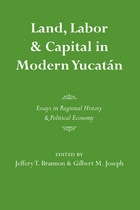
cover of Land, Labor, and Capital in Modern Yucatan: Essays in Regional History and Political Economy

Land, Labor, and Capital in Modern Yucatan

Essays in Regional History and Political Economy

Jeffrey T. Brannon

University of Alabama Press, 1991

Owing to Yucatan’s relative isolation, many assume that the history and economy of the peninsula have evolved in a distinctive way, apart from the central government in Mexico City and insulated from world social and economic factors. The essays in this volume suggest that this has not been the case: the process of development in Yucatan has been linked firmly to national and global forces of change over the past two centuries. The essays are by U.S., Mexican, Canadian, and Belizean social scientists representing both well-established and younger scholars. The result is a perspective on Yucatan’s historical development that is at once international, interdisciplinary, and intergenerational.

    In this volume, all of the contributors are genuinely comfortable with the theories and approaches of several disciplines—economics, history, and anthropology, and sociology. All have used largely untapped, primary, archival sources, and the result is a fascinating offering of new information.
[more]
cover of Latinas on the Line: Invisible Information Workers in Telecommunications

Latinas on the Line

Invisible Information Workers in Telecommunications

Melissa Villa-Nicholas

Rutgers University Press, 2022
Latinas on the Line provides a compelling analysis and historical and theoretical grounding of the oral histories, never before seen, of Latina information workers in the Bell System from their entrance in 1973 to their retirements by 2015. Author Melissa Villa-Nicholas demonstrates the importance of Latinas of the field of telecommunications through their own words and uses supporting archival research to provide an overview of how Latinas engage and remember a critical analysis of their work place, information technologies, and the larger globalized economy and shifting borderlands through their intersectional identities as information workers. The book offers a rich and engaging portrait of the critical history of Latinas in telecommunications, from their manual to automated to digitized labor.

 
[more]
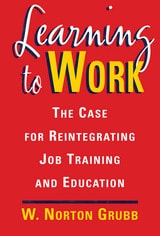
cover of Learning to Work: The Case for Reintegrating Job Training and Education

Learning to Work

The Case for Reintegrating Job Training and Education

W. Norton Grubb

Russell Sage Foundation, 1996

"Grubb's powerful vision of a workforce development system connected by vertical ladders for upward mobility adds an important new dimension to our continued efforts at system reform. The unfortunate reality is that neither our first-chance education system nor our second-chance job training system have succeeded in creating clear pathways out of poverty for many of our citizens. Grubb's message deserves a serious hearing by policy makers and practitioners alike." —Evelyn Ganzglass, National Governors' Association Over the past three decades, job training programs have proliferated in response to mounting problems of unemployment, poverty, and expanding welfare rolls. These programs and the institutions that administer them have grown to a number and complexity that make it increasingly difficult for policymakers to interpret their effectiveness. Learning to Work offers a comprehensive assessment of efforts to move individuals into the workforce, and explains why their success has been limited. Learning to Work offers a complete history of job training in the United States, beginning with the Department of Labor's manpower development programs in the1960s and detailing the expansion of services through the Comprehensive Employment and Training Act in the 1970s and the Job Training Partnership Act in the 1980s.Other programs have sprung from the welfare system or were designed to meet the needs of various state and corporate development initiatives. The result is a complex mosaic of welfare-to-work, second-chance training, and experimental programs, all with their own goals, methodology, institutional administration, and funding. Learning to Work examines the findings of the most recent and sophisticated job training evaluations and what they reveal for each type of program. Which agendas prove most effective? Do their effects last over time? How well do programs benefit various populations, from welfare recipients to youths to displaced employees in need of retraining? The results are not encouraging. Many programs increase employment and reduce welfare dependence, but by meager increments, and the results are often temporary. On average most programs boosted earnings by only $200 to $500 per year, and even these small effects tended to decay after four or five years.Overall, job training programs moved very few individuals permanently off welfare, and provided no entry into a middle-class occupation or income. Learning to Work provides possible explanations for these poor results, citing the limited scope of individual programs, their lack of linkages to other programs or job-related opportunities, the absence of academic content or solid instructional methods, and their vulnerability to local political interference. Author Norton Grubb traces the root of these problems to the inherent separation of job training programs from the more successful educational system. He proposes consolidating the two domains into a clearly defined hierarchy of programs that combine school- and work-based instruction and employ proven methods of student-centered, project-based teaching. By linking programs tailored to every level of need and replacing short-term job training with long-term education, a system could be created to enable individuals to achieve increasing levels of economic success. The problems that job training programs address are too serious too ignore. Learning to Work tells us what's wrong with job training today, and offers a practical vision for reform.
[more]
cover of Leaving Science

Leaving Science

Anne E. Preston

Russell Sage Foundation, 2004
The past thirty years have witnessed a dramatic decline in the number of U.S. students pursuing advanced degrees in science and an equally dramatic increase in the number of professionals leaving scientific careers. Leaving Science provides the first significant examination of this worrisome new trend. Economist Anne E. Preston examines a wide range of important questions: Why do professionals who have invested extensive time and money on a rigorous scientific education leave the field? Where do these scientists go and what do they do? What policies might aid in retaining and improving the quality of life for science personnel? Based on data from a large national survey of nearly 1,700 people who received university degrees in the natural sciences or engineering between 1965 and 1990 and a subsequent in-depth follow-up survey, Leaving Science provides a comprehensive portrait of the career trajectories of men and women who have earned science degrees. Alarmingly, by the end of the follow-up survey, only 51 percent of the original respondents were still working in science. During this time, federal funding for scientific research decreased dramatically relative to private funding. Consequently, the direction of scientific research has increasingly been dictated by market forces, and many scientists have left academic research for income and opportunity in business and industry. Preston identifies the main reasons for people leaving scientific careers as dissatisfaction with compensation and career advancement, difficulties balancing family and career responsibilities, and changing professional interests. Highlighting the difference between male and female exit patterns, Preston shows that most men left because they found scientific salaries low relative to perceived alternatives in other fields, while most women left scientific careers in response to feelings of alienation due to lack of career guidance, difficulty relating to their work, and insufficient time for their family obligations. Leaving Science contains a unique blend of rigorous statistical analysis with voices of individual scientists, ensuring a rich and detailed understanding of an issue with profound consequences for the nation's future. A better understanding of why professionals leave science can help lead to changes in scientific education and occupations and make the scientific workplace more attractive and hospitable to career men and women.
[more]
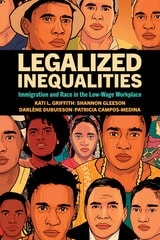
cover of Legalized Inequalities: Immigration and Race in the Low-wage Workplace

Legalized Inequalities

Immigration and Race in the Low-wage Workplace

Kati L. Griffith

Russell Sage Foundation, 2025

Beyond unlivable wages and a lack of upward mobility, low-wage work in the United States is rife with danger and degrading treatment. Immigrants and people of color are overrepresented in these “bad jobs” and often feel as though they are unable to change their working conditions. In Legalized Inequalities, law scholar Kati L. Griffith, sociologist Shannon Gleeson, anthropologist Darlène Dubuisson, and political scientist Patricia Campos-Medina investigate the government’s role in perpetuating poor and dangerous work environments for low-wage immigrant workers of color.

Drawing on interviews with over three hundred low-wage Haitian and Central American workers and worker advocates, Griffith, Gleeson, Dubuisson, and Campos-Medina reveal how U.S. policies produce and sustain job instability and insecurity. Together, contemporary U.S. labor and employment law, immigration policy, and enduring racial inequality work in tandem to keep workers’ wages low, lock them into substandard working conditions, and minimize opportunities to push for change. Workplace regulations meant to protect workers are weak and underenforced, privileging employers over workers. At-will employment policies, which allow employers to terminate employees without cause, discourage workers from bargaining for better jobs or holding employers accountable for even the most egregious mistreatment. Federal immigration policy further disempowers workers by deputizing employers to act as immigration enforcement agents through immigration status verification requirements. Undocumented workers often believe they must endure maltreatment or risk deportation. Anti-immigrant sentiment—encouraged by U.S. policy—impacts workers across all status groups. Additionally, despite a proliferation of civil rights legislation, racial disparities remain in the workplace. Workers of color are often paid less, forced to complete more dangerous and demeaning tasks, and subjected to racial harassment. 
​
While these workers face formidable barriers to fighting for their rights, they are not entirely powerless. Some low-wage workers filed formal complaints with government agencies. Others, on their own or collectively, confronted their employers to demand fair and dignified treatment. Some even quit in protest of their poor working conditions. The authors argue that reforming labor and employment law, immigration law, and Civil Rights law is necessary to reshape the low-wage workplace. They suggest increasing funding for workers’ rights enforcement agencies, removing the mandate for employers to verify a worker’s immigration status, and making it easier to prove that employment discrimination has occurred, among other policy proposals, to help empower and protect low-wage immigrant workers of color.

Legalized Inequalities not only highlights the crushing consequences of U.S. policy on low-wage immigrant workers of color but showcases their resilience in the face of these obstacles.

[more]
cover of Let Me Live

Let Me Live

Angelo Herndon

University of Michigan Press, 2007

Let Me Live tells the remarkable story of Angelo Herndon, a coal miner who worked as a labor organizer in Alabama and Georgia in the 1930s. Herndon led a racially integrated march of the unemployed in 1932 and was subsequently arrested when Communist Party literature was found in his bedroom. His trial made only small headlines at first, but eventually an international campaign to free him emerged, thanks to the efforts of the Communist Party and of labor unions interested in protecting the right to organize in the South. Herndon was finally set free by the U.S. Supreme Court, with the help of well-known leaders including C. Vann Woodward, Thurgood Marshall, A. Philip Randolph, and Whitney North Seymour, Sr.

Written while Herndon was in prison, Let Me Live tells the story behind his arrest and his struggle through the courts. It also describes his early life as a young boy in poverty, as a laborer in the Kentucky mines, and as a construction gang worker and traces the birth and development of his passion for the Communist Party. Originally published in 1937, this is the first new edition of Let Me Live since 1969, when Howard N. Meyer rescued it from obscurity. The book features texts from the Georgia and U.S. Supreme Court decisions, the text of Herndon’s speech, and newspaper editorials from the era. A substantive and thought-provoking introduction by Marlon B. Ross of the University of Virginia sheds light on this unique story and its importance to our understanding of the intersection of race and class in America—past and present.

“A book which every thoughtful American may do well to read. It is moving and challenging as the story of one man’s life and the question of one man’s fate.”

—New York Times
[more]
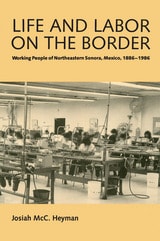
cover of Life and Labor on the Border: Working People of Northeastern Sonora, Mexico, 1886–1986

Life and Labor on the Border

Working People of Northeastern Sonora, Mexico, 1886–1986

Josiah McC. Heyman

University of Arizona Press, 1991

For thousands of Mexican laborers, life among the United States border represents an opportunity both to earn wages and to gain access to consumer goods; for anthropologist Josiah Heyman this labor force presents an opportunity to gain a better understanding of working people, "to uncover the order underlying the history of waged lives." 

Life and Labor on the Border traces the development of the urban working class in northern Sonora over the period of a century. Drawing on an extensive collection of life histories, Heyman describes what has happened to families over several generations as people have left the countryside to work for American-owned companies in northern Sonora or to cross the border to find other employment. 

Heyman searches for the origins of "working classness" in these family histories, revealing aspects of life that strengthen people' s involvement with a consumer economy, including the role of everyday objects like sewing machines, cars, and stoves. He considers the consequences of changing political and economic tides, and also the effects on family life of the new role of women in the labor force. Within the broad sweep of family chronicles, key junctures in individual lives—both personal and historical crises—offer additional insights into social class dynamics. 

Heyman's work dispels the notion that border inhabitants are uniformly impoverished or corrupted by proximity to the United States. These life stories instead convey the positive sense of people's goals in life and reveal the origins of a distinctive way of life in the Borderlands.
[more]
cover of Lincoln and the Economics of the American Dream

Lincoln and the Economics of the American Dream

Gabor S. Boritt

University of Illinois Press, 1994

This unique exploration of Lincoln's economic beliefs shows how they helped shape his view of slavery, his conduct of the war, and most fundamentally his understanding of what the United States was and could become.
[more]
cover of Liquor and Labor in Southern Africa

Liquor and Labor in Southern Africa

Jonathan Crush

Ohio University Press, 1992

In June 1976 political demonstrations in the black township of Soweto exploded into an insurrection that would continue sporadically and spread to urban areas across South Africa. In their assault on apartheid the youths who spearheaded the rebellion attacked and often destroyed the state institutions that they linked to their oppression: police stations, government offices, schools, and state-owned liquor outlets. In Soweto alone during the first days of the revolt protestors smashed and burned eighteen beerhalls and a similar number of bottle stores; as the rebellion spread more were destroyed. This study sets out to demonstrate that liquor outlets were not simply convenient symbols of oppression. The anger that launched gasoline bombs into beerhalls across South Africa had specific origins in deep and complicated struggles over the control of alcohol production and consumption in South Africa.

Conflict over alcohol has continuously intruded upon the lives of the black residents of southern African towns, cities, and labor compounds and upon the rural communities to which these people traced their origins. Yet the subject has received little systematic scholarly attention until now. In Liquor and Labor in Southern Africa scholars explore the complex relationship between alcohol use and the emergence of the modern urban-industrial system. In examining the role of alcohol in social control and the state, they also reveal the vibrant subcultures nurtured in beerhalls and underground shebeens and expose the bitter conflicts over alcohol that run along the fault lines of age, gender, class, and ethnicity.
[more]
cover of Listening to Workers: Oral Histories of Metro Detroit Autoworkers in the 1950s

Listening to Workers

Oral Histories of Metro Detroit Autoworkers in the 1950s

Daniel J. Clark

University of Illinois Press, 2024

Historians and readers alike often overlook the everyday experiences of workers. Drawing on years of interviews and archival research, Daniel J. Clark presents the rich, interesting, and sometimes confounding lives of men and women who worked in Detroit-area automotive plants in the 1950s.

In their own words, the interviewees frankly discuss personal matters like divorce and poverty alongside recollections of childhood and first jobs, marriage and working women, church and hobbies, and support systems and workplace dangers. Their frequent struggles with unstable jobs and economic insecurity upend notions of the 1950s as a golden age of prosperity while stories of domestic violence and infidelity open a door to intimate aspects of their lives. Taken together, the narratives offer seldom-seen accounts of autoworkers as complex and multidimensional human beings.

Compelling and surprising, Listening to Workers foregoes the union-focused strain of labor history to provide ground-level snapshots of a blue-collar world.

[more]
cover of Live Wire: Women and Brotherhood in the Electrical Industry

Live Wire

Women and Brotherhood in the Electrical Industry

Authored by Fran Moccio

Temple University Press, 2010

Belonging to a union can bring higher wages, fringe benefits, greater job security and, sometimes, training. But unions—still known as "brotherhoods"—often remain rigidly segregated by gender, despite the fact that sexual harassment and discrimination in employment are illegal. Live Wire is an in-depth case study of Local 3 of the International Brotherhood of Electrical Workers, arguably the most powerful and influential building trades local in the United States. Francine Moccio brings to life forty years of public policy failure that has resulted in restricted opportunities for women in skilled blue-collar jobs.

Live Wire is a unique foray into the gender dynamics of one trade and one union in historical depth, based on extensive primary, secondary, and archival research. It contributes much-needed research about sex segregation in blue-collar occupations, particularly in unions and fraternal organizations. And it provides important insights into complex interactions of work, union, and family life.

[more]
cover of Lone Pursuit: Distrust and Defensive Individualism Among the Black Poor

Lone Pursuit

Distrust and Defensive Individualism Among the Black Poor

Sandra Susan Smith

Russell Sage Foundation, 2007
Unemployment among black Americans is twice that of whites. Myriad theories have been put forward to explain the persistent employment gap between blacks and whites in the U.S. Structural theorists point to factors such as employer discrimination and the decline of urban manufacturing. Other researchers argue that African-American residents living in urban neighborhoods of concentrated poverty lack social networks that can connect them to employers. Still others believe that African-American culture fosters attitudes of defeatism and resistance to work. In Lone Pursuit, sociologist Sandra Susan Smith cuts through this thicket of competing explanations to examine the actual process of job searching in depth. Lone Pursuit reveals that unemployed African Americans living in the inner city are being let down by jobholding peers and government agencies who could help them find work, but choose not to. Lone Pursuit is a pioneering ethnographic study of the experiences of low-skilled, black urban residents in Michigan as both jobseekers and jobholders. Smith surveyed 105 African-American men and women between the ages of 20 and 40, each of whom had no more than a high school diploma. She finds that mutual distrust thwarts cooperation between jobseekers and jobholders. Jobseekers do not lack social capital per se, but are often unable to make use of the network ties they have. Most jobholders express reluctance about referring their friends and relatives for jobs, fearful of jeopardizing their own reputations with employers. Rather than finding a culture of dependency, Smith discovered that her underprivileged subjects engage in a discourse of individualism. To justify denying assistance to their friends and relatives, jobholders characterize their unemployed peers as lacking in motivation and stress the importance of individual responsibility. As a result, many jobseekers, wary of being demeaned for their needy condition, hesitate to seek referrals from their peers. In a low-skill labor market where employers rely heavily on personal referrals, this go-it-alone approach is profoundly self-defeating. In her observations of a state job center, Smith finds similar distrust and non-cooperation between jobseekers and center staff members, who assume that young black men are unwilling to make an effort to find work. As private contractors hired by the state, the job center also seeks to meet performance quotas by screening out the riskiest prospects—black male and female jobseekers who face the biggest obstacles to employment and thus need the most help. The problem of chronic black joblessness has resisted both the concerted efforts of policymakers and the proliferation of theories offered by researchers. By examining the roots of the African-American unemployment crisis from the vantage point of the everyday job-searching experiences of the urban poor, Lone Pursuit provides a novel answer to this decades-old puzzle.
[more]
cover of Low-Wage America: How Employers Are Reshaping Opportunity in the Workplace

Low-Wage America

How Employers Are Reshaping Opportunity in the Workplace

Eileen Appelbaum

Russell Sage Foundation, 2003

About 27.5 million Americans—nearly 24 percent of the labor force—earn less than $8.70 an hour, not enough to keep a family of four out of poverty, even working full-time year-round. Job ladders for these workers have been dismantled, limiting their ability to get ahead in today's labor market. Low-Wage America is the most extensive study to date of how the choices employers make in response to economic globalization, industry deregulation, and advances in information technology affect the lives of tens of millions of workers at the bottom of the wage distribution. Based on data from hundreds of establishments in twenty-five industries—including manufacturing, telecommunications, hospitality, and health care—the case studies document how firms' responses to economic restructuring often results in harsh working conditions, reduced benefits, and fewer opportunities for advancement. For instance, increased pressure for profits in newly consolidated hotel chains has led to cost-cutting strategies such as requiring maids to increase the number of rooms they clean by 50 percent. Technological changes in the organization of call centers—the ultimate "disposable workplace"—have led to monitoring of operators' work performance, and eroded job ladders. Other chapters show how the temporary staffing industry has provided paths to better work for some, but to dead end jobs for many others; how new technology has reorganized work in the back offices of banks, raising skill requirements for workers; and how increased competition from abroad has forced U.S. manufacturers to cut costs by reducing wages and speeding production. Although employers' responses to economic pressures have had a generally negative effect on frontline workers, some employers manage to resist this trend and still compete successfully. The benefits to workers of multi-employer training consortia and the continuing relevance of unions offer important clues about what public policy can do to support the job prospects of this vast, but largely overlooked segment of the American workforce. Low-Wage America challenges us to a national self-examination about the nature of low-wage work in this country and asks whether we are willing to tolerate the profound social and economic consequences entailed by these jobs. A Volume in the Russell Sage Foundation Case Studies of Job Quality in Advanced Economies
[more]
cover of Low-Wage Work in Denmark

Low-Wage Work in Denmark

Niels Westergaard-Nielsen

Russell Sage Foundation, 2008

The Danish economy offers a dose of American labor market flexibility inside a European welfare state. The Danish government allows employers a relatively high level of freedom to dismiss workers, but also provides generous unemployment insurance. Widespread union coverage and an active system of collective bargaining help regulate working conditions in the absence of strong government regulation. Denmark's rate of low-wage work—8.5 percent—is the lowest of the five countries under analysis. In Low-Wage Work in Denmark, a team of Danish researchers combines comprehensive national registry data with detailed case studies of five industries to explore why low-end jobs are so different in Denmark. Some jobs that are low-paying in the United States, including hotel maids and meat processors, though still demanding, are much more highly compensated in Denmark. And Danes, unlike American workers, do not stay in low-wage jobs for long. Many go on to higher paying jobs, while a significant minority ends up relying temporarily on income support and benefits sustained by one of the highest tax rates in the world.  Low-Wage Work in Denmark provides an insightful look at the particularities of the Danish labor market and the lessons it holds for both the United States and the rest of Europe. A Volume in the Russell Sage Foundation Case Studies of Job Quality in Advanced Economies
[more]
cover of Low-Wage Work in France

Low-Wage Work in France

Eve Caroli

Russell Sage Foundation, 2008

In France, low wages have historically inspired tremendous political controversy. The social and political issues at stake center on integrating the working class into society and maintaining the stability of the republican regime. A variety of federal policies—including high minimum wages and strong employee protection—serve to ensure that the low-wage workforce stays relatively small. Low-Wage Work in France examines both the benefits and drawbacks of this politically inspired system of worker protection. France's high minimum wage, which is indexed not only to inflation but also to the average increase in employee wages, plays a critical role in limiting the development of low-paid work. Social welfare benefits and a mandatory thirty-five hour work week also make life easier for low-wage workers. Strong employee protection is a central characteristic of the French model, but high levels of protection for employees may also be one of the causes of France's chronically high rate of unemployment. The threat of long-term unemployment may, in turn, contribute to a persistent sense of insecurity among French workers. Low-Wage Work in France provides a lucid analysis of how a highly regulated labor market shapes the experiences of workers—for better and for worse. A Volume in the Russell Sage Foundation Case Studies of Job Quality in Advanced Economies
[more]
cover of Low-Wage Work in Germany

Low-Wage Work in Germany

Gerhard Bosch

Russell Sage Foundation, 2008

In recent years, the German government has intentionally expanded the low-wage work sector in an effort to reduce exceptionally high levels of unemployment. As a result, the share of the German workforce employed in low-paying jobs now rivals that of the United States. Low Wage Work in Germany examines both the federal policies and changing economic conditions that have driven this increase in low-wage work. The new "mini-job" reflects the federal government's attempt to make certain low-paying jobs attractive to both employers and employees. Employers pay a low flat rate for benefits, and employees, who work a limited number of hours per week, are exempt from social security and tax contributions. Other factors, including slow economic growth, a declining collective bargaining system, and the influx of foreign workers, also contribute to the growing incidence of low-wage work. Yet while both Germany and the United States have large shares of low-wage workers, German workers receive health insurance, four weeks of paid vacation, and generous old age support—benefits most low-wage workers in the United States can only dream of. The German experience offers an important opportunity to explore difficult trade-offs between unemployment and low-wage work. A Volume in the Russell Sage Foundation Case Studies of Job Quality in Advanced Economies
[more]
cover of Low-Wage Work in the Netherlands

Low-Wage Work in the Netherlands

Weimer Salverda

Russell Sage Foundation, 2008
The Dutch economy has often been heralded for accomplishing solid employment growth within a generous welfare system. In recent years, the Netherlands has seen a rise in low-wage work and has maintained one of the lowest unemployment rates in the European Union. Low-Wage Work in the Netherlands narrows in on the causes and consequences of this new development. The authors find that the increase in low-wage work can be partly attributed to a steep rise in the number of part-time jobs and non-standard work contracts—46 percent of Dutch workers hold part-time jobs. The decline in full-time work has challenged historically powerful Dutch unions and has led to a slow but steady dismantling of many social insurance programs from 1979 onward. At the same time, there are hopeful lessons to be gleaned from the Dutch model: low-wage workers benefit from a well-developed system of income transfers, and many move on to higher paying jobs. Low-Wage Work in the Netherlands paints a nuanced picture of the Dutch economy by analyzing institutions that both support and challenge its low-wage workforce. A Volume in the Russell Sage Foundation Case Studies of Job Quality in Advanced Economies
[more]
cover of Low-Wage Work in the Wealthy World

Low-Wage Work in the Wealthy World

Jerome Gautie

Russell Sage Foundation, 2010

As global flows of goods, capital, information, and people accelerate competitive pressure on businesses throughout the industrialized world, firms have responded by reorganizing work in a variety of efforts to improve efficiency and cut costs. In the United States, where minimum wages are low, unions are weak, and immigrants are numerous, this has often lead to declining wages, increased job insecurity, and deteriorating working conditions for workers with little bargaining power in the lower tiers of the labor market. Low-Wage Work in the Wealthy World builds on an earlier Russell Sage Foundation study (Low-Wage America) to compare the plight of low-wage workers in the United States to five European countries—Denmark, France, Germany, the Netherlands, and the United Kingdom—where wage supports, worker protections, and social benefits have generally been stronger. By examining low-wage jobs in systematic case studies across five industries, this groundbreaking international study goes well beyond standard statistics to reveal national differences in the quality of low-wage work and the well being of low-wage workers. The United States has a high percentage of low-wage workers—nearly three times more than Denmark and twice more than France. Since the early 1990s, however, the United Kingdom, the Netherlands, and Germany have all seen substantial increases in low-wage jobs. While these jobs often entail much the same drudgery in Europe and the United States, quality of life for low-wage workers varies substantially across countries. The authors focus their analysis on the "inclusiveness" of each country's industrial relations system, including national collective bargaining agreements and minimum-wage laws, and the generosity of social benefits such as health insurance, pensions, family leave, and paid vacation time—which together sustain a significantly higher quality of life for low-wage workers in some countries. Investigating conditions in retail sales, hospitals, food processing, hotels, and call centers, the book's industry case studies shed new light on how national institutions influence the way employers organize work and shape the quality of low-wage jobs. A telling example: in the United States and several European nations, wages and working conditions of front-line workers in meat processing plants are deteriorating as large retailers put severe pressure on prices, and firms respond by employing low-wage immigrant labor. But in Denmark, where unions are strong, and, to a lesser extent, in France, where the statutory minimum wage is high, the low-wage path is blocked, and firms have opted instead to invest more heavily in automation to raise productivity, improve product quality, and sustain higher wages. However, as Low-Wage Work in the Wealthy World also shows, the European nations' higher level of inclusiveness is increasingly at risk. "Exit options," both formal and informal, have emerged to give employers ways around national wage supports and collectively bargained agreements. For some jobs, such as room cleaners in hotels, stronger labor relations systems in Europe have not had much impact on the quality of work. Low-Wage Work in the Wealthy World offers an analysis of low-wage work in Europe and the United States based on concrete, detailed, and systematic contrasts. Its revealing case studies not only provide a human context but also vividly remind us that the quality and incidence of low-wage work is more a matter of national choice than economic necessity and that government policies and business practices have inevitable consequences for the quality of workers' lives. A Volume in the Russell Sage Foundation Case Studies of Job Quality in Advanced Economies
[more]
cover of Lured by the American Dream: Filipino Servants in the U.S. Navy and Coast Guard, 1952-1970

Lured by the American Dream

Filipino Servants in the U.S. Navy and Coast Guard, 1952-1970

P. James Paligutan

University of Illinois Press, 2022

Starting in 1952, the United States Navy and Coast Guard actively recruited Filipino men to serve as stewards--domestic servants for officers. Oral histories and detailed archival research inform P. James Paligutan's story of the critical role played by Filipino sailors in putting an end to race-based military policies. Constrained by systemic exploitation, Filipino stewards responded with direct complaints to flag officers and chaplains, rating transfer requests that flooded the bureaucracy, and refusals to work. Their actions had a decisive impact on seagoing military’s elimination of the antiquated steward position. Paligutan looks at these Filipino sailors as agents of change while examining the military system through the lens of white supremacy, racist perceptions of Asian males, and the motives of Filipinos who joined the armed forces of the power that had colonized their nation.

Insightful and dramatic, Lured by the American Dream is the untold story of how Filipino servicepersons overcame tradition and hierarchy in their quest for dignity.

[more]