Results by title
372 books match the query 'Language' and 55 start with l
Language
Leonard Bloomfield
University of Chicago Press, 1984
The book quickly became the primary text for the American descriptivist school of linguistics. Bloomfield’s clear, systematic methodology and focus on observable language data laid the groundwork for a new era in linguistic theory. His work, which covers a wide range of topics, from phonology and morphology to syntax and semantics, provides a comprehensive framework for understanding how language functions as a structured system.
Through twelve detailed chapters, Bloomfield explores topics such as the sounds of language, the structure of words, and the organization of sentences. His emphasis on structuralism and the empirical study of language has had a profound impact on the discipline, making Language an essential reference for anyone interested in the history and development of linguistic theory.
As both an introduction for newcomers and a resource for more advanced students, Language continues to be a crucial text in understanding the scientific study of language and its ongoing evolution.
Language and Art in the Navajo Universe
Gary Witherspoon
University of Michigan Press, 1977
Language and Authority in De Lingua Latina
Varro's Guide to Being RomanDiana Spencer
University of Wisconsin Press, 2022
Language and Death
The Place of NegativityGiorgio Agamben
University of Minnesota Press, 2006
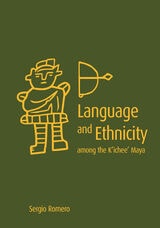
Language and Ethnicity among the K'ichee' Maya
Sergio Romero
University of Utah Press, 2015
This book explores the articulation between “accent” and ethnic identification in K’ichee’, a Mayan language spoken by more than one million people in the western highlands of Guatemala. Based on years of ethnographic work, it is the first anthropological examination of the social meaning of dialectal difference in any Mayan language. Romero deconstructs essentialist perspectives on ethnicity in Mesoamerica and argues that ethnic identification among the highland Maya is multiple and layered, the result of a diverse linguistic precipitate created by centuries of colonial resistance.
In K’ichee’, dialect stereotypes—accents—act as linguistic markers embodying particular ethnic registers. K’ichee’ speakers use and recombine their linguistic repertoire—colloquial K’ichee’, traditional K’ichee’ discourse, colloquial Spanish, Standard Spanish, and language mixing—in strategic ways to mark status and authority and to revitalize their traditional culture. The book surveys literary genres such as lyric poetry, political graffiti, and radio broadcasts, which express new experiences of Mayan-ness and anticolonial resistance. It also takes a historical perspective in examining oral and written K’ichee’ discourses from the sixteenth to the twenty-first centuries, including the famous chronicle known as the Popol Vuh, and explores the unbreakable link between language, history, and culture in the Maya highlands.
Language and Grammar
Studies in Mathematical Linguistics and Natural LanguageEdited by Claudia Casadio, Philip Scott, and Robert Seely
CSLI, 2004

Language and Hegemony in Gramsci
Peter Ives
Pluto Press, 2004
This book places Gramsci’s ideas within the linguistically influenced social theory of the twentieth century. It summarizes some of the major ideas of Ferdinand de Saussure, Ludwig Wittgenstein, language philosophy and post-structuralism in relation to Gramsci’s position. By paying great attention to the linguistic underpinnings of Gramsci's Marxism, Language and Hegemony in Gramsci shows how his theorization of power, language and politics address issues raised by post-modernism and the work of Michel Foucault, Jacques Derrida, Chantal Mouffe, and Ernesto Laclau.
Language and Historical Representation
Getting the Story CrookedHans Kellner
University of Wisconsin Press, 1989
“This may well be the most important contribution to the linguistically informed study of historiography since Hayden White’s Metahistory. Looking at historical texts, Kellner is able to show us that they are more complex, and bear a more complicated relationship to reality, than we think. His scholarship is not only sound but is on the cutting edge or recent reflection on historiography. . . . The insights, not rarely, are stunning.”—Allan Megill, University of Iowa
Language and Human Understanding
David Braine
Catholic University of America Press, 2014
Language and Interpretation in Psychoanalysis
Marshall Edelson
University of Chicago Press, 1984
Language and Learning for Robots
Colleen Crangle and Patrick Suppes
CSLI, 1994
The authors develop the notion of an instructable robot—one which derives its intelligence in part from interaction with humans. Since verbal interaction with a robot requires a natural language semantics, the authors propose a natural-model semantics which they then apply to the interpretation of robot commands. Two experimental projects are described which provide natural-language interfaces to robotic aids for the physically disabled. The authors discuss the specific challenges posed by the interpretation of "stop" commands and the interpretation of spatial prepositions.
The authors also examine the use of explicit verbal instruction to teach a robot new procedures, propose ways a robot can learn from corrective commands containing qualitative spatial expressions, and discuss the machine-learning of a natural language use to instruct a robot in the performance of simple physical tasks. Two chapters focus on probabilistic techniques in learning.
Language and Political Meaning in Revolutionary America
John Howe
University of Massachusetts Press, 2009
Language and Power Reader
Representations of Race in a "Post-Racist" EraRobert Eddy
Utah State University Press, 2014
A Language and Power Reader organizes reading and writing activities for undergraduate students, guiding them in the exploration of racism and cross-racial rhetorics.
Introducing texts written from and about versions of English often disrespected by mainstream Americans, A Language and Power Reader highlights English dialects and discourses to provoke discussions of racialized relations in contemporary America. Thirty selected readings in a range of genres and from writers who work in ?alternative? voices (e.g., Pidgin, African American Language, discourse of international and transnational English speakers) focus on disparate power relations based on varieties of racism in America and how those relations might be displayed, imposed, or resisted across multiple rhetorics. The book also directs student participation and discourse. Each reading is followed by comments and guides to help focus conversation.
Research has long shown that increasing a student?s metalinguistic awareness improves a student?s writing. No other reader available at this time explores the idea of multiple rhetorics or encourages their use, making A Language and Power Reader a welcome addition to writing classrooms.
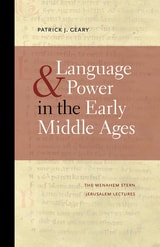
Language and Power in the Early Middle Ages
Patrick J. Geary
Brandeis University Press, 2013
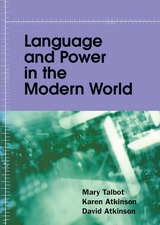
Language and Power in the Modern World
Mary Talbot
University of Alabama Press, 2003
An accessible overview of five major issues in sociolinguistics and the relationship between language and power
This book analyzes the key ways in which language constitutes and conveys power and social relationships in modern society. It offers selected readings that illustrate the thematic introductions and a set of tasks designed to guide linguistic analysis of data and to stimulate student discussion, in five specific areas:
• Multilingualism, Identity, and Ethnicity: examines the phenomena of linguistic diversity from the perspective of language planning and language policies, with emphasis on personal, psychological, educational, cultural, and political issues.
• Language and Youth: examines the languages of old age and the language of youth subcultures.
• Language and Gender: explores the claim that men and women use interactional communication styles based on power and solidarity, respectively.
• Language and the Media: considers the extent to which verbal interaction through mass media differs from other kinds of communication and its consequences in terms of power relations.
• Language and Organizations: explores the use of language as a tool of power in public institutions and bureaucracies and how control over individuals is articulated through a range of different discourse structures and strategies.
With a unique combination of selected readings and student-centered tasks in a single volume, Language and Power in the Modern World covers contemporary issues of communication theory and sociolinguistics, ranging from the global to the interpersonal.

Language and Reality in Swift’s A Tale of a Tub
Frederik N. Smith
The Ohio State University Press, 1900
Language and Sexuality
Contesting Meaning in Theory and PracticeEdited by Kathryn Campbell-Kibler, Robert J. Podesva, Sarah Roberts, and Andrew
CSLI, 2001
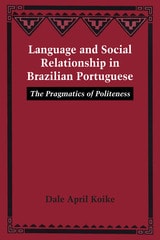
Language and Social Relationship in Brazilian Portuguese
The Pragmatics of PolitenessBy Dale April Koike
University of Texas Press, 1992
"Give me the salt" and "Please pass the salt" make the same request, but in a polite situation the first utterance may give offense, while the second may not. How and why such differences in wording and intonation, in a particular context, produce different effects is the concern of pragmatics, the area of linguistics that deals with how speech is used in interaction. In this innovative study of pragmatics in Brazilian Portuguese, Dale Koike analyzes the politeness phenomenon, specifically in the context of speech acts known as "directives."
As acts intended to get someone to do something, directives bring into play a variety of sociocultural factors, depending on the relationship between the participants. Using empirical data obtained through natural language observation and from questionnaires of over one hundred adult native speakers, Koike identifies factors—such as age, education, and gender—that influence the strategies of politeness a given speaker is likely to use in making a directive. This research clarifies the unwritten language rules and assumptions that native speakers intuitively follow in phrasing their directive utterances.
Koike also includes important material on the acquisition of strategies for politeness by children and adult second-language learners, as well as on gender differences in politeness forms. Her research proposes important additions to the theory of speech acts as conceived by Austin and Searle, particularly in the application of deictic organization to account for a hierarchy of pragmatic forms.
Language and Social Relationship in Brazilian Portuguese will be of interest to a wide audience in diverse fields, including linguistics, anthropology, interaction analysis, communications, semantics, sociology, psychology, and education.
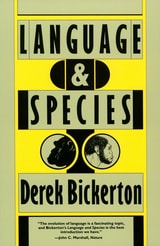
Language and Species
Derek Bickerton
University of Chicago Press, 1992
"You are drawn into [Bickerton's] appreciation of the dominant role language plays not only in what we say, but in what we think and, therefore, what we are."—Robert Wright, New York Times Book Review
"The evolution of language is a fascinating topic, and Bickerton's Language and Species is the best introduction we have."—John C. Marshall, Nature
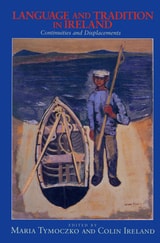
Language and Tradition in Ireland
Continuities and DisplacementsMaria Tymoczko
University of Massachusetts Press, 2003
If language and culture are intimately connected, then cultures involving people who speak more than one language must have special characteristics, as well as particular social issues to negotiate. What are the challenges faced by a people with two or more languages as their heritage? How does that multiple heritage affect cultural forms, including literature and the arts? How does linguistic difference influence the conceptualization and writing of history? And if the meeting of languages within a people has involved contestation and power, how are those conflicts negotiated?
This volume uses the tools of critical theory to explore such questions with respect to the complex, multilingual history of Ireland. Avoiding the simplistic polarized oppositions popular with cultural nationalists, the contributors examine the nexus of language, tradition, and authority in Ireland that has created such a rich, multivalent culture.
Although the linguistic interface of Irish and English has dominated cultural negotiations in Ireland over the last five hundred years, the island has an even longer history of linguistic and cultural exchange. Arguing that tradition is never static, the essays in this volume challenge the concept of a monolithic cultural origin, while insisting on the importance of inherited discourses in the continuity of culture through time and across linguistic difference. The chapters cover a broad range of topics from early Irish narratives and Latin hagiography to literary works by such writers as Yeats, Joyce, Friel, Montague, and McGahern, as well as other cultural forms, including traditional Irish music. Several chapters address issues of politics and power, from the role of interpreters in the relations between linguistic communities in Ireland to the politicization of language in Northern Ireland since the 1980s. Taken together, the essays illuminate scholarly domains as varied as postcolonial theory, the relationship between language and nation, the nature of tradition, and Irish literature of all periods.
In addition to the editors, contributors include Michael Cronin, Joanne Findon, Helen Fulton, Declan Kiberd, Jeremy Lowe, Gordon McCoy and Camille O'Reilly, Catherine McKenna, Cóilín Owens, Thomas Dillon Redshaw, and Sally K. Sommers Smith.
Language and the Creative Mind
Edited by Michael Borkent, Barbara Dancygier, and Jennifer Hinnell
CSLI, 2013
Language and the Law in Deaf Communities
Ceil Lucas
Gallaudet University Press, 2003
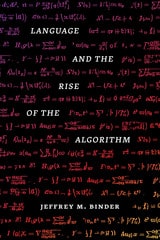
Language and the Rise of the Algorithm
Jeffrey M. Binder
University of Chicago Press, 2022
A wide-ranging history of the algorithm.
Bringing together the histories of mathematics, computer science, and linguistic thought, Language and the Rise of the Algorithm reveals how recent developments in artificial intelligence are reopening an issue that troubled mathematicians well before the computer age: How do you draw the line between computational rules and the complexities of making systems comprehensible to people? By attending to this question, we come to see that the modern idea of the algorithm is implicated in a long history of attempts to maintain a disciplinary boundary separating technical knowledge from the languages people speak day to day.
Here, Jeffrey M. Binder offers a compelling tour of four visions of universal computation that addressed this issue in very different ways: G. W. Leibniz’s calculus ratiocinator; a universal algebra scheme Nicolas de Condorcet designed during the French Revolution; George Boole’s nineteenth-century logic system; and the early programming language ALGOL, short for algorithmic language. These episodes show that symbolic computation has repeatedly become entangled in debates about the nature of communication. Machine learning, in its increasing dependence on words, erodes the line between technical and everyday language, revealing the urgent stakes underlying this boundary.
The idea of the algorithm is a levee holding back the social complexity of language, and it is about to break. This book is about the flood that inspired its construction.
Language from a Cognitive Perspective
Grammar, Usage, and ProcessingEdited by Emily M. Bender and Jennifer E. Arnold
CSLI, 2011
This book is a collection of papers on language processing, usage, and grammar, written to commemorate the career of Thomas Wasow on the occasion of his sixty-fifth birthday. Wasow has been professor of linguistics and philosophy at Stanford University since 1973, and is affiliated with the Symbolic Systems Program. He has made significant contributions to the study of English syntax, psycholinguistics, and philosophy of linguistics.
Language in Exile
Three Hundred Years of Jamaican CreoleBarbara Lalla
University of Alabama Press, 2009
--SECOL Review
"The history of Jamaican Creole comes to life through this book. Scholars will analyze its texts, follow the leads it opens up, and argue about refining its interpretations for a long time to come."
--Journal of Pidgin & Creole Languages
"The authors are to be congratulated on this substantial contribution to our understanding of how Jamaican Creole developed. Its value lies not only in the linguistic insights of the authors but also in the rich trove of texts that they have made accessible."
--English World-Wide
"Provides valuable historical and demographic data and sheds light on the origins and development of Jamaican Creole. Lalla and D'Costa offer interesting insights into Creole genesis, not only through their careful mapping of the migrations from Europe and Africa, which constructed the Jamaican society but also through extensive documentation of early texts. . . . Highly valuable to linguists, historians, anthropologists, psychologists, and anyone interested in the Caribbean or in the history of mankind."
--New West Indian Guide
Language in Hand
Why Sign Came Before SpeechWilliam C. Stokoe
Gallaudet University Press, 2001
In Language in Hand: Why Sign Came Before Speech, William C. Stokoe begins his exploration of the origin of human language with a 2400-year-old quote by Democritus: “Everything existing in the universe is the fruit of chance and necessity.” Stokoe capitalizes upon this simple credo in this far-ranging examination of the scholarly topography to support his formula for the development of language in humans: gesture-to-language-to-speech. Intrinsic to this is the proposition that speech is sufficient for language, but not necessary. Chance brought human ancestors down from the trees to the ground, freeing their hands for gesture, and then sign language, a progression that came from the necessity to communicate.
Stokoe recounts in Language in Hand how inspiration grew out of his original discovery in the 1950s and ’60s that deaf people who signed were using a true language with constructions that did not derive from spoken English. This erudite, highly engaging investigation calls upon decades of personal experience and published research to refute the recently entrenched principles that humans have a special, innate learning faculty for language and that speech equates with language. Integrating current findings in linguistics, semiotics, and anthropology, Stokoe fashions a closely-reasoned argument that suggests how our human ancestors’ powers of observation and natural hand movements could have evolved into signed morphemes.
Stokoe also proposes how the primarily gestural expression of language with vocal support shifted to primarily vocal language with gestural accompaniment. When describing this transition, however, he never loses sight of the significance of humans in the natural world and the role of environmental stimuli in the development of language. Stokoe illustrates this contention with fascinating observations of small, contemporary ethnic groups such as the Assiniboin Nakotas, a Native American group from Montana that intermingle their spoken and signed languages depending upon cultural imperatives.
Language in Hand also presents innovative thoughts on classifiers in American Sign Language and their similarity to certain spoken languages, convincing evidence that speech originally copied sign language forms before developing unrelated conventions through usage. Stokoe concludes with a hypothesis on how the acceptance of sign language as the first language of humans could revolutionize the education of infants, both deaf and hearing, who, like early humans, have the full capacity for language without speech.
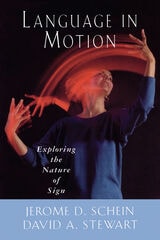
Language in Motion
Exploring the Nature of SignJerome D. Schein
Gallaudet University Press, 1995
This enjoyable book first introduces sign language and communication, follows with a history of sign languages in general, then delves into the structure of ASL. Later chapters outline the special skills of fingerspelling and assess the academic offshoot of artificial sign systems and their value to young deaf children.
Language in Motion offers for consideration the process required to learn sign language and putting sign language to work to communicate in the Deaf community. Appendices featuring the manual alphabets of three countries and a notation system developed to write signs complete this enriching book. Its delightful potpourri of entertaining, accessible knowledge makes it a perfect primer for those interested in learning more about sign language, Deaf culture, and Deaf communities.

Language of Tomorrow
Towards a Transcultural Visual Communication System in a Posthuman ConditionHaytham Nawar
Intellect Books, 2020
Language of Tomorrow is a comprehensive guide to the history, evolution, and current forms of pictographic communication, charting its course from ancient Egyptian writing systems to modern-day emojis. The book is a culmination of research combining visual communication, semiotic theory, cultural studies, linguistics, artificial intelligence, and new media.
Haytham Nawar presents a cohesive and comprehensive historical framework—covering pictographic, logographic, and ideographic writing systems and scripts—through which we can discuss the future of communication. In his analysis, he explores the possibility of developing a standardized universal pictographic communication system that fosters mutual understanding and bridges diverse cultures. Weaving practice and theory across disciplines and bringing together language, culture, art, and design, Language of Tomorrow aims to locate the direction for the research and development of a transcultural visual communication system for the posthuman era.
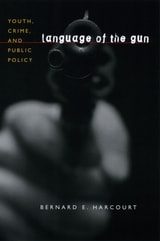
Language of the Gun
Youth, Crime, and Public PolicyBernard E. Harcourt
University of Chicago Press, 2006
Home to over 150 repeat offenders ranging in age from twelve to seventeen, the Catalina Mountain School is made up of a particular stratum of boys—those who have committed the most offenses but will still be released upon reaching adulthood. In an effort to understand the symbolic and emotional language of guns and gun carrying, Harcourt interviewed dozens of these incarcerated Catalina boys. What do these youths see in guns? What draws them to handguns? Why do some of them carry and others not? For Harcourt, their often surprising answers unveil many of the presuppositions that influence our laws and policies.
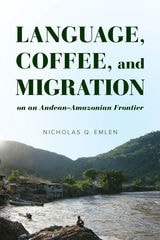
Language, Coffee, and Migration on an Andean-Amazonian Frontier
Nicholas Q. Emlen
University of Arizona Press, 2020
The rich-tasting Peruvian coffee in your cup is the distillate of an intensely dynamic Amazonian frontier, where native Matsigenkas, state agents, and migrants from the rural highlands are carving the forest into farms. Language, Coffee, and Migration on an Andean-Amazonian Frontier shows how people of different backgrounds married together and blended the Quechua, Matsigenka, and Spanish languages in their day-to-day lives. This frontier relationship took place against a backdrop of deforestation, cocaine trafficking, and destructive natural gas extraction.
Nicholas Q. Emlen’s rich account—which takes us to remote Amazonian villages, dusty frontier towns, roadside bargaining sessions, and coffee traders’ homes—offers a new view of settlement frontiers as they are negotiated in linguistic interactions and social relationships. This interethnic encounter was not a clash between distinct groups but rather an integrated network of people who adopted various stances toward each other as they spoke.
The book brings together a fine-grained analysis of multilingualism with urgent issues in Latin America today, including land rights, poverty, drug trafficking, and the devastation of the world’s largest forest. It offers a timely on-the-ground perspective on the agricultural colonization of the Amazon, which has triggered an environmental emergency threatening the future of the planet.
Language, Culture, and Mind
Edited by Michel Achard and Suzanne Kemmer
CSLI, 2003
Language, History, and Identity
Ethnolinguistic Studies of the Arizona TewaPaul V. Kroskrity
University of Arizona Press, 1993

Language, Mind, and Knowledge
Keith Gunderson, Editor
University of Minnesota Press, 1975
Language, Mind, and Knowledge was first published in 1975. Minnesota Archive Editions uses digital technology to make long-unavailable books once again accessible, and are published unaltered from the original University of Minnesota Press editions.
This is Volume VII of the Minnesota Studies in the Philosophy of Science, a series published in cooperation with the Minnesota Center for Philosophy of Science at the University of Minnesota and edited by Herbert Feigl and Grover Maxwell. Professor Maxwell is the present director of the Center. Some of the papers in this volume were presented at or grew out of a conference on the philosophy of language which was held at the Center under the direction of Professor Gunderson. Others were written independently.
The aim of the book, like that of the conference, is to assemble a wide variety of approaches to issues in the philosophy of language with emphasis on the ways in which the issues involved have bearing on other matters such as linguistic theory, cognitive psychology, the philosophy of mind, and epistemology.
There are twelve papers by eleven contributors: "Languages and Language" by David Lewis; "Logic and Language: An Examination of Recent Criticisms of Internationalism" by Jerrold J. Katz; "The Meaning of 'Meaning'" by Hilary Putnam; "Reference and Context" by Charles Chastain; "Language, Thought, and Communication" by Gilbert Harman; "Knowledge of Language" by Noam Chomsky; "Language, Rules, and Complex Behavior" by Michael D. Root; "A Taxonomy of Illocutionary Acts" by John R. Searle; "On What We Know" by Zeno Vendler; "Vendler on Knowledge and Belief" by Bruce Aune; "Reply to Professor Aune" by Zeno Vendler; "Brain Writing and Mind Reading" by D.C. Dennett.

Language, Power, and Ideology in Brunei Darussalam
Mis Sea#99Geoffrey C. Gunn
Ohio University Press, 1996
Language, Power, and Resistance
Mainstreaming Deaf EducationElizabeth S. Mathews
Gallaudet University Press, 2017
The research upon which this book is based examined the implications that mainstreaming has for the tensions between the hegemonic medical model of deafness and the social model of Deafness. This volume explores how different types of power are used in the deaf education system to establish, maintain, and also resist medical views of deafness. Mathews frames this discussion as one of power relations across parents, children, and professionals working within the system. She looks at how various forms of power are used to influence decisions, to resist decisions, and to shape the structure and delivery of deaf education. The author’s findings are a significant contribution to the debates on inclusive education for DHH students and will resonate in myriad social and geographic contexts.

Language, Proof, and Logic
Second EditionDave Barker-Plummer, Jon Barwise, and John Etchemendy
CSLI, 2011
Language Proof and Logic is available as a physical book with the software included and as a downloadable package of software plus the book in PDF format. The all-electronic version is available from Openproof at gradegrinder.net.
The textbook/software package covers first-order language in a method appropriate for first and second courses in logic. An on-line grading services instantly grades solutions to hundred of computer exercises. It is designed to be used by philosophy instructors teaching a logic course to undergraduates in philosophy, computer science, mathematics, and linguistics.
Introductory material is presented in a systematic and accessible fashion. Advanced chapters include proofs of soundness and completeness for propositional and predicate logic, as well as an accessible sketch of Godel's first incompleteness theorem. The book is appropriate for a wide range of courses, from first logic courses for undergraduates (philosophy, mathematics, and computer science) to a first graduate logic course.
The software package includes four programs:
Tarski's World, a new version of the popular program that teaches the basic first-order language and its semantics;
Fitch, a natural deduction proof environment for giving and checking first-order proofs;
Boole, a program that facilitates the construction and checking of truth tables and related notions (tautology, tautological consequence, etc.);
Submit, a program that allows students to submit exercises done with the above programs to the Grade Grinder, the automatic grading service.
Grade reports are returned to the student and, if requested, to the student's instructor, eliminating the need for tedious checking of homework. All programs are available for Windows and Macintosh systems. Instructors do not need to use the programs themselves in order to be able to take advantage of their pedagogical value. More about the software can be found at gradegrinder.net.
The price of a new text/software package includes one Registration ID, which must be used each time work is submitted to the grading service. Once activated, the Registration ID is not transferable.
Language, Resistance and Revival
Republican Prisoners and the Irish Language in the North of IrelandFeargal Mac Ionnrachtaigh
Pluto Press, 2013
Language, Resistance and Revival tells the untold story of the truly groundbreaking linguistic and educational developments that took place among Republican prisoners in Long Kesh prison from 1972-2000.
During a period of bitter struggle between Republican prisoners and the British state, the Irish language was taught and spoken as a form of resistance during incarceration. The book unearths this story for the first time and analyses the rejuvenating impact it had on the cultural revival in the nationalist community beyond the prison walls.
Based on unprecedented interviews, Feargal Mac Ionnrachtaigh explores a key period in Irish history through the original and 'insider' accounts of key protagonists in the contemporary Irish language revival.

Language, Sign and Gender in Beowulf
Gillian R. Overing
Southern Illinois University Press, 1990
Not a book about what Beowulf means but how it means, and how the reader participates in the process of meaning construction.
Overing’s primary aim is to address the poem on its own terms, to trace and develop an interpretive strategy consonant with the extent of its difference. Beowulf’s arcane structure describes cyclical repetitions and patterned intersections of themes which baffle a linear perspective, and suggest instead the irresolution and dynamism of the deconstructionist free play of textual elements.
Chapter 1 posits the self/reader as a function of the text/language, examining the ways in which the text "speaks" the reader. Chapter 2 develops an interactive semiotic strategy in an attempt to describe an isomorphic relation between poem and reader, between text and self. Chapter 3 addresses the notions of text and self as more complex functions or formulations of desire, and thus complicates and expands the arguments of the two preceding chapters. The final chapter examines the issue of desire in the poem, and, to a lesser extent, desire in the reader (insofar as these may legitimately be viewed as distinct from each other).
Language
A Right and a Resource: Approaches to Linguistic Human RightsTibor Várady
Central European University Press, 2000
Linguistic Human Rights (LHR) is a fast growing new area of study combining the principles of national and international law with the study of language as a central dimension of ethnicity. Implementation of these principles is aimed at ensuring that no state or society violates these basic rights.
This path breaking study broadens our knowledge of the important role of language in minority rights and in social and political struggles for LHRs. Exploring the interactions of linguistic diversity, biodiversity, the free market and human rights, the contributors present case studies to highlight such issues as Kurdish satellite TV attempting to create a virtual state on the air through trying to achieve basic LHR’s for Kurds in Turkey; the implementation of LHRs in the Baltic states; language rights activism in Canada; the spread of English as an international language; and the obstacles met in education by Roma and the Deaf in Hungary because of lack of appropriate LHRs.
Language: A Right and a Resource is a valuable multi-disciplinary text which can be used in a variety of different areas of study in the legal profession, linguistics, cultural and political studies.
Leaping into Dance Literacy through the Language of Dance®
Teresa Heiland
Intellect Books, 2023
This book presents the theory and purpose underpinning the approaches to dance literacy as explored by the Language of Dance community in the United States and the United Kingdom. Through their teacher training programs, the community is changing the face of dance-based dance literacy using the practice of motif notation.
Arts literacy can deepen dance craft and transfer arts knowledge, capacities, and skills to lifelong learning. Dance-based dance literacy practices using notation enhance learners’ flexibility, adaptability, self-direction, initiative, productivity, responsibility, leadership, and cross-cultural skills. This volume ushers in a new era for educating with dance notation that focuses on learners’ engagement by making connections between the learning domains using constructivist and constructionist learning approaches. Based on work by dance educator Ann Hutchinson Guest and expanded upon by her protégés, this is the first book of its kind to bring together theory, praxis, original research outcomes, taxonomies, model lesson plans, learning domain taxonomies of dance, and voices of dance teachers who have explored using dance notation literacy.
Legal Language
Peter M. Tiersma
University of Chicago Press, 1999
"Legal Language will resonate with lawyers . . . and any non-lawyer who has waded through legal documents, or has tuned in to the latest trial on Court TV."—Carmie D. Boccuzzi, Jr., Boston Book Review
"[A] masterful, highly readable, and enjoyable book. . . . Legal Language is truly a fun book to read."—David Schultz, Law and Politics Book Review
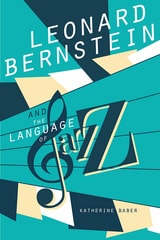
Leonard Bernstein and the Language of Jazz
Katherine Baber
University of Illinois Press, 2019
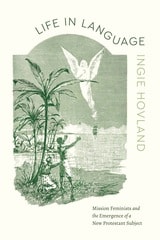
Life in Language
Mission Feminists and the Emergence of a New Protestant SubjectIngie Hovland
University of Chicago Press, 2025
The language of the Bible is a powerful lens through which many Protestants understand themselves and their world, and its prohibitions on women’s speech pose complicated challenges to women. Nevertheless, women frequently serve as vocal leaders in Protestant organizations, including the early twentieth-century Norwegian Mission Society. In Life in Language, Ingie Hovland offers a unique biography of Henny Dons, a leader of the society’s so-called mission feminists, that grapples with ways Protestant women crafted innovative, expansive self-understandings through Christian language. More than their male peers, the mission feminists turned to religious speech to express material, as well as heavenly, desires for paid work, voting rights, and more, and Hovland argues that these experiments in women speaking, reading, writing, and listening paved the way for a new way of being in the world.

Lincoln's Gettysburg Address
Echoes of the Bible and Book of Common PrayerA. E. Elmore
Southern Illinois University Press, 2009
While it has long been determined that Abraham Lincoln’s writings were influenced by the King James Bible, until now no full-length study has shown the precise ways in which the Gettysburg Address uses its specific language. Refuting the view that the address was crafted with traditional classical references, this revealing investigation provides a new way to think about the speech and the man who wrote it. A. E. Elmore offers chapter and verse evidence from the Bible as well as specific examples from the Episcopal Book of Common Prayer to illustrate how Lincoln borrowed from these sources to imbue his speech with meanings that would resonate with his listeners. He cites every significant word and phrase—conceived, brought forth, struggled, remaining, consecrate, dedicate, hallow, devotion, new birth, to name a few—borrowed by Lincoln from these two religious texts for use in his dedication of the Gettysburg National Cemetery.
Lincoln’s Gettysburg Address focuses on a number of overlooked themes and ideas, such as the importance of literary allusion and the general public’s knowledge of the Bible in the age of Lincoln. It provides fresh answers to old questions and poses new questions: Was Lincoln a common thief who made use of words from previously published materials as well as from works by his contemporaries? Was he a genius whose literary and political skills were unmatched? No one who reads this highly engaging study will ever think about Lincoln or the Gettysburg Address the same way again.
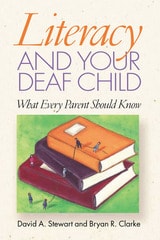
Literacy and Your Deaf Child
What Every Parent Should KnowDavid A. Stewart
Gallaudet University Press, 2003
In the modern world, success depends upon literacy, a fact especially true for deaf children who, if they read and write well, can take full advantage of e-mail, the Internet, and other communication innovations. Literacy and Your Deaf Child: What Every Parent Should Know provides parents with the means to ensure that their deaf or hard of hearing child becomes a proficient reader and writer. In nine chapters, parents will learn about the relationship of language to reading and writing, including the associated terminology, the challenges that deaf children face, and the role of schools. They’ll also learn activities that they can engage in at home that will strengthen their children’s reading and writing capabilities.
Literacy and Your Deaf Child begins by introducing some common concepts, among them the importance of parental involvement in a deaf child’s education. It outlines how children acquire language and describes the auditory and visual links to literacy. With this information, parents can make informed decisions regarding hearing aids, cochlear implants, speechreading, and sign communication, all of which can have a marked influence on their child’s language development. Parents will discover how to create environments at home and in their community for fostering their child’s literacy, especially in school by learning how to work closely with their child’s teachers. The book also refers throughout to the developmental link between American Sign Language and English literacy for children who use sign communication, making it the best guide available for all deaf children and their parents.
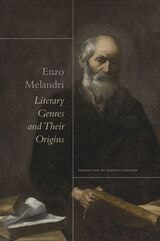
Literary Genres and Their Origins
Enzo Melandri
Seagull Books, 2026
A bold rethinking of genre as both form and philosophical problem.
Why do we have literary genres, and what problems do they solve? In this original engagement with the ancient problem of literary genres, Enzo Melandri begins by asking why literary genres exist in the first place. His investigation extends beyond literary history, as important as it is, to become a philosophical inquiry into the limits of language and the strategies language must employ to register the impossibility of fully grasping its relation to the world. In this light, tragedy, comedy, epic, elegy, and so on emerge as the musical and emotional traces language bears from its encounter with its own limits.
Little Bit Know Something
Stories in a Language of AnthropologyRobin Ridington
University of Iowa Press, 1990
Living in a Law Transformed
Encounters with the Works of James Boyd WhiteJulen Etxabe and Gary Watt, eds.
Michigan Publishing Services, 2014
Logic, Information and Agency
Johan van Benthem
CSLI, 2025
Everything we do is driven by information, but the dynamic process of acquiring information and adjusting our views based on it has seldom been put at the center place in logic, and there are few textbooks introducing readers to this line of work. The present book introduces the reader to major logical techniques for studying information dynamics and interaction between agents, based on a variety of intuitive scenarios as well as recent research. Readers will learn styles of modeling, as well as the basic features of the new logical systems emanating from this line of work. All the separate strands in the book are brought together in a comprehensive study of information flow and action in games, forming a logic-based complement to standard perspectives in game theory.
Logic, Language and Computation
Edited by Jerry Seligman and Dag Westerståhl
CSLI, 1996