Results by title
622 books match the query 'Language Study' and 26 start with l
L'influence de l'arameen sur les traducteurs de la LXX principalement sur les traducteurs grecs poste
Anne-Françoise Loiseau
SBL Press, 2016
Further your understanding of the methods and peculiarities of the ancient Greek translators and revisers of the Hebrew Bible
Loiseau presents examples of Greek translations of verses from the Hebrew Bible that clearly illustrate the influence of Aramaic or Late Hebrew on the semantics of the Septuagint translators. The author postulates that the Greek translators based their translations on Hebrew-Aramaic equivalents maintained as lists or even on proto-targumim such as those found at Qumran, both predecessors of the later Aramaic targumic translations. Loiseau's examples provide convincing explanations for different coincidences occurring between the Greek translations and the interpretative traditions found in the targumim and help elucidate a number of puzzling translations where two Aramaic words that are very similar graphically or phonetically were erroneously interchanged.
Features
- Unique insight into ancient Jewish exegesis
- English summary
- The first extensive illustration of the influence of the Aramaic or Late Hebrew on the Septuagint
LXX Isaiah 24
1-26:6 as Interpretation and Translation: A Methodological DiscussionWilson de Angelo Cunha
SBL Press, 2014
Explore how interpretation affects translation
In this volume Cunha argues that the differences found between the Septuagint text of Isaiah and the Hebrew of the Masoretic Text must be weighed against the literary context in which they are found. The author demonstrates that LXX Isa 24:1–26:6 can be seen as a coherent ideological composition that differs greatly from the way scholars have interpreted MT Isa 24:1–26:6. This coherence comes across through the use of certain lexemes and conjunctions throughout the passage. The book lays the case that a scribe or translator already had an interpretation before he started the process of translation that shaped his translation of the Hebrew text into Greek.
Features:
- An introduction sketching the history of research on LXX Isa 24:1–26:6
- A focused comparision of the Masoretic Text to the Septuagint
- A thorough discussion of the coherence of LXX Isa 24:1–26:6

La vida de Lazarillo de Tormes y de sus fortunas y adversidades
Edited by Everett W. Hesse and Harry F. Williams
University of Wisconsin Press, 1961
First published in 1554 and banned by the Inquisition, the anonymous Lazarillo de Tormes begat a whole new genre—the picaresque novel. This classic has had enduring popularity as a literary expression of Spanish identity and emotion. Through its daring autobiographical form the reader observes the magnificent, conquering Spain of Charles the Fifth through the inner consciousness of the humble Lazarillo.
This editon includes the annotated Spanish-language text and prologue (with modernized and regularized spelling) , a full vocabulary, and concise footnotes explaining allusions and translating phrases of varying difficulty.
Spanish-language with introductions in English
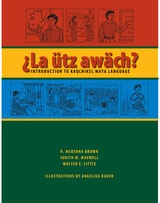
La ütz awäch?
Introduction to Kaqchikel Maya LanguageBy R. McKenna Brown, Judith M. Maxwell, and Walter E. Little
University of Texas Press, 2006
Kaqchikel is one of approximately thirty Mayan languages spoken in Belize, Guatemala, Mexico, and, increasingly, the United States. Of the twenty-two Mayan languages spoken in Guatemala, Kaqchikel is one of the four "mayoritarios," those with the largest number of speakers. About half a million people living in the central highlands between Guatemala City and Lake Atitlán speak Kaqchikel. And because native Kaqchikel speakers are prominent in the field of Mayan linguistics, as well as in Mayan cultural activism generally, Kaqchikel has been adopted as a Mayan lingua franca in some circles.
This innovative language-learning guide is designed to help students, scholars, and professionals in many fields who work with Kaqchikel speakers, in both Guatemala and the United States, quickly develop basic communication skills. The book will familiarize learners with the words, phrases, and structures used in daily communications, presented in as natural a way as possible, and in a logical sequence. Six chapters introduce the language in context (greetings, the classroom, people, the family, food, and life) followed by exercises and short essays on aspects of Kaqchikel life. A grammar summary provides in-depth linguistic analysis of Kaqchikel, and a glossary supports vocabulary learning from both Kaqchikel to English and English to Kaqchikel. These resources, along with sound files and other media on the Internet at ekaq.stonecenter.tulane.edu, will allow learners to develop proficiency in all five major language skills—listening comprehension, speaking, reading, writing, and sociocultural understanding.
Lacandon Maya-Spanish-English Dictionary
Charles A Hofling
University of Utah Press, 2014
Following the same trilingual format as Hofling’s Mopan Maya-Spanish-English Dictionary, this reference contains pronunciation and grammatical information. It is a hybrid of a root dictionary and one with words in alphabetical order; words can be looked up in these two different ways, making it easy to use for both native and nonnative speakers. It also accommodates Spanish speakers who wish to learn Lacandon, and in the future is likely to be helpful to Lacandon-speaking children, who increasingly use Spanish outside the home, while preserving a record of this indigenous language.
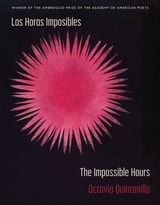
Las Horas Imposibles / The Impossible Hours
Octavio Quintanilla; Translated by Octavio Quintanilla and Natalia Treviño
University of Arizona Press, 2025
Presented in Spanish with English translations, this poetry collection comprises lyric and concrete poems—or frontextos—that explore intimacy and different shades of violence as a means to reconcile the speaker’s sense of belonging in the world. From the opening poem to the last in the first section, Quintanilla captures the perilous journeys that migrants undertake crossing borders as well as the paths that lovers forge to meet their endless longing. These themes are skillfully woven by Quintanilla, guiding us back and forth across the Rio Grande to encounter the apparitions of the disappeared and to witness the willingness of many to risk life and limb for a better life. The second half of the collection is one long poem, a letter addressed to a lost lover who will never get to read the speaker’s secret thoughts. Haunted by loss—of parents, of children, of the self—the speaker reaches an inevitable epiphany: “[A]nd sometimes it’s hard to know / on which side of the river I stand.” Stylistically, these poems destabilize our notions and expectations of genre and lyricism.
Las Horas Imposibles / The Impossible Hours is more than just an exercise in poetic virtuosity; it is an excavation into the complexities of what it means to be a human being in our contemporary world.
Latin Grammar
Dirk Panhuis
University of Michigan Press, 2006
Back Cover
Through clear structuring of language phenomena, Panhuis provides a reference that integrates traditional linguistic knowledge with linguistic innovation and didactic clarity. This concise reference, ideal for students and instructors of Latin in high schools and colleges, will supplant the out-dated grammars of Allen & Greenough and Hale & Buck.
Dirk Panhuis graduated in classical philology at the State University of Ghent, Belgium, in 1963 and obtained his PhD in linguistics at the University of Michigan, Ann Arbor, in 1981. He has been assistant and academic secretary of the Institut Supérieur Pédagogique in Kananga (Democratic Republic of Congo) and a teaching assistant at the University of Michigan. He taught classical languages in high schools of the Flemish Community in and around Louvain (Belgium) until his retirement in 2002.
"Panhuis brings a very welcome linguistic orientation to the study of Latin, an approach not found in the older traditional grammars currently used at the college level. Among the features likely to prove most helpful for students is the presentation of information in clear and easily readable charts and grids, and the explanations accompanying the English translations, allowing students to see clearly how to render a Latin structure into English both literally and idiomatically."
Back Cover continued
—Deborah Ross, Department of Classical Studies, University of Michigan
"This innovative grammar incorporates current viewpoints of syntax and semantics, making it a unique tool, especially for the study of sentence structure."—Philip Baldi, Professor of Linguistics and Classics, Pennsylvania State University
"In his Latin Grammar, Panhuis artfully integrates traditional description and modern analysis. It will provide intermediate and advancing Latin students mature help in understanding Latin syntax and offers material on the dynamics of text which is unique for an introductory reference tool. Not to be overlooked is its value as a resource to those who teach Latin."
—Charles Elerick, Professor of Languages and Linguistics, The University of Texas at El Paso
Latin for Reading
A Beginner's Textbook with ExercisesGlenn M. Knudsvig, Ruth S. Craig, and Gerda M. Seligson
University of Michigan Press, 1986
Latin for Reading
A Beginner's Textbook with Exercises, Instructor's ManualGlenn M. Knudsvig, Ruth S. Craig, and Gerda M. Seligson
University of Michigan Press, 1986

Le Français - Instructor’s Manual
Départ—ArrivéeJohn A. Rassias and Jacqueline de La Chapelle Skubly
Dartmouth College Press, 2008
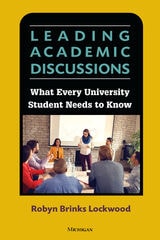
Leading Academic Discussions
What Every University Student Needs to KnowRobyn Brinks Lockwood
University of Michigan Press, 2021
Although discussions are heavily reliant on words, they are also influenced and affected by other verbal cues, such as pronunciation, stress, pitch, or tone. Because speakers need to both notice and use these cues to make their messages clear to other participants, the text addresses these factors as well. Additionally, non-verbal communication plays an essential role as well, so one chapter is devoted to it.
Throughout the text, reflection questions about leading discussions are provided for those who are or hope to be teaching assistants (TAs) and project leads/managers. Video analysis tasks are included to accompany the six mini discussion videos that are open and available at www.press.umich.edu/elt/compsite/leading.
Lessons in Modern Hebrew
Level 1Edna Amir Coffin
University of Michigan Press, 1977
Lessons in Modern Hebrew
Level 2Edna Amir Coffin
University of Michigan Press, 1978
A comprehensive introduction to modern Israeli Hebrew, Lessons in Modern Hebrew: Level I and Level II provide English-speaking students and well-motivated individuals with all the basic classroom tools necessary for mastery of the language. The lessons introduce the student to the core vocabulary which is then included in reading passages, conversational text, and written communication. All grammatical features of modern Hebrew are thoroughly explained and reinforced by drills and exercises. The books have been classroom-tested at the University of Michigan. Both audio-lingual and cognitive approaches are used.
Cassettes are available from the University of Michigan Language Resource Center: Phone: (734) 764-0424; Email: lrc.contact@umich.edu.
Letters and Orations
Cassandra Fedele
University of Chicago Press, 2000
Lexical Matters
Edited by Ivan A. Sag and Anna Szabolcsi
CSLI, 1992
Lexical Relations
Jean-Pierre Koenig
CSLI, 1999
Lexical and Semantic Aspects of Proverbs
František Cermák
Karolinum Press, 2019
Linguistic Diversity and National Unity
Language Ecology in ThailandWilliam A. Smalley
University of Chicago Press, 1994
Smalley contends that because the people of Thailand perceive their social hierarchy as the normal order, Standard Thai, spoken by members of the higher levels of society, prevails as the uncontested national language. By examining the hierarchy of Thailand's diverse languages and dialects in light of Thai history, education, culture, and religion, Smalley shows how Thailand has been able to keep its many ethnic groups at peace.
Linguistic Diversity and National Unity explores the intricate relationship between language and power and the ways in which social and linguistic rank can be used to perpetuate order.
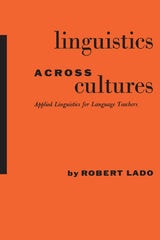
Linguistics Across Cultures
Applied Linguistics for Language TeachersRobert Lado
University of Michigan Press, 1957
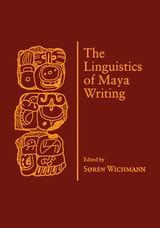
Linguistics Of Maya Writing
Soren Wichmann
University of Utah Press, 2004
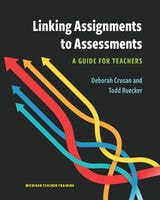
Linking Assignments to Assessments
A Guide for TeachersDeborah Crusan and Todd Ruecker
University of Michigan Press, 2022
The book shares foundational information on the importance of assessment literacy and on how language acquisition, student backgrounds, and language standards need to be considered. Linking Assignments to Assessments offers step-by-step instructions on creating effective assessments for listening and reading, speaking and writing, grammar and vocabulary. Teachers are provided context for understanding standardized assessments and strategies to advocate for and prepare English learners in high-stakes assessment contexts. Each chapter includes activities, discussion questions, and strategies for developing an assessment philosophy to help educators link their theory and practice.
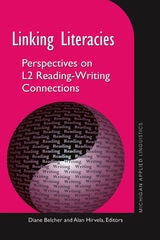
Linking Literacies
Perspectives on L2 Reading-Writing ConnectionsDiane Belcher and Alan Hirvela, Editors
University of Michigan Press, 2001
Linking Literacies provides the most up to date theoretical overview of the connection between reading and writing in second language acquisition. Belcher and Hirvela have brought together the definitive collection of developments in reading-writing relations research and pedagogy. Papers are organized into these parts:
Ground Practice: Theory, Research, and History
In the Classroom: Teaching Reading as Writing and Writing as Reading
(E)Merging Literacies and the Challenge of Textual Ownership
Technology-Assisted Reading and Writing.
In addition to examining the ways in which L1 influences have affected the development of L2 reading-writing theory and pedagogy, Linking Literacies looks at how L2 reading-writing scholarship has created an identity separate of an L1 framework. Linking Literacies examines a broad range of questions and concerns within the structure of L2 reading-writing connections and L2 academic literacy through discussions of theory, research, and
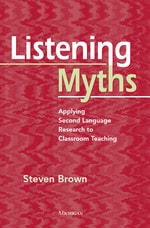
Listening Myths
Applying Second Language Research to Classroom TeachingSteven Brown
University of Michigan Press, 2011
This volume was conceived as a "best practices" resource for teachers of ESL listening courses in the way that Vocabulary Myths by Keith S. Folse (and Writing Myths by Joy Reid) is one for reading and vocabulary teachers. It was written to help ensure that teachers of listening are not perpetuating the myths of teaching listening.
Both the research and pedagogy in this book are based on the newest research in the field of second language acquisition. Steven Brown is the author of the Active Listening textbook series and is a teacher trainer.
The myths debunked in this book are:
§ Listening is the same as reading.
§ Listening is passive.
§ Listening equals comprehension.
§ Because L1 language ability is effortlessly acquired, L2 listening ability is too.
§ Listening means listening to conversations.
§ Listening is an individual, inside-the-head process.
§ Students should only listen to authentic materials.
§ Listening can’t be taught
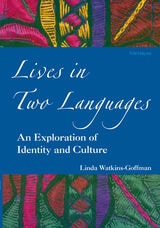
Lives in Two Languages
An Exploration of Identity and CultureLinda Watkins-Goffman
University of Michigan Press, 2001
Lives in Two Languages focuses on the experience of multicultural authors--like Richard Rodriguez, Amy Tan, Eva Hoffman, Chang-rae Lee, and Julia Alvarez--whose experiences can be related to anyone who has moved from one culture or subculture to another. As such, this text is an excellent comprehensive introduction to the multicultural experience for teachers and educators in all disciplines, as well as of interest to anyone interested in language culture and psychological process of identity.
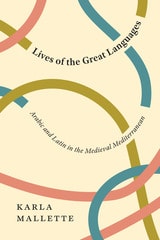
Lives of the Great Languages
Arabic and Latin in the Medieval MediterraneanKarla Mallette
University of Chicago Press, 2021
In this ambitious book, Karla Mallette studies the nature and behaviors of the medieval cosmopolitan languages of learning—classical Arabic and medieval Latin—as they crossed the Mediterranean. Through anecdotes of relationships among writers, compilers, translators, commentators, and copyists, Mallette tells a complex story about the transmission of knowledge in the period before the emergence of a national language system in the late Middle Ages and early modernity.
Mallette shows how the elite languages of learning and culture were only tenuously related to the languages of everyday life. These languages took years of study to master, marking the passage from intellectual childhood to maturity. In a coda to the book, Mallette speculates on the afterlife of cosmopolitan languages in the twenty-first century, the perils of monolingualism, and the ethics of language choice. The book offers insight for anyone interested in rethinking linguistic and literary tradition, the transmission of ideas, and cultural expression in an increasingly multilingual world.
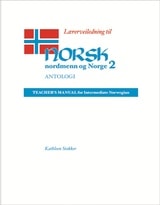
Lærerveiledning til Norsk, nordmenn og Norge 2, Antologi
Teacher's Manual for Intermediate NorwegianKathleen Stokker
University of Wisconsin Press, 1993
This teacher's guide to the intermediate anthology and workbook suggests a variety of classroom communicative activities for both pairs and small groups.