Results by title
78 books match the query 'Legends' and 13 start with l
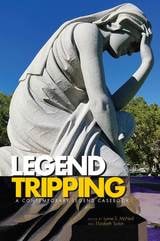
Legend Tripping
A Contemporary Legend CasebookLynne S. McNeill
Utah State University Press, 2018
The volume presents both insightful research and useful pedagogy, making this an invaluable resource in the classroom. Selected major articles on legend tripping, with introductory sections written by the editors, are followed by discussion questions and projects designed to inspire readers to engage critically with legend traditions and customs of legend tripping and to explore possible meanings and symbolics at work. Suggested projects incorporate digital technology as it appears both in legends and in modes of legend tripping.
Legend Tripping is appropriate for students, general readers, and folklorists alike. It is the first volume in the International Society for Contemporary Legend Research series, a set of casebooks providing thorough and up-to-date studies that showcase a variety of scholarly approaches to contemporary legends, along with variants of legend texts, discussion questions, and projects for students.
Contributors: S. Elizabeth Bird, Bill Ellis, Carl Lindahl, Patricia M. Meley, Tim Prizer
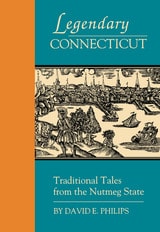
Legendary Connecticut
Traditional Tales from the Nutmeg StateDavid E. Philips
Northwestern University Press, 1995

Legendary Ladies of Texas
Francis Edward Abernethy
University of North Texas Press, 1994
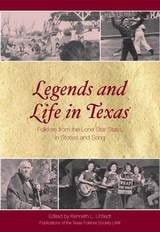
Legends and Life in Texas
Folklore from the Lone Star State, in Stories and SongKenneth L. Untiedt
University of North Texas Press, 2017
Legends and Lore of Southern Illinois
John W. Allen
Southern Illinois University Press, 1963
In the 1950s and ‘60s, John W. Allen told the people of southern Illinois about themselves—about their region, its history, and its folkways—in his series of newspaper articles, “It Happened in Southern Illinois.” Each installment of the series depicted a single item of interest—a town, a building, an enterprise, a person, an event, a custom. Originally published in 1963, Legends & Lore of Southern Illinois brings together a selection of these articles preserving a valuable body of significant local history and cultural lore.
During territorial times and early statehood, southern Illinois was the most populous and most influential part of the state. But the advent of the steamboat and the building of the National Road made the lands to the west and north more easily accessible, and the later settlers struck out for the more expansive and fertile prairies. The effect of this movement was to isolate that section of the state known as Egypt and halt its development, creating what Allen termed “an historical eddy.” Bypassed as it was by the main current of westward expansion and economic growth, its culture changed very slowly. Methods, practices, and the tools of the pioneer continued in use for a long time. The improved highways and better means of communication of the twentieth century brought a marked change upon the region, and daily life no longer differed materially from that of other areas.
Against such a cultural and historical backdrop, Mr. Allen wrote these sketches of the people of southern Illinois—of their folkways and beliefs, their endeavors, successes, failures, and tragedies, and of the land to which they came. There are stories here of slaves and their masters, criminals, wandering peddlers, politicians, law courts and vigilantes, and of boat races on the rivers. Allen also looks at the region’s earlier history, describing American Indian ruins, monuments, and artifacts as well as the native population’s encounters with European settlers.
Many of the vestiges of the region’s past culture have all but disappeared, surviving only in museums and in the written record. This new paperback edition of Legends & Lore of Southern Illinois brings that past culture to life again in Allen’s descriptive, engaging style.
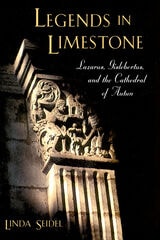
Legends in Limestone
Lazarus, Gislebertus, and the Cathedral of AutunLinda Seidel
University of Chicago Press, 1999
Legends in Limestone reveals how "Gislebertus, sculptor" was discovered and subsequently sanctified over the course of the last century. Seidel makes a compelling case for the identification of the name with an ancestor of the local ducal family, invoked for his role in the acquisition of the precious relics. With the aid of evidence drawn from the richly carved decoration of the building, she demonstrates how medieval visitors would have read a different holy narrative in the church fabric, one that constructed before their eyes an account of their patron saint's life.
Legends in Limestone, an absorbing study of one of France's most revered medieval monuments, provides fresh insights into modern and medieval interpretive practices.
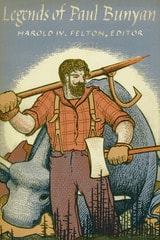
Legends of Paul Bunyan
Harold W. Felton
University of Minnesota Press, 2008
The collected lore of Minnesota's favorite lumberjack hero
Paul Bunyan is a true American folk character, created in logging camp bunkhouses by men who spun exaggerated stories that combined hard work and fantasy.
While the origins of Paul Bunyan and his sidekick Babe the Blue Ox are hazy, many storytellers have over the years contributed their own takes to produce an existing body of work--a true American legend--that matches the size of the lumberjack himself. Collected in colorful and engaging sections such as "Paul the Man," "Paul and the Animal Kingdom," and "The Wonderful Big Blue Ox, Babe," Legends of Paul Bunyan features more than thirty authors celebrating the largest lumberman, including stories by such Bunyan luminaries as James Stevens and W. B. Laughead, as well as such literary icons as Robert Frost and Carl Sandburg.
Legends of the Capilano
E. Pauline Johnson
University of Manitoba Press, 2023
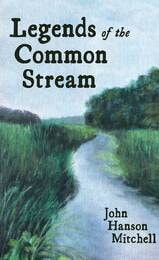
Legends of the Common Stream
John Hanson Mitchell
University of Massachusetts Press, 2021
While Mitchell never leaves the brook's shores, he draws from a range of traditions and takes readers on excursions to regions and cultures across the globe and across time, making the case that our contemporary separation from nature goes hand in hand with our alienation from the world of myth. This book seeks to restore these broken relationships and offers the reminder that while cultures may come and go, the stream goes on forever.

Legends of the Northern Paiute
as told by Wilson WewaWilson Wewa
Oregon State University Press, 2017
The legends in this volume were recorded, transcribed, reviewed, and edited by Wilson Wewa and James Gardner. Each legend was recorded, then read and edited out loud, to respect the creativity, warmth, and flow of Paiute storytelling. The stories selected for inclusion include familiar characters from native legends, such as Coyote, as well as intriguing characters unique to the Northern Paiute, such as the creature embodied in the Smith Rock pinnacle, now known as Monkey Face, but known to the Paiutes in Central Oregon as Nuwuzoho the Cannibal.
Wewa’s apprenticeship to Northern Paiute culture began when he was about six years old. These legends were passed on to him by his grandmother and other tribal elders. They are now made available to future generations of tribal members, and to students, scholars, and readers interested in Wewa’s fresh and authentic voice. These legends are best read and appreciated as they were told—out loud, shared with others, and delivered with all of the verve, cadence, creativity, and humor of original Paiute storytellers on those clear, cold winter nights in the high desert.

Legends of the Slow Explosion
Eleven Modern LivesBaron Wormser
Tupelo Press, 2018

Legends of the Warring States
Persuasions, Romances, and Stories from <em>Chan-kuo Ts'e</em>J. I. Crump
University of Michigan Press, 1998

Lives and Legends of the Christmas Tree Ships
Fred Neuschel
University of Michigan Press, 2007
Lives and Legends of the Christmas Tree Ships brings the maritime heritage of the Great Lakes to life, using the tragic story of the schooner Rouse Simmons as a porthole into the robust but often forgotten communities that thrived along Lake Michigan from the Civil War to World War I.
Memorialized in songs, poems, fiction, and even a musical, the infamous ship that went down in a Thanksgiving storm while delivering Christmas trees to Chicago has long been shrouded in myth and legend. As a result, the larger story of the captain, crew, and affected communities has often been overlooked. Fred Neuschel delves into this everyday life of camaraderie, drudgery, ambition, and adventure—with tales of the Midwest’s burgeoning immigrant groups and rapid industrialization—to create a true story that is even more fascinating than the celebrated legends.