102 books match the query 'Limits' and 8 start with l
cover of Liberal Democracy and the Limits of Tolerance: Essays in Honor and Memory of Yitzhak Rabin

Liberal Democracy and the Limits of Tolerance

Essays in Honor and Memory of Yitzhak Rabin

Raphael Cohen-Almagor, Editor

University of Michigan Press, 2000

An irony inherent in all political systems is that the principles that underlie and characterize them can also endanger and destroy them. This collection examines the limits that need to be imposed on democracy, liberty, and tolerance in order to ensure the survival of the societies that cherish them. The essays in this volume consider the philosophical difficulties inherent in the concepts of liberty and tolerance; at the same time, they ponder practical problems arising from the tensions between the forces of democracy and the destructive elements that take advantage of liberty to bring harm that undermines democracy.
Written in the wake of the assasination of Yitzhak Rabin, this volume is thus dedicated to the question of boundaries: how should democracies cope with antidemocratic forces that challenge its system? How should we respond to threats that undermine democracy and at the same time retain our values and maintain our commitment to democracy and to its underlying values?
All the essays here share a belief in the urgency of the need to tackle and find adequate answers to radicalism and political extremism. They cover such topics as the dilemmas embodied in the notion of tolerance, including the cost and regulation of free speech; incitement as distinct from advocacy; the challenge of religious extremism to liberal democracy; the problematics of hate speech; free communication, freedom of the media, and especially the relationships between media and terrorism.
The contributors to this volume are David E. Boeyink, Harvey Chisick, Irwin Cotler, David Feldman, Owen Fiss, David Goldberg, J. Michael Jaffe, Edmund B. Lambeth, Sam Lehman-Wilzig, Joseph Eliot Magnet, Richard Moon, Frederick Schauer, and L.W. Sumner. The volume includes the opening remarks of Mrs.Yitzhak Rabin to the conference--dedicated to the late Yitzhak Rabin--at which these papers were originally presented. These studies will appeal to politicians, sociologists, media educators and professionals, jurists and lawyers, as well as the general public.
[more]
cover of Limits and Possibilities: The Crisis of Yugoslav Socialism and State Socialist Systems

Limits and Possibilities

The Crisis of Yugoslav Socialism and State Socialist Systems

Bogdan Denitch

University of Minnesota Press, 1990

Limits and Possibilities was first published in 1990. Minnesota Archive Editions uses digital technology to make long-unavailable books once again accessible, and are published unaltered from the original University of Minnesota Press editions.

The nature of the Eastern European Socialist state and its potential for transformation without sacrificing its specific identity is the subject of extensive current debate. Limits and Possibilities is the first book to be written that deals conceptually and historically with the myriad kinds of change a state might undergo. Bogdon Denitch has chosen the Yugoslavian model to frame his analysis because it initiated these "modernizing" changes in the 1960s and can therefore provide a case study of the limits of reforms possible in Communist regimes. In using the Yugoslav case paradigmatically, the volume addresses in a more general sense the issues of decentralization, autonomy for nonparty and nonstate institutions, multi-ethnicity, new social movements, including the "greens," and the role of women and women's movements.
[more]
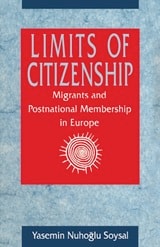
cover of Limits of Citizenship: Migrants and Postnational Membership in Europe

Limits of Citizenship

Migrants and Postnational Membership in Europe

Yasemin Nuhoglu Soysal

University of Chicago Press, 1994

In many Western countries, rights that once belonged solely to citizens are being extended to immigrants, a trend that challenges the nature and basis of citizenship at a time when nation-states are fortifying their boundaries through restirictive border controls and expressions of nationalist ideologies. In this book, Yasemin Soysal compares the different ways European nations incorporate immigrants, how these policies evolved, and how they are influenced by international human rights discourse.

Soysal focuses on postwar international migration, paying particular attention to "guestworkers." Taking an in-depth look at France, Germany, the Netherlands, Sweden, Switzerland, and the United Kingdom, she identifies three major patterns that reflect the varying emphasis particular states place on individual versus corporate groups as the basis for incorporation. She finds that the global expansion and intensification of human rights discourse puts nation-states under increasing outside pressure to extend membership rights to aliens, resulting in an increasingly blurred line between citizen and noncitizen. Finally, she suggests a possible accommodation to these shifts: specifically, a model of post-national membership that derives its legitimacy from universal personhood, rather than national belonging.

This fresh approach to the study of citizenship, rights, and immigration will be invaluable to anyone involved in issues of human rights, international migration, and transnational cultural interactions, as well as to those who study the contemporary transformation of the nation-state, nationalism, and globalization.
[more]
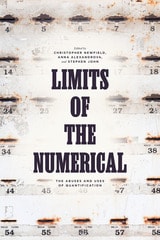
cover of Limits of the Numerical: The Abuses and Uses of Quantification

Limits of the Numerical

The Abuses and Uses of Quantification

Edited by Christopher Newfield, Anna Alexandrova, and Stephen John

University of Chicago Press, 2022

This collection examines the uses of quantification in climate science, higher education, and health.
 
Numbers are both controlling and fragile. They drive public policy, figuring into everything from college rankings to vaccine efficacy rates. At the same time, they are frequent objects of obfuscation, manipulation, or outright denial. This timely collection by a diverse group of humanists and social scientists challenges undue reverence or skepticism toward quantification and offers new ideas about how to harmonize quantitative with qualitative forms of knowledge.   

Limits of the Numerical focuses on quantification in several contexts: climate change; university teaching and research; and health, medicine, and well-being more broadly. This volume shows the many ways that qualitative and quantitative approaches can productively interact—how the limits of the numerical can be overcome through equitable partnerships with historical, institutional, and philosophical analysis. The authors show that we can use numbers to hold the powerful to account, but only when those numbers are themselves democratically accountable.
[more]
cover of Limits to Culture: Urban Regeneration vs. Dissident Art

Limits to Culture

Urban Regeneration vs. Dissident Art

Malcolm Miles

Pluto Press, 2015

Limits to Culture outlines the cultural turn in urban policy from the 1980s to the 2000s, in which new art museums and cultural or heritage quarters lent a creative mask to urban redevelopment. Malcolm Miles challenges the notions of a creative class and a creative city, aligning them to gentrification, while exploring the history of cultural urban policy and its relationship to the real culture of dissent. As Miles shows, in the 1960s, creativity was identified with revolt, yet beginning in the 1980s it was subsumed by consumerism, as evidenced in the 1990s culture of cool. But in the wake of the 2008 crash, the money has run out and the illusory creative city has given way to urban clearances, ripe for a new kind of artistic regeneration.
[more]
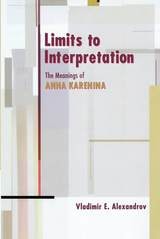
cover of Limits to Interpretation: The Meanings of Anna Karenina

Limits to Interpretation

The Meanings of Anna Karenina

Vladimir E. Alexandrov

University of Wisconsin Press, 2017
Vladimir E. Alexandrov advocates a broad revision of the academic study of literature, proposing an adaptive, text-specific approach designed to minimize the circularity of interpretation inherent in the act of reading. He illustrates this method with the example of Tolstoy's classic novel via a detailed "map" of the different possible readings that the novel can support. The novel Anna Karenina emerges as deeply conflicted, polyvalent, and quite unlike what one finds in other critical studies.
[more]
cover of Limits to Liberation after Apartheid: Citizenship, Governance, & Culture

Limits to Liberation after Apartheid

Citizenship, Governance, & Culture

Steven L. Robins

Ohio University Press, 2005

Postapartheid South Africa struggles with race tensions, social inequalities, and unemployment that are contributing to widespread crises. In addressing the transition to democracy, Limits to Liberation After Apartheid examines issues of culture and identity, drawing attention to the creative agency of citizens of the “new” South Africa. The writers question the classical western model of citizenship and procedural democracy in the face of the inability of many African states to provide basic needs. Their bold, interdisciplinary inquiry contributes to South African and international scholarship on urban planning, governance, and citizenship.
[more]
cover of Living Between Danger and Love: The Limits of Choice

Living Between Danger and Love

The Limits of Choice

Jones, Kathleen B.

Rutgers University Press, 1999

Andrea O'Donnell did not fit what criminal justice experts call the "victim profile." The twenty-seven-year old women's studies major at San Diego State University was the director of the campus Women's Resource Center and a self-defense instructor. Nevertheless, in the early morning hours of November 5, 1994, she was brutally murdered. Her decomposed body was discovered in the apartment that she shared with her boyfriend, Andres English-Howard. In August 1995, he was convicted of first-degree murder. The night before he was scheduled to appear in court for sentencing, English-Howard hanged himself in his jail cell. Author Kathleen B. Jones, one of O'Donnell's professors, was particularly shaken by her death. In Living Between Danger and Love, she examines O'Donnell's death and what it has to say to all of us. She provokes readers to consider the irony that our ideas about choice might prevent us from imagining and discovering social relationships of intimacy where love and power are not in conflict
[more]