Results by title
642 books match the query 'Linguistics' and 65 start with l
Language
Leonard Bloomfield
University of Chicago Press, 1984
The book quickly became the primary text for the American descriptivist school of linguistics. Bloomfield’s clear, systematic methodology and focus on observable language data laid the groundwork for a new era in linguistic theory. His work, which covers a wide range of topics, from phonology and morphology to syntax and semantics, provides a comprehensive framework for understanding how language functions as a structured system.
Through twelve detailed chapters, Bloomfield explores topics such as the sounds of language, the structure of words, and the organization of sentences. His emphasis on structuralism and the empirical study of language has had a profound impact on the discipline, making Language an essential reference for anyone interested in the history and development of linguistic theory.
As both an introduction for newcomers and a resource for more advanced students, Language continues to be a crucial text in understanding the scientific study of language and its ongoing evolution.
Language Attitudes in the American Deaf Community
Joseph C. Hill
Gallaudet University Press, 2012
In a diverse signing community, it is not unusual to encounter a wide variety of expression in the types of signs used by different people. Perceptions of signing proficiency often vary within the community, however. Conventional wisdom intimates that those who learned at an early age at home or in school know true standard American Sign Language, while those who learned ASL later in life or use contact or coded signs are considered to be less skillful. Joseph Christopher Hill’s new study Language Attitudes in the American Deaf Community explores the linguistic and social factors that govern such stereotypical perceptions of social groups about signing differences.
Hill’s analysis focuses on affective, cognitive, and behavioral types of evaluative responses toward particular language varieties, such as ASL, contact signing, and Signed English. His work takes into account the perceptions of these signing types among the social groups of the American Deaf community that vary based on generation, age of acquisition, and race. He also gauges the effects of social information on these perceptions and the evaluations and descriptions of signing that results from their different concepts of a signing standard. Language Attitudes concludes that standard ASL’s value will continue to rise and the Deaf/Hearing cultural dichotomy will remain relevant without the occurrence of a dramatic cultural shift.
Language Files
Materials for an Introduction to Language and Linguistics, 11th EditionDepartment of Linguistics
The Ohio State University Press, 2011
Language Files
Materials for an Introduction to Language and Linguistics, 12th EditionDepartment of Linguistics, The Ohio State University
The Ohio State University Press, 2016
The twelfth edition has been significantly revised, clarified, and updated throughout—with particular attention to the chapters on phonetics, phonology, pragmatics, and especially psycholinguistics. The restructured chapter on psycholinguistics makes use of recent research on language in the brain and includes expanded coverage of language processing disorders, introducing students to current models of speech perception and production and cutting-edge research techniques. In addition, exercises have been updated, and icons have been added to the text margins throughout the book, pointing instructors and students to useful and engaging audio files, videos, and other online resources on the accompanying Language Files website, which has also been significantly expanded.
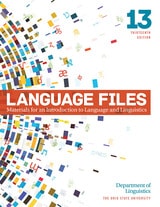
Language Files
Materials for an Introduction to Language and Linguistics, 13th EditionThe Ohio State University Department of Linguistics
The Ohio State University Press, 2022
The thirteenth edition has been revised, clarified, and updated throughout to ensure that it remains the most comprehensive and accessible introductory linguistics textbook on the market. The revised chapter on morphology includes a more thorough discussion of allomorphy and adds sections on templatic morphology, suprasegmental morphology, and morphological metathesis to give students a more complete picture of all morphological phenomena. The chapter on language and computers has been updated with new sections on deep learning, artificial neural networks, and on other areas of computational linguistics, providing readers with a better sense of current research and applications in this rapidly developing field. Other additions include new sections on syntactic non-constituents and non-generative rule systems in the syntax chapter and a complete rewrite to the creole languages file in the language contact chapter. We have also adopted the use of the singular they when referring to a generic person whose gender is unknown or irrelevant. Exercises and lists of other readings have been updated throughout.

Language Policy and Planning for Sign Languages
Timothy G. Reagan
Gallaudet University Press, 2010
This volume addresses the burgeoning need for language policy and language planning for the sign languages used by deaf people. Author Timothy Reagan writes for two audiences in his new book, those who know language policy and language planning but not the Deaf World, and those well-versed in the Deaf cultural community but unfamiliar with language planning studies. To begin, Chapter 1 presents an overview of the Deaf World and a brief introduction to sign language in general. The second chapter outlines a broad overview of language policy and language planning studies both as an academic discipline and an applied type of social engineering.
In Chapter 3, Reagan examines the specifics of American Sign Language in terms of the history of language policy and planning from the nineteenth century to the post-Congress of Milan period and its form in recent years. The fourth chapter critically examines the creation of manual codes used in deaf education in the U.S. and elsewhere. Chapter 5 analyzes language policy and planning in settings around the world, and the final chapter recommends steps and methods for future language policy and planning efforts for sign language. The cohesive rationale offered in Language Policy and Planning for Sign Languages will prove to be invaluable to all administrators and educators working with populations that use sign languages.

Language Use and Language Change in Brunei Darussalam
Mis Sea#100Peter W. Martin
Ohio University Press, 1996
The oil-rich sultanate of Brunei Darussalam is located on the northern coast of Borneo between the two Malaysian states of Sarawak and Sabah. Though the country is small in size and in population, the variety of language use there provides a veritable laboratory for linguists in the fields of Austronesian linguistics, bilingual studies, and sociolinguistic studies, particularly those dealing with language shift.
This useful reference is divided into three sections: one on varieties of the Malay language used in the country, one on other indigenous languages, and one on the role and form of the English used there. Contributors to the collection include Bruneian scholars as well as established experts in the fields of Austronesian linguistics, sociolinguistics studies, and the description of new varieties of English.
Language and Authority in De Lingua Latina
Varro's Guide to Being RomanDiana Spencer
University of Wisconsin Press, 2022
Language and Ethnicity among the K'ichee' Maya
Sergio Romero
University of Utah Press, 2015
This book explores the articulation between “accent” and ethnic identification in K’ichee’, a Mayan language spoken by more than one million people in the western highlands of Guatemala. Based on years of ethnographic work, it is the first anthropological examination of the social meaning of dialectal difference in any Mayan language. Romero deconstructs essentialist perspectives on ethnicity in Mesoamerica and argues that ethnic identification among the highland Maya is multiple and layered, the result of a diverse linguistic precipitate created by centuries of colonial resistance.
In K’ichee’, dialect stereotypes—accents—act as linguistic markers embodying particular ethnic registers. K’ichee’ speakers use and recombine their linguistic repertoire—colloquial K’ichee’, traditional K’ichee’ discourse, colloquial Spanish, Standard Spanish, and language mixing—in strategic ways to mark status and authority and to revitalize their traditional culture. The book surveys literary genres such as lyric poetry, political graffiti, and radio broadcasts, which express new experiences of Mayan-ness and anticolonial resistance. It also takes a historical perspective in examining oral and written K’ichee’ discourses from the sixteenth to the twenty-first centuries, including the famous chronicle known as the Popol Vuh, and explores the unbreakable link between language, history, and culture in the Maya highlands.
Language and Grammar
Studies in Mathematical Linguistics and Natural LanguageEdited by Claudia Casadio, Philip Scott, and Robert Seely
CSLI, 2004

Language and Hegemony in Gramsci
Peter Ives
Pluto Press, 2004
This book places Gramsci’s ideas within the linguistically influenced social theory of the twentieth century. It summarizes some of the major ideas of Ferdinand de Saussure, Ludwig Wittgenstein, language philosophy and post-structuralism in relation to Gramsci’s position. By paying great attention to the linguistic underpinnings of Gramsci's Marxism, Language and Hegemony in Gramsci shows how his theorization of power, language and politics address issues raised by post-modernism and the work of Michel Foucault, Jacques Derrida, Chantal Mouffe, and Ernesto Laclau.
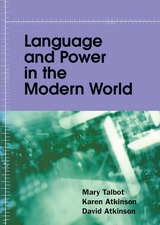
Language and Power in the Modern World
Mary Talbot
University of Alabama Press, 2003
An accessible overview of five major issues in sociolinguistics and the relationship between language and power
This book analyzes the key ways in which language constitutes and conveys power and social relationships in modern society. It offers selected readings that illustrate the thematic introductions and a set of tasks designed to guide linguistic analysis of data and to stimulate student discussion, in five specific areas:
• Multilingualism, Identity, and Ethnicity: examines the phenomena of linguistic diversity from the perspective of language planning and language policies, with emphasis on personal, psychological, educational, cultural, and political issues.
• Language and Youth: examines the languages of old age and the language of youth subcultures.
• Language and Gender: explores the claim that men and women use interactional communication styles based on power and solidarity, respectively.
• Language and the Media: considers the extent to which verbal interaction through mass media differs from other kinds of communication and its consequences in terms of power relations.
• Language and Organizations: explores the use of language as a tool of power in public institutions and bureaucracies and how control over individuals is articulated through a range of different discourse structures and strategies.
With a unique combination of selected readings and student-centered tasks in a single volume, Language and Power in the Modern World covers contemporary issues of communication theory and sociolinguistics, ranging from the global to the interpersonal.
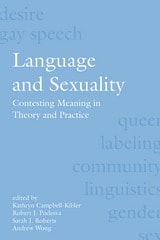
Language and Sexuality
Contesting Meaning in Theory and PracticeEdited by Kathryn Campbell-Kibler, Robert J. Podesva, Sarah Roberts, and Andrew
CSLI, 2001

Language and Social Relationship in Brazilian Portuguese
The Pragmatics of PolitenessBy Dale April Koike
University of Texas Press, 1992
"Give me the salt" and "Please pass the salt" make the same request, but in a polite situation the first utterance may give offense, while the second may not. How and why such differences in wording and intonation, in a particular context, produce different effects is the concern of pragmatics, the area of linguistics that deals with how speech is used in interaction. In this innovative study of pragmatics in Brazilian Portuguese, Dale Koike analyzes the politeness phenomenon, specifically in the context of speech acts known as "directives."
As acts intended to get someone to do something, directives bring into play a variety of sociocultural factors, depending on the relationship between the participants. Using empirical data obtained through natural language observation and from questionnaires of over one hundred adult native speakers, Koike identifies factors—such as age, education, and gender—that influence the strategies of politeness a given speaker is likely to use in making a directive. This research clarifies the unwritten language rules and assumptions that native speakers intuitively follow in phrasing their directive utterances.
Koike also includes important material on the acquisition of strategies for politeness by children and adult second-language learners, as well as on gender differences in politeness forms. Her research proposes important additions to the theory of speech acts as conceived by Austin and Searle, particularly in the application of deictic organization to account for a hierarchy of pragmatic forms.
Language and Social Relationship in Brazilian Portuguese will be of interest to a wide audience in diverse fields, including linguistics, anthropology, interaction analysis, communications, semantics, sociology, psychology, and education.
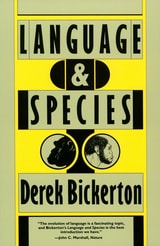
Language and Species
Derek Bickerton
University of Chicago Press, 1992
"You are drawn into [Bickerton's] appreciation of the dominant role language plays not only in what we say, but in what we think and, therefore, what we are."—Robert Wright, New York Times Book Review
"The evolution of language is a fascinating topic, and Bickerton's Language and Species is the best introduction we have."—John C. Marshall, Nature
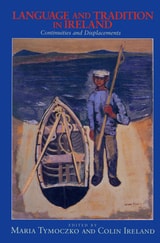
Language and Tradition in Ireland
Continuities and DisplacementsMaria Tymoczko
University of Massachusetts Press, 2003
If language and culture are intimately connected, then cultures involving people who speak more than one language must have special characteristics, as well as particular social issues to negotiate. What are the challenges faced by a people with two or more languages as their heritage? How does that multiple heritage affect cultural forms, including literature and the arts? How does linguistic difference influence the conceptualization and writing of history? And if the meeting of languages within a people has involved contestation and power, how are those conflicts negotiated?
This volume uses the tools of critical theory to explore such questions with respect to the complex, multilingual history of Ireland. Avoiding the simplistic polarized oppositions popular with cultural nationalists, the contributors examine the nexus of language, tradition, and authority in Ireland that has created such a rich, multivalent culture.
Although the linguistic interface of Irish and English has dominated cultural negotiations in Ireland over the last five hundred years, the island has an even longer history of linguistic and cultural exchange. Arguing that tradition is never static, the essays in this volume challenge the concept of a monolithic cultural origin, while insisting on the importance of inherited discourses in the continuity of culture through time and across linguistic difference. The chapters cover a broad range of topics from early Irish narratives and Latin hagiography to literary works by such writers as Yeats, Joyce, Friel, Montague, and McGahern, as well as other cultural forms, including traditional Irish music. Several chapters address issues of politics and power, from the role of interpreters in the relations between linguistic communities in Ireland to the politicization of language in Northern Ireland since the 1980s. Taken together, the essays illuminate scholarly domains as varied as postcolonial theory, the relationship between language and nation, the nature of tradition, and Irish literature of all periods.
In addition to the editors, contributors include Michael Cronin, Joanne Findon, Helen Fulton, Declan Kiberd, Jeremy Lowe, Gordon McCoy and Camille O'Reilly, Catherine McKenna, Cóilín Owens, Thomas Dillon Redshaw, and Sally K. Sommers Smith.
Language and the Creative Mind
Edited by Michael Borkent, Barbara Dancygier, and Jennifer Hinnell
CSLI, 2013
Language and the Law in Deaf Communities
Ceil Lucas
Gallaudet University Press, 2003
Language from a Cognitive Perspective
Grammar, Usage, and ProcessingEdited by Emily M. Bender and Jennifer E. Arnold
CSLI, 2011
This book is a collection of papers on language processing, usage, and grammar, written to commemorate the career of Thomas Wasow on the occasion of his sixty-fifth birthday. Wasow has been professor of linguistics and philosophy at Stanford University since 1973, and is affiliated with the Symbolic Systems Program. He has made significant contributions to the study of English syntax, psycholinguistics, and philosophy of linguistics.
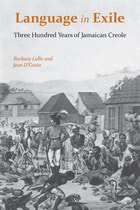
Language in Exile
Three Hundred Years of Jamaican CreoleBarbara Lalla
University of Alabama Press, 2009
--SECOL Review
"The history of Jamaican Creole comes to life through this book. Scholars will analyze its texts, follow the leads it opens up, and argue about refining its interpretations for a long time to come."
--Journal of Pidgin & Creole Languages
"The authors are to be congratulated on this substantial contribution to our understanding of how Jamaican Creole developed. Its value lies not only in the linguistic insights of the authors but also in the rich trove of texts that they have made accessible."
--English World-Wide
"Provides valuable historical and demographic data and sheds light on the origins and development of Jamaican Creole. Lalla and D'Costa offer interesting insights into Creole genesis, not only through their careful mapping of the migrations from Europe and Africa, which constructed the Jamaican society but also through extensive documentation of early texts. . . . Highly valuable to linguists, historians, anthropologists, psychologists, and anyone interested in the Caribbean or in the history of mankind."
--New West Indian Guide
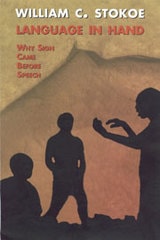
Language in Hand
Why Sign Came Before SpeechWilliam C. Stokoe
Gallaudet University Press, 2001
In Language in Hand: Why Sign Came Before Speech, William C. Stokoe begins his exploration of the origin of human language with a 2400-year-old quote by Democritus: “Everything existing in the universe is the fruit of chance and necessity.” Stokoe capitalizes upon this simple credo in this far-ranging examination of the scholarly topography to support his formula for the development of language in humans: gesture-to-language-to-speech. Intrinsic to this is the proposition that speech is sufficient for language, but not necessary. Chance brought human ancestors down from the trees to the ground, freeing their hands for gesture, and then sign language, a progression that came from the necessity to communicate.
Stokoe recounts in Language in Hand how inspiration grew out of his original discovery in the 1950s and ’60s that deaf people who signed were using a true language with constructions that did not derive from spoken English. This erudite, highly engaging investigation calls upon decades of personal experience and published research to refute the recently entrenched principles that humans have a special, innate learning faculty for language and that speech equates with language. Integrating current findings in linguistics, semiotics, and anthropology, Stokoe fashions a closely-reasoned argument that suggests how our human ancestors’ powers of observation and natural hand movements could have evolved into signed morphemes.
Stokoe also proposes how the primarily gestural expression of language with vocal support shifted to primarily vocal language with gestural accompaniment. When describing this transition, however, he never loses sight of the significance of humans in the natural world and the role of environmental stimuli in the development of language. Stokoe illustrates this contention with fascinating observations of small, contemporary ethnic groups such as the Assiniboin Nakotas, a Native American group from Montana that intermingle their spoken and signed languages depending upon cultural imperatives.
Language in Hand also presents innovative thoughts on classifiers in American Sign Language and their similarity to certain spoken languages, convincing evidence that speech originally copied sign language forms before developing unrelated conventions through usage. Stokoe concludes with a hypothesis on how the acceptance of sign language as the first language of humans could revolutionize the education of infants, both deaf and hearing, who, like early humans, have the full capacity for language without speech.
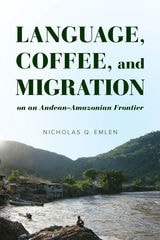
Language, Coffee, and Migration on an Andean-Amazonian Frontier
Nicholas Q. Emlen
University of Arizona Press, 2020
The rich-tasting Peruvian coffee in your cup is the distillate of an intensely dynamic Amazonian frontier, where native Matsigenkas, state agents, and migrants from the rural highlands are carving the forest into farms. Language, Coffee, and Migration on an Andean-Amazonian Frontier shows how people of different backgrounds married together and blended the Quechua, Matsigenka, and Spanish languages in their day-to-day lives. This frontier relationship took place against a backdrop of deforestation, cocaine trafficking, and destructive natural gas extraction.
Nicholas Q. Emlen’s rich account—which takes us to remote Amazonian villages, dusty frontier towns, roadside bargaining sessions, and coffee traders’ homes—offers a new view of settlement frontiers as they are negotiated in linguistic interactions and social relationships. This interethnic encounter was not a clash between distinct groups but rather an integrated network of people who adopted various stances toward each other as they spoke.
The book brings together a fine-grained analysis of multilingualism with urgent issues in Latin America today, including land rights, poverty, drug trafficking, and the devastation of the world’s largest forest. It offers a timely on-the-ground perspective on the agricultural colonization of the Amazon, which has triggered an environmental emergency threatening the future of the planet.
Language, Culture, and Mind
Edited by Michel Achard and Suzanne Kemmer
CSLI, 2003
Language, History, and Identity
Ethnolinguistic Studies of the Arizona TewaPaul V. Kroskrity
University of Arizona Press, 1993

Language, Proof, and Logic
Second EditionDave Barker-Plummer, Jon Barwise, and John Etchemendy
CSLI, 2011
Language Proof and Logic is available as a physical book with the software included and as a downloadable package of software plus the book in PDF format. The all-electronic version is available from Openproof at gradegrinder.net.
The textbook/software package covers first-order language in a method appropriate for first and second courses in logic. An on-line grading services instantly grades solutions to hundred of computer exercises. It is designed to be used by philosophy instructors teaching a logic course to undergraduates in philosophy, computer science, mathematics, and linguistics.
Introductory material is presented in a systematic and accessible fashion. Advanced chapters include proofs of soundness and completeness for propositional and predicate logic, as well as an accessible sketch of Godel's first incompleteness theorem. The book is appropriate for a wide range of courses, from first logic courses for undergraduates (philosophy, mathematics, and computer science) to a first graduate logic course.
The software package includes four programs:
Tarski's World, a new version of the popular program that teaches the basic first-order language and its semantics;
Fitch, a natural deduction proof environment for giving and checking first-order proofs;
Boole, a program that facilitates the construction and checking of truth tables and related notions (tautology, tautological consequence, etc.);
Submit, a program that allows students to submit exercises done with the above programs to the Grade Grinder, the automatic grading service.
Grade reports are returned to the student and, if requested, to the student's instructor, eliminating the need for tedious checking of homework. All programs are available for Windows and Macintosh systems. Instructors do not need to use the programs themselves in order to be able to take advantage of their pedagogical value. More about the software can be found at gradegrinder.net.
The price of a new text/software package includes one Registration ID, which must be used each time work is submitted to the grading service. Once activated, the Registration ID is not transferable.
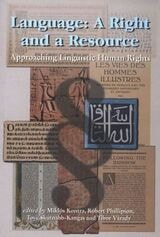
Language
A Right and a Resource: Approaches to Linguistic Human RightsTibor Várady
Central European University Press, 2000
Linguistic Human Rights (LHR) is a fast growing new area of study combining the principles of national and international law with the study of language as a central dimension of ethnicity. Implementation of these principles is aimed at ensuring that no state or society violates these basic rights.
This path breaking study broadens our knowledge of the important role of language in minority rights and in social and political struggles for LHRs. Exploring the interactions of linguistic diversity, biodiversity, the free market and human rights, the contributors present case studies to highlight such issues as Kurdish satellite TV attempting to create a virtual state on the air through trying to achieve basic LHR’s for Kurds in Turkey; the implementation of LHRs in the Baltic states; language rights activism in Canada; the spread of English as an international language; and the obstacles met in education by Roma and the Deaf in Hungary because of lack of appropriate LHRs.
Language: A Right and a Resource is a valuable multi-disciplinary text which can be used in a variety of different areas of study in the legal profession, linguistics, cultural and political studies.
Languages of Modern Jewish Cultures
Comparative PerspectivesEdited by Joshua L. Miller and Anita Norich
University of Michigan Press, 2016
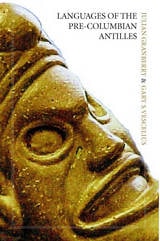
Languages of the Pre-Columbian Antilles
Julian Granberry and Gary Vescelius
University of Alabama Press, 2004
A linguistic analysis supporting a new model of the colonization of the Antilles before 1492
This work formulates a testable hypothesis of the origins and migration patterns of the aboriginal peoples of the Greater Antilles (Cuba, Jamaica, Hispaniola, and Puerto Rico), the Lucayan Islands (the Commonwealth of the Bahamas and the Crown Colony of the Turks and Caicos), the Virgin Islands, and the northernmost of the Leeward Islands, prior to European contact. Using archaeological data as corroboration, the authors synthesize evidence that has been available in scattered locales for more than 500 years but which has never before been correlated and critically examined.
Within any well-defined geographical area (such as these islands), the linguistic expectation and norm is that people speaking the same or closely related language will intermarry, and, by participating in a common gene pool, will show similar socioeconomic and cultural traits, as well as common artifact preferences. From an archaeological perspective, the converse is deducible: artifact inventories of a well-defined sociogeographical area are likely to have been created by speakers of the same or closely related language or languages.
Languages of the Pre-Columbian Antilles presents information based on these assumptions. The data is scant—scattered words and phrases in Spanish explorers' journals, local place names written on maps or in missionary records—but the collaboration of the authors, one a linguist and the other an archaeologist, has tied the linguistics to the ground wherever possible and allowed the construction of a framework with which to understand the relationships, movements, and settlement patterns of Caribbean peoples before Columbus arrived.
Last Words
Large Language Models and the AI ApocalypsePaul Kockelman
Prickly Paradigm Press, 2024
What kind of meaning can machines make—and why does it matter that it’s not the same as ours?
Anthropologist Paul Kockelman's Last Words offers a rigorous but accessible account of how large language models actually work—and why the meaning they produce is fundamentally different from human meaning-making. Drawing on the semiotics of C.S. Peirce, Kockelman’s witty and insightful pamphlet shows how LLMs are trained to predict word-word relations, not word-world relations, which explains both their uncanny fluency and their systematic blind spots. The result is a compact, essential guide to cutting through the hype: not a dismissal of AI, but a precise account of what it can and cannot do—and who profits from the confusion.

Latin Classics in Medieval Hungary
Eleventh CenturyElod Nemerkényi
Central European University Press, 2004
Layers of Aspect
Patricia Cabredo Hofherr and Brenda Laca
CSLI, 2010
The eight articles in this volume reexamine the syntactic and semantic analyses of aspect that have been proposed mainly on the basis of aspectual expressions in English. The authors contrast expressions sharing an analogous morpho-syntactic make-up and some core distributional and semantic properties, drawing on a wide range of new empirical data from languages as diverse as Syrian Arabic, Urdu, Brazilian Portuguese, Russian, Indonesian, and German. The papers address four aspect-related problems in particular: the grammatical and semantic constraints on the different readings of the present perfect, the semantic and syntactic analysis of auxiliaries, the impact of adverbial expressions on the aspectual properties of the sentence, and morphology-semantics mapping.
Learnable Classes of Categorial Grammars
Makoto Kanazawa
CSLI, 1998
Lectures on Contemporary Syntactic Theories
An Introduction to Government-Binding Theory, Generalized Phrase Structure Grammar, and Lexical-Function GrammarPeter Sells
CSLI, 1985

Lectures on Deixis
Charles Fillmore
CSLI, 1997
Let's Speak Twi
A Proficiency Course in Akan Language and CultureAdams Bodomo, Charles Marfo, and Lauren Hall-Lew
CSLI, 2010
Let’s Speak Twi is an introductory language-learning textbook for speakers of English and other languages who seek proficiency in Akan Twi, the most widely used and understood native language of Ghana. Included in the book are several practice exercises and activities; an extensive range of culturally relevant topics and dialogues; lists of idiomatic, colloquial, and euphemistic expressions; a reference glossary; and tips on culturally appropriate behavior.
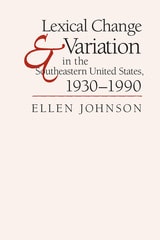
Lexical Change and Variation in the Southeastern United States, 1930-1990
Ellen Johnson
University of Alabama Press, 1996
This book discusses words used in the Southeast and how they have changed
during the 20th century. It also describes how the lexicon varies according
to the speaker's age, race, education, sex, and place of residence
(urban versus rural; coastal versus piedmont versus mountain). Data collected
in the 1930s as part of the Linguistic Atlas of the Middle and South Atlantic
States project were compared with data collected in 1990 from similar speakers
in the same communities.
The results show that region was the most important
factor in differentiating dialects in the 1930s but that it is the least
important element in the 1990s, with age, education, race, and age all
showing about the same influence on the use of vocabulary. An appendix
contains a tally of the responses given by 78 speakers to 150 questions
about vocabulary items, along with speakers' commentary. Results
from the 1930s may be compared to those from 1990, making this a treasure
trove for anyone interested in regional terms or in how our speech is changing
as the South moves from an agricultural economy through industrialization
and into the information age.
Lexical Relations
Jean-Pierre Koenig
CSLI, 1999
Lexical Semantics in LFG
Edited by Miriam Butt and Tracy Holloway King
CSLI, 2006
Lexical and Constructional Aspects of Linguistic Explanation
Edited by Gert Webelhuth, Jean-Pierre Koenig, and Andreas Kathol
CSLI, 1999
Lexical-Functional Grammar
An Introduction to Parallel Constraint-Based SyntaxYehuda N. Falk
CSLI, 2001

Life in Language
Mission Feminists and the Emergence of a New Protestant SubjectIngie Hovland
University of Chicago Press, 2025
The language of the Bible is a powerful lens through which many Protestants understand themselves and their world, and its prohibitions on women’s speech pose complicated challenges to women. Nevertheless, women frequently serve as vocal leaders in Protestant organizations, including the early twentieth-century Norwegian Mission Society. In Life in Language, Ingie Hovland offers a unique biography of Henny Dons, a leader of the society’s so-called mission feminists, that grapples with ways Protestant women crafted innovative, expansive self-understandings through Christian language. More than their male peers, the mission feminists turned to religious speech to express material, as well as heavenly, desires for paid work, voting rights, and more, and Hovland argues that these experiments in women speaking, reading, writing, and listening paved the way for a new way of being in the world.
LingVis
Visual Analytics for LinguisticsEdited by Miriam Butt, Annette Hautli-Janisz, and Verena Lyding
CSLI, 2018

Linguistic Atlas of the Middle and South Atlantic States, Fascicle 2
Raven I. McDavid Jr. and Raymond K. O'Cain
University of Chicago Press, 1980

Linguistic Databases
Edited by John Nerbonne
CSLI, 1998
Linguistic Diversity in Space and Time
Johanna Nichols
University of Chicago Press, 1992
"An awe-inspiring book, unequalled in scope, originality, and the range of language data considered."—Anna Siewierska, Linguistics
"Fascinating. . . . A brilliant pioneering study."—Journal of Indo-European Studies
"A superbly reasoned book."—John A. C. Greppin, Times Literary Supplement
Linguistic Form and Its Computation
Edited by Christian Rohrer, Antje Rossdeutscher, and Hans Kamp
CSLI, 2001
Linguistic Individuals
Almerindo E. Ojeda
CSLI, 1993
Linguistic Issues in Language Technology Vol 9
Perspectives on Semantic Representations for Textual InferenceEdited by Cleo Condoravdi, Valeria de Paiva, and Annie Zaenen
CSLI, 2014
Linguistics Across Cultures
Applied Linguistics for Language TeachersRobert Lado
University of Michigan Press, 1957
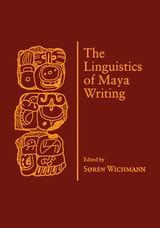
Linguistics Of Maya Writing
Soren Wichmann
University of Utah Press, 2004