138 books match the query 'Logic' and 24 start with l
cover of LOGIC OF PREELECTORAL COALITION FORMATION

LOGIC OF PREELECTORAL COALITION FORMATION

SONA NADENICHEK GOLDER

The Ohio State University Press, 2006

Why do some parties coordinate their electoral strategies as part of a pre-electoral coalition, while others choose to compete independently at election time? Scholars have long ignored pre-electoral coalitions in favor of focusing on the government coalitions that form after parliamentary elections. Yet electoral coalitions are common, they affect electoral outcomes, and they have important implications for democratic policy-making itself.

The Logic of Pre-Electoral Coalition Formation by Sona Nadenichek Golder includes a combination of methodological approaches (game theoretic, statistical, and historical) to explain why pre-electoral coalitions form in some instances but not in others. The results indicate that pre-electoral coalitions are more likely to form between ideologically compatible parties. They are also more likely to form when the expected coalition size is large (but not too large) and when the potential coalition partners are similar in size. Ideologically polarized party systems and disproportional electoral rules in combination also increase the likelihood of electoral coalition formation.

Golder links the analysis of pre-electoral coalition formation to the larger government coalition literature by showing that pre-electoral agreements increase (a) the likelihood that a party will enter government, (b) the ideological compatibility of governments, and (c) the speed with which governments take office. In addition, pre-electoral coalitions provide an opportunity for combining the best elements of the majoritarian vision of democracy with the best elements of the proportional vision of democracy.
[more]
cover of Language, Proof, and Logic: Second Edition

Language, Proof, and Logic

Second Edition

Dave Barker-Plummer, Jon Barwise, and John Etchemendy

CSLI, 2011

Language Proof and Logic is available as a physical book with the software included and as a downloadable package of software plus the book in PDF format. The all-electronic version is available from Openproof at gradegrinder.net.

The textbook/software package covers first-order language in a method appropriate for first and second courses in logic. An on-line grading services instantly grades solutions to hundred of computer exercises. It is designed to be used by philosophy instructors teaching a logic course to undergraduates in philosophy, computer science, mathematics, and linguistics.

Introductory material is presented in a systematic and accessible fashion. Advanced chapters include proofs of soundness and completeness for propositional and predicate logic, as well as an accessible sketch of Godel's first incompleteness theorem. The book is appropriate for a wide range of courses, from first logic courses for undergraduates (philosophy, mathematics, and computer science) to a first graduate logic course.

The software package includes four programs:

Tarski's World, a new version of the popular program that teaches the basic first-order language and its semantics;

Fitch, a natural deduction proof environment for giving and checking first-order proofs;

Boole, a program that facilitates the construction and checking of truth tables and related notions (tautology, tautological consequence, etc.);

Submit, a program that allows students to submit exercises done with the above programs to the Grade Grinder, the automatic grading service.

Grade reports are returned to the student and, if requested, to the student's instructor, eliminating the need for tedious checking of homework. All programs are available for Windows and Macintosh systems. Instructors do not need to use the programs themselves in order to be able to take advantage of their pedagogical value. More about the software can be found at gradegrinder.net.

The price of a new text/software package includes one Registration ID, which must be used each time work is submitted to the grading service. Once activated, the Registration ID is not transferable.
[more]
cover of Leading a Human Life: Wittgenstein, Intentionality, and Romanticism

Leading a Human Life

Wittgenstein, Intentionality, and Romanticism

Richard Eldridge

University of Chicago Press, 1997

In this provocative new study, Richard Eldridge presents a highly original and compelling account of Wittgenstein's Philosophical Investigations, one of the most enduring yet enigmatic works of the twentieth century. He does so by reading the text as a dramatization of what is perhaps life's central motivating struggle—the inescapable human need to pursue an ideal of expressive freedom within the difficult terms set by culture.

Eldridge sees Wittgenstein as a Romantic protagonist, engaged in an ongoing internal dialogue over the nature of intentional consciousness, ranging over ethics, aesthetics, and philosophy of mind. The picture of the human mind that emerges through this dialogue unsettles behaviorism, cognitivism, and all other scientifically oriented orthodoxies. Leading a human life becomes a creative act, akin to writing a poem, of continuously seeking to overcome both complacency and skepticism. Eldridge's careful reconstruction of the central motive of Wittgenstein's work will influence all subsequent scholarship on it.
[more]
cover of Lectures on Linear Logic

Lectures on Linear Logic

A. S. Troelstra

CSLI, 1992
Linear logic is an example of a "resource-sensitive" logic, keeping track of the number of times data of given types are used. Formulas in linear logic represent either the data themselves or data types, whereas in ordinary logic a formula is a proposition. If ordinary logic is a logic of truth, linear logic is a logic of actions. Linear logic and its implications are explored in depth in this volume. Particular attention has been given to the various formalisms for linear logic, embeddings of classical and intuitionistic logic into linear logic, the connection with certain types of categories, the "formulas-as-types" paradigm for linear logic and associated computational interpretations, and Girard's proof nets for classical linear logic as an analogue of natural deduction. It is also shown that linear logic is undecidable. A final section, contributed by D. Roorda, presents a proof of strong normalization for cut elimination in linear logic. Linear logic is of interest to logicians and computer scientists, and shows links with many other topics, such as coherence theorems in category theory, the theory of Petri nets, and abstract computing machines without garbage collection
[more]
cover of Listening for Africa: Freedom, Modernity, and the Logic of Black Music's African Origins

Listening for Africa

Freedom, Modernity, and the Logic of Black Music's African Origins

David F. Garcia

Duke University Press, 2017
In Listening for Africa David F. Garcia explores how a diverse group of musicians, dancers, academics, and activists engaged with the idea of black music and dance’s African origins between the 1930s and 1950s. Garcia examines the work of figures ranging from Melville J. Herskovits, Katherine Dunham, and Asadata Dafora to Duke Ellington, Dámaso Pérez Prado, and others who believed that linking black music and dance with Africa and nature would help realize modernity’s promises of freedom in the face of fascism and racism in Europe and the Americas, colonialism in Africa, and the nuclear threat at the start of the Cold War. In analyzing their work, Garcia traces how such attempts to link black music and dance to Africa unintentionally reinforced the binary relationships between the West and Africa, white and black, the modern and the primitive, science and magic, and rural and urban. It was, Garcia demonstrates, modernity’s determinations of unraced, heteronormative, and productive bodies, and of scientific truth that helped defer the realization of individual and political freedom in the world.
[more]
cover of Logic Colloquium '92

Logic Colloquium '92

Edited by Lázló Csirmaz, Dov M. Gabbay, and Maarten de Rijke

CSLI, 1995
Logic Colloquium '92, the European Summer Meeting of the Association for Symbolic Logic, was held in Veszpre;m, Hungary, in August 1992. Two of the main themes of the event were algebraic logic, and axiomatisability and decidability of logical systems. The present volume contains a selection of papers that grew out of invited and contributed talks on these themes. Most of the papers have a strong interdisciplinary flavour as they investigate logical properties of formal systems by studying algebraic properties of corresponding classes of algebras, or vice versa. The remaining papers focus on connected areas from model theory and the combination of logics. This is a useful and timely volume on algebraic logic and related areas, with contributions by leading people in the field.
[more]
cover of Logic and Automata: History and Perspectives

Logic and Automata

History and Perspectives

Edited by Jörg Flum, Erich Grädel, and Thomas Wilke

Amsterdam University Press, 2008
Mathematical logic and automata theory are two scientific disciplines with a fundamentally close relationship. The authors of Logic and Automata take the occasion of the sixtieth birthday of Wolfgang Thomas to present a tour d’horizon of automata theory and logic. The twenty papers in this volume cover many different facets of logic and automata theory, emphasizing the connections to other disciplines such as games, algorithms, and semigroup theory, as well as discussing current challenges in the field.
 
[more]
cover of Logic and Pragmatism: Selected Essays by Giovanni Vailati

Logic and Pragmatism

Selected Essays by Giovanni Vailati

Claudia Arrighi, Paola Cantu, Mauro de Zan, and Patrick Suppes

CSLI, 2009

Logic and Pragmatism features a number of the key writings of Giovanni Vailati (1863–1909), the Italian mathematician and philosopher renowned for his work in mechanics, geometry, logic, and epistemology. The selections in this book—many of which are available here for the first time in English—focus on Vailati’s significant contributions to the field of pragmatism. Accompanying these pieces are introductory essays by the volume’s editors that outline the traits of Vailati’s pragmatism and provide insights into the scholar’s life.
[more]
cover of Logic and Representation

Logic and Representation

Robert C. Moore

CSLI, 1993

Logic and Representation brings together a collection of essays, written over a period of ten years, that apply formal logic and the notion of explicit representation of knowledge to a variety of problems in artificial intelligence, natural language semantics, and the philosophy of mind and language. Particular attention is paid to modeling and reasoning about knowledge and belief, including reasoning about one's own beliefs, and the semantics of sentences about knowledge and belief. Robert C. Moore begins by exploring the role of logic in artificial intelligence, considering logic as an analytical tool., as a basis for reasoning systems, and as a programming language. He then looks at various logical analyses of propositional attitudes, including possible-world models, syntactic models, and models based on Russellian propositions. Next Moore examines autoepistemic logic, a logic for modeling reasoning about one's own beliefs. Rounding out the volume is a section on the semantics of natural language, including a survey of problems in semantic representation; a detailed study of the relations among events, situations, and adverbs; and a presentation of a unification-based approach to semantic interpretation. Robert C. Moore is principal scientist of the Artificial Intelligence Center of SRI International.
[more]
cover of Logic and Sin in the Writings of Ludwig Wittgenstein

Logic and Sin in the Writings of Ludwig Wittgenstein

Philip R. Shields

University of Chicago Press, 1992

Philip R. Shields shows that ethical and religious concerns inform even the most technical writings on logic and language, and that, for Wittgenstein, the need to establish clear limitations is both a logical and an ethical demand. Rather than merely saying specific things about theology and religion, major texts from the Tractatus to the Philosophical Investigations express their fundamentally religious nature by showing that there are powers which bear down upon and sustain us. Shields finds a religious view of the world at the very heart of Wittgenstein's philosophy.

"Shields argues that the appearance throughout Wittgenstein's writings of such concepts as ritual, limit, transgression, a change of will, pride, temptation, and judgment implies a relation between religion and the logical aspects of Wittgenstein's philosophy."—Choice

"Of the many recent books about Wittgenstein, Logic and Sin is one of the very few that are well worth having"—Fergus Kerr, Modern Theology

"What Shields has uncovered in Wittgenstein's religious sensibility is something genuine and profound. . . . Shields has not just written an important book on Wittgenstein but an enlightening work that invites further reflection."—Eric O. Springsted, Cross Currents
[more]
cover of Logic and Visual Information

Logic and Visual Information

Eric M. Hammer

CSLI, 1995
[more]
cover of Logic and the Art of Memory: The Quest for a Universal Language

Logic and the Art of Memory

The Quest for a Universal Language

Paolo Rossi

University of Chicago Press, 2001

The mnemonic arts and the idea of a universal language that would capture the essence of all things were originally associated with cryptology, mysticism, and other occult practices. And it is commonly held that these enigmatic efforts were abandoned with the development of formal logic in the seventeenth century and the beginning of the modern era. In his distinguished book, Logic and the Art of Memory Italian philosopher and historian Paolo Rossi argues that this view is belied by an examination of the history of the idea of a universal language.

Based on comprehensive analyses of original texts, Rossi traces the development of this idea from late medieval thinkers such as Ramon Lull through Bruno, Bacon, Descartes, and finally Leibniz in the seventeenth century. The search for a symbolic mode of communication that would be intelligible to everyone was not a mere vestige of magical thinking and occult sciences, but a fundamental component of Renaissance and Enlightenment thought. Seen from this perspective, modern science and combinatorial logic represent not a break from the past but rather its full maturity.

Available for the first time in English, this book (originally titled Clavis Universalis) remains one of the most important contributions to the history of ideas ever written. In addition to his eagerly anticipated translation, Steven Clucas offers a substantial introduction that places this book in the context of other recent works on this fascinating subject. A rich history and valuable sourcebook, Logic and the Art of Memory documents an essential chapter in the development of human reason.
[more]
cover of Logic as a Liberal Art: An Introduction to Rhetoric and Reasoning

Logic as a Liberal Art

An Introduction to Rhetoric and Reasoning

R. E. Houser

Catholic University of America Press, 2020
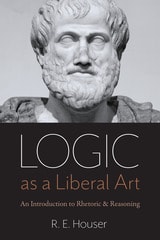
In the twenty-first century there are two ways to study logic. The more recent approach is symbolic logic. The history of teaching logic since World War II, however, casts doubt on the idea that symbolic logic is best for a first logic course. Logic as a Liberal Art is designed as part of a minority approach, teaching logic in the "verbal" way, in the student's "natural" language, the approach invented by Aristotle. On utilitarian grounds alone, this "verbal" approach is superior for a first course in logic, for the whole range of students. For millennia, this "verbal" approach to logic was taught in conjunction with grammar and rhetoric, christened the trivium. The decline in teaching grammar and rhetoric in American secondary schools has led Dr. Rollen Edward Houser to develop this book. The first part treats grammar, rhetoric, and the essential nature of logic. Those teachers who look down upon rhetoric are free, of course, to skip those lessons. The treatment of logic itself follows Aristotle's division of the three acts of the mind (Prior Analytics 1.1). Formal logic is then taken up in Aristotle's order, with Parts on the logic of Terms, Propositions, and Arguments. The emphasis in Logic as a Liberal Art is on learning logic through doing problems. Consequently, there are more problems in each lesson than would be found, for example, in many textbooks. In addition, a special effort has been made to have easy, medium, and difficult problems in each Problem Set. In this way the problem sets are designed to offer a challenge to all students, from those most in need of a logic course to the very best students.
[more]
cover of Logic, Convention, and Common Knowledge: A Conventionalist Account of Logic

Logic, Convention, and Common Knowledge

A Conventionalist Account of Logic

Paul F. Syverson

CSLI, 2002

One of the fundamental theses of this book is that logical consequence and logical truth are not simply given, but arise as conventions among the users of logic. Thus Syverson explains convention within a game-theoretic framework, as a kind of equilibrium between the strategies of players in a game where they share common knowledge of events—a revisiting of Lewis's Convention that argues that convention can be reasonably treated as coordination equilibria. Most strikingly, a realistic solution is provided for Gray's classic coordination problem, wherein two generals can only communicate with each other through unreliable means.
[more]
cover of Logic, Information and Agency

Logic, Information and Agency

Johan van Benthem

CSLI, 2025

A systematic study of information dynamics that extends beyond what is found in standard logic textbooks.

Everything we do is driven by information, but the dynamic process of acquiring information and adjusting our views based on it has seldom been put at the center place in logic, and there are few textbooks introducing readers to this line of work. The present book introduces the reader to major logical techniques for studying information dynamics and interaction between agents, based on a variety of intuitive scenarios as well as recent research. Readers will learn styles of modeling, as well as the basic features of the new logical systems emanating from this line of work. All the separate strands in the book are brought together in a comprehensive study of information flow and action in games, forming a logic-based complement to standard perspectives in game theory.
 
[more]
cover of Logic, Langage and Computation, Volume 2

Logic, Langage and Computation, Volume 2

Edited by Lawrence S. Moss, Jonathan Ginzburg, and Maarten de Rijke

CSLI, 1999
The fields of logic, linguistics and computer science are intimately related, and modern research has uncovered a wide range of connections. This collection focuses on work that is based on the unifying concept of information. This collection of nineteen papers covers subjects such as channel theory, presupposition and constraints, the modeling of discourse, and belief. They were all presented at the 1996 Conference on Information-Theoretic Approaches to Logic, Language, Information, and Computation.
[more]
cover of Logic, Language and Computation

Logic, Language and Computation

Edited by Jerry Seligman and Dag Westerståhl

CSLI, 1996
Subject: Linguistics; Logic; Computational Linguistics
[more]
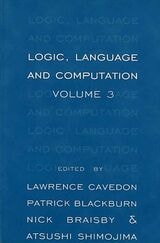
cover of Logic, Language and Computation, Volume 3

Logic, Language and Computation, Volume 3

Edited by Patrick Blackburn, Nick Braisby, Lawrence Cavedon, and Atsushi Shimoji

CSLI, 2001

With the rise of the internet and the proliferation of technology to gather and organize data, our era has been defined as "the information age." With the prominence of information as a research concept, there has arisen an increasing appreciation of the intertwined nature of fields such as logic, linguistics, and computer science that answer the questions about information and the ways it can be processed. The many research traditions do not agree about the exact nature of information. By bringing together ideas from diverse perspectives, this book presents the emerging consensus about what a conclusive theory of information should be. The book provides an introduction to the topic, work on the underlying ideas, and technical research that pins down the richer notions of information from a mathematical point of view.

The book contains contributions to a general theory of information, while also tackling specific problems from artificial intelligence, formal semantics, cognitive psychology, and the philosophy of mind. There is focus on the dynamics of information flow, and also a consideration of static approaches to information content; both quantitative and qualitative approaches are represented.
[more]
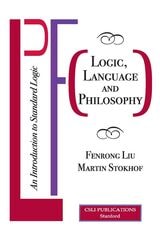
cover of Logic, Language and Philosophy: An Introduction to Standard Logic

Logic, Language and Philosophy

An Introduction to Standard Logic

Fenrong Liu and Martin Stokhof

CSLI, 2024

A fresh introduction to the field of logic, this book provides a fascinating encounter between linguistics and philosophy utilizing logic.

This book explores the systematic and formal study of reasoning. It introduces the core systems of logic, discusses a portion of its extensions, and illustrates the application of logic in philosophy and linguistics utilizing classical and contemporary sources. In doing so, it provides the students with a rich set of tools along with first-hand experience regarding their applications in the study of rationality and meaning. With lots of exercises, and study and discussion questions, it provides a complete set of materials for courses for a variety of audiences at different levels.
 
[more]
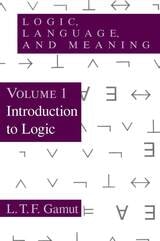
cover of Logic, Language, and Meaning, Volume 1: Introduction to Logic

Logic, Language, and Meaning, Volume 1

Introduction to Logic

L. T. F. Gamut

University of Chicago Press, 1990

Although the two volumes of Logic, Language, and Meaning can be used independently of one another, together they provide a comprehensive overview of modern logic as it is used as a tool in the analysis of natural language. Both volumes provide exercises and their solutions.

Volume 1, Introduction to Logic, begins with a historical overview and then offers a thorough introduction to standard propositional and first-order predicate logic. It provides both a syntactic and a semantic approach to inference and validity, and discusses their relationship. Although language and meaning receive special attention, this introduction is also accessible to those with a more general interest in logic.

In addition, the volume contains a survey of such topics as definite descriptions, restricted quantification, second-order logic, and many-valued logic. The pragmatic approach to non-truthconditional and conventional implicatures are also discussed. Finally, the relation between logic and formal syntax is treated, and the notions of rewrite rule, automation, grammatical complexity, and language hierarchy are explained.
[more]
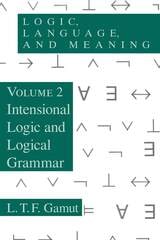
cover of Logic, Language, and Meaning, Volume 2: Intensional Logic and Logical Grammar

Logic, Language, and Meaning, Volume 2

Intensional Logic and Logical Grammar

L. T. F. Gamut

University of Chicago Press, 1990
Although the two volumes of Logic, Language, and Meaning can be used independently of one another, together they provide a comprehensive overview of modern logic as it is used as a tool in the analysis of natural language. Both volumes provide exercises and their solutions.
[more]
cover of Logical Reasoning with Diagrams and Sentences: Using Hyperproof

Logical Reasoning with Diagrams and Sentences

Using Hyperproof

Dave Barker-Plummer, Jon Barwise, and John Etchemendy

CSLI, 2016

The Logical Reasoning with Diagrams and Sentences courseware package teaches the principles of analytical reasoning and proof construction using a carefully crafted combination of textbook, desktop, and online materials. This package is sure to be an essential resource in a range of courses incorporating logical reasoning, including formal linguistics, philosophy, mathematics, and computer science.

Unlike traditional formal treatments of reasoning, this package uses both graphical and sentential representations to reflect common situations in everyday reasoning where information is expressed in many forms, such as finding your way to a location using a map and an address. It also teaches students how to construct and check the logical validity of a variety of proofs—of consequence and non-consequence, consistency and inconsistency, and independence—using an intuitive proof system which extends standard proof treatments with sentential, graphical, and heterogeneous inference rules, allowing students to focus on proof content rather than syntactic structure. Building upon the widely used Tarski’s World and Language, Proof and Logic courseware packages, Logical Reasoning with Diagrams and Sentences contains more than three hundred exercises, most of which can be assessed by the Grade Grinder online assessment service; is supported by an extensive website through which students and instructors can access online video lectures by the authors; and allows instructors to create their own exercises and assess their students’ work.

Logical Reasoning with Diagrams and Sentences is an expanded revision of the Hyperproof courseware package.
[more]
cover of Logics of Time and Computation

Logics of Time and Computation

Robert Goldblatt

CSLI, 1992
"This is a short but excellent introduction to modal, temporal, and dynamic logic....It manages to cover, in highly readable style, the basic completeness, decidability, and expressability results in a variety of logics of the three kinds considered." -Rohit Parikh, reviewing the first edition in the Journal of Symbolic Logic. Now revised and significantly expanded, this textbook introduces modal logic and examines the relevance of modal systems for theoretical computer science. Golblatt sets out a basic theory of normal modal and temporal propositional logics, including issues such as completeness proofs, decidability, first-order defiability, and canonicity. The basic theory is then applied to logics of discrete, dense, and continuous time; to the temporal logic of concurrent programs involving the connectives henceforth, next , anduntil; and to the dynamic logic of regular programs. New material for the second edition extends the temporal logic of concurrency to branching time, studying a system of Computational Tree Logic that formalizes reasoning about behavior. Dynamic logic is also extended to the case of concurrency, intorducing a connective for the parallel execution of commands. A seperate section is devoted to the quantificational dynamic logic. Numerous excercises are included for use in the classroom. Robert Goldblatt is a professor of pure mathematics at the Victoria University of Wellington, New Zealand. Center for the Study of Language and Information- Lecture Notes, Number 7
[more]
cover of Love and Logic: The Evolution of Blake's Thought

Love and Logic

The Evolution of Blake's Thought

Stephen Cox

University of Michigan Press, 1992

William Blake is usually regarded as the greatest poet of mysticism in the English language. His primary theme is love -- love of God, love of the Divine Humanity that he often equated with God, and the sexual love that he regarded sometimes as an embodiment and sometimes as a parody of divine love. For Blake, love was not so much a virtue as a problem, a problem that he reassessed in different ways throughout his life, using a variety of logical tools. Love and logic may seem an unusual pair of concerns, especially for a visionary poet, but author Stephen Cox believes that in Blake's work the problems of love and logic evolve together, constantly influencing each other and determining the structure of the poet's vision.Scholars who have come to view Blake as a visionary whose work followed nonlinear processes have advanced the notion that his artistic achievement defies conventional interpretation. Love and Logic challenges the tendency in postmodern criticism to see authors and readers as confined by history, language, and logic, denied the ability discover truth or to communicate it in determinate form. Love and Logic emphasizes Blake's ambitious quest for truth, his desire to keep telling the story of human and divine love until he got it right, using all the strategies of logic available to him.Cox points to what he sees as the irony of Blake’s relationship to his postmodern admirers: although his goals and values are antithetical to theirs, he encounters grave difficulties when he handles logic in some of the ways in which they do. In this connection, Love and Logic’s analysis of the the problems of logical “substantialism” is especially important. The analysis develops the idea that it is not logic itself but a particular way of using logic that produces an effect of logical self-imprisonment.
[more]