Results by title
209 books match the query 'Mathematics' and 14 start with l
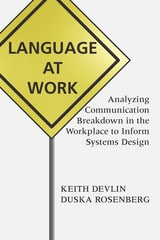
Language at Work
Analyzing Communication Breakdown in the Workplace to Inform Systems DesignKeith Devlin and Duska Rosenberg
CSLI, 1996
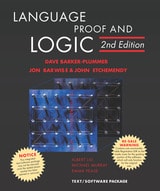
Language, Proof, and Logic
Second EditionDave Barker-Plummer, Jon Barwise, and John Etchemendy
CSLI, 2011
Language Proof and Logic is available as a physical book with the software included and as a downloadable package of software plus the book in PDF format. The all-electronic version is available from Openproof at gradegrinder.net.
The textbook/software package covers first-order language in a method appropriate for first and second courses in logic. An on-line grading services instantly grades solutions to hundred of computer exercises. It is designed to be used by philosophy instructors teaching a logic course to undergraduates in philosophy, computer science, mathematics, and linguistics.
Introductory material is presented in a systematic and accessible fashion. Advanced chapters include proofs of soundness and completeness for propositional and predicate logic, as well as an accessible sketch of Godel's first incompleteness theorem. The book is appropriate for a wide range of courses, from first logic courses for undergraduates (philosophy, mathematics, and computer science) to a first graduate logic course.
The software package includes four programs:
Tarski's World, a new version of the popular program that teaches the basic first-order language and its semantics;
Fitch, a natural deduction proof environment for giving and checking first-order proofs;
Boole, a program that facilitates the construction and checking of truth tables and related notions (tautology, tautological consequence, etc.);
Submit, a program that allows students to submit exercises done with the above programs to the Grade Grinder, the automatic grading service.
Grade reports are returned to the student and, if requested, to the student's instructor, eliminating the need for tedious checking of homework. All programs are available for Windows and Macintosh systems. Instructors do not need to use the programs themselves in order to be able to take advantage of their pedagogical value. More about the software can be found at gradegrinder.net.
The price of a new text/software package includes one Registration ID, which must be used each time work is submitted to the grading service. Once activated, the Registration ID is not transferable.
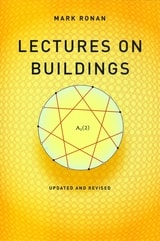
Lectures on Buildings
Updated and RevisedMark Ronan
University of Chicago Press, 2009
In mathematics, “buildings” are geometric structures that represent groups of Lie type over an arbitrary field. This concept is critical to physicists and mathematicians working in discrete mathematics, simple groups, and algebraic group theory, to name just a few areas.
Almost twenty years after its original publication, Mark Ronan’s Lectures on Buildings remains one of the best introductory texts on the subject. A thorough, concise introduction to mathematical buildings, it contains problem sets and an excellent bibliography that will prove invaluable to students new to the field. Lectures on Buildings will find a grateful audience among those doing research or teaching courses on Lie-type groups, on finite groups, or on discrete groups.
“Ronan’s account of the classification of affine buildings [is] both interesting and stimulating, and his book is highly recommended to those who already have some knowledge and enthusiasm for the theory of buildings.”—Bulletin of the London Mathematical Society

Lectures on Exceptional Lie Groups
J. F. Adams
University of Chicago Press, 1996
Because Lie groups form a staple of most mathematics graduate students' diets, this work on exceptional Lie groups should appeal to many of them, as well as to researchers of algebraic geometry and topology.
J. Frank Adams was Lowndean professor of astronomy and geometry at the University of Cambridge. The University of Chicago Press published his Lectures on Lie Groups and has reprinted his Stable Homotopy and Generalized Homology.
Chicago Lectures in Mathematics Series
Lectures on Lie Groups
J. F. Adams
University of Chicago Press, 1983
Lectures on Linear Logic
A. S. Troelstra
CSLI, 1992
Legendre Polynomials
George C. Clark and Stuart W. Churchill
University of Michigan Press, 1957
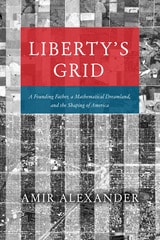
Liberty's Grid
A Founding Father, a Mathematical Dreamland, and the Shaping of AmericaAmir Alexander
University of Chicago Press, 2024
Seen from an airplane, much of the United States appears to be a gridded land of startling uniformity. Perpendicular streets and rectangular fields, all precisely measured and perfectly aligned, turn both urban and rural America into a checkerboard landscape that stretches from horizon to horizon. In evidence throughout the country, but especially the West, the pattern is a hallmark of American life. One might consider it an administrative convenience—an easy way to divide land and lay down streets—but it is not. The colossal grid carved into the North American continent, argues historian and writer Amir Alexander, is a plan redolent with philosophical and political meaning.
In 1784 Thomas Jefferson presented Congress with an audacious scheme to reshape the territory of the young United States. All western lands, he proposed, would be inscribed with a single rectilinear grid, transforming the natural landscape into a mathematical one. Following Isaac Newton and John Locke, he viewed mathematical space as a blank slate on which anything is possible and where new Americans, acting freely, could find liberty. And if the real America, with its diverse landscapes and rich human history, did not match his vision, then it must be made to match it.
From the halls of Congress to the open prairies, and from the fight against George III to the Trail of Tears, Liberty’s Grid tells the story of the battle between grid makers and their opponents. When Congress endorsed Jefferson’s plan, it set off a struggle over American space that has not subsided. Transcendentalists, urban reformers, and conservationists saw the grid not as a place of possibility but as an artificial imposition that crushed the human spirit. Today, the ideas Jefferson associated with the grid still echo through political rhetoric about the country’s founding, and competing visions for the nation are visible from Manhattan avenues and Kansan pastures to Yosemite’s cliffs and suburbia’s cul-de-sacs. An engrossing read, Liberty’s Grid offers a powerful look at the ideological conflict written on the landscape.
Lie Algebras and Locally Compact Groups
Irving Kaplansky
University of Chicago Press, 1971
Logic Colloquium '92
Edited by Lázló Csirmaz, Dov M. Gabbay, and Maarten de Rijke
CSLI, 1995
Logic and Automata
History and PerspectivesEdited by Jörg Flum, Erich Grädel, and Thomas Wilke
Amsterdam University Press, 2008
Logic and Representation
Robert C. Moore
CSLI, 1993
Logic and Visual Information
Eric M. Hammer
CSLI, 1995
Logics of Time and Computation
Robert Goldblatt
CSLI, 1992