Results by title
157 books match the query 'Mexican-American Border Region' and 7 start with l
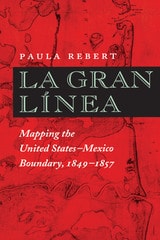
La Gran Línea
Mapping the United States–Mexico Boundary, 1849–1857By Paula Rebert
University of Texas Press, 2001
The Treaty of Guadalupe Hildalgo, which officially ended the U.S.-Mexican War in 1848, cost Mexico half its territory, while the United States gained land that became California, Nevada, Utah, Texas, and parts of Colorado, Arizona, and New Mexico. Because the new United States-Mexico border ran through territory that was still incompletely mapped, the treaty also called for government commissions from both nations to locate and mark the boundary on the ground. This book documents the accomplishments of both the U.S. and the Mexican Boundary Commissions that mapped the boundary between 1849 and 1857, as well as the fifty-four pairs of maps produced by their efforts and the ongoing importance of these historical maps in current boundary administration. Paula Rebert explores how, despite the efforts of both commissions to draw neutral, scientific maps, the actual maps that resulted from their efforts reflected the differing goals and outlooks of the two countries. She also traces how the differences between the U.S. and Mexican maps have had important consequences for the history of the boundary.
Labor Market Issues along the U.S.-Mexico Border
Edited by Marie T. Mora and Alberto Dávila
University of Arizona Press, 2009
The contributors take up issues that dominate the current discourse— migration, trade, gender, education, earnings, and employment. They analyze labor conditions and their relationship to immigration, and also provide insight into income levels and population concentrations, the relative prosperity of Mexico’s border region, and NAFTA’s impact on trade and living conditions.
Drawing on demographic, economic, and labor data, the chapters treat topics ranging from historical context to directions for future research. They cover the importance of trade to both the United States and Mexico, salary differentials, the determinants of wages among Mexican immigrant women on the U.S. side, and the net effect of Mexican migration on the public coffers in U.S. border states. The book’s concluding policy prescriptions are geared toward improving conditions on the U.S. side without dampening the success of workers in Mexico.
Written to be equally accessible to social scientists, policy makers, and concerned citizens, this book deals with issues often overlooked in national policy discussions and can help readers better understand real-life conditions along the border. It dispels misconceptions regarding labor interdependence between the two countries while offering policy recommendations useful for improving the economic and social well-being of border residents.
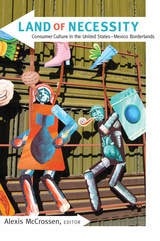
Land of Necessity
Consumer Culture in the United States–Mexico BorderlandsAlexis McCrossen, ed.
Duke University Press, 2009
In Land of Necessity, historians and anthropologists unravel the interplay of the national and transnational and of scarcity and abundance in the region split by the 1,969-mile boundary line dividing Mexico and the United States. This richly illustrated volume, with more than 100 images including maps, photographs, and advertisements, explores the convergence of broad demographic, economic, political, cultural, and transnational developments resulting in various forms of consumer culture in the borderlands. Though its importance is uncontestable, the role of necessity in consumer culture has rarely been explored. Indeed, it has been argued that where necessity reigns, consumer culture is anemic. This volume demonstrates otherwise. In doing so, it sheds new light on the history of the U.S.-Mexico borderlands, while also opening up similar terrain for scholarly inquiry into consumer culture.
The volume opens with two chapters that detail the historical trajectories of consumer culture and the borderlands. In the subsequent chapters, contributors take up subjects including smuggling, tourist districts and resorts, purchasing power, and living standards. Others address home décor, housing, urban development, and commercial real estate, while still others consider the circulation of cinematic images, contraband, used cars, and clothing. Several contributors discuss the movement of people across borders, within cities, and in retail spaces. In the two afterwords, scholars reflect on the U.S.-Mexico borderlands as a particular site of trade in labor, land, leisure, and commodities, while also musing about consumer culture as a place of complex political and economic negotiations. Through its focus on the borderlands, this volume provides valuable insight into the historical and contemporary aspects of the big “isms” shaping modern life: capitalism, nationalism, transnationalism, globalism, and, without a doubt, consumerism.
Contributors. Josef Barton, Peter S. Cahn, Howard Campbell, Lawrence Culver, Amy S. Greenberg, Josiah McC. Heyman, Sarah Hill, Alexis McCrossen, Robert Perez, Laura Isabel Serna, Rachel St. John, Mauricio Tenorio-Trillo, Evan R. Ward
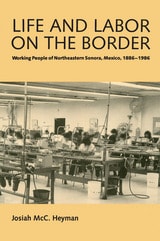
Life and Labor on the Border
Working People of Northeastern Sonora, Mexico, 1886–1986Josiah McC. Heyman
University of Arizona Press, 1991
Life and Labor on the Border traces the development of the urban working class in northern Sonora over the period of a century. Drawing on an extensive collection of life histories, Heyman describes what has happened to families over several generations as people have left the countryside to work for American-owned companies in northern Sonora or to cross the border to find other employment.
Heyman searches for the origins of "working classness" in these family histories, revealing aspects of life that strengthen people' s involvement with a consumer economy, including the role of everyday objects like sewing machines, cars, and stoves. He considers the consequences of changing political and economic tides, and also the effects on family life of the new role of women in the labor force. Within the broad sweep of family chronicles, key junctures in individual lives—both personal and historical crises—offer additional insights into social class dynamics.
Heyman's work dispels the notion that border inhabitants are uniformly impoverished or corrupted by proximity to the United States. These life stories instead convey the positive sense of people's goals in life and reveal the origins of a distinctive way of life in the Borderlands.
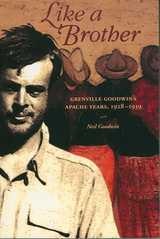
Like a Brother
Grenville Goodwin’s Apache Years, 1928-1939Neil Goodwin
University of Arizona Press, 2004
Assembled by Goodwin's son Neil, who never knew his father, these writings are gathered in thematic chapters that extend Neil Goodwin's earlier work, The Apache Diaries, and shed light on Grenville Goodwin's deepening understanding of the Apache people and their culture, and of the wrenching problems which reservation life forced on them. In two of the chapters Neil tells how he retraced his father's search for the Sierra Madre Apache, re-discovering abandoned Apache campsites and conveying even more personally than his father's diaries what was for both father and son the adventure of a lifetime. Other chapters trace Goodwin's interest in children of the Sierra Madre Apaches who were captured in Mexican raids on these camps during the early decades of the twentieth century. The full stories of the lives of three of these children are for the first time pieced together from newly gathered research.
Grenville was quiet, self-effacing and rarely revealed his inner life, but one chapter affords a closer look: a portrait of his marriage to Neil's mother, Jan. Her diary entries, juxtaposed with her vivid poetry and her paintings and drawings, illuminate her relationship with Grenville and throw his elusive personality into deeper relief than his own writings do. Here too are letters from Goodwin's Apache friends that paint a powerful and poignant portrait of their daily lives and of their relationship with him. Goodwin's daily diary excerpts relate his own experiences on the San Carlos Apache reservation from 1928 to 1936: what was happening at the store, how the cattle were doing, who was in jail, and thousands of other details that give readers a sharp sense of what the reservation was like in the 1930s. As these writings also show, Goodwin was powerfully drawn to Apache spirituality and became steeped in their sacred knowledge. His simple description of a day in the life of an Apache family captures the expression of this spirituality in the rhythms of everyday life, whether greeting the rising sun, curing an injury, plowing the earth, or simply being good to one's family.
More than half a century after his death, Grenville Goodwin continues to be regarded as one of the most enigmatic and romantic figures in American anthropology. Like a Brother gives us a fuller understanding of the man and his work as it broadens our knowledge of Apache history and culture.
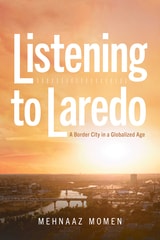
Listening to Laredo
A Border City in a Globalized AgeMehnaaz Momen
University of Arizona Press, 2023
Bringing together issues of growth, globalization, and identity, Mehnaaz Momen traces Laredo’s trajectory through the voices of its people. In contrast to the many studies of border cities defined by the outside—and seldom by the people who live at the border—this volume collects oral histories from seventy-five in-depth interviews that collectively illuminate the evolution of the city’s cultural and economic infrastructure, its interdependence with its sister city across the national boundary, and, above all, the strength of its community as it adapts to and even challenges the national narrative regarding the border. The resonant and lively voices of Laredo’s people convey proud ownership of an archetypal border city that has time and again resurrected itself.
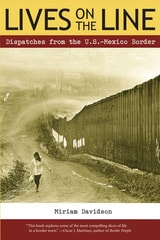
Lives on the Line
Dispatches from the U.S.-Mexico BorderMiriam Davidson
University of Arizona Press, 2000
In Lives on the Line, Miriam Davidson tells five true stories from these border cities to show the real-life effects that the maquiladora boom and the law enforcement crackdown have had on the people of "Ambos (Both) Nogales." Readers will meet Yolanda Sánchez, a single mother who came to work in the factories; Jimmy Teyechea, a cancer victim who became an outspoken environmental activist; Dario Miranda Valenzuela, an undocumented immigrant who was shot and killed by a U.S. Border Patrol agent; Cristina, a "tunnel kid" who aspired to flee the gang lifestyle; and Hope Torres and Tom Higgins, maquiladora managers who have made unique contributions to the community.
In sharing these stories of people transformed by love and faith, by pain and loss, Davidson relates their experiences to larger issues and shows that, although life on the border is tough, it is not without hope.
Lives on the Line is an impassioned look at the changes that have swept the U.S.-Mexico border: the rising tension concerning free trade and militarization, the growing disparity between the affluent and the impoverished. At the same time, the book highlights the positive aspects of change, revealing challenges and opportunities not only for the people who live on the border but for all Americans.