149 books match the query 'Modernity' and 3 start with l

cover of Landscape of Modernity: Essays on New York City, 1900-1940

Landscape of Modernity

Essays on New York City, 1900-1940

David Ward

Russell Sage Foundation, 1992
New York City stands as the first expression of the modern city, a mosaic of disparate neighborhoods born in 1898 with the amalgamation of the five boroughs and shaped by the passions of developers and regulators, architects and engineers, politicians and reformers, immigrant entrepreneurs and corporate builders. Through their labor, their ideals, and their often fierce battles, the physical and social dimensions—the landscape—of the modern city were forged. The original essays in The Landscape of Modernity tell the compelling story of the growth of New York City from 1900 to 1940, from the beginnings of its skyscraper skyline to the expanding reaches of suburbanization. At the beginning of the century, New York City was already one of the world's leading corporate and commercial centers. The Zoning Ordinance of 1916, initially proposed by Fifth Avenue merchants as a means of halting the uptown spread of the garment industry, became the nation's first comprehensive zoning law and the proving ground for a new occupation—the urban planner. During the 1920s, frenzied development created a vertical metamorphosis in Manhattan's booming business district, culminating in its most spectacularly modern icon, the Empire State Building. The city also spread laterally, with the controversial development of subway systems and the creation of the powerful Port of New York Authority, whose new bridges and tunnels decentralized the population and industry of New York. New York's older ethnic enclaves were irrevocably altered by this new urban landscape: the Lower East Side's Jewish community was nearly dismantled by the flight of the garment industry and the attractiveness of new suburbs, while Little Italy fought government forces eager to homogenize commercial use of the streets by eliminating the traditional pushcart peddlers. Illustrated with striking photographs and maps, The Landscape of Modernity links important scenes of growth and development to the larger political, economic, social, and cultural processes of the early twentieth century.
[more]
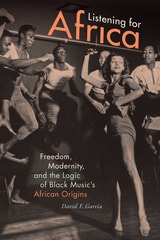
cover of Listening for Africa: Freedom, Modernity, and the Logic of Black Music's African Origins

Listening for Africa

Freedom, Modernity, and the Logic of Black Music's African Origins

David F. Garcia

Duke University Press, 2017
In Listening for Africa David F. Garcia explores how a diverse group of musicians, dancers, academics, and activists engaged with the idea of black music and dance’s African origins between the 1930s and 1950s. Garcia examines the work of figures ranging from Melville J. Herskovits, Katherine Dunham, and Asadata Dafora to Duke Ellington, Dámaso Pérez Prado, and others who believed that linking black music and dance with Africa and nature would help realize modernity’s promises of freedom in the face of fascism and racism in Europe and the Americas, colonialism in Africa, and the nuclear threat at the start of the Cold War. In analyzing their work, Garcia traces how such attempts to link black music and dance to Africa unintentionally reinforced the binary relationships between the West and Africa, white and black, the modern and the primitive, science and magic, and rural and urban. It was, Garcia demonstrates, modernity’s determinations of unraced, heteronormative, and productive bodies, and of scientific truth that helped defer the realization of individual and political freedom in the world.
[more]
cover of Locations of Buddhism: Colonialism and Modernity in Sri Lanka

Locations of Buddhism

Colonialism and Modernity in Sri Lanka

Anne M. Blackburn

University of Chicago Press, 2010

Modernizing and colonizing forces brought nineteenth-century Sri Lankan Buddhists both challenges and opportunities. How did Buddhists deal with social and economic change; new forms of political, religious, and educational discourse; and Christianity?  And how did Sri Lankan Buddhists, collaborating with other Asian Buddhists, respond to colonial rule? To answer these questions, Anne M. Blackburn focuses on the life of leading monk and educator Hikkaduve Sumangala (1827–1911) to examine more broadly Buddhist life under foreign rule.

In Locations of Buddhism, Blackburn reveals that during Sri Lanka’s crucial decades of deepening colonial control and modernization, there was a surprising stability in the central religious activities of Hikkaduve and the Buddhists among whom he worked. At the same time, they developed new institutions and forms of association, drawing on pre-colonial intellectual heritage as well as colonial-period technologies and discourse. Advocating a new way of studying the impact of colonialism on colonized societies, Blackburn is particularly attuned here to human experience, paying attention to the habits of thought and modes of affiliation that characterized individuals and smaller scale groups. Locations of Buddhism is a wholly original contribution to the study of Sri Lanka and the history of Buddhism more generally.

[more]