Results by title
618 books match the query 'Motion pictures' and 13 start with l
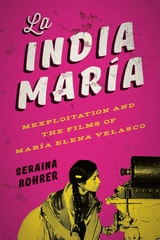
La India María
Mexploitation and the Films of María Elena VelascoBy Seraina Rohrer
University of Texas Press, 2017
La India María—a humble and stubborn indigenous Mexican woman—is one of the most popular characters of the Mexican stage, television, and film. Created and portrayed by María Elena Velasco, La India María has delighted audiences since the late 1960s with slapstick humor that slyly critiques discrimination and the powerful. At the same time, however, many critics have derided the iconic figure as a racist depiction of a negative stereotype and dismissed the India María films as exploitation cinema unworthy of serious attention. By contrast, La India María builds a convincing case for María Elena Velasco as an artist whose work as a director and producer—rare for women in Mexican cinema—has been widely and unjustly overlooked.
Drawing on extensive interviews with Velasco, her family, and film industry professionals, as well as on archival research, Seraina Rohrer offers the first full account of Velasco’s life; her portrayal of La India María in vaudeville, television, and sixteen feature film comedies, including Ni de aquí, ni de allá [Neither here, nor there]; and her controversial reception in Mexico and the United States. Rohrer traces the films’ financing, production, and distribution, as well as censorship practices of the period, and compares them to other Mexploitation films produced at the same time. Adding a new chapter to the history of a much-understudied period of Mexican cinema commonly referred to as “la crisis,” this pioneering research enriches our appreciation of Mexploitation films.
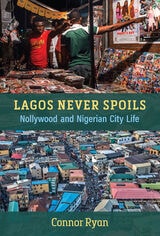
Lagos Never Spoils
Nollywood and Nigerian City LifeConnor Ryan
University of Michigan Press, 2023
Winner of the Society for Cinema and Media Studies, Media Industries Scholarly Interest Group Outstanding Book Award
The slogan “Lagos shall not spoil,” found in print media, political campaigns, and common conversation, represents a shared expression of the optimism the city embodies. However, on city streets the phrase also appears scrawled in irreverent variations—“Lagos cannot spoil more than this!”—that meet the frustrations of city life with irony. In both cases, the slogan captures the resilience and persistence with which residents of Lagos live on, despite it all. This book examines the circumstances that make it possible for residents to persist in pursuing their various projects and for the city to remain a platform that supports these projects and creates space for even more to emerge. Author Connor Ryan argues that residents continually work to combine contingency and endurance in opportunistic ways that make the city work for them, and as such, Lagos never spoils: it endures.
What makes Lagos remarkable is what residents have made of it, and Nollywood—the industry and the body of films—both embodies and represents this continual urban transformation. Lagos Never Spoils traces how Nollywood arose from the social milieu of Lagos and, in turn, generates a repertoire of stories, images, styles, and sentiments with which audiences come to grips with city life. The book traces the evolution of the screen media industry in Lagos and explores how this corresponds with historical phases in the city’s representation onscreen. It discusses important urban spaces of production and consumption, including historic movie halls, video marketplaces, film sets, and multiplex cinemas. Across six chapters, it attends to celluloid films about oil-boom wealth, television sitcoms about urban tricksters, video melodramas about urban crisis, glossy romantic comedies about young professionals, and dark thrillers on streaming platforms about the pleasure of moral transgression. In this fashion, the book offers new approaches to the interpretation of screen texts produced in and about Lagos, a place that is today the most influential image of West African city life.
Latent Destinies
Cultural Paranoia and Contemporary U.S. NarrativePatrick O Donnell
Duke University Press, 2000
O’Donnell argues that paranoia on the broadly cultural level is essentially a narrative process in which history and postmodern identity are negotiated simultaneously. The result is an erasure of historical temporality—the past and future become the all-consuming, self-aware present. To explain and exemplify this, O’Donnell looks at such books and films as Libra, JFK, The Crying of Lot 49, The Truman Show, Reservoir Dogs, Empire of the Senseless, Oswald’s Tale, The Executioner’s Song, Underworld, The Killer Inside Me, and Groundhog Day. Organized around the topics of nationalism, gender, criminality, and construction of history, Latent Destinies establishes cultural paranoia as consonant with our contradictory need for multiplicity and certainty, for openness and secrecy, and for mobility and historical stability.
Demonstrating how imaginative works of novels and films can be used to understand the postmodern historical condition, this book will interest students and scholars of American literature and cultural studies, postmodern theory, and film studies.
Latin American Melodrama
Passion, Pathos, and EntertainmentEdited and with an Introduction by Darlene J. Sadlier
University of Illinois Press, 2008
Like their Hollywood counterparts, Latin American film and TV melodramas have always been popular and highly profitable. The first of its kind, this anthology engages in a serious study of the aesthetics and cultural implications of Latin American melodramas. Written by some of the major figures in Latin American film scholarship, the studies range across seventy years of movies and television within a transnational context, focusing specifically on the period known as the "Golden Age" of melodrama, the impact of classic melodrama on later forms, and more contemporary forms of melodrama. An introductory essay examines current critical and theoretical debates on melodrama and places the essays within the context of Latin American film and media scholarship.
Contributors are Luisela Alvaray, Mariana Baltar, Catherine L. Benamou, Marvin D’Lugo, Paula Félix-Didier, Andrés Levinson, Gilberto Perez, Darlene J. Sadlier, Cid Vasconcelos, and Ismail Xavier.
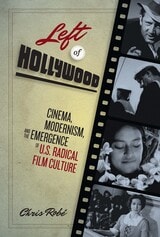
Left of Hollywood
Cinema, Modernism, and the Emergence of U.S. Radical Film CultureBy Chris Robé
University of Texas Press, 2010
In the 1930s as the capitalist system faltered, many in the United States turned to the political Left. Hollywood, so deeply embedded in capitalism, was not immune to this shift. Left of Hollywood offers the first book-length study of Depression-era Left film theory and criticism in the United States. Robé studies the development of this theory and criticism over the course of the 1930s, as artists and intellectuals formed alliances in order to establish an engaged political film movement that aspired toward a popular cinema of social change. Combining extensive archival research with careful close analysis of films, Robé explores the origins of this radical social formation of U.S. Left film culture.
Grounding his arguments in the surrounding contexts and aesthetics of a few films in particular—Sergei Eisenstein's Que Viva Mexico!, Fritz Lang's Fury, William Dieterle's Juarez, and Jean Renoir's La Marseillaise—Robé focuses on how film theorists and critics sought to foster audiences who might push both film culture and larger social practices in more progressive directions. Turning at one point to anti-lynching films, Robé discusses how these movies united black and white film critics, forging an alliance of writers who championed not only critical spectatorship but also the public support of racial equality. Yet, despite a stated interest in forging more egalitarian social relations, gender bias was endemic in Left criticism of the era, and female-centered films were regularly discounted. Thus Robé provides an in-depth examination of this overlooked shortcoming of U.S. Left film criticism and theory.

Limiting Secularism
The Ethics of Coexistence in Indian Literature and FilmPriya Kumar
University of Minnesota Press, 2008
With a backdrop of religious violence and escalating regional tensions in South Asia, Priya Kumar’s Limiting Secularism probes the urgent topic of secularism and tolerance in Indian culture and life. Kumar explores Partition as the founding trauma of the Indian nation-state and traces the consequences of its marking off of “Indian” from “Pakistani” and the positioning of Indian Muslims as strangers within the nation.
Kumar unpacks the implications of the Nehruvian doctrine of tolerance-with all of its resonances of condescension and inequality-and asks whether more ethical cohabitation can replace the “arrogant compulsive tolerance” of the state and the majority. Informed by Jacques Derrida’s recent work on hospitality and living together, Kumar argues for the emergence of an “ethics of coexistence” in Indian fiction and film. Considering narratives ranging from the cosmopolitan English novels of Rushdie and Ghosh to literature in South Asian languages as well as recent Hindi cinema, Kumar demonstrates that these fictions are important resources for reimagining tolerance and coexistence.
Distinctive and timely in its investigation of secularism and communalism, Limiting Secularism works to envision the radical possibilities of going beyond tolerance to living well together.
Priya Kumar is associate professor of English at the University of Iowa.
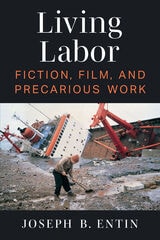
Living Labor
Fiction, Film, and Precarious WorkJoseph B. Entin
University of Michigan Press, 2023
Cover attribution: Allan Sekula, Shipwreck and worker, Istanbul, from TITANIC’s wake, 1998/2000. Courtesy of the Allan Sekula Studio.
Long Shadows
The Second World War in British Fiction and FilmEdited by Petra Rau
Northwestern University Press, 2016
Looking Past the Screen
Case Studies in American Film History and MethodJon Lewis and Eric Smoodin, eds.
Duke University Press, 2007
Focusing on Hollywood cinema from the teens to the 1970s, these case studies show the value of this extraordinary range of historical materials in developing interdisciplinary approaches to film stardom, regulation, reception, and production. The contributors examine State Department negotiations over the content of American films shown abroad; analyze the star image of Clara Smith Hamon, who was notorious for having murdered her lover; and consider film journalists’ understanding of the arrival of auteurist cinema in Hollywood as it was happening during the early 1970s. One contributor chronicles the development of film studies as a scholarly discipline; another offers a sociopolitical interpretation of the origins of film noir. Still another brings to light Depression-era film reviews and Production Code memos so sophisticated in their readings of representations of sexuality that they undermine the perception that queer interpretations of film are a recent development. Looking Past the Screen suggests methods of historical research, and it encourages further thought about the modes of inquiry that structure the discipline of film studies.
Contributors. Mark Lynn Anderson, Janet Bergstrom, Richard deCordova, Kathryn Fuller-Seeley, Sumiko Higashi, Jon Lewis, David M. Lugowski, Dana Polan, Eric Schaefer, Andrea Slane, Eric Smoodin, Shelley Stamp
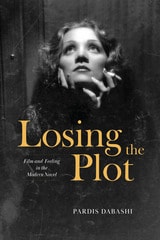
Losing the Plot
Film and Feeling in the Modern NovelPardis Dabashi
University of Chicago Press, 2023
The modernist novel sought to escape what Virginia Woolf called the “tyranny” of plot. Yet even as twentieth-century writers pushed against the constraints of plot-driven Victorian novels, plot kept its hold on them through the influence of another medium: the cinema. Focusing on the novels of Nella Larsen, Djuna Barnes, and William Faulkner—writers known for their affinities and connections to classical Hollywood—Pardis Dabashi links the moviegoing practices of these writers to the tensions between the formal properties of their novels and the characters in them. Even when they did not feature outright happy endings, classical Hollywood films often provided satisfying formal resolutions and promoted normative social and political values. Watching these films, modernist authors were reminded of what they were leaving behind—both formally and in the name of aesthetic experimentalism—by losing the plot.
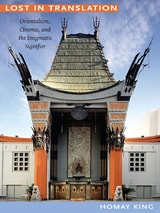
Lost in Translation
Orientalism, Cinema, and the Enigmatic SignifierHomay King
Duke University Press, 2010
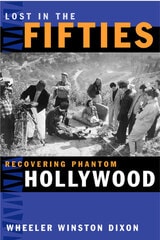
Lost in the Fifties
Recovering Phantom HollywoodWheeler Winston Dixon
Southern Illinois University Press, 2005
Lost in the Fifties: Recovering Phantom Hollywood reveals two 1950s: an era glorified in Hollywood movies and a darker reality reflected in the esoteric films of the decade. Renowned film scholar Wheeler Winston Dixon turns to the margins—the television shows and films of a hidden Hollywood—to offer an authentic view of the 1950s that counters the Tinsel-town version. Dixon examines the lost films and directors of the decade. Contrasting traditional themes of love, marriage, and family, Dixon’s 1950s film world unveils once-taboo issues of rape, prostitution, and gangs. Television shows such as Captain Midnight and Ramar of the Jungle are juxtaposed with the cheerful world of I Love Lucy and Howdy Doody. Highlighting directors including Herbert L. Strock, Leslie Martinson, Arnold Laven, and Charles Haas, Dixon provides new insights on the television series Racket Squad, Topper, and The Rifleman and the teen films I Was a Teenage Werewolf and High School Confidential.
Geared for scholars and students of film and pop culture, Lost in the Fifties includes twenty-five photos—many previously unpublished—and draws on rare interviews with key directors, actors, and producers. The volume provides the first detailed profile of the most prolific producer in Hollywood history, Sam Katzman, and his pop culture classics Rock Around the Clock and Earth vs. The Flying Saucers. Dixon profiles, for the first time, B-movie phenomenon Fred F. Sears, who directed more than fifty touchstone films of a generation, including the noir thriller Chicago Syndicate, the criminal career story Cell 2455 Death Row, and the 3-D color western The Nebraskan. Also profiled is Ida Lupino, the only woman to direct in Hollywood in the 1950s, who tackled issues of bigamy, teenage pregnancy, and sports corruption in The Bigamist, The Hitch-Hiker, Outrage, Never Fear, Not Wanted, and Hard, Fast and Beautiful, when no major studio would touch such controversial topics. Dixon also looks at the era’s social guidance films, which instructed adolescents in acceptable behavior, proper etiquette, and healthy hygiene.
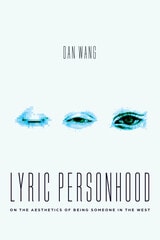
Lyric Personhood
On the Aesthetics of Being Someone in the WestDan Wang
University of Chicago Press, 2025
What does it mean to be a person? One might think of the possession of certain rights, having the capacity for love, or being self-determined. But if words like “person” or “love” seem to carry an internal meaning, where does this meaningfulness come from? Lyric Personhood contends that to be encultured in the modern West is to learn, on top of everything else, an unspoken and mostly felt sense of what it means to be someone, a sense transmitted not only in language but also through encounters with aesthetic form. Through close readings that span nineteenth-century European opera, commercial cinema, and amateur YouTube proposal videos, Dan Wang shows that a “person” has become an aesthetic concept—and not just a legal, moral, political, or philosophical one—in the last two hundred years of Western culture.
It’s hard to let go of the organizing promise of romantic love, the dream of therapeutic “health,” and the aspiration to belong to national culture, Wang argues, because these longings have been shaped by an archive of sentimental and melodramatic works that trains people's expectations for life, genre, and even the knowing promised in theory itself. Tracing a surprisingly continuous imagination of personhood through opera and film aesthetics, Lyric Personhood introduces modes of reading audiovisual works that allow a longer story to be told about the forms that make personhood sensible in the West.