Results by title
344 books match the query 'Nationalism' and 8 start with l
La Grande Italia
The Rise and Fall of the Myth of the Nation in the Twentieth CenturyEmilio Gentile
University of Wisconsin Press, 2008
Gentile’s definition of “Italians” encompasses the whole range of political, cultural, and social actors: Liberals and Catholics, Monarchists and Republicans, Fascists and Socialists. La Grande Italia presents a sweeping study of the development of Italian national identity in all its incarnations throughout the twentieth century. This important contribution to the study of modern Italian nationalism and the ambition to achieve a “great Italy” between the unification of Italy and the advent of the Italian Republic will appeal to anyone interested in modern European history, Fascism, and nationalism.
Best Books for Special Interests, selected by the American Association of School Librarians, and Best Books for Regional General Interests, selected by the Public Library Association
Late Enlightenment
Emergence of the Modern 'National Idea'Marius Turda
Central European University Press, 2006

Lawless Liberators
Political Banditry and Cuban IndependenceRosalie Schwartz
Duke University Press, 1989
Manuel Garcia, a hero-villian of Cuban folklore to this day, was the most notorious of the brigand-patriots and led a gang that spread terror throughout Havana province, contributing to the breakdown of rural order that preceded full-scale rebellion in 1895. Lawless Liberators examines the origins, actions, and ends (often sudden and violent) of the bandit groups such as Garcia’s that paved the way for the revolution and offers a reasoned and balanced analysis of their role in those dramatic events.
Legitimating Nationalism
Political Identity in Russia's Ethnic RepublicsKatie L. Stewart
University of Wisconsin Press, 2024
Even in the current autocratic system, however, Russia’s multiethnic nature and fractured political history mean that not all political symbols work the same way everywhere; not every story finds the same audience in the same way. The message may emanate from Moscow, but regional actors—including local governments, civic organizations, and cultural institutions—have some agency in how they spread the message: some regionalization of identity work is permitted to ensure that Russian national symbols and narratives resonate with people, and to avoid protest. This book investigates how nation building works on the ground through close studies of three of Russia’s ethnic republics: Karelia, Tatarstan, and Buryatia. Understanding how the project of legitimating nationalism, in support of a unified country and specifically Putin’s regime, works in practice offers crucial context in understanding the shape and story of contemporary Russia.

Liberty and the Search for Identity
Ivan Zoltan Denes
Central European University Press, 2006
Life in and against the Odds
Debts of Freedom and the Speculative Roots of U.S. CultureHeidi Hoechst
Temple University Press, 2015
Somehow people continue to imagine a world of justice against the odds of a deck that has been stacked against them. In her urgent and perceptive book, Life in and against the Odds, Hoechst focuses on the particular circumstances and conditions of different phases of speculative expansion in the United States. She traces the roots of the nation-state to nineteenth-century land markets and slave exchanges. Hoechst also chronicles how these racial foundations extend through corporate capitalism from the 1920s and ´30s to the present era of financialized capitalism and the recent housing bubble.
Life in and against the Odds identifies where and how speculative nationalism creates roadblocks to freedom. Hoechst retells the history of the United States with a perspective on how human lives are made, destroyed, reconfigured, and claimed under the systemic violence of a nation that is rooted in the racializing futurity of speculative capitalism.
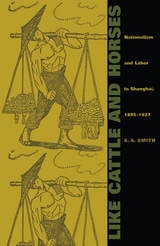
Like Cattle and Horses
Nationalism and Labor in Shanghai, 1895-1927S. A. Smith
Duke University Press, 2002
While the massive wave of labor protest in the 1920s was principally an expression of militant nationalism rather than of class consciousness, Smith argues, elements of a precarious class identity were in turn forged by the very discourse of nationalism. By linking work-related demands to the defense of the nation, anti-imperialist nationalism legitimized participation in strikes and sensitized workers to the fact that they were worthy of better treatment as Chinese citizens. Smith shows how the workers’ refusal to be treated “like cattle and horses” (a phrase frequently used by workers to describe their condition) came from a new but powerfully felt sense of dignity. In short, nationalism enabled workers to interpret the anger they felt at their unjust treatment in the workplace in political terms and to create a link between their position as workers and their position as members of an oppressed nation. By focusing on the role of the working class, Like Cattle and Horses is one of very few studies that examines nationalism “from below,” acknowledging the powerful agency of nonelite forces in promoting national identity.
Like Cattle and Horses will interest historians of labor, modern China, and nationalism, as well as those engaged in the study of revolutions and revolt.

Looking for Mexico
Modern Visual Culture and National IdentityJohn Mraz
Duke University Press, 2009
Turning to film, Mraz compares portrayals of the Mexican Revolution by Fernando de Fuentes to the later movies of Emilio Fernández and Gabriel Figueroa. He considers major stars of Golden Age cinema as gender archetypes for mexicanidad, juxtaposing the charros (hacienda cowboys) embodied by Pedro Infante, Pedro Armendáriz, and Jorge Negrete with the effacing women: the mother, Indian, and shrew as played by Sara García, Dolores del Río, and María Félix. Mraz also analyzes the leading comedians of the Mexican screen, representations of the 1968 student revolt, and depictions of Frida Kahlo in films made by Paul Leduc and Julie Taymor. Filled with more than fifty illustrations, Looking for Mexico is an exuberant plunge into Mexico’s national identity, its visual culture, and the connections between the two.