152 books match the query 'New York (N.Y.)' and 4 start with l
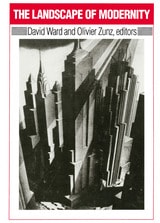
cover of Landscape of Modernity: Essays on New York City, 1900-1940

Landscape of Modernity

Essays on New York City, 1900-1940

David Ward

Russell Sage Foundation, 1992
New York City stands as the first expression of the modern city, a mosaic of disparate neighborhoods born in 1898 with the amalgamation of the five boroughs and shaped by the passions of developers and regulators, architects and engineers, politicians and reformers, immigrant entrepreneurs and corporate builders. Through their labor, their ideals, and their often fierce battles, the physical and social dimensions—the landscape—of the modern city were forged. The original essays in The Landscape of Modernity tell the compelling story of the growth of New York City from 1900 to 1940, from the beginnings of its skyscraper skyline to the expanding reaches of suburbanization. At the beginning of the century, New York City was already one of the world's leading corporate and commercial centers. The Zoning Ordinance of 1916, initially proposed by Fifth Avenue merchants as a means of halting the uptown spread of the garment industry, became the nation's first comprehensive zoning law and the proving ground for a new occupation—the urban planner. During the 1920s, frenzied development created a vertical metamorphosis in Manhattan's booming business district, culminating in its most spectacularly modern icon, the Empire State Building. The city also spread laterally, with the controversial development of subway systems and the creation of the powerful Port of New York Authority, whose new bridges and tunnels decentralized the population and industry of New York. New York's older ethnic enclaves were irrevocably altered by this new urban landscape: the Lower East Side's Jewish community was nearly dismantled by the flight of the garment industry and the attractiveness of new suburbs, while Little Italy fought government forces eager to homogenize commercial use of the streets by eliminating the traditional pushcart peddlers. Illustrated with striking photographs and maps, The Landscape of Modernity links important scenes of growth and development to the larger political, economic, social, and cultural processes of the early twentieth century.
[more]
cover of Latin Moon in Manhattan: A Novel

Latin Moon in Manhattan

A Novel

Jaime Manrique

University of Wisconsin Press, 2003

Exuberant and colorful, Latin Moon in Manhattan paints a vivid portrait of New York City as the land of El Dorado for today’s Latino immigrants. From Little Colombia in Queens to the street life of Times Square, this brilliant novel is crowded with an extraordinary cast of characters: Hot Sauce, a midget hooker; Simon Bolivar, a parrot who croons Julio Iglesias songs; the Urrutias, a family rich from cocaine smuggling; Santiago Martinez, a loner and would-be poet whose ancient cat, Mr. O’Donnell, is slowly dying of an enlarged heart. Exploding with a profusion of plots and subplots involving drug smuggling, romance, and the literary politics of Queens, Latin Moon in Manhattan is a rich and utterly charming work.
[more]
cover of Latino Urban Ethnography and the Work of Elena Padilla

Latino Urban Ethnography and the Work of Elena Padilla

Merida M. Rua

University of Illinois Press, 2010
This study reclaims and builds upon the classic work of anthropologist Elena Padilla in an effort to examine constructions of space and identity among Latinos. The volume includes an annotated edition of Padilla's 1947 University of Chicago master's thesis, "Puerto Rican Immigrants in New York and Chicago: A Study in Comparative Assimilation," which broke with traditional urban ethnographies and examined racial identities and interethnic relations. Weighing the importance of gender and the interplay of labor, residence, and social networks, Padilla examined the integration of Puerto Rican migrants into the social and cultural life of the larger community where they settled. Also included are four comparative and interdisciplinary original essays that foreground the significance of Padilla's early study about Latinos in Chicago. Contributors discuss the implications of her groundbreaking contributions to urban ethnographic traditions and to the development of Puerto Rican studies and Latina/o studies.
 
Contributors are Nicholas De Genova, Zaire Z. Dinzey-Flores, Elena Padilla, Ana Y. Ramos-Zayas, Mérida M. Rúa, and Arlene Torres.
[more]
cover of Loft Living: Culture and Capital in Urban Change

Loft Living

Culture and Capital in Urban Change

Zukin, Sharon

Rutgers University Press, 2014

Since its initial publication, Loft Living has become the classic analysis of the emergence of artists as a force of gentrification and the related rise of “creative city” policies around the world.  This 25th anniversary edition, with a new introduction, illustrates how loft living has spread around the world and that artists’ districts—trailing the success of SoHo in New York—have become a global tourist attraction. Sharon Zukin reveals the economic shifts and cultural transformations that brought widespread attention to artists as lifestyle models and agents of urban change, and explains their role in attracting investors and developers to the derelict loft districts where they made their home.

Prescient and dramatic, Loft Living shows how a declining downtown Manhattan became a popular “scene,” how loft apartments became hot commodities for the middle class, and how investors, corporations, and rich elites profited from deindustrializing the city’s factory districts and turning them into trendy venues for art galleries, artisanal restaurants, and bars. However, this edition points out that the artists who led the trend are now priced out of the loft market.  Even in New York, where the loft living market was born, artists have no legal claim on loft districts, nor do they get any preferential treatment in the harsh real estate market.

From the story of SoHo in Lower Manhattan to SoWa in Boston and SoMa in San Francisco, Zukin explains how once-edgy districts are transformed into high-price neighborhoods, and how no city can restrain the juggernaut of rising property values.
[more]