Results by title
572 books match the query 'Photography' and 22 start with l
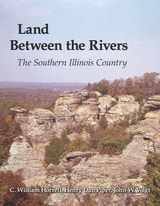
Land Between the Rivers
The Southern Illinois CountryC. William Horrell, Henry Dan Piper, John W. Voigt
Southern Illinois University Press, 1973
Surveying the area in words and pictures, the authors sensitively and appreciatively portray the region’s special qualities. Land Between the Rivers, a perennial classic since it was first published in 1973, provides an uncommon portrayal of American life in a distinct region, a memorable journey in both time and place.
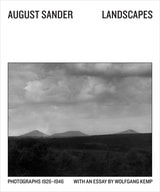
Landscapes
Photographs 1926-1946August Sander
University of Chicago Press, 2016
These photographs showcase a variety of scenes, from a sunrise over Cologne to the slopes of the Rhine valley. The Rhine River flows through many of these pictures, its dynamic curves and lively current leading the eye through an intriguing mix of natural and urban landscapes. A new essay by art historian Wolfgang Kemp provides context for Sander’s work while introducing his contemporaries, including the writer Hans Ludwig Mathar and the painter Franz M. Jansen. Also explored are the ties between Sander’s landscapes and his portrait photography, which is celebrated worldwide. Crucially, Kemp highlights the need to consider the Rhineland’s unique political situation in the 1920s and 1930s for any discussion of Sander’s artistic approach.
Shining welcome light on the full range of Sander’s practice, this book offers a glorious journey through the landscapes that most affected him.
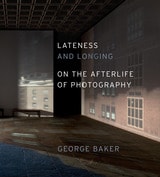
Lateness and Longing
On the Afterlife of PhotographyGeorge Baker
University of Chicago Press, 2023
Beginning in the 1990s, a series of major artists imagined the expansion of photography, intensifying its ideas and effects while abandoning many of its former medium constraints. Simultaneous with this development in contemporary art, however, photography was moving toward total digitalization.
Lateness and Longing presents the first account of a generation of artists—focused on the work of Zoe Leonard, Tacita Dean, Sharon Lockhart, and Moyra Davey—who have collectively transformed the practice of photography, using analogue technologies in a dissident way and radicalizing signifiers of older models of feminist art. All these artists have resisted the transition to the digital in their work. Instead—in what amounts to a series of feminist polemics—they return to earlier, incomplete, or unrealized moments in photography’s history, gravitating toward the analogue basis of photographic mediums. Their work announces that photography has become—not obsolete—but “late,” opened up by the potentially critical forces of anachronism.
Through a strategy of return—of refusing to let go—the work of these artists proposes an afterlife and survival of the photographic in contemporary art, a formal lateness wherein photography finds its way forward through resistance to the contemporary itself.
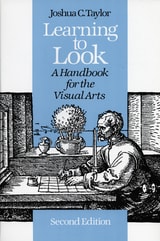
Learning to Look
A Handbook for the Visual ArtsJoshua C. Taylor
University of Chicago Press, 1981
This handy guide to the visual arts is designed to provide a comprehensive view of art, moving from the analytic study of specific works to a consideration of broad principles and technical matters. Forty-four carefully selected illustrations afford an excellent sampling of the wide range of experience awaiting the explorer.
The second edition of Learning to Look includes a new chapter on twentieth-century art. Taylor's thoughtful discussion of pure forms and our responses to them gives the reader a few useful starting points for looking at art that does not reproduce nature and for understanding the distance between contemporary figurative art and reality.
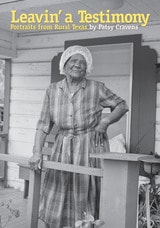
Leavin' a Testimony
Portraits from Rural TexasBy Patsy Cravens
University of Texas Press, 2006
First settled by Stephen F. Austin's colonists in the early nineteenth century, Colorado County has deep roots in Texas history. Mainly rural and agrarian until late in the twentieth century, Colorado County was a cotton-growing region whose population was about evenly divided between blacks and whites. These life-long neighbors led separate and unequal lives, memories of which still linger today. To preserve those memories, Patsy Cravens began interviewing and photographing the older residents of Colorado County in the 1980s. In this book, she presents photographs and recollections of the last generation, black and white, who grew up in the era of Jim Crow segregation.
The folks in Colorado County have engrossing stories to tell. They recall grinding poverty and rollicking fun in the Great Depression, losing crops and livestock to floods, working for the WPA, romances gone wrong and love gone right, dirty dancing, church and faith, sharecropping, quilting, raising children, racism and bigotry, and even the horrific lynching of two African American teenagers in 1935. The Colorado County residents' stories reveal an amazing resiliency and generosity of spirit, despite the hardships that have filled most of their lives. They also capture a rural way of life that was once common across the South, but is now gone forever.
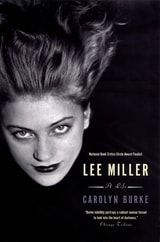
Lee Miller
A LifeCarolyn Burke
University of Chicago Press, 2007
Legal Spectatorship
Slavery and the Visual Culture of Domestic ViolenceKelli Moore
Duke University Press, 2022
Duke University Press Scholars of Color First Book Award recipient
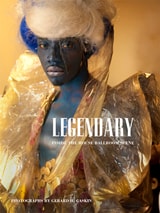
Legendary
Inside the House Ballroom SceneGerard H. Gaskin
Duke University Press, 0
From the quiet backstage, to the shimmering energies of the runway. to the electricity of the crowd, Gaskin's photographs take us to the ball. Legendary, comprised of photos taken at events in the New York city area, Philadelphia, Richmond, and Washington, D.C., is a collaboration between Gaskin, a camera-laden outsider who has been attending balls for twenty years, and the house members who let him enter the intimate world of ball culture. In addition to an introduction by Deborah Willis, Legendary includes an essay, "The Queer Undercommons," by Frank Roberts.
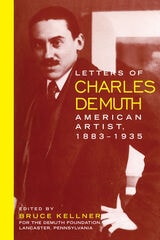
Letters Of Charles Demuth
Bruce Kellner
Temple University Press, 2000
This collection of 155 of his letters offers valuable views of the arts and letters colonies in Provincetown, New York, and Paris. Besides offering information on Demuth's own works, the letters also shed light on the output of his contemporaries, as well as references to their trips, liaisons, and idiosyncrasies. Demuth numbered among his correspondents some of the most famous artists and writers of his time, including Georgia O'Keeffe, Eugene O'Neill, John Reed, Gertrude Stein, Alfred Stieglitz, Carl Van Vechten, and William Carlos Willliams. In his travels in the United States and abroad, he encountered many other talented contemporaries: Peggy Bacon, Muriel Draper, Marcel Duchamp, the Stetthemer sisters, artists and writers, patrons, and gallery owners.
Whether he is offering to pick up a copy of Joyce's Ulysses for Eugene O'Neill or trying to convince Georgia O'Keeffe to decorate his music room ("just allow that red and yellow 'canna' one to spread until it fills the room"), Demuth is always in the thick of art and literary life. Flamboyant in attire but discreet in his homosexuality, Demuth also reveals in his letters the life of a talented homosexual in the teens and twenties. With his best friends Robert Locher and Marsden Hartley, he circulated through the art colonies of Greenwich Village, Provincetown, and Paris, meeting everyone.
The book also contains reprints of some short appraisals of Demuth and his work that were published during his lifetime, long out of print, including pieces by A. E. Gallatin, Angela E. Hagen, Marsden Hartley, Helen Henderson, Henry McBride, Carl Van Vechten, Rita Wells, and Willard Huntington Wright.
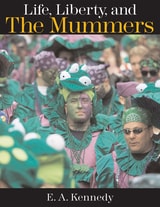
Life, Liberty, and the Mummers
Ed Kennedy
Temple University Press, 2007
Noted photographer E. A. Kennedy spent four years documenting the Mummers and their parade. He has personally selected the striking images included here -- more than 150 in all -- and he has written an engaging history of the parade itself. As Kennedy explains, and as his photos make clear, "mummery" is a way of life for Mummers, who have deep attachments to their clubs, associations, and brigades.
For all its glitz, the Mummers Parade remains a folk parade. This is the captivating story of the folks behind the parade.
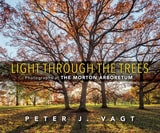
Light Through the Trees
Photographs at The Morton ArboretumPeter J. Vagt
University of Illinois Press, 2022
“I don’t compose pictures, I find them in the colors, patterns, and shadows of the trees in front of me. While I walk, I let my feelings well up in my consciousness. My feelings guide me to find what I’m seeing and feeling and distill it into a picture.”
A beloved and popular Illinois institution, The Morton Arboretum welcomes one million annual visitors to walk its trails and view the 4,200 tree species on the grounds. Peter Vagt has photographed the Arboretum for over twenty years. This collection showcases eighty-five of his favorite works, each one in full color. Vagt's close attention to place and time reflects both his profound connection to the Arboretum and its preeminence as a sanctuary for anyone in search of transcendence in nature.
A celebration of The Morton Arboretum in its centenary year, Light Through the Trees is the perfect keepsake or gift for anyone who admires trees and believes in their restorative power.
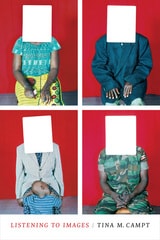
Listening to Images
Tina M. Campt
Duke University Press, 2017

Living In The Depot
The Two-Story Railroad StationH. Roger Grant
University of Iowa Press, 1997
At the heart of this excellent book are the striking and rare postcards that provide a comprehensive visual review of this popular building type from coast to coast. Over 150 illustrations feature the gingerbread structures of the Northeast, the simple buildings of the Gold Rush West, and the mission-style stations of the Southwest in this first book to concentrate on this overlooked aspect of railroad history.
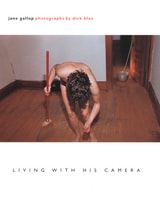
Living with His Camera
Jane Gallop
Duke University Press, 2003
Living with His Camera is Gallop’s nuanced meditation on photography and the place it has in her private life and in her family. A reflection on family, it attempts—like Blau’s photographs themselves—to portray the realities of family life beyond the pieties of conventional representations. Living with His Camera is about some of the most pressing issues of visuality and some of the most basic issues of daily life. Gallop considers intimate photographs of moments both dramatic and routine: of herself giving birth to son Max or crying in the midst of an argument with Blau, pouring herself cereal as Max colors at the breakfast table, or naked, sweeping the floor. With her trademark candor, humor, and critical acumen, Gallop mixes personal reflection with close readings of Roland Barthes’s Camera Lucida, Susan Sontag’s On Photography, Kathryn Harrison’s novel Exposure, and Pierre Bourdieu’s Photography.
Presenting his photographs and her text, Living with His Camera is a portrait of a couple whose professional activity is part of their private lives and whose private life is viewed through their professional gazes. While most of us set aside rigorous thought when we turn to the sentimental realm of home life, Gallop and Blau look at each other not only with great affection but also with the keen focus of a sharp, critical gaze.

Look at me
Photographs from Mexico City by Jed FieldingJed Fielding
University of Chicago Press, 2009
Sight is central to the medium of photography. But what happens when the subjects of photographic portraits cannot look back at the photographer or even see their own image? An in-depth pictorial study of blind schoolchildren in Mexico, Look at me draws attention to (and distinctions between) the activity of sight and the consciousness of form.
Combining aspects of his earlier, acclaimed street work with an innovative approach to portraiture, Chicago-based photographer Jed Fielding has concentrated closely on these children’s features and gestures, probing the enigmatic boundaries between surface and interior, innocence and knowing, beauty and grotesque. Design, composition, and the play of light and shadow are central elements in these photographs, but the images are much more than formal experiments; they confront disability in a way that affirms life. Fielding’s sightless subjects project a vitality that seems to extend beyond the limits of self-consciousness. In collaborative, joyful participation with the children, he has made pictures that reveal essential gestures of absorption and the basic expressions of our creatureliness.
Fielding’s work achieves what only great art, and particularly great portraiture can: it launches and then complicates a process of identification across the barriers that separate us from each other. Look at me contains more than sixty arresting images from which we often want to look away, but into which we are nevertheless drawn by their deep humanity and palpable tenderness. This is a monograph of uncommon significance by an important American photographer.

Looking for Marshall McLuhan in Afghanistan
iProbes and iPhone PhotographsRita Leistner
Intellect Books, 2013
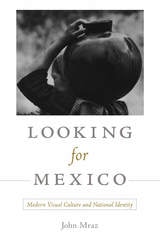
Looking for Mexico
Modern Visual Culture and National IdentityJohn Mraz
Duke University Press, 2009
Turning to film, Mraz compares portrayals of the Mexican Revolution by Fernando de Fuentes to the later movies of Emilio Fernández and Gabriel Figueroa. He considers major stars of Golden Age cinema as gender archetypes for mexicanidad, juxtaposing the charros (hacienda cowboys) embodied by Pedro Infante, Pedro Armendáriz, and Jorge Negrete with the effacing women: the mother, Indian, and shrew as played by Sara García, Dolores del Río, and María Félix. Mraz also analyzes the leading comedians of the Mexican screen, representations of the 1968 student revolt, and depictions of Frida Kahlo in films made by Paul Leduc and Julie Taymor. Filled with more than fifty illustrations, Looking for Mexico is an exuberant plunge into Mexico’s national identity, its visual culture, and the connections between the two.
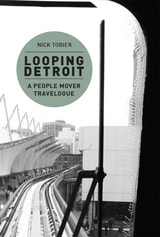
Looping Detroit
A People Mover TravelogueNick Tobier
Michigan Publishing Services, 2016
Looping Detroit invites artists and writers to ride the small loop as an explorer, mining the environs around each station as a poetic ramble, a psycho geographic wander, a cultural inquiry that simultaneously ponders the poetics of circulating above the city streets while probing the greater narrative of Detroit’s public transit conundrum.
Contributors include award-winning Detroit novelists Lolita Hernandez and Michael Zardoorian, poets Gloria House and Walter Lacy, music producer Cornelius Harris, Chace MicWrite Morris, frontman of the Detroit hip-hop trio Coldmen Young, and radio producer Zak Rosen.
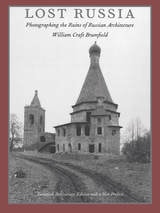
Lost Russia
Photographing the Ruins of Russian ArchitectureWilliam Craft Brumfield
Duke University Press, 1995
The twentieth century in Russia has been a cataclysm of rare proportions, as war, revolution, famine, and massive political terror tested the limits of human endurance. The results of this assault on Russian culture are particularly evident in ruined architectural monuments, some of which are little known even within Russia itself. Over the past four decades William Craft Brumfield, noted historian and photographer of Russian architecture, has traveled throughout Russia and photographed many of these neglected, lost buildings, poignant and haunting in their ruin. Lost Russia provides a unique view of Brumfield’s acclaimed work, which illuminates Russian culture as reflected in these remnants of its distinctive architectural traditions.
Capturing the quiet, ineffable beauty that graces these buildings, these photographs are accompanied by a text that provides not only a brief historical background for Russian architecture, but also Brumfield’s personal impressions, thoughts, and insights on the structures he views. Churches and monasteries from the fifteenth to the twentieth century as well as abandoned, ruined manor houses are shown—ravaged by time, willful neglect, and cultural vandalism. Brumfield also illustrates examples of recent local initiatives to preserve cultural landmarks from steady decline and destruction.
Concluding with photographs of the remarkable log architecture found in Russia’s far north, Lost Russia is a book for all those concerned with the nation’s cultural legacy, history, and architecture, and with historic and cultural preservation generally. It will also interest those who appreciate the fine art of exceptional photography.
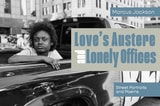
Love’s Austere and Lonely Offices
Street Portraits and PoemsMarcus Jackson
Northwestern University Press, 2026
An astounding collection of photographs from a renowned poet
Created during the tumultuous years of 2020 and 2021, Love’s Austere and Lonely Offices: Street Portraits and Poems intersects the lens of accomplished poet and photographer Marcus Jackson with his words. The focus: the Black experience and existence. Amid isolation, protest, and survival, Jackson is the aperture and scribe giving visual consciousness and breath to these human portraits. His camera strips the view of endless cycles of social and moral injustices, presenting a resonant collection of photographs that make space for the moments and the people whose beings represent the ongoing interplay between history, society, and the individual soul.
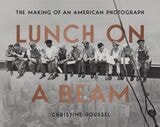
Lunch on a Beam
The Making of an American PhotographChristine Roussel
Brandeis University Press, 2026
Lunch on a Beam, also known as Lunch Atop a Skyscraper, shows ironworkers eating lunch on a steel beam during the construction of Rockefeller Center’s RCA Building in 1932. It’s a photo so famous you can likely picture it in your mind: seated in a row, eleven men chat and break bread 850 feet above the ground, the dense cityscape behind them. While the scene may look spontaneous, the photo was taken during a publicity shoot to promote Rockefeller Center’s new skyscraper. And despite the image’s renown, for years, little information was available about its subjects or its photographer.
In Lunch on a Beam, Rockefeller Center archivist Christine Roussel interweaves the art, architectural, and social history behind the photograph with her personal experience as a confidante to the financiers who developed Rockefeller Center. She tells the stories of the fearless photographers, brazen publicity men, the ironworkers, and their immigrant and Indigenous communities. This portrait of eleven construction workers, she points out, is also a celebration of the nation’s richest man. She examines how, in the depths of the Great Depression, John D. Rockefeller, Jr., took it upon himself to build a monument to American industry and sell it to the public.
Featuring striking images from the Rockefeller Center Archives, Lunch on a Beam calls attention to the fascinating paradoxes contained in a single photo and celebrates the men who built an architectural marvel at great personal risk. This is a story of art and commerce, and the role of a photograph in the mythmaking of New York City.
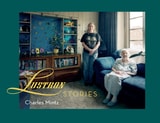
Lustron Stories
Charles Mintz
The Ohio State University Press, 2016
A remarkable cross section of individuals and families live in these modest (~1100 sq. ft.) homes. While certainly diverse in age and place in life, the homeowners are still firmly working class. Everyone who lives in a Lustron home has an opinion about it. The material is miserable to cut or drill into. Repairs are more about metalworking and enamel finishing than carpentry or house painting. And magnets tend to be a popular solution for hanging objects inside and outside the steel walls.
Four years ago, Charles Mintz set out to photograph the people living in these homes. The residents, owners, or both were photographed outside and occasionally inside. Mintz used a large format wooden camera and available light. This book features 65 of the resulting photographs and essays from Shannon Thomas Perich, Curator of the Photographic History Collection at Smithsonian’s National Museum of American History, and Jeffrey Head, author and architecture critic.