Results by title
2018 books match the query 'Political aspects' and 50 start with l
La Consentida
Settlement, Subsistence, and Social Organization in an Early Formative Mesoamerican CommunityGuy David Hepp
University Press of Colorado, 2019
La Consentida explores Early Formative period transitions in residential mobility, subsistence, and social organization at the site of La Consentida in coastal Oaxaca, Mexico. Examining how this site transformed during one of the most fundamental moments of socioeconomic change in the ancient Americas, the book provides a new way of thinking about the social dynamics of Mesoamerican communities of the period.
Guy David Hepp summarizes the results of several seasons of fieldwork and laboratory analysis under the aegis of the La Consentida Archaeological Project, drawing on various forms of evidence—ground stone tools, earthen architecture, faunal remains, human dental pathologies, isotopic indicators, ceramics, and more— to reveal how transitions in settlement, subsistence, and social organization at La Consentida were intimately linked. While Mesoamerica is too diverse for research at a single site to lay to rest ongoing debates about the Early Formative period, evidence from La Consentida should inform those debates because of the site’s unique ecological setting, its relative lack of disturbance by later occupations, and because it represents the only well-documented Early Formative period village in a 300-mile stretch of Mexico’s Pacific coast.
One of the only studies to closely document multiple lines of evidence of the transition toward a sedentary, agricultural society at an individual settlement in Mesoamerica, La Consentida is a key resource for understanding the transition to settled life and social complexity in Mesoamerican societies.
Labs of Our Own
Feminist Tinkerings with ScienceSig / Sara Giordano
Rutgers University Press, 2025
Lagos Never Spoils
Nollywood and Nigerian City LifeConnor Ryan
University of Michigan Press, 2023
Winner of the Society for Cinema and Media Studies, Media Industries Scholarly Interest Group Outstanding Book Award
The slogan “Lagos shall not spoil,” found in print media, political campaigns, and common conversation, represents a shared expression of the optimism the city embodies. However, on city streets the phrase also appears scrawled in irreverent variations—“Lagos cannot spoil more than this!”—that meet the frustrations of city life with irony. In both cases, the slogan captures the resilience and persistence with which residents of Lagos live on, despite it all. This book examines the circumstances that make it possible for residents to persist in pursuing their various projects and for the city to remain a platform that supports these projects and creates space for even more to emerge. Author Connor Ryan argues that residents continually work to combine contingency and endurance in opportunistic ways that make the city work for them, and as such, Lagos never spoils: it endures.
What makes Lagos remarkable is what residents have made of it, and Nollywood—the industry and the body of films—both embodies and represents this continual urban transformation. Lagos Never Spoils traces how Nollywood arose from the social milieu of Lagos and, in turn, generates a repertoire of stories, images, styles, and sentiments with which audiences come to grips with city life. The book traces the evolution of the screen media industry in Lagos and explores how this corresponds with historical phases in the city’s representation onscreen. It discusses important urban spaces of production and consumption, including historic movie halls, video marketplaces, film sets, and multiplex cinemas. Across six chapters, it attends to celluloid films about oil-boom wealth, television sitcoms about urban tricksters, video melodramas about urban crisis, glossy romantic comedies about young professionals, and dark thrillers on streaming platforms about the pleasure of moral transgression. In this fashion, the book offers new approaches to the interpretation of screen texts produced in and about Lagos, a place that is today the most influential image of West African city life.
Landscape and Power, Second Edition
Edited by W. J. T. Mitchell
University of Chicago Press, 2002
The first edition of this book, published in 1994, reshaped the direction of landscape studies by considering landscape not simply as an object to be seen or a text to be read, but as an instrument of cultural force, a central tool in the creation of national and social identities. This second edition adds not only a new preface, but five new essays—from Edward Said, W. J. T. Mitchell, Jonathan Bordo, Michael Taussig, and Robert Pogue Harrison—extending the scope of the book in remarkable ways.
Landscape and Power continues to be a central text for students and scholars who want to understand the importance of landscape to the making of our social, political, and cultural world.
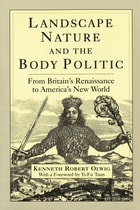
Landscape, Nature, and the Body Politic
From Britain's Renaissance to America's New WorldKenneth Robert Olwig
University of Wisconsin Press, 2002
Landscape, Nature, and the Body Politic explores the origins and lasting influences of two contesting but intertwined discourses that persist today when we use the words landscape, country, scenery, nature, national. In the first sense, the land is a physical and bounded body of terrain upon which the nation state is constructed (e.g., the purple mountain majesties above the fruited plain, from sea to shining sea). In the second, the country is constituted through its people and established through time and precedence (e.g., land where our fathers died, land of the Pilgrims’ pride). Kenneth Robert Olwig’s extended exploration of these discourses is a masterful work of scholarship both broad and deep, which opens up new avenues of thinking in the areas of geography, literature, theater, history, political science, law, and environmental studies.
Olwig tracks these ideas though Anglo-American history, starting with seventeenth-century conflicts between the Stuart kings and the English Parliament, and the Stuart dream of uniting Scotland with England and Wales into one nation on the island of Britain. He uses a royal production of a Ben Jonson masque, with stage sets by architect Inigo Jones, as a touchstone for exploring how the notion of "landscape" expands from artful stage scenery to a geopolitical ideal. Olwig pursues these contested concepts of the body politic from Europe to America and to global politics, illuminating a host of topics, from national parks and environmental planning to theories of polity and virulent nationalistic movements.
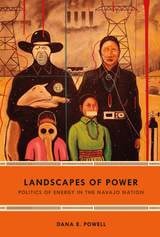
Landscapes of Power
Politics of Energy in the Navajo NationDana E. Powell
Duke University Press, 2018
Language Loyalties
A Source Book on the Official English ControversyEdited by James Crawford
University of Chicago Press, 1992
Supporters argue that English has always been our common language—a means of resolving conflicts in a nation of diverse racial, ethnic, and religious groups, and an essential tool of social mobility and cultural integration. Opponents charge that the amendment is unnecessary and that it threatens civil rights, educational opportunities, and free speech, wrapping racist biases in a cloak of patriotism.
Language Loyalties: A Source Book on the Official English Controversy provides a balanced, comprehensive guide to this complex and often confusing debate. It is an essential handbook and reference for advocates, educators, policymakers, jurists, scholars, and citizens who seek to join this debate fully informed. Addressing the issues involved in developing America's first planned national language policy, James Crawford has expertly collected and introduced more than eighty-five source documents and articles.

Language, Resistance and Revival
Republican Prisoners and the Irish Language in the North of IrelandFeargal Mac Ionnrachtaigh
Pluto Press, 2013
Language, Resistance and Revival tells the untold story of the truly groundbreaking linguistic and educational developments that took place among Republican prisoners in Long Kesh prison from 1972-2000.
During a period of bitter struggle between Republican prisoners and the British state, the Irish language was taught and spoken as a form of resistance during incarceration. The book unearths this story for the first time and analyses the rejuvenating impact it had on the cultural revival in the nationalist community beyond the prison walls.
Based on unprecedented interviews, Feargal Mac Ionnrachtaigh explores a key period in Irish history through the original and 'insider' accounts of key protagonists in the contemporary Irish language revival.
Language
A Right and a Resource: Approaches to Linguistic Human RightsTibor Várady
Central European University Press, 2000
Linguistic Human Rights (LHR) is a fast growing new area of study combining the principles of national and international law with the study of language as a central dimension of ethnicity. Implementation of these principles is aimed at ensuring that no state or society violates these basic rights.
This path breaking study broadens our knowledge of the important role of language in minority rights and in social and political struggles for LHRs. Exploring the interactions of linguistic diversity, biodiversity, the free market and human rights, the contributors present case studies to highlight such issues as Kurdish satellite TV attempting to create a virtual state on the air through trying to achieve basic LHR’s for Kurds in Turkey; the implementation of LHRs in the Baltic states; language rights activism in Canada; the spread of English as an international language; and the obstacles met in education by Roma and the Deaf in Hungary because of lack of appropriate LHRs.
Language: A Right and a Resource is a valuable multi-disciplinary text which can be used in a variety of different areas of study in the legal profession, linguistics, cultural and political studies.

Latin American Comics in the Twenty-First Century
Transgressing the FrameJames Scorer
University of Texas Press, 2024
2025 Katherine Singer Kovacs Prize, Modern Language Association
2025 Comics Studies Society Charles Hatfield Book Prize, Honorable Mention
How twenty-first-century Latin American comics transgress social, political, and cultural frontiers.
Given comics’ ability to cross borders, Latin American creators have used the form to transgress the political, social, spatial, and cultural borders that shape the region. A groundbreaking and comprehensive study of twenty-first-century Latin American comics, Latin American Comics in the Twenty-First Century documents how these works move beyond national boundaries and explores new aspects of the form, its subjects, and its creators.
Latin American comics production is arguably more interconnected and more networked across national borders than ever before. Analyzing works from Argentina, Chile, Colombia, Mexico, Peru, and Uruguay, James Scorer organizes his study around forms of “transgression,” such as transnationalism, border crossings, transfeminisms, punk bodies, and encounters in the neoliberal city. Scorer examines the feminist comics collective Chicks on Comics; the DIY comics zine world; nonfiction and journalistic comics; contagion and zombie narratives; and more. Drawing from archives across the United States, Europe, and Latin America, Latin American Comics in the Twenty-First Century posits that these comics produce micronarratives of everyday life that speak to sites of social struggle shared across nation states.
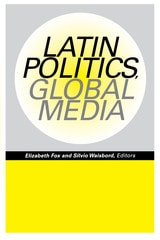
Latin Politics, Global Media
Edited by Elizabeth Fox and Silvio Waisbord
University of Texas Press, 2002
The globalization of media industries that began during the 1980s and 1990s occurred at the same time as the establishment of or return to democratic forms of government in many Latin American countries. In this volume of specially commissioned essays, thirteen well-known media experts examine how the intersection of globalization and democratization has transformed media systems and policies throughout Latin America.
Following an extensive overview by editors Elizabeth Fox and Silvio Waisbord, the contributors investigate the interaction of local politics and global media in individual Latin American countries. Some of the issues they discuss include the privatization and liberalization of the media, the rise of media conglomerates, the impact of trade agreements on media industries, the role of the state, the mediazation of politics, the state of public television, and the role of domestic and global forces. The contributors address these topics with a variety of theoretical approaches, combining institutional, historical, economic, and legal perspectives.
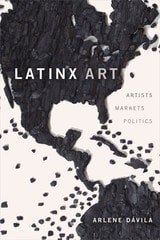
Latinx Art
Artists, Markets, and PoliticsArlene Dávila
Duke University Press, 2020
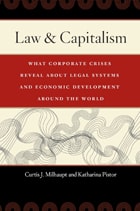
Law & Capitalism
What Corporate Crises Reveal about Legal Systems and Economic Development around the WorldCurtis J. Milhaupt and Katharina Pistor
University of Chicago Press, 2008
Using comparative case studies that address the United States, China, Germany, Japan, Korea, and Russia, Curtis J. Milhaupt and Katharina Pistor argue that a disparate blend of legal and nonlegal mechanisms have supported economic growth around the world. Their groundbreaking findings show that law and markets evolve together in a “rolling relationship,” and legal systems, including those of the most successful economies, therefore differ significantly in their organizational characteristics. Innovative and insightful, Law and Capitalism will change the way lawyers, economists, policy makers, and business leaders think about legal regulation in an increasingly global market for capital and corporate governance.
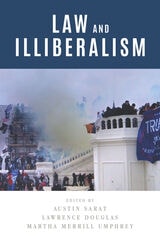
Law and Illiberalism
Edited by Austin Sarat, Lawrence Douglas, and Martha Merrill Umphrey
University of Massachusetts Press, 2022
Does the law shield citizens from authoritarian regimes? Are the core beliefs of classical liberalism—namely the rights of all individuals and constraints on state power—still protected by law? Liberalism and its expansion of rights could not exist without the legal system, and unsurprisingly, many scholars have explored the relationship between law and liberalism. However, the study of law and illiberalism is a relatively recent undertaking, a project that takes on urgency in light of the rise of authoritarian powers, among them Donald Trump’s administration, Viktor Orban’s Hungary, Recep Erdogan’s Turkey, and Jair Bolsanoro’s Brazil.
In this volume, six penetrating essays explore the dynamics of the law and illiberal quests for power, examining the anti-liberalism of neoliberalism; the weaponization of “free speech”; the role of the administrative state in current crises of liberal democracy; the broad and unstoppable assault on facts, truth, and reality; and the rise of conspiracism leading up to the Capitol insurrection. In addition to the editors, contributors include Sharon Krause, Elizabeth Anker, Jeremy Kessler, Lee McIntyre, and Nancy Rosenblum.
Lawsuits in a Market Economy
The Evolution of Civil LitigationStephen C. Yeazell
University of Chicago Press, 2018
Lawsuits in a Market Economy explains how contemporary civil litigation in the United States works and how it has changed over the past century. The book corrects common misconceptions—some of which have proved remarkably durable even in the face of contrary evidence—and explores how our constitutional structure, an evolving economy, and developments in procedural rules and litigation financing systems have moved us from expecting that lawsuits end in trial and judgments to expecting that they will end in settlements. Yeazell argues that today’s system has in some ways overcome—albeit inconsistently—disparities between the rich and poor in access to civil justice. Once upon a time, might regularly triumphed over right. That is slightly less likely today—even though we continue to witness enormous disparities in wealth and power.
The book concludes with an evaluation of recent changes and their possible consequences.
Learning One’s Native Tongue
Citizenship, Contestation, and Conflict in AmericaTracy B. Strong
University of Chicago Press, 2019
With Learning One’s Native Tongue, Tracy B. Strong explores the development of the concept of American citizenship and what it means to belong to this country,
starting with the Puritans in the seventeenth century and continuing to the present day. He examines the conflicts over the meaning of citizenship in the writings and speeches of prominent thinkers and leaders ranging from John Winthrop and Roger Williams to Thomas Jefferson, Nathaniel Hawthorne, Abraham Lincoln, Frederick Douglass, and Franklin Roosevelt, among many others who have participated in these important cultural and political debates. The criteria that define what being a citizen entails change over time and in response to historical developments, and they are thus also often the source of controversy and conflict, as with voting rights for women and African Americans. Strong looks closely at these conflicts and the ensuing changes in the conception of citizenship, paying attention to what difference each change makes and what each particular conception entails socially and politically.
Learning to Glow
A Nuclear ReaderJohn Bradley
University of Arizona Press, 2000
In Learning to Glow, twenty-four essays testify to many of the unsuspected human and environmental costs of atomic science. They show that Americans have paid a terrible price for supposedly "winning" the Cold War--for although the nuclear nightmare may be over, we are still living with nuclear threats every day. Writers such as Scott Russell Sanders, Terry Tempest Williams, and Barbara Kingsolver reveal the psychic and emotional fallout of the Cold War and of subsequent developments in nuclear science. The essays include personal testimonies of what it was like to grow up with family members in nuclear-related jobs; hard-hitting journalism on the health and environmental costs of our nuclear policies and practices; and poignant stories of coming to terms with nuclear power, including contributions by writers who revisit Hiroshima in an attempt to heal the wounds left by the Bomb.
These essays offer an alternative to the official version of nuclear history as told to us by school textbooks, government authorities, and nuclear industry officials. They are stories of and by ordinary people who have suffered the consequences of the decisions made by those in power-stories that have been largely ignored, dismissed, or suppressed. They will challenge readers to re-examine their preconceptions about the way we deal with issues of nuclear arms and radioactive waste because they show that nuclear history does not belong to experts but to us all.
Contributors:
Marilou Awiakta
John Bradley
Jim Carrier
Alison Hawthorne Deming
Mary Dickson
Edward Dougherty
Ray Gonzalez
Karl Grossman
Sonya Huber
Barbara Kingsolver
Valerie Kuletz
Mary Laufer
Kay Mack
Craig McGrath
Bill Mesler
Richard H. Minear
Randy Morris
Mayumi Oda
Catherine Quigg
Richard Rawles
Kenneth Robbins
Scott Russell Sanders
David Seaborg
Terry Tempest Williams
Bill Witherup
Phil Woods
Learning to Live with the Past
Krishna Kumar
Seagull Books, 2023
How does education shape political rivalry and hostility? The Partition of the Indian subcontinent in 1947—the violence that followed it, and its living legacy of rival nationalisms—has made a deep and pervasive impact on education in both India and Pakistan. In Learning to Live with the Past, educationist Krishna Kumar dwells on the complex terrain every history teacher has to navigate: how to make the past come alive without running the risk of creating a desire to lose this “pastness.”
Substantiating this question with a wealth of experiences gained from his extensive research on history textbooks, as well as his interactions with students and teachers in both countries, Kumar explores the integral function the discipline of history plays in the project of nation-building. To help children learn to live with the past, Kumar amplifies the need for spaces that create possibilities for inquiries into a “longer” common heritage shared by South Asia without necessarily denying a national narrative or encouraging an urge to undo the past.

Leaving Art
Writings on Performance, Politics, and Publics, 1974-2007Suzanne Lacy
Duke University Press, 2010
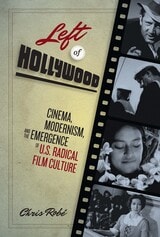
Left of Hollywood
Cinema, Modernism, and the Emergence of U.S. Radical Film CultureBy Chris Robé
University of Texas Press, 2010
In the 1930s as the capitalist system faltered, many in the United States turned to the political Left. Hollywood, so deeply embedded in capitalism, was not immune to this shift. Left of Hollywood offers the first book-length study of Depression-era Left film theory and criticism in the United States. Robé studies the development of this theory and criticism over the course of the 1930s, as artists and intellectuals formed alliances in order to establish an engaged political film movement that aspired toward a popular cinema of social change. Combining extensive archival research with careful close analysis of films, Robé explores the origins of this radical social formation of U.S. Left film culture.
Grounding his arguments in the surrounding contexts and aesthetics of a few films in particular—Sergei Eisenstein's Que Viva Mexico!, Fritz Lang's Fury, William Dieterle's Juarez, and Jean Renoir's La Marseillaise—Robé focuses on how film theorists and critics sought to foster audiences who might push both film culture and larger social practices in more progressive directions. Turning at one point to anti-lynching films, Robé discusses how these movies united black and white film critics, forging an alliance of writers who championed not only critical spectatorship but also the public support of racial equality. Yet, despite a stated interest in forging more egalitarian social relations, gender bias was endemic in Left criticism of the era, and female-centered films were regularly discounted. Thus Robé provides an in-depth examination of this overlooked shortcoming of U.S. Left film criticism and theory.
Let Them Eat Junk
How Capitalism Creates Hunger and ObesityRobert Albritton
Pluto Press, 2009
Respected economist Robert Albritton argues that the capitalist system, far from delivering on the promise of cheap, nutritious food for all, has created a world where 25% of the world population are over-fed and 25% are hungry. This malnourishment of 50% of the world's population is explained systematically, a refreshing change from accounts that focus on cultural factors and individual greed. Albritton details the economic relations and connections that have put us in a situation of simultaneous oversupply and undersupply of food.
This explosive book provides yet more evidence that the human cost of capitalism is much bigger than those in power will admit.
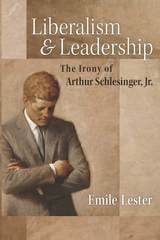
Liberalism and Leadership
The Irony of Arthur Schlesinger, Jr.Emile Lester
University of Michigan Press, 2019
Most scholars and pundits today view Franklin Delano Roosevelt and John F. Kennedy as aggressive liberal leaders, while viewing Schlesinger’s famous histories of their presidencies as celebrations of their steadfast progressive leadership. A more careful reading of Schlesinger’s work demonstrates that he preferred an ironic political outlook emphasizing the virtues of restraint, patience, and discipline. For Schlesinger, Roosevelt and Kennedy were liberal heroes and models as much because they respected the constraints on their power and ideals as because they tested traditional institutions and redefined the boundaries of presidential power.
Aggressive liberalism involves the use of inspirational rhetoric and cunning political tactics to expand civil liberties and insure economic equality. Schlesinger’s emphasis on the crucial role that irony has played and should play in liberalism poses a challenge to the aggressive liberalism advocated by liberal activists, political thinkers, and pundits. That his counsel was grounded in conservative insights as well as liberal values makes it accessible to leaders across the political spectrum.
Liberalism and the Culture of Security
The Nineteenth-Century Rhetoric of ReformKatherine Henry
University of Alabama Press, 2011
Rethinking the language of liberty, protection, and citizenship in nineteenth-century America.
Figures of protection and security are everywhere in American public discourse, from the protection of privacy or civil liberties to the protection of marriage or the unborn, and from social security to homeland security. Liberalism and the Culture of Security traces a crucial paradox in historical and contemporary notions of citizenship: in a liberal democratic culture that imagines its citizens as self-reliant, autonomous, and inviolable, the truth is that claims for citizenship—particularly for marginalized groups such as women and slaves—have just as often been made in the name of vulnerability and helplessness.
Katherine Henry traces this turn back to the eighteenth-century opposition of liberty and tyranny, which imagined our liberties as being in danger of violation by the forces of tyranny and thus in need of protection. She examines four particular instances of this rhetorical pattern. The first chapters show how women’s rights and antislavery activists in the antebellum era exploited the contradictions that arose from the liberal promise of a protected citizenry: first by focusing primarily on arguments over slavery in the 1850s that invoke the Declaration of Independence, including Harriet Beecher Stowe’s fiction and Frederick Douglass’s “Fourth of July” speech; and next by examining Angelina Grimké’s brief but intense antislavery speaking career in the 1830s.
New conditions after the Civil War and Emancipation changed the way arguments about civic inclusion and exclusion could be advanced. Henry considers the issue of African American citizenship in the 1880s and 1890s, focusing on the mainstream white Southern debate over segregation and the specter of a tyrannical federal government, and then turning to Frances E. W. Harper’s fictional account of African American citizenship in Iola Leroy. Finally, Henry examines Henry James’s 1886 novel The Bostonians, in which arguments over the appropriate role of women and the proper place of the South in post–Civil War America are played out as a contest between Olive Chancellor and Basil ransom for control over the voice of the eloquent girl Verena Tarrant.
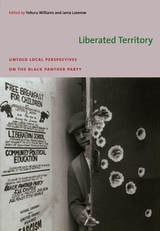
Liberated Territory
Untold Local Perspectives on the Black Panther PartyYohuru Williams and Jama Lazerow, eds.
Duke University Press, 2008
The histories and character of the party branches vary as widely as their locations. The Cape Verdeans of New Bedford, Massachusetts, were initially viewed as a particular challenge for the local Panthers but later became the mainstay of the Boston-area party. In the early 1970s, the Winston-Salem, North Carolina, chapter excelled at implementing the national Black Panther Party’s strategic shift from revolutionary confrontation to mainstream electoral politics. In Detroit, the Panthers were defined by a complex relationship between their above-ground activities and an underground wing dedicated to armed struggle. While the Milwaukee chapter was born out of a rising tide of black militancy, it ultimately proved more committed to promoting literacy and health care and redressing hunger than to violence. The Alabama Black Liberation Front did not have the official imprimatur of the national party, but it drew heavily on the Panthers’ ideas and organizing strategies, and its activism demonstrates the broad resonance of many of the concerns articulated by the national party: the need for jobs, for decent food and housing, for black self-determination, and for sustained opposition to police brutality against black people. Liberated Territory reveals how the Black Panther Party’s ideologies, goals, and strategies were taken up and adapted throughout the United States.
Contributors: Devin Fergus, Jama Lazerow, Ahmad A. Rahman, Robert W. Widell Jr., Yohuru Williams
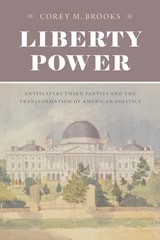
Liberty Power
Antislavery Third Parties and the Transformation of American PoliticsCorey M. Brooks
University of Chicago Press, 2015
As Corey M. Brooks explains, abolitionist trailblazers who organized first the Liberty Party and later the more moderate Free Soil Party confronted formidable opposition from a two-party system expressly constructed to suppress disputes over slavery. Identifying the Whigs and Democrats as the mainstays of the southern Slave Power’s national supremacy, savvy abolitionists insisted that only a party independent of slaveholder influence could wrest the federal government from its grip. A series of shrewd electoral, lobbying, and legislative tactics enabled these antislavery third parties to wield influence far beyond their numbers. In the process, these parties transformed the national political debate and laid the groundwork for the success of the Republican Party and the end of American slavery.

Libraries Promoting Reflective Dialogue In A Time Of Political
Andrea Baer
Assoc of College & Research Libraries, 2019
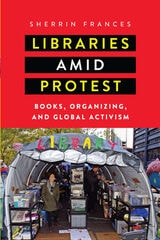
Libraries amid Protest
Books, Organizing, and Global ActivismSherrin Frances
University of Massachusetts Press, 2020
Libraries amid Protest unpacks how these protest libraries—labor-intensive, temporary installations in parks and city squares, poorly protected from the weather, at odds with security forces—continue to arise. In telling the stories of these surprising and inspiring spaces through interviews and other research, Sherrin Frances confronts the complex history of American public libraries. She argues that protest libraries function as the spaces of opportunity and resistance promised, but not delivered, by American public libraries.
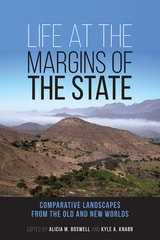
Life at the Margins of the State
Comparative Landscapes from the Old and New WorldsAlicia M. Boswell
University Press of Colorado, 2022
Case studies from the New and Old Worlds—including historic California, medieval Iceland, ancient Mesoamerica, ancient Nubia, colonial El Salvador, the prehistoric Levant, pre-Columbian Amazon, Africa’s historic central Sahel, and ancient Peru—offer novel perspectives on how borderland societies adapted to the unique human and natural environments of these liminal spaces. Contributors draw on archaeological evidence as well as historical documents and linguistic data to facilitate the documentation of local histories and the strategies employed by communities living in or near ancient states and empires.
This close study of groups on the margins shows that peripheral polities are not simply the by-products of complexity emanating from a political core and demonstrates that traditional assumptions and models need to be reconsidered.
Contributors:
Tara D. Carter, Mikael Fauvelle, Elena A.A. Garcea, Esteban Gomez, Scott MacEachern, Claire Novotny, Bradley J Parker, Erin Smith, John H. Walker
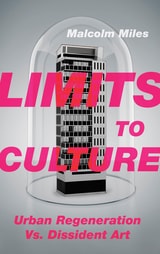
Limits to Culture
Urban Regeneration vs. Dissident ArtMalcolm Miles
Pluto Press, 2015
Limits to Liberation after Apartheid
Citizenship, Governance, & CultureSteven L. Robins
Ohio University Press, 2005
Lincoln and Congress
William C. Harris
Southern Illinois University Press, 2017
In Lincoln and Congress, William C. Harris reveals that the relationship between the president and Congress, though sometimes contentious, was cooperative rather than adversarial. During his time as president, Abraham Lincoln embodied his personal conviction that the nation’s executive should not interfere with the work of the legislature, and though often critical of him privately, in public congressional leaders compromised with and assisted the president to unite the North and minimize opposition to the war.
Despite the turbulence of the era and the consequent tensions within the government, the executive and legislative branches showed restraint in their dealings with each other. In fact, except in his official messages to Congress, Lincoln rarely lobbied for congressional action, and he vetoed only one important measure during his tenure as president. Many congressmen from Lincoln’s own party, although publicly supportive, doubted his leadership and sought a larger role for Congress in setting war policies. Though they controlled Congress, Republican legislators frequently differed among themselves in shaping legislation and in their reactions to events as well as in their relationships both with each other and with the president. Harris draws intriguing sketches of nineteenth-century congressional leaders and shows that, contrary to what historians have traditionally concluded, radical Republicans such as Representative Thaddeus Stevens and Senator Charles Sumner did not dominate their party or Congress. Harris includes the minority party’s role, showing that Northern Democrats and conservative Unionists of the border states generally opposed Republican policies but worked with them on support for the troops and on nonwar issues like the Pacific Railroad Bill.
Lincoln and Congress sheds new light on the influence of members of Congress and their relationship with Lincoln on divisive issues such as military affairs, finance, slavery, constitutional rights, reconstruction, and Northern political developments. Enjoyable both for casual Civil War readers and professional historians, this book provides an engaging narrative that helps readers redefine and understand the political partnership that helped the Union survive.
Lincoln and Emancipation
Edna Greene Medford
Southern Illinois University Press, 2015
In this succinct study, Edna Greene Medford examines the ideas and events that shaped President Lincoln’s responses to slavery, following the arc of his ideological development from the beginning of the Civil War, when he aimed to pursue a course of noninterference, to his championing of slavery’s destruction before the conflict ended. Throughout, Medford juxtaposes the president’s motivations for advocating freedom with the aspirations of African Americans themselves, restoring African Americans to the center of the story about the struggle for their own liberation.
Lincoln and African Americans, Medford argues, approached emancipation differently, with the president moving slowly and cautiously in order to save the Union while the enslaved and their supporters pressed more urgently for an end to slavery. Despite the differences, an undeclared partnership existed between the president and slaves that led to both preservation of the Union and freedom for those in bondage. Medford chronicles Lincoln’s transition from advocating gradual abolition to campaigning for immediate emancipation for the majority of the enslaved, a change effected by the military and by the efforts of African Americans. The author argues that many players—including the abolitionists and Radical Republicans, War Democrats, and black men and women—participated in the drama through agitation, military support of the Union, and destruction of the institution from within. Medford also addresses differences in the interpretation of freedom: Lincoln and most Americans defined it as the destruction of slavery, but African Americans understood the term to involve equality and full inclusion into American society. An epilogue considers Lincoln’s death, African American efforts to honor him, and the president’s legacy at home and abroad.
Both enslaved and free black people, Medford demonstrates, were fervent participants in the emancipation effort, showing an eagerness to get on with the business of freedom long before the president or the North did. By including African American voices in the emancipation narrative, this insightful volume offers a fresh and welcome perspective on Lincoln’s America.
Lincoln and the Politics of Christian Love
Grant N. Havers
University of Missouri Press, 2009
In this provocative book, Grant Havers argues that charity is a central tenet of what Lincoln once called America’s “political religion.” He explores the implications of making Christian love the highest moral standard for American democracy, showing how Lincoln’s legacy demands that a true democracy be charitable toward all—and that only a people who lived according to such ideals could succeed in building democracy as Lincoln understood it.
Havers argues that it is simplistic to conflate Lincoln’s invocation of “with charity for all” with his abiding support for the ideal of human equality. The ethic of charity in his view also brought a uniquely Christian realism to the universalism of democracy. He also describes how, since World War I, intellectuals and political leaders have denied that there exists a necessary relation between democracy and Christian love, proposing that democracy is sufficiently ethical without reliance on a specific religious tradition. Today’s neoconservatives and liberals instead posit a universal yearning for democracy that requires no foundation in the ethic of charity. Havers shows that this democratic universalism, espoused by those who believe a “chosen people” should uphold the natural rights of humanity, is alien to the sober thought of both the founders and Lincoln.
This carefully argued work defends Lincoln’s understanding of charity as essential to democracy while emphasizing the difficulty of fusing this ethic with the desire to spread democracy to people who do not share America’s Christian heritage. In considering the prospect of America’s leaders rediscovering a moral foreign policy based on charity rather than the costly idolization of democracy, Lincoln and the Politics of Christian Love makes a timely contribution to the wider debate over both the meaning of religion in American politics and the mission of America in the world—and opens a new window on Lincoln’s lasting legacy.
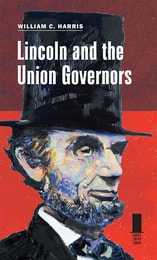
Lincoln and the Union Governors
William C. Harris
Southern Illinois University Press, 2013
Over the course of the Civil War, fifty-nine men served as governors of the twenty-five Union states. Although these state executives were occasionally obstructionist and often disagreed amongst themselves, their overall cooperation and counsel bolstered the policies put forth by Abraham Lincoln and proved essential to the Union’s ultimate victory. In this revealing volume, award-winning historian William C. Harris explores the complex relationship between Lincoln and the governors of the Union states, illuminating the contributions of these often-overlooked state leaders to the preservation of the nation.
Lincoln recognized that in securing the governors’ cooperation in the war he had to tread carefully and, as much as possible, respect their constitutional authority under the federal system of government. Contributing to the success of the partnership, Harris shows, was the fact that almost all of the governors were members of Lincoln’s Republican or Union Party, and most had earlier associated with his Whig party. Despite their support for the war, however, the governors reflected different regional interests, and Lincoln understood and attempted to accommodate these differences in order to maintain a unified war effort.
Harris examines the activities of the governors, who often worked ahead of Lincoln in rallying citizens for the war, organizing state regiments for the Union army, and providing aid and encouragement to the troops in the field. The governors kept Lincoln informed about political conditions in their states and lobbied Lincoln and the War Department to take more vigorous measures to suppress the rebellion. Harris explores the governors’ concerns about many issues, including the divisions within their states over the war and Lincoln’s most controversial policies, especially emancipation and military conscription. He also provides the first modern account of the 1862 conference of governors in Altoona, Pennsylvania, which provided important backing for Lincoln’s war leadership.
By emphasizing the difficult tasks that both the governors and President Lincoln faced in dealing with the major issues of the Civil War, Harris provides fresh insight into the role this dynamic partnership played in preserving the nation’s democratic and constitutional institutions and ending the greatest blight on the republic—chattel slavery.
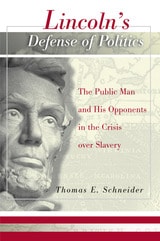
Lincoln's Defense of Politics
The Public Man and His Opponents in the Crisis Over SlaveryThomas E. Schneider
University of Missouri Press, 2005
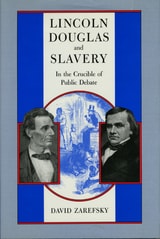
Lincoln, Douglas, and Slavery
In the Crucible of Public DebateDavid Zarefsky
University of Chicago Press, 1990
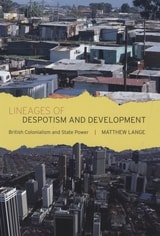
Lineages of Despotism and Development
British Colonialism and State PowerMatthew Lange
University of Chicago Press, 2009
Traditionally, social scientists have assumed that past imperialism hinders the future development prospects of colonized nations. Challenging this widespread belief, Matthew Lange argues in Lineages of Despotism and Development that countries once under direct British imperial control have developed more successfully than those that were ruled indirectly.
Combining statistical analysis with in-depth case studies of former British colonies, this volume argues that direct rule promoted cogent and coherent states with high levels of bureaucratization and inclusiveness, which contributed to implementing development policy during late colonialism and independence. On the other hand, Lange finds that indirect British rule created patrimonial, weak states that preyed on their own populations. Firmly grounded in the tradition of comparative-historical analysis while offering fresh insight into the colonial roots of uneven development, Lineages of Despotism and Development will interest economists, sociologists, and political scientists alike.

Lion Songs
Thomas Mapfumo and the Music That Made ZimbabweBanning Eyre
Duke University Press, 2015

Listening to Images
Tina M. Campt
Duke University Press, 2017
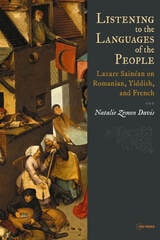
Listening to the Languages of the People
Lazare Sainéan on Romanian, Yiddish, and FrenchNatalie Zemon Davis
Central European University Press, 2022
This tale of great achievements and great disappointments offers a fresh perspective on the interplay between scholarship and political sentiment in the late nineteenth and early twentieth centuries.
Lazăr Șăineanu (1859-1934), linguist and folklorist, was a pioneer in his native Romania, seeking out the popular elements in culture along with high literary ones. He was among the first to publish a study of Yiddish as a genuine language, and he uncovered Turkish features in Romanian language and customs. He also made an index of hundreds of Romanian folktales. Yet when he sought Romanian citizenship and a professorship, he was blocked by powerful figures who thought Jews could not be Romanians and who fancied the origins of Romanian culture to be wholly Latin. Faced with anti-Semitism, some of his friends turned to Zionism. Instead he tried baptism, which brought him only mockery and shame.
Hoping to find a polity to which he could belong, Șăineanu moved with his family to Paris in 1900 and became Lazare Sainéan. There he made innovative studies of French popular speech and slang, culminating in his great work on the language of Rabelais. Once again, he was contributing to the development of a national tongue. Even then, while welcomed by literary scholars, Sainéan was unable to get a permanent university post. Though a naturalized citizen of France, he felt himself a foreigner, an “intruder,” into his old age.

Live Stock and Dead Things
The Archaeology of Zoopolitics between Domestication and ModernityHannah Chazin
University of Chicago Press, 2024
In Live Stock and Dead Things, Hannah Chazin combines zooarchaeology and anthropology to challenge familiar narratives about the role of nonhuman animals in the rise of modern societies. Conventional views of this process tend to see a mostly linear development from hunter-gatherer societies, to horticultural and pastoral ones, to large-scale agricultural ones, and then industrial ones. Along the way, traditional accounts argue that owning livestock as property, along with land and other valuable commodities, introduced social inequality and stratification. Against this, Chazin raises a provocative question: What if domestication wasn’t the origin of instrumentalizing nonhuman animals after all?
Chazin argues that these conventional narratives are inherited from conjectural histories and ignore the archaeological data. In her view, the category of “domestication” flattens the more complex dimensions of humans’ relationship to herd animals. In the book’s first half, Chazin offers a new understanding of the political possibilities of pastoralism, one that recognizes the powerful role herd animals have played in shaping human notions of power and authority. In the second half, she takes readers into her archaeological fieldwork in the South Caucasus, which sheds further light on herd animals’ transformative effect on the economy, social life, and ritual. Appealing to anthropologists and archaeologists alike, this daring book offers a reconceptualization of human-animal relationships and their political significance.
Lively Capital
Biotechnologies, Ethics, and Governance in Global MarketsKaushik Sunder Rajan, ed.
Duke University Press, 2012
Contributors. Timothy Choy, Joseph Dumit, Michael M. J. Fischer, Kim Fortun, Mike Fortun, Donna Haraway, Sheila Jasanoff, Wen-Hua Kuo, Andrew Lakoff, Kristin Peterson, Chloe Silverman, Elta Smith, Kaushik Sunder Rajan, Travis J. Tanner

Lives, Letters, and Quilts
Women and Everyday Rhetorics of ResistanceVanessa Kraemer Sohan
University of Alabama Press, 2020
In Lives, Letters, and Quilts: Women and Everyday Rhetorics of Resistance, Vanessa Kraemer Sohan applies a translingual and transmodal framework informed by feminist rhetorical practice to three distinct case studies that demonstrate women using unique and effective rhetorical strategies in political, religious, and artistic contexts. These case studies highlight a diverse set of actors uniquely situated by their race, gender, class, or religion, but who are nevertheless connected by their capacity to envision and recontextualize the seemingly ordinary means and materials available to them in order to effectively persuade others.
The Great Depression provides the backdrop for the first case study, a movement whereby thousands of elderly citizens proselytized and fundraised for a monthly pension plan dreamt up by a California doctor in the hopes of lifting themselves out of poverty. Sohan investigates how the Townsend Plan’s elderly supporters—the Townsendites—worked within and across language, genre, mode, and media to enable them for the first time to be recognized by others, and themselves, as a viable political constituency.
Next, Sohan recounts the story of Quaker minister Eliza P. Kirkbride Gurney who met President Abraham Lincoln in 1862. Their subsequent epistolary exchanges concerning conscientious objectors made such an impression on him that one of her letters was rumored to be in his pocket the night of his assassination. Their exchanges and Gurney’s own accounts of her transnational ministry in her memoir provide useful examples of how, throughout history, women rhetors have adopted and transformed typically underappreciated forms of rhetoric—such as the epideictic—for their particular purposes.
The final example focuses on the Gee’s Bend quiltmakers—a group of African American women living in rural Alabama who repurpose discarded work clothes and other cast-off fabrics into the extraordinary quilts for which they are known. By drawing on the means and materials at hand to create celebrated works of art in conditions of extreme poverty, these women show how marginalized artisans can operate both within and outside the bounds of established aesthetic traditions and communicate the particulars of their experience across cultural and economic divides.
Living Politics in South Africa’s Urban Shacklands
Kerry Ryan Chance
University of Chicago Press, 2018
Tracking everyday practices and interactions between poor residents and state agents in South Africa’s shack settlements, Chance investigates the rise of nationwide protests since the late 1990s. Based on ethnography in Durban, Cape Town, and Johannesburg, the book analyzes the criminalization of popular forms of politics that were foundational to South Africa’s celebrated democratic transition. Chance argues that we can best grasp the increasingly murky line between “the criminal” and “the political” with a “politics of living” that casts slum and state in opposition to one another. Living Politics shows us how legitimate domains of politics are redefined, how state sovereignty is forcibly enacted, and how the production of new citizen identities crystallize at the intersections of race, gender, and class.
Living Translation
Gayatri Chakravorty Spivak
Seagull Books, 2022
Living Translation offers a powerful perspective on the work of distinguished thinker and writer Gayatri Chakravorty Spivak, revealing how, throughout her long career, she has made translation a central concern of the comparative humanities.
Starting with her landmark “Translator’s Preface” to Jacques Derrida’s Of Grammatology in 1976, and continuing with her foreword to Mahasweta Devi’s Draupadi and afterword to Devi’s Chotti MundaandHis Arrow, Spivak has tackled questions of translatability. She has been interested in interrogating the act of translation from the ground up and at the political limit. She sees at play at border checkpoints, at sites of colonial pedagogy, in acts of resistance to monolingual regimes of national language, at the borders of minor literature and schizo-analysis, in the deficits of cultural debt and linguistic expropriation, and, more generally, at theory’s edge, which is to say, where practical criticism yields to theorizing in untranslatables. This volume also addresses how Spivak’s institution-building as director of comparative literature at the University of Iowa—and in her subsequent places of employment—began at the same time. From this perspective, Spivak takes her place within a distinguished line-up of translator-theorists who have been particularly attuned to the processes of cognizing in languages, all of them alive to the coproductivity of thinking, translating, writing.

Living the High Life in Minsk
Russian Energy Rents, Domestic Populism and Belarus' Impending CrisisMargarita M. Balmaceda
Central European University Press, 2014
Living the High Life in Minsk looks at the sources of stability and instability in post-Soviet authoritarian states through the case study of President Lukashenka’s firm hold on power in Belarus. In particular, it seeks to understand the role of energy relations, policies, and discourses in the maintenance of this power. The central empirical question Balmaceda seeks to answer is what has been the role of energy policies in the maintenance of Lukashenka’s power in Belarus? In particular, it analyzes the role of energy policies in the management of Lukashenka’s relationship with three constituencies crucial to his hold on power: Russian actors, the Belarusian nomenklatura, and the Belarusian electorate.
In terms of foreign relations, the book focuses on the factors explaining Lukashenka’s ability to project Belarus’ power in its relationship with Russia in such a way as to compensate for its objective high level of dependency, assuring high levels of energy subsidies and rents continuing well beyond the initial worsening of the relationship in c. 2004. In terms of domestic relations, Balmaceda examines Lukashenka’s specific use of those energy rents in such a way as to assure the continuing support of both the Belarusian nomenklatura and the Belarusian electorate.

Louder Than Bombs
A Life with Music, War, and PeaceEd Vulliamy
University of Chicago Press, 2020
Describing the artists, songs, and concerts that most influenced him, Vulliamy brings together the two largest threads of his life—music and war. Louder Than Bombs covers some of the most important musical milestones of the past fifty years, from Jimi Hendrix playing “Machine Gun” at the Isle of Wight Festival in 1970 to the Bataclan in Paris under siege in 2015. Vulliamy was present for many of these historic moments, and with him as our guide, we see them afresh, along the way meeting musicians like B. B. King, Graham Nash, Patti Smith, Daniel Barenboim, Gustavo Dudamel, and Bob Dylan. Vulliamy peppers the book with short vignettes—which he dubs 7" singles—recounting some of his happiest memories from a lifetime with music. Whether he’s working as an extra in the Vienna State Opera’s production of Aida, buying blues records in Chicago, or drinking coffee with Joan Baez, music is never far from his mind. As Vulliamy discovers, when horror is unspeakable, when words seem to fail us, we can turn to music for expression and comfort, or for rage and pain. Poignant and sensitively told, Louder Than Bombs is an unforgettable record of a life bursting with music.

Love in the Time of Zika
Environmental Crisis and the Future of ReproductionPaige Marie Patchin
Duke University Press, 2026
Loving Black Boys
A Black Feminist Bible on Racism and Revolutionary MotheringTamura Lomax
Duke University Press, 2026
Lusophone Africa
Beyond IndependenceFernando Arenas
University of Minnesota Press, 2010
Exploring the evolving relationship of Lusophone Africa with Portugal, its former colonial power, and Brazil, Fernando Arenas situates the countries on the geopolitical map of contemporary global forces. Drawing from popular music, film, literature, cultural history, geopolitics, and critical theory to investigate the postcolonial condition of Portuguese-speaking Africa, Arenas offers an entirely original discussion of world music phenomenon Cesária Évora, as well as the most thorough examination to date of Lusophone African cinema and of Angolan post-civil-war fiction.
Throughout, Arenas evokes the rich multidimensionality of this community of African nations as a whole and of its individual parts: Angola, Cape Verde, Guinea-Bissau, and Mozambique, and São Tomé and Príncipe since they gained their independence in the mid-1970s. In doing so, he puts forth a conceptual framework for understanding, for the first time, recent cultural and historical developments in Portuguese-speaking Africa.