207 books match the query 'Political participation' and 4 start with l
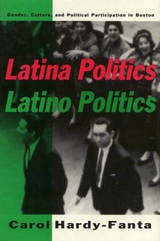
cover of Latina Politics, Latino Politics: Gender, Culture, and Political Participation in Boston

Latina Politics, Latino Politics

Gender, Culture, and Political Participation in Boston

Carol Hardy-Fanta

Temple University Press, 1993

Through an in-depth study of the Latino community in Boston, Carol hardy-Fanta addressees three key debates in American politics: how to look at the ways in which women and men envision the meaning of politics and political participation; how to understand culture and the political life of expanding immigrant populations; and how to create a more participatory America. The author's interviews with Latinos from Puerto Rico, the Dominican Republic, and Central and South America and her participation in community events in North Dorchester, Jamaica Plain, and the South End document the often ignored contribution of Latina women as candidates, political mobilizers, and community organizers. Hardy-Fanta examines critical gender differences in how politics is defined, what strategies Latina women and Latino men use to generate political participation, and how culture and gender interact in the political empowerment of the ethic communities.

Hardy-Fanta challenges the notion of political apathy among Latinos and presents factors that stimulate political participation. She finds that the vision of politics promoted by Latina women—one based on connectedness, collectivity, community, and consiousness-raising—contrasts sharply with a male political concern for status, hierarchy, and personal opportunity.
[more]
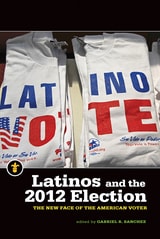
cover of Latinos and the 2012 Election: The New Face of the American Voter

Latinos and the 2012 Election

The New Face of the American Voter

Gabriel R. Sanchez

Michigan State University Press, 2015
In giving President Obama a record level of support (75 percent) and reaching a watershed 10 percent of the voting population, Latinos proved to be decisive in the 2012 election outcome—an unprecedented mark of influence for this segment of the wider electorate. This shift also signaled a radical reenvisioning of mobilization strategies by both parties and created a sea change in the way political organizations conduct outreach and engagement efforts. In this groundbreaking volume, experts in Latino politics ask: What is the scope of Latino voter influence, where does this electorate have the greatest impact, and what issues matter to them most? They examine a key national discussion—immigration reform—as it relates to voter behavior, and also explore the influence of Latinos within key states, including California, Colorado, New Mexico, Virginia, North Carolina, Ohio, Nevada, and Florida. While some of these states have traditionally had strong Latino voting blocs, in others Latinos are just emerging as major players electorally. The book also discusses the extent to which Latinos were mobilized during the 2012 campaign and analyzes election outcomes using new tools created by Latino Decisions. A blend of rigorous data analysis and organizational commentary, the book offers a variety of perspectives on the past, present, and future of the Latino electorate.
[more]
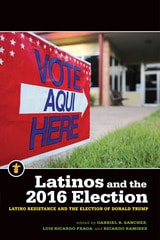
cover of Latinos and the 2016 Election: Latino Resistance and the Election of Donald Trump

Latinos and the 2016 Election

Latino Resistance and the Election of Donald Trump

Gabriel R. Sanchez

Michigan State University Press, 2020
The 2016 election saw more Latino votes than the record voter turnout of the 2012 election. The essays in this volume provide a highly detailed analysis of the state and national impact Latino voters had in what will be remembered as one of the biggest surprises in presidential election history. Contrary to much commentary, Latino voters increased their participation rates in all states beyond the supposed peak levels that they attained in 2012. Moreover, they again displayed their overwhelming support of Democratic candidates and even improved their Democratic support in Florida. Nonetheless, their continued presence and participation in national elections was not sufficient to prevent the election of Donald Trump, the Republican presidential candidate who vilified Latinos and especially Latino immigrants. Each essay provides insights as to how these two competing realities coexist, while the conclusion addresses the implications of this coexistence for the future of Latinos in American politics.
[more]
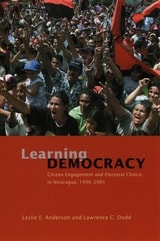
cover of Learning Democracy: Citizen Engagement and Electoral Choice in Nicaragua, 1990-2001

Learning Democracy

Citizen Engagement and Electoral Choice in Nicaragua, 1990-2001

Leslie E. Anderson and Lawrence C. Dodd

University of Chicago Press, 2005

Historically, Nicaragua has been mired in poverty and political conflict, yet the country has become a model for the successful emergence of democracy in a developing nation. Learning Democracy tells the story of how Nicaragua overcame an authoritarian government and American interventionism by engaging in an electoral revolution that solidified its democratic self-governance.

By analyzing nationwide surveys conducted during the 1990, 1996, and 2001 Nicaraguan presidential elections, Leslie E. Anderson and Lawrence C. Dodd provide insight into one of the most unexpected and intriguing recent advancements in third world politics. They offer a balanced account of the voting patterns and forward-thinking decisions that led Nicaraguans to first support the reformist Sandinista revolutionaries only to replace them with a conservative democratic regime a few years later. Addressing issues largely unexamined in Latin American studies, Learning Democracy is a unique and probing look at how the country's mass electorate moved beyond revolutionary struggle to establish a more stable democratic government by realizing the vital role of citizens in democratization processes.
[more]