Results by title
138 books match the query 'Postcolonialism' and 7 start with l
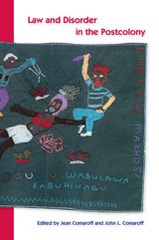
Law and Disorder in the Postcolony
Edited by Jean Comaroff and John L. Comaroff
University of Chicago Press, 2006
Are postcolonies haunted more by criminal violence than other nation-states? The usual answer is yes. In Law and Disorder in the Postcolony, Jean and John Comaroff and a group of respected theorists show that the question is misplaced: that the predicament of postcolonies arises from their place in a world order dominated by new modes of governance, new sorts of empires, new species of wealth—an order that criminalizes poverty and race, entraps the “south” in relations of corruption, and displaces politics into the realms of the market, criminal economies, and the courts.
As these essays make plain, however, there is another side to postcoloniality: while postcolonies live in states of endemic disorder, many of them fetishize the law, its ways and itsmeans. How is the coincidence of disorder with a fixation on legalities to be explained? Law and Disorder in the Postcolony addresses this question, entering into critical dialogue with such theorists as Benjamin, Agamben, and Bayart. In the process, it also demonstrates how postcolonies have become crucial sites for the production of contemporary theory, not least because they are harbingers of a global future under construction.
Laws of the Postcolonial
Eve Darian-Smith and Peter Fitzpatrick, Editors
University of Michigan Press, 1999
In perceptions of Western law there is an enduring disparity between law's pervasive power and its fragility. Many of these essays provide graphic accounts of law's tremendous shaping power in that massive occidental movement which settled and unsettled the globe. These accounts point to the West's encompassing and transforming of other peoples and other legal systems in ways which constitute and confirm the West in its own self-creation. Other essays deal with situations "within" the West which show how its identity is created, sustained, and also challenged in a constant reference to those contrary "others" which a powerful law has shaped and transformed. This challenge comes not least from the resistance of those "others" --resistances that profoundly disrupt the West and its law, revealing them as fractured at the seemingly confident core of their own self-constitution.
Contributors include Antony Anghie, Rolando Gaete, Alan Norrie, Dianne Otto, Paul Passavant, Jeannine Perdy, Colin Perrin, Annelise Riles, Roshan de Silva, and John Strawson, in addition to the editors.
Eve Darian-Smith is Assistant Professor of Anthropology, University of California, Santa Barbara. Peter Fitzpatrick is Professor of Law, Queen Mary and Westfield College, University of London.
Learning to Unlearn
Decolonial Reflections from Eurasia and the AmericasMadina V. Tlostanova and Walter D. Mignolo
The Ohio State University Press, 2012
Learning to Unlearn: Decolonial Reflections from Eurasia and the Americas is a complex, multisided rethinking of the epistemic matrix of Western modernity and coloniality from the position of border epistemology. Colonial and imperial differences are the two key concepts to understanding how the logic of coloniality creates ontological and epistemic exteriorities. Being at once an enactment of decolonial thinking and an attempt to define its main grounds, mechanisms, and concepts, the book shifts the politics of knowledge from “studying the other” (culture, society, economy, politics) toward “the thinking other” (the authors).
Addressing areas as diverse as the philosophy of higher education, gender, citizenship, human rights, and indigenous agency, and providing fascinating and little-known examples of decolonial thinking, education, and art, Madina V. Tlostanova and Walter D. Mignolo deconstruct the modern architecture of knowledge—its production and distribution as manifested in the corporate university. In addition, the authors dwell on and define the echoing global decolonial sensibilities as expressed in the Americas and in peripheral Eurasia. The book is an important addition to the emerging transoceanic inquiries that introduce decolonial thought and non-Western border epistemologies not only to update or transform disciplines but also to act and think decolonially in the global futures to come.
Liberating Shahrazad
Feminism, Postcolonialism, and IslamSuzanne Gauch
University of Minnesota Press, 2006
In Liberating Shahrazad, Suzanne Gauch analyzes how postcolonial writers and filmmakers from Algeria, Morocco, and Tunisia have reclaimed the storyteller in order to portray Muslim women in ways that highlight their power to shape their own destinies. Gauch looks at Maghrebian works that incorporate Shahrazad’s storytelling techniques into unexpected and unforeseen narratives. Highlighting the fluid nature of storytelling, Gauch demonstrates how these new depictions of Shahrazad—from artists such as Moufida Tlatli, Fatima Mernissi, Tahar Ben Jelloun, Assia Djebar, Leïla Sebbar—navigate the demands of a global marketplace, even as they reshape the stories told about the Islamic world.
In the face of both rising fundamentalism and proliferating Western media representations of Arab and Muslim women as silent, exploited, and uneducated victims, Gauch establishes how contemporary works of literature and film revive the voice of a long-silenced Shahrazad—and, ultimately, overthrow oppressive images of Muslim women. Suzanne Gauch is assistant professor of English and women’s studies at Temple University.
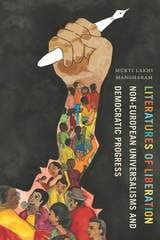
Literatures of Liberation
Non-European Universalisms and Democratic ProgressMukti Lakhi Mangharam
The Ohio State University Press, 2017
In this way, she posits that these universalisms reconceptualize democratic ideals not as Western imports into precolonial societies but as regional phenomena tied to local relations of power and resistance. In charting these alternative democratic trajectories, Mangharam examines oft-overlooked regional and vernacular literary forms and provides a fresh approach to current theorizations of postcolonial and world literatures.

Lusophone Africa
Beyond IndependenceFernando Arenas
University of Minnesota Press, 2010
Exploring the evolving relationship of Lusophone Africa with Portugal, its former colonial power, and Brazil, Fernando Arenas situates the countries on the geopolitical map of contemporary global forces. Drawing from popular music, film, literature, cultural history, geopolitics, and critical theory to investigate the postcolonial condition of Portuguese-speaking Africa, Arenas offers an entirely original discussion of world music phenomenon Cesária Évora, as well as the most thorough examination to date of Lusophone African cinema and of Angolan post-civil-war fiction.
Throughout, Arenas evokes the rich multidimensionality of this community of African nations as a whole and of its individual parts: Angola, Cape Verde, Guinea-Bissau, and Mozambique, and São Tomé and Príncipe since they gained their independence in the mid-1970s. In doing so, he puts forth a conceptual framework for understanding, for the first time, recent cultural and historical developments in Portuguese-speaking Africa.
Lying On The Postcolonial Couch
The Idea Of IndifferenceRukmini Bhaya Nair
University of Minnesota Press, 2002
Exposes the complicity of language and its uses in the colonial project
A revealing look into the long afterlife of colonial conquest, Lying on the Postcolonial Couch offers an original, overarching concept that informs—and helps to explain—the workings of postcoloniality. This concept, "indifference," is a play on the key critical term "difference." Indifference is a cognitive stance invented during the colonial period for the purpose of organizing the complex domain of the Indian subcontinent, one that created its own brand of poetics. Considering postcoloniality as a symptomatic condition, this book proposes a cure involving a return to buried memories of colonial trauma before the phenomenon itself succumbs to the absolute indifference of the slowly gathering amnesia of the new millennium.
Rukmini Bhaya Nair traces a paper trail beginning in 1757 with the Battle of Plassey, winding through the contentious Mutiny of 1857, and ending with Salman Rushdie’s Satanic Verses predicament. Along this trail, she uncovers hidden residues of feeling, from guilt and mistrust to wonder and pleasure, and analyzes the linguistic pillars that hold up the institution of bureaucratic indifference that she exposes.