Results by title
1201 books match the query 'Race relations' and 36 start with l
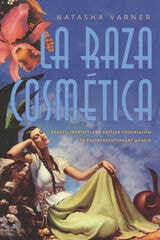
La Raza Cosmética
Beauty, Identity, and Settler Colonialism in Postrevolutionary MexicoNatasha Varner
University of Arizona Press, 2020
Critically examining beauty pageants, cinema, tourism propaganda, photography, murals, and more, Natasha Varner shows how postrevolutionary understandings of mexicanidad were fundamentally structured by legacies of colonialism, as well as shifting ideas about race, place, and gender. This interdisciplinary study smartly weaves together cultural history, Indigenous and settler colonial studies, film and popular culture analysis, and environmental and urban history. It also traces a range of Indigenous interventions in order to disrupt top-down understandings of national identity construction and to “people” this history with voices that have all too often been entirely ignored.
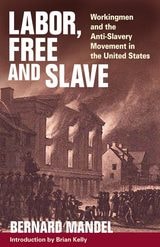
Labor, Free and Slave
Workingmen and the Anti-Slavery Movement in the United StatesBernard Mandel.Introduction by Brian Kelly
University of Illinois Press, 2006
Bernard Mandel's classic study provides a concise overview of the relationship between organized abolitionism and the fledgling labor movement in the period before the Civil War. Mandel argues that slavery reinforced the powerlessness of white workers North and South, and the racial divisions that it upheld rendered effective labor solidarity impossible. Deep distrust between abolitionists and the working classes, however, compelled Northern workers to find their own way into the antislavery ranks.
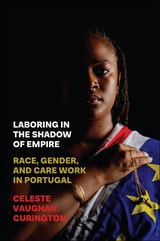
Laboring in the Shadow of Empire
Race, Gender, and Care Work in PortugalCeleste Vaughan Curington
Rutgers University Press, 2024
Winner of the ASA Race, Gender, and Class section's Distinguished Contribution to Scholarship Award
Winner of the ASA Racial and Ethnic Minorities section’s Oliver Cromwell Cox Book Award
Laboring in the Shadow of Empire: Race, Gender, and Care Work in Portugal examines the everyday lives of an African-descendant care service workforce that labors in an ostensibly “anti-racial” Europe and against the backdrop of the Portuguese colonial empire. While much of the literature on global care work has focused on Asian and Latine migrant care workers, there is comparatively less research that explicitly examines African care workers and their migration histories to Europe. Sociologist Celeste Vaughan Curington focuses on Portugal—a European setting with comparatively liberal policies around family settlement and naturalization for migrants. In this setting, rapid urbanization in the late twentieth century, along with a national push to reconcile work and family, has shaped the growth of paid home care and cleaning service industries. Many researchers focus on informal work settings, where immigrant rights are restricted and many workers are undocumented or without permanent residence status. Curington instead examines workers who have accessed citizenship or permanent residence status and also explores African women’s experiences laboring in care and service industries in the formal market, revealing how deeply colonial and intersectional logics of a racialized and international division of reproductive labor in Portugal render these women “hyper-invisible” and “hyper-visible” as “appropriate” workers in Lisbon.
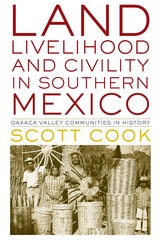
Land, Livelihood, and Civility in Southern Mexico
Oaxaca Valley Communities in HistoryBy Scott Cook
University of Texas Press, 2014
In the Valley of Oaxaca in Mexico’s Southern Highland region, three facets of sociocultural life have been interconnected and interactive from colonial times to the present: first, community land as a space to live and work; second, a civil-religious system managed by reciprocity and market activity wherein obligations of citizenship, office, and festive sponsorships are met by expenditures of labor-time and money; and third, livelihood. In this book, noted Oaxacan scholar Scott Cook draws on thirty-five years of fieldwork (1965–1990) in the region to present a masterful ethnographic historical account of how nine communities in the Oaxaca Valley have striven to maintain land, livelihood, and civility in the face of transformational and cumulative change across five centuries.
Drawing on an extensive database that he accumulated through participant observation, household surveys, interviews, case studies, and archival work in more than twenty Oaxacan communities, Cook documents and explains how peasant-artisan villagers in the Oaxaca Valley have endeavored over centuries to secure and/or defend land, worked and negotiated to subsist and earn a living, and striven to meet expectations and obligations of local citizenship. His findings identify elements and processes that operate across communities or distinguish some from others. They also underscore the fact that landholding is crucial for the sociocultural life of the valley. Without land for agriculture and resource extraction, occupational options are restricted, livelihood is precarious and contingent, and civility is jeopardized.
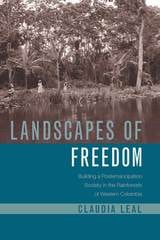
Landscapes of Freedom
Building a Postemancipation Society in the Rainforests of Western ColombiaClaudia Leal
University of Arizona Press, 2018
After emancipation in 1851, the African descendants living in the extra-humid rainforests of the Pacific coast of Colombia attained levels of autonomy hardly equaled anywhere else in the Americas. This autonomy rested on their access to a diverse environment—including small strips of fertile soils, mines, forests, rivers, and wetlands—that contributed to their subsistence and allowed them to procure gold, platinum, rubber, and vegetable ivory for export.
Afro-Colombian slave labor had produced the largest share of gold in the colony of New Granada. After the abolishment of slavery, some free people left the mining areas and settled elsewhere along the coast, making this the largest area of Latin America in which black people predominate into the present day. However, this economy and society, which lived off the extraction of natural resources, was presided over by a very small white commercial elite living in the region’s ports, where they sought to create an urban environment that would shelter them from the jungle.
Landscapes of Freedom reconstructs a nonplantation postemancipation trajectory that sheds light on how environmental conditions and management influenced the experience of freedom. It also points at the problematic associations between autonomy and marginality that have shaped the history of Afro-America. By focusing on racialized landscapes, Leal offers a nuanced and important approach to understanding the history of Latin America.
Langston Hughes and the *Chicago Defender*
Essays on Race, Politics, and Culture, 1942-62Langston Hughes. Edited by Christopher C. De Santis
University of Illinois Press, 1995
But it was as a columnist for the famous African-American newspaper the Chicago Defender that Hughes chronicled the hopes and despair of his people. For twenty years, he wrote forcefully about international race relations, Jim Crow, the South, white supremacy, imperialism and fascism, segregation in the armed forces, the Soviet Union and communism, and African-American art and culture. None of the racial hypocrisies of American life escaped his searing, ironic prose.
This is the first collection of Hughes's nonfiction journalistic writings. For readers new to Hughes, it is an excellent introduction; for those familiar with him, it gives new insights into his poems and fiction.
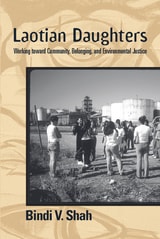
Laotian Daughters
Working toward Community, Belonging, and Environmental JusticeBindi V. Shah
Temple University Press, 2011
Laotian Daughters focuses on second-generation environmental justice activists in Richmond, California. Bindi Shah's pathbreaking book charts these young women's efforts to improve the degraded conditions in their community and explores the ways their activism and political practices resist the negative stereotypes of race, class, and gender associated with their ethnic group.
Using ethnographic observations, interviews, focus groups, and archival data on their participation in Asian Youth Advocates—a youth leadership development project—Shah analyzes the teenagers' mobilization for social rights, cross-race relations, and negotiations of gender and inter-generational relations. She also addresses issues of ethnic youth, and immigration and citizenship and how these shape national identities.
Shah ultimately finds that citizenship as a social practice is not just an adult experience, and that ethnicity is an ongoing force in the political and social identities of second-generation Laotians.
Latinas/os in New Jersey
Histories, Communities, and CulturesAldo A. Lauria Santiago
Rutgers University Press, 2025
Contributors: Yamil Avivi; Jennifer Ayala; Ulla D. Berg; Giovani Burgos; Elsa Candelario; Laura Curran; Lilia Fernández; Ismael García Colón; Olga Jiménez de Wagenheim; Benjamin Lapidus; Aldo A. Lauria Santiago; Johana Londoño; Kathleen Lopez; Giancarlo Muschi; Melanie Z. Plasencia; Ana Y. Ramos-Zayas; Elena Sabogal; Raymond Sanchez Mayers; William Suárez Gómez; Alex F. Trillo; Daniela Valdez; Anil Venkatesh; Lyna L. Wiggins
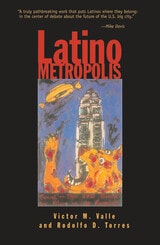
Latino Metropolis
Victor M. Valle
University of Minnesota Press, 2000
A readable look at culture and politics in Los Angeles through a Latino lens.
Los Angeles: scratch the surface of the city’s image as a rich mosaic of multinational cultures and a grittier truth emerges-its huge, shimmering economy was built on the backs of largely Latino immigrants and still depends on them. This book exposes the underside of the development and restructuring that have turned Los Angeles into a global city, and in doing so it reveals the ways in which ideas about ethnicity-Latino identity itself-are implicated and elaborated in the process. A penetrating analysis of the social, economic, cultural, and political consequences of the growth of the Latino working-class populations in Los Angeles, Latino Metropolis is also a nuanced account of the complex links between political economy and the social construction of ethnicity.
Lifting examples from recent news stories, political encounters, and cultural events, the authors demonstrate how narratives about Latinos are used to maintain the status quo-particularly the existing power grid-in the city. In media representations of riots, in the recasting (and "whitening") of Mexican food as Spanish-American cuisine, in the community displacement that occurred as part of the development of the Staples Center-in telling instances large and small, we see how Los Angeles and its Latino population are mutually transforming. And we see how an old Latino politics of "racial" identity is inevitably giving way to a new politics of class. Combining political and economic insight with trenchant social and cultural analysis, this work offers the clearest statement to date of how ethnicity and class intersect in defining racialized social relations in the contemporary metropolis.Globalization and Community Series, volume 7Translation Inquiries: University of Minnesota Press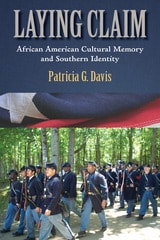
Laying Claim
African American Cultural Memory and Southern IdentityPatricia G. Davis
University of Alabama Press, 2016
Reclaiming Southern history through the voices, memories, and experiences of African Americans.
In Laying Claim: African American Cultural Memory and Southern Identity, Patricia Davis identifies the Civil War as the central narrative around which official depictions of southern culture have been defined. Because that narrative largely excluded African American points of view, the resulting southern identity was monolithically white. Davis traces how the increasing participation of black public voices in the realms of Civil War memory—battlefields, museums, online communities—has dispelled the mirage of “southernness” as a stolid cairn of white culture and has begun to create a more fluid sense of southernness that welcomes contributions by all of the region’s peoples.
Laying Claim offers insightful and penetrating examinations of African American participation in Civil War reenactments; the role of black history museums in enriching representations of the Civil War era with more varied interpretations; and the internet as a forum within which participants exchange and create historical narratives that offer alternatives to unquestioned and dominant public memories. From this evolving cultural landscape, Davis demonstrates how simplistic caricatures of African American experiences are giving way to more authentic, expansive, and inclusive interpretations of southernness.
As a case-study and example of change, Davis cites the evolution of depictions of life at Thomas Jefferson’s Monticello. Where visitors to the site once encountered narratives that repeated the stylized myth of Monticello as a genteel idyll, modern accounts of Jefferson’s day offer a holistic, inclusive, and increasingly honest view of Monticello as the residents on every rung of the social ladder experienced it.
Contemporary violence and attacks about or inspired by the causes, outcomes, and symbols of the Civil War, even one hundred and fifty years after its end, add urgency to Davis’s argument that the control and creation of public memories of that war is an issue of concern not only to scholars but all Americans. Her hopeful examination of African American participation in public memory illuminates paths by which this enduring ideological impasse may find resolutions.
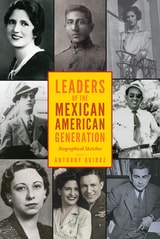
Leaders of the Mexican American Generation
Biographical EssaysAnthony Quiroz
University Press of Colorado, 2016
Leaders of the Mexican American Generation explores the lives of a wide range of influential members of the US Mexican American community between 1920 and 1965 who paved the way for major changes in their social, political, and economic status within the United States.
Including feminist Alice Dickerson Montemayor, to San Antonio attorney Gus García, and labor activist and scholar Ernesto Galarza, the subjects of these biographies include some of the most prominent idealists and actors of the time. Whether debating in a court of law, writing for a major newspaper, producing reports for governmental agencies, organizing workers, holding public office, or otherwise shaping space for the Mexican American identity in the United States, these subjects embody the core values and diversity of their generation.
More than a chronicle of personalities who left their mark on Mexican American history, Leaders of the Mexican American Generation cements these individuals as major players in the history of activism and civil rights in the United States. It is a rich collection of historical biographies that will enlighten and enliven our understanding of Mexican American history.
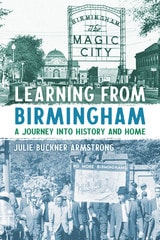
Learning from Birmingham
A Journey into History and HomeJulie Buckner Armstrong
University of Alabama Press, 2023
A steel town daughter’s search for truth and beauty in Birmingham, Alabama
“As Birmingham goes, so goes the nation,” Fred Shuttlesworth observed when he invited Martin Luther King Jr. to the city for the transformative protests of 1963. From the height of the Civil Rights Movement through its long aftermath, images of police dogs, fire hoses and four girls murdered when Ku Klux Klan members bombed the Sixteenth Street Baptist Church have served as an uncomfortable racial mirror for the nation. Like many white people who came of age in the Civil Rights Movement’s wake, Julie Buckner Armstrong knew little about this history. Only after moving away and discovering writers like Toni Morrison and Alice Walker did she realize how her hometown and family were part of a larger, ongoing story of struggle and injustice.
When Armstrong returned to Birmingham decades later to care for her aging mother, Shuttlesworth’s admonition rang in her mind. By then an accomplished scholar and civil rights educator, Armstrong found herself pondering the lessons Birmingham holds for a twenty-first century America. Those lessons extended far beyond what a 2014 Teaching Tolerance report describes as the common distillation of the Civil Rights Movement into “two names and four words: Martin Luther King Jr, Rosa Parks, and ‘I have a dream.’” Seeking to better understand a more complex local history, its connection to broader stories of oppression and resistance, and her own place in relation to it, Armstrong embarked on a journey to unravel the standard Birmingham narrative to see what she would find.
Beginning at the center, with her family’s 1947 arrival to a housing project near the color line, within earshot of what would become known as Dynamite Hill, Armstrong works her way over time and across the map. Weaving in stories of her white working-class family, classmates, and others not traditionally associated with Birmingham’s civil rights history, including members of the city’s LGBTQ community, she forges connections between the familiar and lesser-known. The result is a nuanced portrait of Birmingham--as seen in public housing, at old plantations, in segregated neighborhoods, across contested boundary lines, over mountains, along increasingly polluted waterways, beneath airport runways, on highways cutting through town, and under the gaze of the iconic statue of Vulcan.
In her search for truth and beauty in Birmingham, Armstrong draws on the powers of place and storytelling to dig into the cracks, complicating easy narratives of civil rights progress. Among the discoveries she finds in America’s racial mirror is a nation that has failed to recognize itself in the horrific images from Birmingham’s past and to acknowledge the continuing inequalities that make up the Civil Right’s Movement’s unfinished business. Learning from Birmingham reminds us that stories of civil rights, structural oppression, privilege, abuse, race and gender bias, and inequity are difficult and complicated, but their telling, especially from multiple stakeholder perspectives, is absolutely necessary.
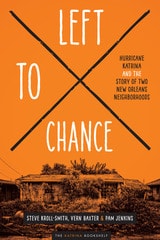
Left to Chance
Hurricane Katrina and the Story of Two New Orleans NeighborhoodsBy Steve Kroll-Smith, Vern Baxter, and Pam Jenkins
University of Texas Press, 2015
How do survivors recover from the worst urban flood in American history, a disaster that destroyed nearly the entire physical landscape of a city, as well as the mental and emotional maps that people use to navigate their everyday lives? This question has haunted the survivors of Hurricane Katrina and informed the response to the subsequent flooding of New Orleans across many years.
Left to Chance takes us into two African American neighborhoods—working-class Hollygrove and middle-class Pontchartrain Park—to learn how their residents have experienced “Miss Katrina” and the long road back to normal life. The authors spent several years gathering firsthand accounts of the flooding, the rushed evacuations that turned into weeks- and months-long exile, and the often confusing and exhausting process of rebuilding damaged homes in a city whose local government had all but failed. As the residents’ stories make vividly clear, government and social science concepts such as “disaster management,” “restoring normality,” and “recovery” have little meaning for people whose worlds were washed away in the flood. For the neighbors in Hollygrove and Pontchartrain Park, life in the aftermath of Katrina has been a passage from all that was familiar and routine to an ominous world filled with raw existential uncertainty. Recovery and rebuilding become processes imbued with mysteries, accidental encounters, and hasty adaptations, while victories and defeats are left to chance.
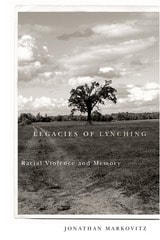
Legacies Of Lynching
Racial Violence And MemoryJonathan Markovitz
University of Minnesota Press, 2004
Traces the changing meanings of lynching and examines the political power of lynching as metaphor
Between 1880 and 1930, thousands of African Americans were lynched in the United States. Beyond the horrific violence inflicted on these individuals, lynching terrorized whole communities and became a defining characteristic of Southern race relations in the Jim Crow era. As spectacle, lynching was intended to serve as a symbol of white supremacy. Yet, Jonathan Markovitz notes, the act's symbolic power has endured long after the practice of lynching has largely faded away.
Legacies of Lynching examines the evolution of lynching as a symbol of racial hatred and a metaphor for race relations in popular culture, art, literature, and political speech. Markovitz credits the efforts of the antilynching movement with helping to ensure that lynching would be understood not as a method of punishment for black rapists but as a terrorist practice that provided stark evidence of the brutality of Southern racism and as America’s most vivid symbol of racial oppression. Cinematic representations of lynching, from Birth of a Nation to Do the Right Thing, he contends, further transform the ways that American audiences remember and understand lynching, as have disturbing recent cases in which alleged or actual acts of racial violence reconfigured stereotypes of black criminality. Markovitz further reveals how lynching imagery has been politicized in contemporary society with the example of Clarence Thomas, who condemned the Senate's investigation into allegations of sexual harassment during his Supreme Court confirmation hearings as a “high-tech lynching.”Even today, as revealed by the 1998 dragging death of James Byrd in Jasper, Texas, and the national soul-searching it precipitated, lynching continues to pervade America's collective memory. Markovitz concludes with an analysis of debates about a recent exhibition of photographs of lynchings, suggesting again how lynching as metaphor remains always in the background of our national discussions of race and racial relations.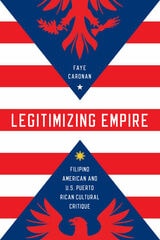
Legitimizing Empire
Filipino American and U.S. Puerto Rican Cultural CritiqueFaye Caronan
University of Illinois Press, 2015
Faye Caronan's examination interprets the pivotal engagement of novels, films, performance poetry, and other cultural productions as both symptoms of and resistance against American military, social, economic, and political incursions. Though the Philippines became an independent nation and Puerto Rico a U.S. commonwealth, both remain subordinate to the United States. Caronan's juxtaposition reveals two different yet simultaneous models of U.S. neocolonial power and contradicts American exceptionalism as a reluctant empire that only accepts colonies for the benefit of the colonized and global welfare. Her analysis, meanwhile, demonstrates how popular culture allows for alternative narratives of U.S. imperialism, but also functions to contain those alternatives.
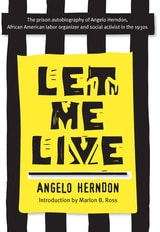
Let Me Live
Angelo Herndon
University of Michigan Press, 2007
Let Me Live tells the remarkable story of Angelo Herndon, a coal miner who worked as a labor organizer in Alabama and Georgia in the 1930s. Herndon led a racially integrated march of the unemployed in 1932 and was subsequently arrested when Communist Party literature was found in his bedroom. His trial made only small headlines at first, but eventually an international campaign to free him emerged, thanks to the efforts of the Communist Party and of labor unions interested in protecting the right to organize in the South. Herndon was finally set free by the U.S. Supreme Court, with the help of well-known leaders including C. Vann Woodward, Thurgood Marshall, A. Philip Randolph, and Whitney North Seymour, Sr.
Written while Herndon was in prison, Let Me Live tells the story behind his arrest and his struggle through the courts. It also describes his early life as a young boy in poverty, as a laborer in the Kentucky mines, and as a construction gang worker and traces the birth and development of his passion for the Communist Party. Originally published in 1937, this is the first new edition of Let Me Live since 1969, when Howard N. Meyer rescued it from obscurity. The book features texts from the Georgia and U.S. Supreme Court decisions, the text of Herndon’s speech, and newspaper editorials from the era. A substantive and thought-provoking introduction by Marlon B. Ross of the University of Virginia sheds light on this unique story and its importance to our understanding of the intersection of race and class in America—past and present.
“A book which every thoughtful American may do well to read. It is moving and challenging as the story of one man’s life and the question of one man’s fate.”
—New York Times
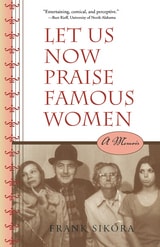
Let Us Now Praise Famous Women
A MemoirFrank Sikora
University of Alabama Press, 2005
An affectionate, humorous account of small town Alabama during the civil rights era.
When Frank Sikora's six-year-old daughter contracted pneumonia in 1962, his wife Millie vowed that would be the last winter she would spend in Ohio. Despite their misgivings about the racial tensions erupting there, they moved their family of six south, where Frank hoped to fulfill his dream of becoming a newspaper reporter. But when those dreams didn't materialize immediately, mounting bills, repossession, and eviction forced them to move in with Millie's parents, Dan and Minnie Belle Helms, in rural Wellington, Alabama.
With even slimmer prospects for employment in impoverished Calhoun County, the Sikoras came to depend heavily upon the Helmses and extended family members and all their lives became closely intertwined. The Helmses were uneducated, unpolished people, but Sikora's narration of his life with them—often humorous but never condescending—provides a compelling portrait of the attitudes and lifestyle of poor whites in Alabama during the second half of the 20th century, just as James Agee's monumental work, Let Us Now Praise Famous Men, illuminated the Depression years in Hale County, Alabama. Sikora illustrates how resourceful, southern women, in particular, held their families together through trying times.
Interwoven with this commentary on rural white culture in the Deep South is the story of Sikora's developing career as a newsman. Determined to succeed, he finally lands a job with the Gadsden Times reporting the news of black citizens. From that introduction to journalism, Sikora becomes one of Alabama's most acclaimed chroniclers of the civil rights movement, eventually writing some of the acknowledged masterpieces about the subject. Like his landmark book, Selma, Lord, Selma, Sikora's newest work tells the stories of ordinary Alabamians and their perspectives on extraordinary times.
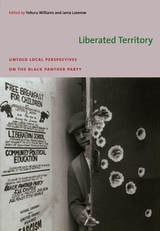
Liberated Territory
Untold Local Perspectives on the Black Panther PartyYohuru Williams and Jama Lazerow, eds.
Duke University Press, 2008
The histories and character of the party branches vary as widely as their locations. The Cape Verdeans of New Bedford, Massachusetts, were initially viewed as a particular challenge for the local Panthers but later became the mainstay of the Boston-area party. In the early 1970s, the Winston-Salem, North Carolina, chapter excelled at implementing the national Black Panther Party’s strategic shift from revolutionary confrontation to mainstream electoral politics. In Detroit, the Panthers were defined by a complex relationship between their above-ground activities and an underground wing dedicated to armed struggle. While the Milwaukee chapter was born out of a rising tide of black militancy, it ultimately proved more committed to promoting literacy and health care and redressing hunger than to violence. The Alabama Black Liberation Front did not have the official imprimatur of the national party, but it drew heavily on the Panthers’ ideas and organizing strategies, and its activism demonstrates the broad resonance of many of the concerns articulated by the national party: the need for jobs, for decent food and housing, for black self-determination, and for sustained opposition to police brutality against black people. Liberated Territory reveals how the Black Panther Party’s ideologies, goals, and strategies were taken up and adapted throughout the United States.
Contributors: Devin Fergus, Jama Lazerow, Ahmad A. Rahman, Robert W. Widell Jr., Yohuru Williams
Lifting the Shadow
Reshaping Memory, Race, and Slavery in U.S. MuseumsAmy Sodaro
Rutgers University Press, 2025
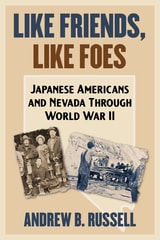
Like Friends, Like Foes
Japanese Americans and Nevada through World War IIAndrew B. Russell
University of Nevada Press, 2026
Like Friends, Like Foes offers a comprehensive analysis of how Nevada residents responded and reacted to the “Japanese Question” during World War II. Both before and during the war, the experience of Japanese American residents of Nevada varied widely. Once the war started, Japanese immigrants experienced an unusual case of mass internment from the mining towns of Ruth and McGill, Nevada, while Japanese American railroad workers and their families, scattered across the state, faced sudden layoffs and evictions. At the same time, most of the Japanese Americans living in Nevada fared much better than their counterparts who resided in the surrounding states.
Andrew Russell’s study examines how variations in local history and local circumstances generated starkly different perspectives and responses to the supposed “Japanese problems” confronting Nevada’s small communities, the state, and the larger region. While Russell’s interpretive history spotlights some highly unusual developments, it nevertheless offers fresh evidence of how individuals or small groups can play significant roles in combating the abuse of civil rights during times of fear and uncertainty.
Limits to Liberation after Apartheid
Citizenship, Governance, & CultureSteven L. Robins
Ohio University Press, 2005
Lincoln and Emancipation
Edna Greene Medford
Southern Illinois University Press, 2015
In this succinct study, Edna Greene Medford examines the ideas and events that shaped President Lincoln’s responses to slavery, following the arc of his ideological development from the beginning of the Civil War, when he aimed to pursue a course of noninterference, to his championing of slavery’s destruction before the conflict ended. Throughout, Medford juxtaposes the president’s motivations for advocating freedom with the aspirations of African Americans themselves, restoring African Americans to the center of the story about the struggle for their own liberation.
Lincoln and African Americans, Medford argues, approached emancipation differently, with the president moving slowly and cautiously in order to save the Union while the enslaved and their supporters pressed more urgently for an end to slavery. Despite the differences, an undeclared partnership existed between the president and slaves that led to both preservation of the Union and freedom for those in bondage. Medford chronicles Lincoln’s transition from advocating gradual abolition to campaigning for immediate emancipation for the majority of the enslaved, a change effected by the military and by the efforts of African Americans. The author argues that many players—including the abolitionists and Radical Republicans, War Democrats, and black men and women—participated in the drama through agitation, military support of the Union, and destruction of the institution from within. Medford also addresses differences in the interpretation of freedom: Lincoln and most Americans defined it as the destruction of slavery, but African Americans understood the term to involve equality and full inclusion into American society. An epilogue considers Lincoln’s death, African American efforts to honor him, and the president’s legacy at home and abroad.
Both enslaved and free black people, Medford demonstrates, were fervent participants in the emancipation effort, showing an eagerness to get on with the business of freedom long before the president or the North did. By including African American voices in the emancipation narrative, this insightful volume offers a fresh and welcome perspective on Lincoln’s America.
Lincoln and Race
Richard Striner
Southern Illinois University Press, 2012
Named on the 2013 list of University Press Books for Public and Secondary Schools
Abraham Lincoln is known as the Great Emancipator, yet his personal views on race have long been debated. Since his death, his legend has been shadowed by the mystery of his true stance toward non-whites. While Lincoln took many actions to fight slavery throughout his political career, his famously crafted speeches can be interpreted in different ways: at times his words suggest personal bigotry, but at other times he sounds like an enemy of racists. In Lincoln and Race, Richard Striner takes on one of the most sensitive subjects of Abraham Lincoln’s legacy, exploring in depth Lincoln’s mixed record and writings on the issue of race.
Striner gives fair hearing to two prevailing theories about Lincoln’s seemingly contradictory words and actions: Did Lincoln fight a long-term struggle to overcome his personal racism? Or were his racist comments a calculated act of political deception? Beginning with an exploration of the historical context of Lincoln’s attitudes toward race in the years before his presidency, Striner details the ambiguity surrounding the politician’s participation in the Free Soil Movement and his fight to keep slavery from expanding into the West. He explores Lincoln’s espousal of colonization—the controversial idea that freed slaves should be resettled in a foreign land—as a voluntary measure for black people who found the prospect attractive. The author analyzes some of Lincoln’s most racially charged speeches and details Lincoln’s presidential words and policies on race and the hotbed issue of voting rights for African Americans during the last years of the president’s life.
A brief but comprehensive look into one of the most contentious quandaries about Abraham Lincoln, Lincoln and Race invites readers to delve into the mind, heart, and motives of one of America’s most fascinating and complex leaders.
University Press Books for Public and Secondary Schools 2013 edition
Livin' the Blues
Memoirs of a Black Journalist and PoetFrank Marshall Davis
University of Wisconsin Press, 1993
Frank Marshall Davis was a prominent poet, journalist, jazz critic, and civil rights activist on the Chicago and Atlanta scene from the 1920s through 1940s. He was an intimate of Langston Hughes and Richard Wright and an influential editor at the Chicago Evening Bulletin, the Chicago Whip, the Chicago Star, and the Atlanta World. He renounced his writing career in 1948 and moved to Hawaii, forgotten until the Black Arts Movement rediscovered him in the 1960s.
Because of his early self-exile from the literary limelight, Davis's life and work have been shrouded in mystery. Livin' the Blues offers us a chance to rediscover this talented poet and writer and stands as an important example of black autobiography, similar in form, style, and message to those of Langston Hughes and Richard Wright.
"Both a social commentary and intellectual exploration into African American life in the twentieth century."—Charles Vincent, Atlanta History
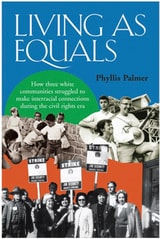
Living as Equals
How Three White Communities Struggled to Make Interracial Connections During the Civil Rights EraPhyllis Palmer
Vanderbilt University Press, 2008
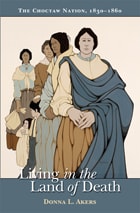
Living in the Land of Death
The Choctaw Nation, 1830-1860Donna L. Akers
Michigan State University Press, 2004
With the Indian Removal Act of 1830, the Choctaw people began their journey over the Trail of Tears from their homelands in Mississippi to the new lands of the Choctaw Nation. Suffering a death rate of nearly 20 percent due to exposure, disease, mismanagement, and fraud, they limped into Indian Territory, or, as they knew it, the Land of the Dead (the route taken by the souls of Choctaw people after death on their way to the Choctaw afterlife). Their first few years in the new nation affirmed their name for the land, as hundreds more died from whooping cough, floods, starvation, cholera, and smallpox.
Living in the Land of the Dead depicts the story of Choctaw survival, and the evolution of the Choctaw people in their new environment. Culturally, over time, their adaptation was one of homesteads and agriculture, eventually making them self-sufficient in the rich new lands of Indian Territory. Along the Red River and other major waterways several Choctaw families of mixed heritage built plantations, and imported large crews of slave labor to work cotton fields. They developed a sub-economy based on interaction with the world market. However, the vast majority of Choctaws continued with their traditional subsistence economy that was easily adapted to their new environment.
The immigrant Choctaws did not, however, move into land that was vacant. The U.S. government, through many questionable and some outright corrupt extralegal maneuvers, chose to believe it had gained title through negotiations with some of the peoples whose homelands and hunting grounds formed Indian Territory. Many of these indigenous peoples reacted furiously to the incursion of the Choctaws onto their rightful lands. They threatened and attacked the Choctaws and other immigrant Indian Nations for years. Intruding on others’ rightful homelands, the farming-based Choctaws, through occupation and economics, disrupted the traditional hunting economy practiced by the Southern Plains Indians, and contributed to the demise of the Plains ways of life.
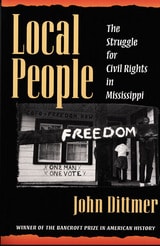
Local People
The Struggle for Civil Rights in MississippiJohn Dittmer
University of Illinois Press, 1994
Publication of this book was supported by a grant from DePauw University, Greencastle, Indiana.
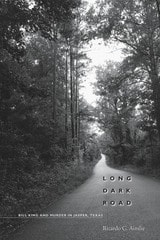
Long Dark Road
Bill King and Murder in Jasper, TexasBy Ricardo C. Ainslie
University of Texas Press, 2004
On a long dark road in deep East Texas, James Byrd Jr. was dragged to his death behind a pickup truck one summer night in 1998. The brutal modern-day lynching stunned people across America and left everyone at a loss to explain how such a heinous crime could possibly happen in our more racially enlightened times. Many eventually found an answer in the fact that two of the three men convicted of the murder had ties to the white supremacist Confederate Knights of America. In the ex-convict ringleader, Bill King, whose body was covered in racist and satanic tattoos, people saw the ultimate monster, someone so inhuman that his crime could be easily explained as the act of a racist psychopath. Few, if any, asked or cared what long dark road of life experiences had turned Bill King into someone capable of committing such a crime.
In this gripping account of the murder and its aftermath, Ricardo Ainslie builds an unprecedented psychological profile of Bill King that provides the fullest possible explanation of how a man who was not raised in a racist family, who had African American friends in childhood, could end up on death row for viciously killing a black man. Ainslie draws on exclusive in-prison interviews with King, as well as with Shawn Berry (another of the perpetrators), King's father, Jasper residents, and law enforcement and judicial officials, to lay bare the psychological and social forces—as well as mere chance—that converged in a murder on that June night. Ainslie delves into the whole of King's life to discover how his unstable family relationships and emotional vulnerability made him especially susceptible to the white supremacist ideology he adopted while in jail for lesser crimes.
With its depth of insight, Long Dark Road not only answers the question of why such a racially motivated murder happened in our time, but it also offers a frightening, cautionary tale of the urgent need to intervene in troubled young lives and to reform our violent, racist-breeding prisons. As Ainslie chillingly concludes, far from being an inhuman monster whom we can simply dismiss, "Bill King may be more like the rest of us than we care to believe."
Long Is the Way and Hard
One Hundred Years of the NAACPKevern Verney
University of Arkansas Press, 2009
Lost on the Freedom Trail
The National Park Service and Urban Renewal in Postwar BostonSeth C. Bruggeman
University of Massachusetts Press, 2022
Boston National Historical Park is one of America's most popular heritage destinations, drawing in millions of visitors annually. Tourists flock there to see the site of the Boston Massacre, to relive Paul Revere's midnight ride, and to board Old Ironsides—all of these bound together by the iconic Freedom Trail, which traces the city's revolutionary saga.
Making sense of the Revolution, however, was never the primary aim for the planners who reimagined Boston's heritage landscape after the Second World War. Seth C. Bruggeman demonstrates that the Freedom Trail was always largely a tourist gimmick, devised to lure affluent white Americans into downtown revival schemes, its success hinging on a narrow vision of the city's history run through with old stories about heroic white men. When Congress pressured the National Park Service to create this historical park for the nation's bicentennial celebration in 1976, these ideas seeped into its organizational logic, precluding the possibility that history might prevail over gentrification and profit.
Lovable Racists, Magical Negroes, and White Messiahs
David Ikard
University of Chicago Press, 2017
In the book, Ikard explodes the fiction of a postracial society while awakening us to the sobering reality that we must continue to fight for racial equality or risk losing the hard-fought gains of the Civil Rights movement. Through his close reading of novels, films, journalism, and political campaigns, he analyzes willful white blindness and attendant master narratives of white redemption—arguing powerfully that he who controls the master narrative controls the perception of reality. The book sounds the alarm about seemingly innocuous tropes of white redemption that abound in our society and generate the notion that blacks are perpetually indebted to whites for liberating, civilizing, and enlightening them. In Lovable Racists, Magical Negroes, and White Messiahs, Ikard expertly and unflinchingly gives us a necessary critical historical intervention.
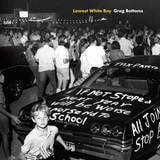
Lowest White Boy
Greg Bottoms
West Virginia University Press, 2019
An innovative, hybrid work of literary nonfiction, Lowest White Boy takes its title from Lyndon Johnson’s observation during the civil rights era: “If you can convince the lowest white man he’s better than the best colored man, he won’t notice you’re picking his pocket.”
Greg Bottoms writes about growing up white and working class in Tidewater, Virginia, during school desegregation in the 1970s. He offers brief stories that accumulate to reveal the everyday experience of living inside complex, systematic racism that is often invisible to economically and politically disenfranchised white southerners—people who have benefitted from racism in material ways while being damaged by it, he suggests, psychologically and spiritually. Placing personal memories against a backdrop of documentary photography, social history, and cultural critique, Lowest White Boy explores normalized racial animus and reactionary white identity politics, particularly as these are collected and processed in the mind of a child.
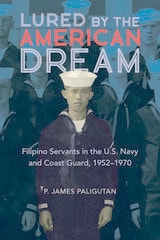
Lured by the American Dream
Filipino Servants in the U.S. Navy and Coast Guard, 1952-1970P. James Paligutan
University of Illinois Press, 2022
Insightful and dramatic, Lured by the American Dream is the untold story of how Filipino servicepersons overcame tradition and hierarchy in their quest for dignity.
Lynching Beyond Dixie
American Mob Violence Outside the SouthEdited by Michael J. Pfeifer
University of Illinois Press, 2013
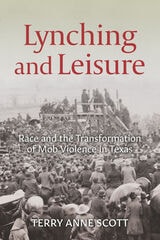
Lynching and Leisure
Race and the Transformation of Mob Violence in TexasTerry Anne Scott
University of Arkansas Press, 2022
Winner, 2022 Ottis Lock Endowment “Best Book” Award from the East Texas Historical Association
In Lynching and Leisure, Terry Anne Scott examines how white Texans transformed lynching from a largely clandestine strategy of extralegal punishment into a form of racialized recreation in which crowd involvement was integral to the mode and methods of the violence. Scott powerfully documents how lynchings came to function not only as tools for debasing the status of Black people but also as highly anticipated occasions for entertainment, making memories with friends and neighbors, and reifying whiteness. In focusing on the sense of pleasure and normality that prevailed among the white spectatorship, this comprehensive study of Texas lynchings sheds new light on the practice understood as one of the chief strategies of racial domination in the nineteenth- and twentieth-century South.
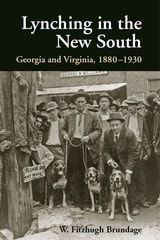
Lynching in the New South
Georgia and Virginia, 1880-1930W. Fitzhugh Brundage
University of Illinois Press, 1993
A groundbreaking study, Lynching in the New South is a classic portrait of the tradition of violence that poisoned American life.