Results by title
1017 books match the query 'Reference' and 22 start with l
Lacandon Maya-Spanish-English Dictionary
Charles A Hofling
University of Utah Press, 2014
Following the same trilingual format as Hofling’s Mopan Maya-Spanish-English Dictionary, this reference contains pronunciation and grammatical information. It is a hybrid of a root dictionary and one with words in alphabetical order; words can be looked up in these two different ways, making it easy to use for both native and nonnative speakers. It also accommodates Spanish speakers who wish to learn Lacandon, and in the future is likely to be helpful to Lacandon-speaking children, who increasingly use Spanish outside the home, while preserving a record of this indigenous language.
Land Filled with Flies
A Political Economy of the KalahariEdwin N. Wilmsen
University of Chicago Press, 1989
"[A] major work. . . . Anthropologists will, and should, use Wilmsen's meticulously detailed study to revise their early lectures in the introductory course, and no future study of African 'foragers' should ignore it."—Parker Shipton, American Anthropologist
"An impressive book. . . . The reader need only read the first few pages to judge both the quality and ambitiousness of the work. . . . Essential reading."—David R. Penna, Africa Today
Land of Smoke and Mirrors
A Cultural History of Los AngelesBrook, Vincent
Rutgers University Press, 2013
Unlike the more forthrightly mythic origins of other urban centers—think Rome via Romulus and Remus or Mexico City via the god Huitzilopochtli—Los Angeles emerged from a smoke-and-mirrors process that is simultaneously literal and figurative, real and imagined, material and metaphorical, physical and textual. Through penetrating analysis and personal engagement, Vincent Brook uncovers the many portraits of this ever-enticing, ever-ambivalent, and increasingly multicultural megalopolis. Divided into sections that probe Los Angeles’s checkered history and reflect on Hollywood’s own self-reflections, the book shows how the city, despite considerable remaining challenges, is finally blowing away some of the smoke of its not always proud past and rhetorically adjusting its rear-view mirrors.
Part I is a review of the city’s history through the early 1900s, focusing on the seminal 1884 novel Ramona and its immediate effect, but also exploring its ongoing impact through interviews with present-day Tongva Indians, attendance at the 88th annual Ramona pageant, and analysis of its feature film adaptations.
Brook deals with Hollywood as geographical site, film production center, and frame of mind in Part II. He charts the events leading up to Hollywood’s emergence as the world’s movie capital and explores subsequent developments of the film industry from its golden age through the so-called New Hollywood, citing such self-reflexive films as Sunset Blvd.,Singin’ in the Rain, and The Truman Show.
Part III considers LA noir, a subset of film noir that emerged alongside the classical noir cycle in the 1940s and 1950s and continues today. The city’s status as a privileged noir site is analyzed in relation to its history and through discussions of such key LA noir novels and films as Double Indemnity, Chinatown, and Crash.
In Part IV, Brook examines multicultural Los Angeles. Using media texts as signposts, he maps the history and contemporary situation of the city’s major ethno-racial and other minority groups, looking at such films as Mi Familia (Latinos), Boyz N the Hood (African Americans), Charlotte Sometimes (Asians), Falling Down (Whites), and The Kids Are All Right (LGBT).
Latin American Identity and Constructions of Difference
Amaryll Chanady
University of Minnesota Press, 1993
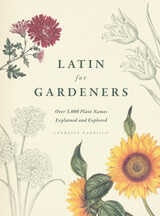
Latin for Gardeners
Over 3,000 Plant Names Explained and ExploredLorraine Harrison
University of Chicago Press, 2012
Since Latin became the standard language for plant naming in the eighteenth century, it has been intrinsically linked with botany. And while mastery of the classical language may not be a prerequisite for tending perennials, all gardeners stand to benefit from learning a bit of Latin and its conventions in the field. Without it, they might buy a Hellebores foetidus and be unprepared for its fetid smell, or a Potentilla reptans with the expectation that it will stand straight as a sentinel rather than creep along the ground.
An essential addition to the gardener’s library, this colorful, fully illustrated book details the history of naming plants, provides an overview of Latin naming conventions, and offers guidelines for pronunciation. Readers will learn to identify Latin terms that indicate the provenance of a given plant and provide clues to its color, shape, fragrance, taste, behavior, functions, and more.
Lectures on Deixis
Charles Fillmore
CSLI, 1997
Legacies of Slavery
Shared History and Family Conversations with Myra Davis-Branic, Frye Gaillard, and Kern JacksonEdited by Frye Gaillard
University of Alabama Press, 2026
Documents conversations between two southern writers and friends whose families were intertwined in slavery
Legacies of Slavery commemorates a story of racial reconciliation in the South. Writers, educators, and friends Frye Gaillard and Myra Davis-Branic discovered a shared family history of slavery in Eutawville, South Carolina, where Davis-Branic’s family was enslaved by Gaillard’s family.
In 2024, the University of South Alabama’s Kern Jackson moderated three conversations with Davis-Branic and Gaillard in Mobile. These conversations are presented here in an edited format. Davis-Branic and Gaillard discussed their intertwined family history and what they each learned from research into their ancestors. They relay origin stories and the role of a key grandparent who greatly impacted their lives. They also talk about their own trajectories in a historical context, the issue of slavery in their families, and the legacy of slavery for their children and families.
The book concludes with short excerpts, one from Davis-Branic’s book Cornbread My Soul: The Davis Family of Eutawville, South Carolina, and one from Gaillard’s family history, Lessons from the Big House: One Family’s Passage Through the History of the South, a Memoir. Legacies of Slavery stands as a powerful and unique documentation for all who are interested in how two southern families, bound by slavery in the past and now by friendship and a degree of understanding, have found some measure of redemption.
Legal Language
Peter M. Tiersma
University of Chicago Press, 1999
"Legal Language will resonate with lawyers . . . and any non-lawyer who has waded through legal documents, or has tuned in to the latest trial on Court TV."—Carmie D. Boccuzzi, Jr., Boston Book Review
"[A] masterful, highly readable, and enjoyable book. . . . Legal Language is truly a fun book to read."—David Schultz, Law and Politics Book Review
Legal Writing in Plain English, Second Edition
A Text with ExercisesBryan A. Garner
University of Chicago Press, 2013
Accessible and witty, Legal Writing in Plain English draws on real-life writing samples that Garner has gathered through decades of teaching experience. Trenchant advice covers all types of legal materials, from analytical and persuasive writing to legal drafting, and the book’s principles are reinforced by sets of basic, intermediate, and advanced exercises in each section.
In this new edition, Garner preserves the successful structure of the original while adjusting the content to make it even more classroom-friendly. He includes case examples from the past decade and addresses the widespread use of legal documents in electronic formats. His book remains the standard guide for producing the jargon-free language that clients demand and courts reward.
Legal Writing in Plain English, Third Edition
A Text with ExercisesBryan A. Garner
University of Chicago Press, 2023
Admirably clear, concise, down-to-earth, and powerful—all too often, legal writing embodies none of these qualities. Its reputation for obscurity and needless legalese is widespread. Since 2001, Bryan A. Garner’s Legal Writing in Plain English has helped address this problem by providing lawyers, judges, paralegals, law students, and legal scholars with sound advice and practical tools for improving their written work. Now the leading guide to clear writing in the field, this indispensable volume encourages legal writers to challenge conventions and offers valuable insights into the writing process: how to organize ideas, create and refine prose, and improve editing skills.
Accessible and witty, Legal Writing in Plain English draws on real-life writing samples that Garner has gathered through decades of teaching experience. Trenchant advice covers all types of legal materials, from analytical and persuasive writing to legal drafting, and the book’s principles are reinforced by sets of basic, intermediate, and advanced exercises in each section.
For this third edition, Garner has retained the structure of the previous versions, with updates and new material throughout. There are new sections on making your writing vivid and concrete and on using graphics to enhance your argument. The coverage and examples of key topics such as achieving parallelism, avoiding legalese, writing effective openers and summaries, and weaving quotations into your text have also been expanded. And the sample legal documents and exercises have been updated, while newly added checklists provide quick summaries of each section.
Altogether, this new edition will be the most useful yet for legal professionals and students seeking to improve their prose.
Legal Writing in Plain English
A Text with ExercisesBryan A. Garner
University of Chicago Press, 2001
Replete with common sense and wit, the book draws on real-life writing samples that Garner has gathered through more than a decade of teaching in the field. Trenchant advice covers all types of legal materials, from analytical and persuasive writing to legal drafting. Meanwhile, Garner explores important aspects of document design. Basic, intermediate, and advanced exercises in each section reinforce the book's principles. (An answer key to basic exercises is included in the book; answers to intermediate and advanced exercises are provided in a separate Instructor's Manual, free of charge to instructors.) Appendixes include a comprehensive punctuation guide with advice and examples, and four model documents.
Today more than ever before, legal professionals cannot afford to ignore the trend toward clear language shorn of jargon. Clients demand it, and courts reward it. Despite the age-old tradition of poor writing in law, Legal Writing in Plain English shows how legal writers can unshackle themselves.
Legal Writing in Plain English includes:
*Tips on generating thoughts, organizing them, and creating outlines.
*Sound advice on expressing your ideas clearly and powerfully.
*Dozens of real-life writing examples to illustrate writing problems and solutions.
*Exercises to reinforce principles of good writing (also available on the Internet).
*Helpful guidance on page layout.
*A punctuation guide that shows the correct uses of every punctuation mark.
*Model legal documents that demonstrate the power of plain English.
Listening Subjects
Music, Psychoanalysis, CultureDavid Schwarz
Duke University Press, 1997
Schwarz applies the ideas of post-Lacanian psychoanalytic theorists Slavoj Zizek, Julia Kristeva, and Kaja Silverman to an analysis of diverse works. In a discussion of John Adams’s opera Nixon in China, he presents music listening as a fantasy of being enclosed in a second skin of enveloping sound. He looks at the song cycles of Franz Schubert as an examination and expression of epistemological doubts at the advent of modernism, and traverses fantasy "space" in his exploration of the white noise at the end of the Beatles’ "I Want You (She’s So Heavy)." Schwarz also considers the psychosexual undercurrent in Peter Gabriel’s "Intruder" and the textual and ideological structures of German Oi Musik. Concluding with a reading of two compositions by Diamanda Galás, he reveals how some performances can simultaneously produce terror and awe, abjection and rage, pleasure and displeasure. This multilayered study transcends other interventions in the field of musicology, particularly in its groundbreaking application of literary theory to popular and classical music.
Listening to People
A Practical Guide to Interviewing, Participant Observation, Data Analysis, and Writing It All UpAnnette Lareau
University of Chicago Press, 2021
In-depth interviews and close observation are essential to the work of social scientists, but inserting one’s researcher-self into the lives of others can be daunting, especially early on. Esteemed sociologist Annette Lareau is here to help. Lareau’s clear, insightful, and personal guide is not your average methods text. It promises to reduce researcher anxiety while illuminating the best methods for first-rate research practice.
As the title of this book suggests, Lareau considers listening to be the core element of interviewing and observation. A researcher must listen to people as she collects data, listen to feedback as she describes what she is learning, listen to the findings of others as they delve into the existing literature on topics, and listen to herself in order to sift and prioritize some aspects of the study over others. By listening in these different ways, researchers will discover connections, reconsider assumptions, catch mistakes, develop and assess new ideas, weigh priorities, ponder new directions, and undertake numerous adjustments—all of which will make their contributions clearer and more valuable.
Accessibly written and full of practical, easy-to-follow guidance, this book will help both novice and experienced researchers to do their very best work. Qualitative research is an inherently uncertain project, but with Lareau’s help, you can alleviate anxiety and focus on success.
Literature and Revolution
Leon Trotsky
University of Michigan Press, 1960

Living and Sustaining a Creative Life
Essays by 40 Working ArtistsEdited by Sharon Louden
Intellect Books, 2013
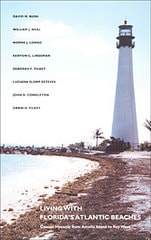
Living with Florida's Atlantic Beaches
Coastal Hazards from Amelia Island to Key WestDavid M. Bush, William J. Neal, Norma J. Longo, Kenyon C. Lindeman, Deborah F. Pilkey, Luciana Slomp Esteves, John D. Congleton, and Orrin H. Pilkey
Duke University Press, 2004
From Amelia Island just south of Georgia to Key West's southern tip, beaches are one of Florida's greatest assets. Yet these beaches are in danger: rapid structural development on a highly erodible coast make them vulnerable to some of nature's greatest storms. The same development that has been driven by the attraction of beautiful beaches and coastal amenities now threatens those very resources. In turn, coastal structures are at risk from sea-level rise, shoreline retreat, winter storms, and hurricanes. Most of the methods for reducing losses associated with storms protect property only in the short term—at a growing cost in dollars and loss of natural habitat in the long term.
Living with Florida's Atlantic Beaches is a guide to mitigating or reducing losses of property, human life, and natural resources by living with, rather than just at, the shore. This illustrated volume provides an introduction to coastal processes and geology as well as a brief history of coastal hazards and short-sighted human responses. This is the first volume in the Living with the Shore series to discuss the significant long-term impact of dredge-and-fill beach construction on living marine resources. Guidance is provided for long-term risk reduction in the form of tips on storm-resistant construction and site evaluation; maps for evaluating relative vulnerability to hazards are also included. A brief review of coastal regulations will help property owners understand and navigate the various permit requirements for developing coastal property. Living with Florida's Atlantic Beaches is an invaluable source of information for everyone from the curious beach visitor to the community planner, from the prudent property investor to the decision-making public official.
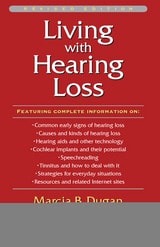
Living with Hearing Loss
Marcia B. Dugan
Gallaudet University Press, 2003
Living with Hearing Loss also suggests strategies for everyday situations and times of emergency. Chapters on speechreading, oral interpreters, assertive communication, and other tips for improving communication can enable people with hearing loss to make changes at work, home, and while traveling to cope with most situations. It can raise significantly the quality of the lives of hard of hearing people while also helping them to avoid dependency upon others.
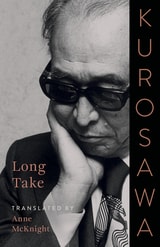
Long Take
Akira Kurosawa
University of Minnesota Press, 2025
A multifaceted portrait of the great Japanese director
For years, Akira Kurosawa resisted writing about himself. “It would turn out to be nothing but talk about movies,” he said. “In other words, take myself, subtract movies, and the result is zero.” The memoir he finally started serializing in 1978, Something like an Autobiography, ended with Rashomon, the film that launched him on the world’s stage in 1950. Long Take, first published in Japan shortly after Kurosawa’s death in 1998, at last tells the story of the rest of his life.
By turns intimate, provocative, and revealing, Long Take creates a dynamic portrait of Kurosawa from his own writings; his conversations with writer Inoue Hisashi and director Yamada Yōji; and essays by his daughter and colleague Kurosawa Kazuko, who details the collaborative history of the “Kurosawa crew.” It features a wealth of industry lore, cultural reference points, inside jokes with other filmmakers and writers, and backstories for his own productions, from the earliest to the last. Of particular interest to all cinephiles is an annotated list of Kurosawa’s 100 favorite films.
A survey of Kurosawa’s prodigious career, this book situates the visionary in the media milieu of his youth, in the literature and performing arts of twentieth-century Japan and Hollywood, and among the myriad films he loved, admired, and referenced, including Japanese silent film and comedy as well as productions from India, Iran, and Soviet-era Russia. Now available to English readers for the first time, Long Take offers a lasting picture of the peerless filmmaker in his element.
Looking After Your Books
Francesca Galligan
Bodleian Library Publishing, 2025
A quirky, indispensable resource packed with tips and advice on how to properly care for your books at home.
Have you ever wondered whether the assortment of books you have at home is a “collection”? Do you want to reorganize it? Expand it? Repair some of your treasured volumes?
This quirky but practical guide covers questions book lovers might have about caring for their books at home. Written by an expert rare book librarian at the Bodleian Library and covering a range of subjects including collecting, arranging, and keeping books in good condition, Looking After Your Books offers friendly advice that will guide readers through all aspects of book ownership. Within these pages, readers will find useful tips on buying from book fairs, bookshops, and dealers, as well as how to identify first editions. Help is on hand with treating accidental mishaps and a range of common problems such as an attack of red rot or a broken spine. There are also chapters on shelving, how to keep track of your books, how to commission a special box for a special book, and how to pass books on usefully.
With historical anecdotes and curious examples at every turn, Looking After Your Books is an indispensable resource and delight for anyone with an interest in books and their history.
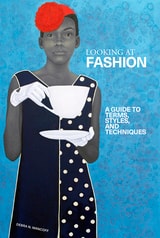
Looking at Fashion
A Guide to Terms, Styles, and TechniquesDebra N. Mancoff
J. Paul Getty Trust, The, 2024
Whether in art or life, fashion makes a statement. It gives form to the temper of the times and the motives of the moment, charting shifts in society, status, technology, and economy. Fashion is shaped by both high and popular culture and reveals the influence of individuals from diverse socioeconomic backgrounds.
Spanning the centuries and representing a global point of view, Looking at Fashion is a guide to the elements that make clothing practical, wearable, stylish, and distinctive. Created for scholars, students, fashionistas, and anyone who wants to expand their understanding of world culture through the history of dress, this book provides a rich and varied lexicon of the vocabulary that describes and explains the most essential components of garments and techniques of clothing construction. Ranging from basic pieces and their individual parts to structure, embellishments, and innovations, Looking at Fashion offers insights into the evolution of dress in terms of style, fit, and design. Gorgeous color illustrations, including paintings, photographs, historical garments, and custom drawings, reveal the interrelationship of fashion and art from antiquity to now.
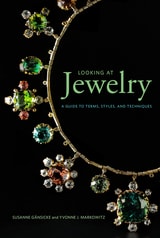
Looking at Jewelry
A Guide to Terms, Styles, and TechniquesSusanne Gänsicke
J. Paul Getty Trust, The, 2019
The fascination with personal adornment is universal. It is a preoccupation that is primal, instinctive, and uniquely human. Jewelry encompasses a seemingly endless number of ornaments produced across time and in all cultures. The range of materials and techniques used in its construction is extraordinary, even revolutionary, with new substances and methods of fabrication added with every generation. In any given society, master artisans have devoted their time, energy, and talent to the fine art of jewelry making, creating some of the most spectacular objects known to humankind.
This volume, geared toward jewelry makers, scholars, scientists, students, and fashionistas alike, begins with a lively introduction that offers a cultural history of jewelry and its production. The main text provides information on the most common, iconic, and culturally significant forms of jewelry and also covers materials, techniques, and manufacturing processes. Containing more than eighty color illustrations, this guide will be invaluable to all those wishing to increase their understanding and enjoyment of the art of jewelry.
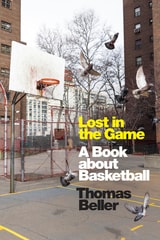
Lost in the Game
A Book about BasketballThomas Beller
Duke University Press, 2022