Results by title
165 books match the query 'Resistance' and 8 start with l
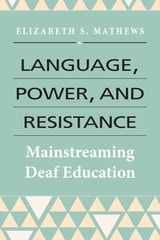
Language, Power, and Resistance
Mainstreaming Deaf EducationElizabeth S. Mathews
Gallaudet University Press, 2017
The research upon which this book is based examined the implications that mainstreaming has for the tensions between the hegemonic medical model of deafness and the social model of Deafness. This volume explores how different types of power are used in the deaf education system to establish, maintain, and also resist medical views of deafness. Mathews frames this discussion as one of power relations across parents, children, and professionals working within the system. She looks at how various forms of power are used to influence decisions, to resist decisions, and to shape the structure and delivery of deaf education. The author’s findings are a significant contribution to the debates on inclusive education for DHH students and will resonate in myriad social and geographic contexts.

Language, Resistance and Revival
Republican Prisoners and the Irish Language in the North of IrelandFeargal Mac Ionnrachtaigh
Pluto Press, 2013
Language, Resistance and Revival tells the untold story of the truly groundbreaking linguistic and educational developments that took place among Republican prisoners in Long Kesh prison from 1972-2000.
During a period of bitter struggle between Republican prisoners and the British state, the Irish language was taught and spoken as a form of resistance during incarceration. The book unearths this story for the first time and analyses the rejuvenating impact it had on the cultural revival in the nationalist community beyond the prison walls.
Based on unprecedented interviews, Feargal Mac Ionnrachtaigh explores a key period in Irish history through the original and 'insider' accounts of key protagonists in the contemporary Irish language revival.
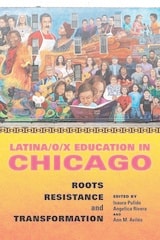
Latina/o/x Education in Chicago
Roots, Resistance, and TransformationEdited by Isaura Pulido, Angelica Rivera, and Ann M. Aviles
University of Illinois Press, 2022
Insightful and enlightening, Latina/o/x Education in Chicago brings to light the ongoing struggle for educational equity in the Chicago Public Schools.
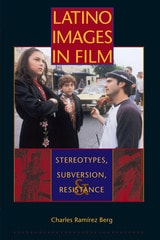
Latino Images in Film
Stereotypes, Subversion, and ResistanceBy Charles Ramírez Berg
University of Texas Press, 2002
The bandido, the harlot, the male buffoon, the female clown, the Latin lover, and the dark lady—these have been the defining, and demeaning, images of Latinos in U.S. cinema for more than a century. In this book, Charles Ramírez Berg develops an innovative theory of stereotyping that accounts for the persistence of such images in U.S. popular culture. He also explores how Latino actors and filmmakers have actively subverted and resisted such stereotyping.
In the first part of the book, Berg sets forth his theory of stereotyping, defines the classic stereotypes, and investigates how actors such as Raúl Julia, Rosie Pérez, José Ferrer, Lupe Vélez, and Gilbert Roland have subverted stereotypical roles. In the second part, he analyzes Hollywood's portrayal of Latinos in three genres: social problem films, John Ford westerns, and science fiction films. In the concluding section, Berg looks at Latino self-representation and anti-stereotyping in Mexican American border documentaries and in the feature films of Robert Rodríguez. He also presents an exclusive interview in which Rodríguez talks about his entire career, from Bedhead to Spy Kids, and comments on the role of a Latino filmmaker in Hollywood and how he tries to subvert the system.
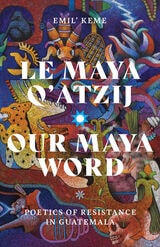
Le Maya Q’atzij/Our Maya Word
Poetics of Resistance in GuatemalaEmil’ Keme
University of Minnesota Press, 2021
Bringing to the fore the voices of Maya authors and what their poetry tells us about resistance, sovereignty, trauma, and regeneration
In 1954, Guatemala suffered a coup d’etat, resulting in a decades-long civil war. During this period, Indigenous Mayans were subject to displacement, disappearance, and extrajudicial killing. Within the context of the armed conflict and the postwar period in Guatemala, K’iche’ Maya scholar Emil’ Keme identifies three historical phases of Indigenous Maya literary insurgency in which Maya authors use poetry to dignify their distinct cultural, political, gender, sexual, and linguistic identities.
Le Maya Q’atzij / Our Maya Word employs Indigenous and decolonial theoretical frameworks to critically analyze poetic works written by ten contemporary Maya writers from five different Maya nations in Iximulew/Guatemala. Similar to other Maya authors throughout colonial history, these authors and their poetry criticize, in their own creative ways, the continuing colonial assaults to their existence by the nation-state. Throughout, Keme displays the decolonial potentialities and shortcomings proposed by each Maya writer, establishing a new and productive way of understanding Maya living realities and their emancipatory challenges in Iximulew/Guatemala.
This innovative work shows how Indigenous Maya poetics carries out various processes of decolonization and, especially, how Maya literature offers diverse and heterogeneous perspectives about what it means to be Maya in the contemporary world.
Lions of the Atlas
France's Wars for Empire and Resistance in North Africa, 1827–1934Edward G. Lengel
Westholme Publishing, 2026
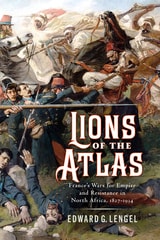
France’s century-long wars of conquest in Algeria, Morocco, and Tunisia remain both understudied and symbolic of European imperialism. Launched to provide political legitimacy for the House of Bourbon during unstable times, these wars of empire ironically ended by generating nationalist sentiments that undermined French imperial aspirations, although France was successful on the battlefield after tremendous effort. The controversy both at the time and today about France’s North African ambitions has overshadowed the significant history of this conflict. Fought across some of the world’s most unforgiving, yet spectacular, terrain, these wars featured innovative military campaigns, epic battles, inspiring resistance leaders, and countless episodes of remarkable courage. Profoundly relevant, the French North African wars had a major global impact, influencing the development of military organization, tactics, and technology in the American Civil War, both world wars, and even modern Middle Eastern conflicts. Yet it is the human element that is most compelling. Based on extensive primary source research, Lions of the Atlas: France’s Wars for Empire and Resistance in North Africa, 1827–1934 is the first-ever comprehensive study, in any language, of these pivotal wars and those who fought them.
Beginning with the French naval blockade and amphibious invasion of Algeria in 1827–1830, the book tells the story of the large-scale campaigns and huge set-piece battles that ensued over the following several decades, across the highest peaks of the Atlas Mountains, in hills and valleys, along and over rivers, through scorching deserts, and even in fierce urban combat in town and city streets. Engagements include two unforgettable campaigns to capture the mountain fortress at Constantine, bold and devastating forays by Algerian cavalrymen and mountain warriors, and the pivotal 1844 Battle of Isly. The story continues with the French invasion of Tunisia in 1881, and then the thirty-year French campaign for the subjugation of Morocco, concluding with the Rif War of the 1920s that shocked the world. The narrative features charismatic resistance leaders such as Algeria’s Emir Abd-el-Kader, legendary military units such as the colorful Zouaves and the Foreign Legion, and changes in military technology, including the use of aircraft and armored vehicles. A major contribution to our understanding of one of the world’s most storied regions, Lions of the Atlas provides gripping and insightful reading while presenting the complex history of war and resistance in North Africa.
Literature and Resistance in Guatemala
Textual Modes and Cultural Politics from El Señor Presidente to Rigoberta MenchúMarc Zimmerman
Ohio University Press, 1994
Lives, Letters, and Quilts
Women and Everyday Rhetorics of ResistanceVanessa Kraemer Sohan
University of Alabama Press, 2020
In Lives, Letters, and Quilts: Women and Everyday Rhetorics of Resistance, Vanessa Kraemer Sohan applies a translingual and transmodal framework informed by feminist rhetorical practice to three distinct case studies that demonstrate women using unique and effective rhetorical strategies in political, religious, and artistic contexts. These case studies highlight a diverse set of actors uniquely situated by their race, gender, class, or religion, but who are nevertheless connected by their capacity to envision and recontextualize the seemingly ordinary means and materials available to them in order to effectively persuade others.
The Great Depression provides the backdrop for the first case study, a movement whereby thousands of elderly citizens proselytized and fundraised for a monthly pension plan dreamt up by a California doctor in the hopes of lifting themselves out of poverty. Sohan investigates how the Townsend Plan’s elderly supporters—the Townsendites—worked within and across language, genre, mode, and media to enable them for the first time to be recognized by others, and themselves, as a viable political constituency.
Next, Sohan recounts the story of Quaker minister Eliza P. Kirkbride Gurney who met President Abraham Lincoln in 1862. Their subsequent epistolary exchanges concerning conscientious objectors made such an impression on him that one of her letters was rumored to be in his pocket the night of his assassination. Their exchanges and Gurney’s own accounts of her transnational ministry in her memoir provide useful examples of how, throughout history, women rhetors have adopted and transformed typically underappreciated forms of rhetoric—such as the epideictic—for their particular purposes.
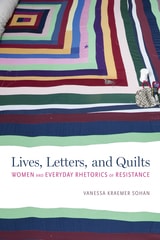
The final example focuses on the Gee’s Bend quiltmakers—a group of African American women living in rural Alabama who repurpose discarded work clothes and other cast-off fabrics into the extraordinary quilts for which they are known. By drawing on the means and materials at hand to create celebrated works of art in conditions of extreme poverty, these women show how marginalized artisans can operate both within and outside the bounds of established aesthetic traditions and communicate the particulars of their experience across cultural and economic divides.