Results by title
164 books match the query 'Revolution' and 6 start with l
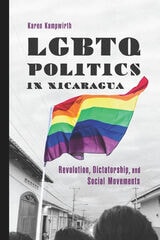
LGBTQ Politics in Nicaragua
Revolution, Dictatorship, and Social MovementsKaren Kampwirth
University of Arizona Press, 2022
Karen Kampwirth is a renowned scholar of the Nicaraguan Revolution, who has been writing at the intersection of gender and politics for decades. In this chronological telling of the last fifty years of political history in Nicaragua, Kampwirth deploys a critical new lens: understanding politics from the perspective of the country’s LGBTQ community. Kampwirth details the gay and lesbian guerrillas in the 1960s and 1970s, Nicaragua’s first openly gay television wizard in the 1980s, and the attempts by LGBTQ revolutionaries to create a civil rights movement and the subsequent squashing of that movement by the ruling Sandinista party. She analyzes the shifting political alliances, the rise of strong feminist and LGBTQ movements in Nicaragua, and the attempts by the administration of Daniel Ortega to co-opt and control these movements.
Ultimately, this is a story of struggle and defeat, progress and joy. This timely book provides a well-documented review of LGBTQ politics in modern Nicaragua, helping us to see the Sandinista Revolution and its ongoing aftermath in a new light.
Land and Revolution in Iran, 1960–1980
By Eric J. Hooglund
University of Texas Press, 1982
Carried out by the government of the shah between 1962 and 1971, the Iranian land reform was one of the most ambitious such undertakings in modern Middle Eastern history. Yet, beneath apparent statistical success, the actual accomplishments of the program, in terms of positive benefits for the peasantry, were negligible. Later, the resulting widespread discontent of thousands of Iranian villagers would contribute to the shah's downfall.
In the first major study of the effects of this widely publicized program, Eric Hooglund's analysis demonstrates that the primary motives behind the land reform were political. Attempting to supplant the near-absolute authority of the landlord class over the countryside, the central government hoped to extend its own authority throughout rural Iran. While the Pahlavi government accomplished this goal, its failure to implement effective structural reform proved to be a long-term liability.
Hooglund, who conducted field research in rural Iran throughout the 1970s and who witnessed the unfolding of the revolution from a small village, provides a careful description of the development of the land reform and of its effects on the main groups involved: landlords, peasants, local officials, merchants, and brokers. He shows how the continuing poverty in the countryside forced the migration of thousands of peasants to the cities, resulting in serious shortages of agricultural workers and an oversupply of unskilled urban labor. When the shah's government was faced with mass opposition in the cities in 1978, not only did a disillusioned rural population fail to support the regime, but thousands of villagers participated in the protests that hastened the collapse of the monarchy.

Literature and Revolution
Leon Trotsky
University of Michigan Press, 1960
Literature and Revolution
British Responses to the Paris Commune of 1871Owen Holland
Rutgers University Press, 2022
This book examines how a heterogeneous group of authors in Britain responded to the Commune. In doing so, it provides the first full-length critical study of the reception and representation of the Commune in Britain during the closing decades of the nineteenth century, showing how discussions of the Commune functioned as a screen to project hope and fear, serving as a warning for some and an example to others. Writers considered in the book include John Ruskin, Edward Bulwer-Lytton, Eliza Lynn Linton, Mary Elizabeth Braddon, Anne Thackeray Ritchie, Margaret Oliphant, George Gissing, Henry James, William Morris, Alfred Austin and H.G. Wells. As the book shows, many, but not all, of these writers responded to the Commune with literary strategies that sought to stabilize bourgeois subjectivity in the wake of the traumatic shock of a revolutionary event. The book extends critical understanding of the Commune’s cultural afterlives and explores the relationship between literature and revolution.
Living for the Revolution
Black Feminist Organizations, 1968–1980Kimberly Springer
Duke University Press, 2005
The organizations that Springer examines were the first to explicitly use feminist theory to further the work of previous black women’s organizations. As she describes, they emerged in response to marginalization in the civil rights and women’s movements, stereotyping in popular culture, and misrepresentation in public policy. Springer compares the organizations’ ideologies, goals, activities, memberships, leadership styles, finances, and communication strategies. Reflecting on the conflicts, lack of resources, and burnout that led to the demise of these groups, she considers the future of black feminist organizing, particularly at the national level. Living for the Revolution is an essential reference: it provides the history of a movement that influenced black feminist theory and civil rights activism for decades to come.
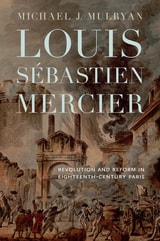
Louis Sébastien Mercier
Revolution and Reform in Eighteenth-Century ParisMichael J. Mulryan
Bucknell University Press, 2023