Results by title
424 books match the query 'Russian & Soviet' and 11 start with l
Legacies of the Stone Guest
The Don Juan Legend in Russian LiteratureAlexander Burry
University of Wisconsin Press, 2023
The story of Don Juan first appeared in writing in seventeenth-century Spain, reaching Russia about a century later. Its real impact, however, was delayed until Russia’s most famous poet, Alexander Pushkin, put his own, unique, and uniquely inspirational, spin on the tale. Published in 1830, TheStone Guest is now recognized, with other Pushkin masterpieces, as part of the Russian literary canon. Alexander Burry traces the influence of Pushkin’s brilliant innovations to the legend, which he shows have proven repeatedly fruitful through successive ages of Russian literature, from the Realist to the Silver Age, Soviet, and contemporary periods. Burry shows that, rather than creating a simple retelling of an originally religious tale about a sinful, consummate seducer, Pushkin offered open-ended scenes, re-envisioned and complicated characters, and new motifs that became recursive and productive parts of Russian literature, in ways that even Pushkin himself could never have predicted.
Legitimating Nationalism
Political Identity in Russia's Ethnic RepublicsKatie L. Stewart
University of Wisconsin Press, 2024
Even in the current autocratic system, however, Russia’s multiethnic nature and fractured political history mean that not all political symbols work the same way everywhere; not every story finds the same audience in the same way. The message may emanate from Moscow, but regional actors—including local governments, civic organizations, and cultural institutions—have some agency in how they spread the message: some regionalization of identity work is permitted to ensure that Russian national symbols and narratives resonate with people, and to avoid protest. This book investigates how nation building works on the ground through close studies of three of Russia’s ethnic republics: Karelia, Tatarstan, and Buryatia. Understanding how the project of legitimating nationalism, in support of a unified country and specifically Putin’s regime, works in practice offers crucial context in understanding the shape and story of contemporary Russia.
Lermontov's "A Hero of Our Time"
A Critical CompanionLewis Bagby
Northwestern University Press, 2001
Lermontov's Narratives of Heroism
Vladimir Golstein
Northwestern University Press, 2012
Lermontov's explorations of the virtues and limitations of heroic, self-reliant conduct have subsequently become obscured or misread. This new book focuses upon the peculiar, disturbing, and arguably most central feature of Russian culture: its suspicion of and hostility toward individual achievement and self-assertion. The analysis and interpretation of Lermontov's texts enables Golstein to address broader cultural issues by exploring the reasons behind the persistent misreading of Lermontov's major works and by investigating the cultural attitudes that shaped Russia's reaction to the challenges of modernity.

Lermontov’s "A Hero of Our Time"
A Critical CompanionLewis Bagby
Northwestern University Press, 0
Limits to Interpretation
The Meanings of Anna KareninaVladimir E. Alexandrov
University of Wisconsin Press, 2017

Literary Politics in the Soviet Ukraine, 1917-1934
George S. N. Luckyj
Duke University Press, 1990
The new edition reissues Luckyj’s critical work in light of current political developments and reflects the revision of previous findings. Luckyj originally drew on published Soviet sources and the important unpublished papers of a Soviet Ukrainian writer who defected to the West to describe how the brief literary revival in the Soviet Ukraine in the 1920s was abruptly halted by Communist Party controls. The present volume features a new preface, an additional chapter covering recent Soviet attitudes toward the literature of the 1920s and 1930s, and an updated bibliography.
Lost in the Shadow of the Word
Space, Time, and Freedom in Interwar Eastern EuropeBenjamin Paloff
Northwestern University Press, 2016
Scholars of modernism have long addressed how literature, painting, and music reflected the radical reconceptualization of space and time in the early twentieth century—a veritable revolution in both physics and philosophy that has been characterized as precipitating an “epistemic trauma” around the world. In this wide-ranging study, Benjamin Paloff contends that writers in Central and Eastern Europe felt this impact quite distinctly from their counterparts in Western Europe. For the latter, the destabilization of traditional notions of space and time inspired works that saw in it a new kind of freedom. However, for many Central and Eastern European authors, who were writing from within public discourses about how to construct new social realities, the need for escape met the realization that there was both nowhere to escape to and no stable delineation of what to escape from. In reading the prose and poetry of Czech, Polish, and Russian writers, Paloff imbues the term “Kafkaesque” with a complexity so far missing from our understanding of this moment in literary history.
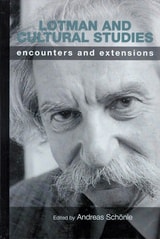
Lotman and Cultural Studies
Encounters and ExtensionsEdited by Andreas Schonle
University of Wisconsin Press, 2006
In this volume, edited by Andreas Schönle, contributors extend Lotman's theories to a number of fields. Focusing on his less frequently studied later period, Lotman and Cultural Studies engages with such ideas as the "semiosphere," the fluid, dynamic semiotic environment out of which meaning emerges; "auto-communication," the way in which people create narratives about themselves that in turn shape their self-identity; change, as both gradual evolution and an abrupt, unpredictable "explosion"; power; law and mercy; Russia and the West; center and periphery.
As William Mills Todd observes in his afterword, the contributors to this volume test Lotman's legacy in a new context: "Their research agendas-Iranian and American politics, contemporary Russian and Czech politics, sexuality and the body-are distant from Lotman's own, but his concepts and awareness yield invariably illuminating results."
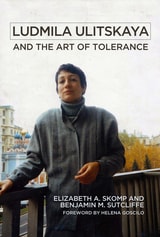
Ludmila Ulitskaya and the Art of Tolerance
Elizabeth Skomp and Benjamin M. Sutcliffe, Foreword by Helena Goscilo
University of Wisconsin Press, 2015
Drawing on interviews with Ulitskaya and sources not readily available to Western scholars, Elizabeth A. Skomp and Benjamin M. Sutcliffe explore the ethical ideals that make Ulitskaya’s novels resonate in today’s Russia—tolerance, sincerity, and diversity—and examine how she uses innovative imagery to personalize history through a focus on body and kinship. This is essential reading for anyone interested in contemporary Russian literature and society.
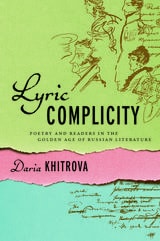
Lyric Complicity
Poetry and Readers in the Golden Age of Russian LiteratureDaria Khitrova
University of Wisconsin Press, 2019
Lyric Complicity helps modern readers recover Russian poetry’s former uses and functions—life situations that moved people to quote or perform a specific passage from a poem or a forgotten occasion that created unforgettable verse.