Results by title
82 books match the query 'Semantics' and 6 start with l
Language Files
Materials for an Introduction to Language and Linguistics, 13th EditionThe Ohio State University Department of Linguistics
The Ohio State University Press, 2022
The thirteenth edition has been revised, clarified, and updated throughout to ensure that it remains the most comprehensive and accessible introductory linguistics textbook on the market. The revised chapter on morphology includes a more thorough discussion of allomorphy and adds sections on templatic morphology, suprasegmental morphology, and morphological metathesis to give students a more complete picture of all morphological phenomena. The chapter on language and computers has been updated with new sections on deep learning, artificial neural networks, and on other areas of computational linguistics, providing readers with a better sense of current research and applications in this rapidly developing field. Other additions include new sections on syntactic non-constituents and non-generative rule systems in the syntax chapter and a complete rewrite to the creole languages file in the language contact chapter. We have also adopted the use of the singular they when referring to a generic person whose gender is unknown or irrelevant. Exercises and lists of other readings have been updated throughout.
Language and the Rise of the Algorithm
Jeffrey M. Binder
University of Chicago Press, 2022
A wide-ranging history of the algorithm.
Bringing together the histories of mathematics, computer science, and linguistic thought, Language and the Rise of the Algorithm reveals how recent developments in artificial intelligence are reopening an issue that troubled mathematicians well before the computer age: How do you draw the line between computational rules and the complexities of making systems comprehensible to people? By attending to this question, we come to see that the modern idea of the algorithm is implicated in a long history of attempts to maintain a disciplinary boundary separating technical knowledge from the languages people speak day to day.
Here, Jeffrey M. Binder offers a compelling tour of four visions of universal computation that addressed this issue in very different ways: G. W. Leibniz’s calculus ratiocinator; a universal algebra scheme Nicolas de Condorcet designed during the French Revolution; George Boole’s nineteenth-century logic system; and the early programming language ALGOL, short for algorithmic language. These episodes show that symbolic computation has repeatedly become entangled in debates about the nature of communication. Machine learning, in its increasing dependence on words, erodes the line between technical and everyday language, revealing the urgent stakes underlying this boundary.
The idea of the algorithm is a levee holding back the social complexity of language, and it is about to break. This book is about the flood that inspired its construction.
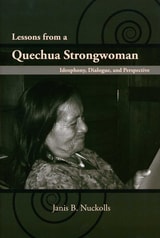
Lessons from a Quechua Strongwoman
Ideophony, Dialogue, and PerspectiveJanis B. Nuckolls
University of Arizona Press, 2010
This book is a fascinating look at ideophones—words that communicate succinctly through imitative sound qualities. They are at the core of Quechua speakers’ discourse—both linguistic and cultural—because they allow agency and reaction to substances and entities as well as beings. Nuckolls shows that Luisa Cadena’s utterances give every individual, major or minor, a voice in her narrative. Sometimes as subtle as a barely felt movement or unintelligible sound, the language supports an amazingly wide variety of voices.
Cadena’s narratives and commentaries on everyday events reveal that sound imitation through ideophones, representations of dialogues between humans and nonhumans, and grammatical distinctions between a speaking self and an other are all part of a language system that allows for the possibility of shared affects, intentions, moral values, and meaningful, communicative interactions between humans and nonhumans.
Lexical Semantics in LFG
Edited by Miriam Butt and Tracy Holloway King
CSLI, 2006
Linguistic Individuals
Almerindo E. Ojeda
CSLI, 1993
Linking by Types in the Hierarchical Lexicon
Anthony R. Davis
CSLI, 2001
Many previous approaches to this problem have employed a set of thematic roles, such as agent and patient, to classify varieties of participants. The alternative developed here fits within the framework of Head-Driven Phrase Structure Grammar while utilizing typed feature structures, certain basic features of verb meaning, a hierarchical classification of verb meanings, and constraints from more general to more specific word classes. Relying on no special mechanisms or components of grammar, this book is unique in its ability to account for the observed range of verb types in human languages with a simple yet widely applicable set of principles.