Results by title
107 books match the query 'Socialism' and 8 start with l
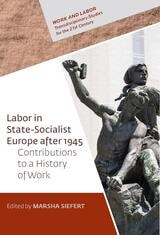
Labor in State-Socialist Europe, 1945–1989
Contributions to a History of WorkMarsha Siefert
Central European University Press, 2020
Labor regimes under communism in East-Central Europe were complex, shifting, and ambiguous. This collection of sixteen essays offers new conceptual and empirical ways to understand their history from the end of World War II to 1989, and to think about how their experiences relate to debates about labor history, both European and global.
The authors reconsider the history of state socialism by re-examining the policies and problems of communist regimes and recovering the voices of the workers who built them. The contributors look at work and workers in Albania, Bulgaria, Czechoslovakia, the German Democratic Republic, Hungary, Poland, Romania, and Yugoslavia. They explore the often contentious relationship between politics and labor policy, dealing with diverse topics including workers’ safety and risks; labor rights and protests; working women’s politics and professions; migrant workers and social welfare; attempts to control workers’ behavior and stem unemployment; and cases of incomplete, compromised, or even abandoned processes of proletarianization. Workers are presented as active agents in resisting and supporting changes in labor policies, in choosing allegiances, and in defining the very nature of work.
Left Populism in Europe
Lessons from Jeremy Corbyn to PodemosMarina Prentoulis
Pluto Press, 2021
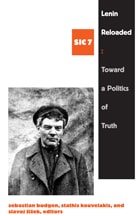
Lenin Reloaded
Toward a Politics of Truth, sic viiSebastian Budgen, Stathis Kouvelakis, and Slavoj Žižek, eds.
Duke University Press, 2007
These essays, some of which are appearing in English for the first time, bring Lenin face-to-face with the problems of today, including war, imperialism, the imperative to build an intelligentsia of wage earners, the need to embrace the achievements of bourgeois society and modernity, and the widespread failure of social democracy. Lenin Reloaded demonstrates that truth and partisanship are not mutually exclusive as is often suggested. Quite the opposite—in the present, truth can be articulated only from a thoroughly partisan position.
Contributors. Kevin B. Anderson, Alain Badiou, Etienne Balibar, Daniel Bensaïd, Sebastian Budgen, Alex Callinicos, Terry Eagleton, Fredric Jameson, Stathis Kouvelakis, Georges Labica, Sylvain Lazarus, Jean-Jacques Lecercle, Lars T. Lih, Domenico Losurdo, Savas Michael-Matsas, Antonio Negri, Alan Shandro, Slavoj Žižek

Leon Trotsky
Writings in ExileLeon Trotsky
Pluto Press, 2012
Leon Trotsky was a key political figure of the twentieth century – a leader of the Russian Revolution, founder of the Red Army, author of books on literature, history, morality and politics.
Leon Trotsky: Writings in Exile contains some of his most insightful and penetrating works. Exiled and isolated by Stalin, Trotsky used the only weapon he had left – words. In these writings he defends the 1917 revolution, warns prophetically of fascism and analyses anti-colonial movements in the global south.
This collection gives a sense of the real Trotsky – passionate, humanist, Marxist. It will introduce the writings of one of history's great revolutionaries to a new generation.

Limits and Possibilities
The Crisis of Yugoslav Socialism and State Socialist SystemsBogdan Denitch
University of Minnesota Press, 1990
Limits and Possibilities was first published in 1990. Minnesota Archive Editions uses digital technology to make long-unavailable books once again accessible, and are published unaltered from the original University of Minnesota Press editions.
The nature of the Eastern European Socialist state and its potential for transformation without sacrificing its specific identity is the subject of extensive current debate. Limits and Possibilities is the first book to be written that deals conceptually and historically with the myriad kinds of change a state might undergo. Bogdon Denitch has chosen the Yugoslavian model to frame his analysis because it initiated these "modernizing" changes in the 1960s and can therefore provide a case study of the limits of reforms possible in Communist regimes. In using the Yugoslav case paradigmatically, the volume addresses in a more general sense the issues of decentralization, autonomy for nonparty and nonstate institutions, multi-ethnicity, new social movements, including the "greens," and the role of women and women's movements.
Lithuanian Social Democracy in Perspective, 1893-1914
Leonas Sabaliunas
Duke University Press, 1990
But Sabaliunas also considers such partners and rivals as the Jewish Bund, the Polish Socialist Party, the Social Democracy of the Kingdom of Poland and Lithuania, and the Russian Social Democratic Labor Party. He focuses on the appearance of socialist parties at the local level, the politics of assertive behavior during the Russian Revolution of 1905–1906, the nature of interparty relations, and efforts to promote party unity. In particular, he investigates the projected relationship between Russia and its subject nationalities—a cardinal concern today as the Baltic peoples attempt to distance themselves from their Russian neighbors.
Sabaliunas clarifies current massive Lithuanian opposition to Moscow and to its version of socialism. He stresses that in Lithuania the socialist movement from the beginning not only sought solutions to social and economic problems but also addressed issues of ethnic and national interest, especially the question of national sovereignty.
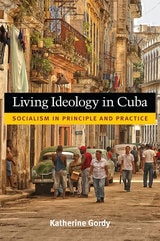
Living Ideology in Cuba
Socialism in Principle and PracticeKatherine A. Gordy
University of Michigan Press, 2015
Long Road to Harpers Ferry
The Rise of the First American LeftMark A. Lause
Pluto Press, 2018
Offering new and fascinating insights into the cast of characters who created a homegrown socialist movement in America—from Thomas Paine’s revolution to Robert Owen’s utopianism, and from Thomas Skidmore’s agrarianism to George Henry Evans’s industrial workers’ reforms—Long Road to Harpers Ferry captures the spirit of the times. Showing how class solidarity and consciousness became more important to a generation of workers than notions of American citizenship, the book offers a fascinating historical background to help us understand the rise of radicalism in the United States today.