Results by title
11 books match the query 'Status'

Creating Market Socialism
How Ordinary People Are Shaping Class and Status in ChinaCarolyn L. Hsu
Duke University Press, 2007
Hsu’s ethnographic research, conducted in the city of Harbin in northwestern China, included participant observation at twenty workplaces and interviews with working adults from a range of professions. By analyzing the shared stories about status and class, jobs and careers, and aspirations and hopes that circulate among Harbiners from all walks of life, Hsu reveals the logic underlying the emerging stratification system. In the post-socialist era, Harbiners must confront a fast-changing and bewildering institutional landscape. Their collective narratives serve to create meaning and order in the midst of this confusion. Harbiners collectively agree that “intellectuals” (scientists, educators, and professionals) are the most respected within the new social order, because they contribute the most to Chinese society, whether that contribution is understood in terms of traditional morality, socialist service, or technological and economic progress. Harbiners understand human capital as an accurate measure of a person’s status. Their collective narratives about suzhi shape their career choices, judgments, and child-rearing practices, and therefore the new practices and institutions developing in post-socialist China.

Honor, Status, and Law in Modern Latin America
Sueann Caulfield, Sarah C. Chambers, and Lara Putnam, eds.
Duke University Press, 2005
Each essay examines honor in the context of specific historical processes, including early republican nation-building in Peru; the transformation in Mexican villages of the cargo system, by which men rose in rank through service to the community; the abolition of slavery in Rio de Janeiro; the growth of local commerce and shifts in women’s status in highland Bolivia; the formation of a multiethnic society on Costa Rica’s Caribbean coast; and the development of nationalist cultural responses to U.S. colonialism in Puerto Rico. By connecting liberal projects that aimed to modernize law and society with popular understandings of honor and status, this volume sheds new light on broad changes and continuities in Latin America over the course of the long nineteenth century.
Contributors. José Amador de Jesus, Rossana Barragán, Sueann Caulfield, Sidney Chalhoub, Sarah C. Chambers, Eileen J. Findley, Brodwyn Fischer, Olívia Maria Gomes da Cunha, Laura Gotkowitz, Keila Grinberg, Peter Guardino, Cristiana Schettini Pereira, Lara Elizabeth Putnam

Hunting for Hides
Deerskins, Status, and Cultural Change in the Protohistoric AppalachiansHeather A. Lapham
University of Alabama Press, 2006
Through research on faunal remains and mortuary assemblages, Lapham tracks both the products Native Americans produced for colonial trade--deerskins and other furs--as well as those items received in exchange--European and native prestige goods that end up in burial contexts. Zooarchaeological analyses provide insights into subsistence practices, deer-hunting strategies, and deer-hide production activities, while an examination of mortuary practices contributes information on the use of the nonlocal goods acquired through trade in deerskins. This study reveals changes in economic organization and mortuary practices that provide new insights into how participation in the colonial deerskin trade initially altered Native American social relations and political systems.
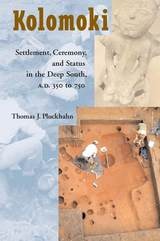
Kolomoki
Settlement, Ceremony, and Status in the Deep South, A.D. 350 to 750Thomas J. Pluckhahn
University of Alabama Press, 2003
A Dan Josselyn Memorial Publication
The first comprehensive and systematic investigation of a Woodland period ceremonial center.
Kolomoki, one of the most impressive archaeological sites in the southeastern United States, includes at least nine large earthen mounds in the lower Chattahoochee River valley of southwest Georgia. The largest, Mound A, rises approximately 20 meters above the terrace that borders it. From its flat-topped summit, a visitor can survey the string of smaller mounds that form an arc to the south and west.
Archaeological research had previously placed Kolomoki within the Mississippian period (ca. A.D. 1000-1500) primarily because of the size and form of the mounds. But this book presents data for the main period of occupation and mound construction that confirm an earlier date, in the Woodland period (ca. A.D. 350-750). Even though the long-standing confusion over Kolomoki’s dating has now been settled, questions remain regarding the lifeways of its inhabitants. Thomas Pluckhahn's research has recovered evidence concerning the level of site occupation and the house styles and daily lives of its dwellers. He presents here a new, revised history of Kolomoki from its founding to its eventual abandonment, with particular attention to the economy and ceremony at the settlement.
This study makes an important contribution to the understanding of middle range societies, particularly the manner in which ceremony could both level and accentuate status differentiation within them. It provides a readable overview of one of the most important but historically least understood prehistoric Native American sites in the United States.
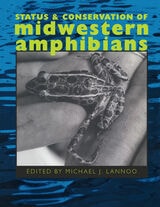
Status and Conservation of Midwestern Amphibians
Michael J. Lannoo
University of Iowa Press, 1998
In 1990 an international group of biologists, meeting to discuss rumors of declines in the number of amphibians, discovered that amphibian disappearances once thought to be a local problem were not—the problem was global. And, even more disturbing, amphibians were disappearing not just from areas settled by humans but from regions of the world once believed to be pristine. Under the mantle of the Declining Amphibian Populations Task Force, this timely book addresses three fundamental questions for the midwestern United States: are amphibians declining; if so, why; and, if so, what can be done to halt these losses?
In the Midwest—defined here as Missouri, Iowa, Illinois, Indiana, Ohio, Minnesota, Wisconsin, and Michigan—there can be no doubt that the number of salamanders and frogs has declined with Euro-American settlement and the conversion to an agriculturally dominated landscape. Habitat loss and landscape fragmentation have been major factors in this decline, as have aquacultural uses of natural wetlands. Bullfrog introductions have eliminated populations of native amphibians, and collecting for the biological supply trade has reduced the number of individuals within many populations. The goal of the forty-two essays in this well-documented, well-illustrated book is to put between two covers all we know now about the status of midwestern amphibians. By doing this, the editor has created a readily accessible historical record for future studies.
Organized into sections covering landscape patterns and biogeography, species status, regional and state status, diseases and toxins, conservation, and monitoring and applications, this landmark volume will serve as the foundation for amphibian conservation in the Midwest.

Status
Why Is It Everywhere? Why Does It Matter?Cecilia L. Ridgeway
Russell Sage Foundation, 2019
Ridgeway’s research on status has important implications for our understanding of social inequality. Distinct from power or wealth, status is prized because it provides affirmation from others and affords access to valuable resources. Ridgeway demonstrates how the conferral of status inevitably contributes to differing life outcomes for individuals, with impacts on pay, wealth creation, and health and wellbeing. Status beliefs are widely held views about who is better in society than others in terms of esteem, wealth, or competence. These beliefs confer advantages which can exacerbate social inequality. Ridgeway notes that status advantages based on race, gender, and class—such as the belief that white men are more competent than others—are the most likely to increase inequality by facilitating greater social and economic opportunities.
Ridgeway argues that status beliefs greatly enhance higher status groups’ ability to maintain their advantages in resources and access to positions of power and make lower status groups less likely to challenge the status quo. Many lower status people will accept their lower status when given a baseline level of dignity and respect—being seen, for example, as poor but hardworking. She also shows that people remain willfully blind to status beliefs and their effects because recognizing them can lead to emotional discomfort. Acknowledging the insidious role of status in our lives would require many higher-status individuals to accept that they may not have succeeded based on their own merit; many lower-status individuals would have to acknowledge that they may have been discriminated against.
Ridgeway suggests that inequality need not be an inevitable consequence of our status beliefs. She shows how status beliefs can be subverted—as when we reject the idea that all racial and gender traits are fixed at birth, thus refuting the idea that women and people of color are less competent than their male and white counterparts. This important new book demonstrates the pervasive influence of status on social inequality and suggests ways to ensure that it has a less detrimental impact on our lives.
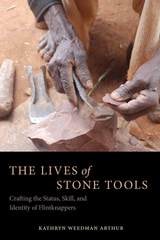
The Lives of Stone Tools
Crafting the Status, Skill, and Identity of FlintknappersKathryn Weedman Arthur
University of Arizona Press, 2018
Anthropologist Kathryn Weedman Arthur offers insights from her more than twenty years working with the Gamo. She deftly addresses historical and present-day experiences and practices, privileging the Gamo’s perspectives. Providing a rich, detailed look into the world of lithic technology, Arthur urges us to follow her into a world that recognizes Indigenous theories of material culture as valid alternatives to academic theories. In so doing, she subverts long-held Western perspectives concerning gender, skill, and lifeless status of inorganic matter.
The book offers the perspectives that, contrary to long-held Western views, stone tools are living beings with a life course, and lithic technology is a reproductive process that should ideally include both male and female participation. Only individuals of particular lineages knowledgeable in the lives of stones may work with stone technology. Knappers acquire skill and status through incremental guided instruction corresponding to their own phases of maturation. The tools’ lives parallel those of their knappers from birth (procurement), circumcision (knapping), maturation (use), seclusion (storage), and death (discardment).
Given current expectations that the Gamo’s lithic technology may disappear with the next generation, The Lives of Stone Tools is a work of vital importance and possibly one of the last contemporaneous books about a population that engages with the craft daily.
The Nature and Status of Ethnobotany, 2nd ed
Edited by Richard I. Ford with a new introduction by Richard I. Ford
University of Michigan Press, 1994

The Status and Distribution of New Jersey's Birds
Leck, Charles F
Rutgers University Press, 1984
Trustees of Culture
Power, Wealth, and Status on Elite Arts BoardsFrancie Ostrower
University of Chicago Press, 2002
Her new study demonstrates that members of elite arts boards walk a fine line between maintaining their status and serving the needs of the large-scale organizations they oversee. As class members whose status depends in part on the prestige of the boards on which they serve, trustees seek to perpetuate arts boards as exclusive elite enclaves. But in response to pressures to increase and diversify the audiences for arts institutions, elite board members act in a surprisingly open manner in terms of organizational accessibility and operations.
Written with clarity and grace, Trustees of Culture will contribute significantly to our understanding of organizational governance; the politics of fundraising; elite arts participation and philanthropy; as well as the consequences of wider social policies that continue to emphasize private financial support. Ostrower's study will prove to be indispensable reading for not just sociologists of culture, but anyone interested in how the arts are financially and institutionally supported.

Unequal Higher Education
Wealth, Status, and Student OpportunityBarrett J. Taylor
Rutgers University Press, 2019