Results by title
70 books match the query 'Spanish' and 4 start with l
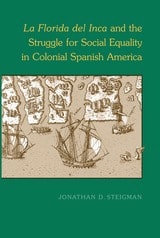
La Florida del Inca and the Struggle for Social Equality in Colonial Spanish America
Jonathan D. Steigman
University of Alabama Press, 2005
A cross-disciplinary view of an important De Soto chronicle.
Among the early Spanish chroniclers who contributed to popular images of the New World was the Amerindian-Spanish (mestizo) historian and literary writer, El Inca Garcilaso de la Vega (1539-1616). He authored several works, of which La Florida del Inca (1605) stands out as the best because of its unique Amerindian and European perspectives on the De Soto expedition (1539-1543). As the child of an Indian mother and a Spanish father, Garcilaso lived in both worlds--and saw value in each. Hailed throughout Europe for his excellent contemporary Renaissance writing style, his work was characterized as literary art. Garcilaso revealed the emotions, struggles, and conflicts experienced by those who participated in the historic and grandiose adventure in La Florida. Although criticized for some lapses in accuracy in his attempts to paint both the Spaniards and the Amerindians as noble participants in a world-changing event, his work remains the most accessible of all the chronicles.
In this volume, Jonathan Steigman explores El Inca’s rationale and motivations in writing his chronicle. He suggests that El Inca was trying to influence events by influencing discourse; that he sought to create a discourse of tolerance and agrarianism, rather than the dominant European discourse of intolerance, persecution, and lust for wealth. Although El Inca's purposes went well beyond detailing the facts of De Soto’s entrada, his skill as a writer and his dual understanding of the backgrounds of the participants enabled him to paint a more complete picture than most--putting a sympathetic human face on explorers and natives alike.
La vida de Lazarillo de Tormes y de sus fortunas y adversidades
Edited by Everett W. Hesse and Harry F. Williams
University of Wisconsin Press, 1961
First published in 1554 and banned by the Inquisition, the anonymous Lazarillo de Tormes begat a whole new genre—the picaresque novel. This classic has had enduring popularity as a literary expression of Spanish identity and emotion. Through its daring autobiographical form the reader observes the magnificent, conquering Spain of Charles the Fifth through the inner consciousness of the humble Lazarillo.
This editon includes the annotated Spanish-language text and prologue (with modernized and regularized spelling) , a full vocabulary, and concise footnotes explaining allusions and translating phrases of varying difficulty.
Spanish-language with introductions in English
Lacandon Maya-Spanish-English Dictionary
Charles A Hofling
University of Utah Press, 2014
Following the same trilingual format as Hofling’s Mopan Maya-Spanish-English Dictionary, this reference contains pronunciation and grammatical information. It is a hybrid of a root dictionary and one with words in alphabetical order; words can be looked up in these two different ways, making it easy to use for both native and nonnative speakers. It also accommodates Spanish speakers who wish to learn Lacandon, and in the future is likely to be helpful to Lacandon-speaking children, who increasingly use Spanish outside the home, while preserving a record of this indigenous language.
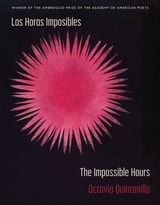
Las Horas Imposibles / The Impossible Hours
Octavio Quintanilla; Translated by Octavio Quintanilla and Natalia Treviño
University of Arizona Press, 2025
Presented in Spanish with English translations, this poetry collection comprises lyric and concrete poems—or frontextos—that explore intimacy and different shades of violence as a means to reconcile the speaker’s sense of belonging in the world. From the opening poem to the last in the first section, Quintanilla captures the perilous journeys that migrants undertake crossing borders as well as the paths that lovers forge to meet their endless longing. These themes are skillfully woven by Quintanilla, guiding us back and forth across the Rio Grande to encounter the apparitions of the disappeared and to witness the willingness of many to risk life and limb for a better life. The second half of the collection is one long poem, a letter addressed to a lost lover who will never get to read the speaker’s secret thoughts. Haunted by loss—of parents, of children, of the self—the speaker reaches an inevitable epiphany: “[A]nd sometimes it’s hard to know / on which side of the river I stand.” Stylistically, these poems destabilize our notions and expectations of genre and lyricism.
Las Horas Imposibles / The Impossible Hours is more than just an exercise in poetic virtuosity; it is an excavation into the complexities of what it means to be a human being in our contemporary world.