Results by title
93 books match the query 'Special Interest' and 3 start with l
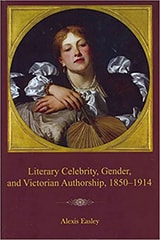
Literary Celebrity, Gender, and Victorian Authorship, 1850-1914
Alexis Easley
University of Delaware Press, 2011
This study examines literary celebrity in Britain from 1850 to 1914. Through lively analysis of rare cultural materials, Easley demonstrates the crucial role of the celebrity author in the formation of British national identity. As Victorians toured the homes and haunts of famous writers, they developed a sense of shared national heritage. At the same time, by reading sensational accounts of writers’ lives, they were able to reconsider conventional gender roles and domestic arrangements. As women were featured in interviews and profiles, they were increasingly associated with the ephemerality of the popular press and were often excluded from emerging narratives of British literary history, which defined great literature as having a timeless appeal. Nevertheless, women writers were able to capitalize on celebrity media as a way of furthering their own careers and retelling history on their own terms. Press attention had a more positive effect on men’s literary careers since they were expected to assume public identities; however, in some cases, media exposure had the effect of sensationalizing their lives, bodies, and careers. With the development of proto-feminist criticism and historiography, the life stories of male writers were increasingly used to expose unhealthy domestic relationships and imagine ideal forms of British masculinity.
The first section of Literary Celebrity explores the practice of literary tourism in Victorian Britain, focusing specifically on the homes and haunts of Charles Dickens, Christina Rossetti, George Eliot, Elizabeth Barrett Browning, and Harriet Martineau. This investigation incorporates analysis of fascinating cultural texts, including maps, periodicals, and tourist guidebooks. Easley links the practice of literary tourism to a variety of cultural developments, including nationalism, urbanization, spiritualism, the women’s movement, and the expansion of popular print culture. The second section provides fresh insight into the ways that celebrity culture informed the development of Victorian historiography. Easley demonstrates how women were able to re-tell history from a proto-feminist perspective by writing contemporary history, participating in architectural reform movements, and becoming active in literary societies. In this chapter she returns to the work of Harriet Martineau and introduces a variety of lesser-known contributors to the field, including Mary Gillies and Mary Ward. Literary Celebrity concludes with a third section focused on the expansion of celebrity media at the fin de siècle. These chapters and a brief coda link the popularization of celebrity news to the de-canonization of women writers, the professionalization of medicine, the development of the open space movement, and the institutionalization of English studies. These investigations elucidate the role of celebrity media in the careers of Charlotte Robinson, Marie Corelli, Mary Braddon, Harriet Martineau, Thomas Carlyle, Ernest Hart, and Octavia Hill.
Published by University of Delaware Press. Distributed worldwide by Rutgers University Press.

Living Medjugorje
Saverio Gaeta
St. Augustine's Press, 2025
What is happening in Medjugorje and why do hundreds of thousands of people visit each year? In June of 1981, the Blessed Virgin Mary, Mother of God, began appearing to six young people with messages above all of peace and conversion. She calls herself the "Queen of Peace," and these apparitions have continued to this day. First coming to the children in the rocky hills outside the small city ravaged by war and Communism, throngs of pilgrims walk the unfriendly trails to the original spot every day of the year and often with bare feet. The miracles and spiritual experiences attributed to this place are impossible to count.
The pilgrimage to Rome is historical and deeply woven into the custom of piety and devotion in the Catholic Church. But for the post-modern world, Medjugorje is the pre-eminent 'destination' for all people seeking to encounter God, especially those who have fallen away or have no religious affiliation. The Jubilee Year will bring many more to Medjugorje and Saverio Gaeta's guidebook provides a necessary service of how to do it and what to do while one is there. The introduction to the English edition is provided by the official chaplain to English-speaking pilgrims, Leon Pereira.
There are over 200 color photographs and graphs.
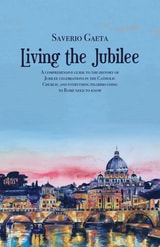
Living the Jubilee
Saverio Gaeta
St. Augustine's Press, 2025
Saverio Gaeta provides a concise and insightful history of Jubilee celebrations, tracing the custom to biblical norms and following developments up to present day. Jubilees are joyous remembrances of God's consistent paternal intervention in human life, and a time to acknowledge a common orientation toward the encounter with his Son, Jesus Christ, who brings salvation and life in the Trinity.
Living the Jubilee is indispensable for the reader who wishes to embark on a journey of faith, to live as a pilgrim and not tourist in this life. Gaeta inspires everyone to partake of the Jubilee celebrations. He also provides everything a traveler to Rome needs to know to make this trip––public transportation routes, event schedules, how one acquires the Vatican-issued pilgrim card and tickets needed to attend many of these events, plus much more. Even if readers do not make the voyage to Rome, Gaeta's account of the Jubilee in the Catholic Church is a wondrous display of thousands of years of tradition and history that has never lost a sense of joy and gratitude for the God who remains among us. It is a remarkable keepsake and helpful even for Jubilee celebrations in parishes and local communities.