Results by title
9 books match the query 'Keepers'

A Passion to Preserve
Gay Men as Keepers of CultureWill Fellows
University of Wisconsin Press, 2005
From large cities to rural communities, gay men have long been impassioned pioneers as keepers of culture: rescuing and restoring decrepit buildings, revitalizing blighted neighborhoods, saving artifacts and documents of historical significance. A Passion to Preserve explores this authentic and complex dimension of gay men’s lives by profiling early and contemporary preservationists from throughout the United States, highlighting contributions to the larger culture that gays are exceptionally inclined to make.

Keepers of the Flame
NFL Films and the Rise of Sports MediaTravis Vogan
University of Illinois Press, 2014
Drawing on research at the NFL Films Archive and the Pro Football Hall of Fame and interviews with media pioneer Steve Sabol and others, Travis Vogan shows how NFL Films has constructed a consistent, romanticized, and remarkably visible mythology for the National Football League. The company packages football as a visceral and dramatic sequence of violent, beautiful, graceful, and heroic gridiron battles. Historically proven formulas for presentation--such as the dramatic voiceovers once provided by John Facenda's baritone, the soaring scores of Sam Spence's rousing background music, and the epic poetry found in Steve Sabol's scripts--are still used today.
From the Vincent Price-narrated Strange but True Football Stories to the currently running series Hard Knocks, NFL Films distinguishes the NFL from other sports organizations and from other media and entertainment. Vogan tells the larger story of the company's relationship with and vast influence on our culture's representations of sport, the expansion of sports television beyond live game broadcasts, and the emergence of cable television and Internet sports media.
Keepers of the Flame: NFL Films and the Rise of Sports Media presents sports media as an integral facet of American popular culture and NFL Films as key to the transformation of professional football into the national obsession commonly known as America's Game.
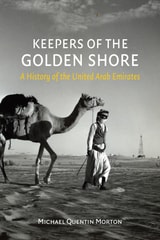
Keepers of the Golden Shore
A History of the United Arab EmiratesMichael Quentin Morton
Reaktion Books, 2016
As Michael Quentin Morton recounts, the region now known as the UAE likely began as a trading post between Mesopotamia and Oman, and since that time has been the stage of important economic and cultural exchanges. It has seen the rise and fall of a thriving pearl industry, piracy, invasions and wars, and the arrival of the oil age that would make it one of the richest countries on earth. Since the early 1970s, when seven sheikhs agreed to enter into a union, it has been a sovereign nation, carrying on the resourceful spirit—with resplendent fervor—that the brutally inhospitable landscape has long demanded of the people. Ultimately, Morton shows that the country is not only rich in oil and money but in an extraordinarily deep history and culture.

Keepers of the Sacred Chants
The Poetics of Ritual Power in an Amazonian SocietyJonathan D. Hill
University of Arizona Press, 1993

Keepers of the Wolves
Richard P. Thiel
University of Wisconsin Press, 2018
This new edition brings Thiel's story into the twenty-first century, recounting his work monitoring wolves as they spread to central Wisconsin, conflicts of wolves with landowners and recreationalists, changes in state and federal policies, the establishment of a state wolf-hunting season in 2012, and Thiel's forecast for the future of wolves in Wisconsin.

Keepers of the Wolves
The Early Years of Wolf Recovery in WisconsinRichard P. Thiel
University of Wisconsin Press, 2001
Thus begins Keepers of the Wolves, Thiel’s tale of his ten years at the center of efforts to track and protect the recovery of wolves in Northern Wisconsin. From his early efforts as a student enthusiast to his departure in 1989 from the post of wolf biologist for the Department of Natural Resources, Thiel conveys the wonder, frustrations, humor, and everyday hard work of field biologists, as well as the politics and public relations pitfalls that so often accompany their profession.
We share in the excitement as Thiel and his colleagues find wolf tracks in the snow, howl in the forest night and are answered back, learn to safely trap wolves to attach radio collars, and track the packs’ ranges by air from a cramped Piper Cub. We follow the stories of individual wolves and their packs as pups are born and die, wolves are shot by accident and by intent, ravages of canine parvovirus and hard winters take their toll, and young adults move on to new ranges. Believing he had left his beloved wolves behind, Thiel takes a new job as an environmental educator in central Wisconsin, but soon wolves follow. By 1999, there were an estimated 200 timber wolves in 54 packs in Wisconsin.
This is a sequel to Dick Thiel's 1994 book, The Timber Wolf in Wisconsin: The Death and Life of a Majestic Predator. That book traced the wolf's history in Wisconsin, its near extinction, and the initial efforts to reestablish it in our state. Thiel's new book looks at how successful that program has been.

Lunkers, Keepers, and Ones that Got Away
Fish Tales from Four Generations of AnglersJerry Apps
Wisconsin Historical Society Press, 2025
From his first experiences going fishing with his pa as a boy, Jerry Apps was hooked. Eighty-some years later, Apps reflects on a lifetime of fishing and the memories and lessons hauled in along the way. As he recounts the simple pleasures of casting a line from shore on a warm summer evening or reeling in a lunker on opening day of trout season, he reminds us of the values fishing can teach people of all ages: persistence, resourcefulness, and the importance of caring for our natural world.
Along with his best-loved fish tales, Apps includes fishing photos from the family album and favorite angling locales, lingo, bait, and gear. He draws on interviews with fellow fishermen and -women, his own journal entries recorded over decades, and his popular newspaper column Outdoor Notebook. And, since it’s a tradition among fishing folks to pass along tales told by others, he shares stories that have come his way from extended family and friends—some of them funny, some poignant, many embellished, and all of them keepers. Humorous pen-and-ink illustrations made by artist Sid Boyum to commemorate the annual fishing season opener add charm to this delightful volume.
In Lunkers, Keepers, and Ones that Got Away, Apps captures the exciting, heartwarming, and nostalgia-inducing experiences that fishing brings to avid and casual anglers alike.

The Keepers of Truth
Michael Collins
University of Iowa Press, 2021

The Keepers of Water and Earth
Mexican Rural Social Organization and IrrigationBy Kjell I. Enge and Scott Whiteford
University of Texas Press, 1989
Agrarian reforms transformed the Mexican countryside in the late twentieth century but without, in many cases, altering fundamental power relationships. This study of the Tehuacán Valley in the state of Puebla highlights different strategies to manipulate the local implementation of federal government programs. With their very differing successes in the struggle to regain and maintain control of land and water rights, these strategies raise important questions about the meaning of the phrase "locally controlled development."
Because Mexico is dependent on irrigation for 45 percent of its cash crop production, national policy has focused on developing vast government controlled and financed irrigation systems. In the Tehuacán Valley, however, the inhabitants have developed a complex irrigation system without government aid or supervision. Yet, in contrast to most parts of Mexico, water rights can be bought and sold as a commodity, leading to accumulation, stratification, and emergence of a regional elite whose power is based on ownership of land and water. The analysis provides an important contribution to the understanding of local control.
The findings of this study will be important to a wide audience involved in the study of irrigation, local agricultural systems, and the interplay between local power structures and the national government in developing countries. The book also presents unique material on gravity-fed, horizontal wells, known as qanat in the Middle East, which had been unknown in the literature on Latin America before this book.