Results by title
67 books match the query 'Technology Studies' and 3 start with l

Labs of Our Own
Feminist Tinkerings with ScienceSig / Sara Giordano
Rutgers University Press, 2025
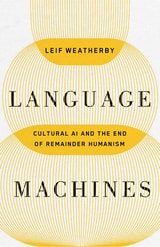
Language Machines
Cultural AI and the End of Remainder HumanismLeif Weatherby
University of Minnesota Press, 2025
How generative AI systems capture a core function of language
Looking at the emergence of generative AI, Language Machines presents a new theory of meaning in language and computation, arguing that humanistic scholarship misconstrues how large language models (LLMs) function. Seeing LLMs as a convergence of computation and language, Leif Weatherby contends that AI does not simulate cognition, as widely believed, but rather creates culture. This evolution in language, he finds, is one that we are ill-prepared to evaluate, as what he terms “remainder humanism” counterproductively divides the human from the machine without drawing on established theories of representation that include both.
To determine the consequences of using AI for language generation, Weatherby reads linguistic theory in conjunction with the algorithmic architecture of LLMs. He finds that generative AI captures the ways in which language is at first complex, cultural, and poetic, and only later referential, functional, and cognitive. This process is the semiotic hinge on which an emergent AI culture depends. Weatherby calls for a “general poetics” of computational cultural forms under the formal conditions of the algorithmic reproducibility of language.
Locating the output of LLMs on a spectrum from poetry to ideology, Language Machines concludes that literary theory must be the backbone of a new rhetorical training for our linguistic-computational culture.

Livestreaming
An Aesthetics and Ethics of Technical EncounterEL Putnam
University of Minnesota Press, 2024
An inquiry into how livestreaming can help us meaningfully connect
Livestreaming is ubiquitous in our Covid-19-inflected era. In this book, EL Putnam takes up the implications of this technology, arguing that livestreamed internet broadcasts perform aesthetic and ethical encounters that invite distinctive means of relating to others. Treating humans and technologies as inherently relational, Putnam considers how livestreaming constitutes new patterns of being together that are complex, ambivalent, and transformative. Understood in such a way, we see how livestreaming exceeds quantifying and calculating metrics, challenges emphasis on content generation, and introduces an entirely new—and dynamic—means of social engagement.