Results by title
56 books match the query 'Thought' and 5 start with l
Life and Thought in the Ancient Near East
Louis L. Orlin
University of Michigan Press, 2010
Intended for readers seeking insight into the day-to-day life of some of the world's most ancient peoples, Life and Thought in the Ancient Near East presents brief, fascinating explorations of key aspects of the civilizations of Egypt, Mesopotamia, Palestine, Asia Minor, and Iran. With vignettes on agriculture, architecture, crafts and industries, literature, religion, topography, and history, Orlin has created something refreshingly unique: a modern guidebook to an ancient world. The book also reaches out to students of the Ancient Near Eastern World with essays on decipherments, comparative cultural developments between Egypt and Mesopotamia, and language and literature.
In addition to general readers, the book will be useful in the classroom as a text supplementing a more conventional introduction to Near Eastern Studies.
"Well-written and accessible, Life and Thought in the Ancient Near East deftly connects the past with present experience by drawing out the differences between, for instance, modern churches and ancient temples, and frequently employing biblical references. This simplicity together with connecting contemporary to ancient experience makes the text ideal for freshmen and general readers."
---Marc Cooper, Professor of History, Missouri State University
Now Professor Emeritus, Louis L. Orlin taught in the department of Ancient Near Eastern History and Literature at the University of Michigan for more than thirty years. He is the author and editor of several books, including Assyrian Colonies in Cappadocia and Ancient Near Eastern Literature: A Bibliography of One Thousand Items on the Cuneiform Literatures of the Ancient World.

Life and Thought in the Middle Ages
Robert S. Hoyt, Editor
University of Minnesota Press, 1967
Life and Thought in the Middle Ages was first published in 1967. Minnesota Archive Editions uses digital technology to make long-unavailable books once again accessible, and are published unaltered from the original University of Minnesota Press editions.
The period of the early Middle Ages - from the fourth to the eleventh centuries—used to be commonly called "the dark ages." Now that term has been discarded by scholars, who reject its implications as they recognize increasingly, the historical importance of the period. In this volume eight historians, in as many essays, discuss various aspects of the life and thought which prevailed during the centuries which extended from the time of the establishment of Germanic "successor states" in the western provinces of the Roman Empire to the appearance of some of the economic and feudal institutions which provided a basis for the civilization of the high Middle Ages.
The essay, by showing that a process of assimilation and synthesis of the Roman, Christian, and barbarian elements characterized life in the early Middle Ages, demonstrate that the significance of the period is far better indicated by words like "transition" or "transformation" than by the term "dark ages."
An essay by the late Professor Adolf Katzenellenbogen, "The Image of Christ in the Early Middle Ages," is illustrated with eighteen halftones showing examples of art of the period.
The other essays are "The Barbarian Kings of Lawgivers and Judges" by Katherine Fischer Drew; "Of Towns and Trade" by Robert S. Lopez; "The Two Levels of Feudalism" by Joseph R. Strayer; "The Life of the Silent Majority" by Lynn White, Jr; "Beowulf and Bede" by John C. McGalliard; "Viking - Tunnit - Eskimo" by the late T. J. Oleson; "The Church, Reform, and Renaissance in the Early Middle Ages" by Karl F. Morrison.
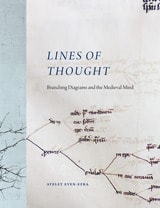
Lines of Thought
Branching Diagrams and the Medieval MindAyelet Even-Ezra
University of Chicago Press, 2021
These diagrams not only allow a glimpse into the thinking practices of the past but also constitute a chapter in the history of how people learned to rely on external devices—from stone to parchment to slide rules to smartphones—for recording, storing, and processing information. Beautifully illustrated throughout with previously unstudied and unedited diagrams, Lines of Thought is a historical overview of an important cognitive habit, providing a new window into the world of medieval scholars and their patterns of thinking.
Lines of Thought
Discourse, Architectonics, and the Origin of Modern PhilosophyClaudia Brodsky Lacour
Duke University Press, 1996
While Cartesianism has long served as a synonym for rationalism, the contents of Descartes’s method and cogito have remained infamously resistant to rational analysis. Similarly, although modern phenomenological analyses descend from Descartes’s notion of intuition, the “things” Cartesian intuitions represent bear no resemblance to phenomena. By returning to what Descartes calls the construction of his “foundation” in the Discours, Brodsky Lacour identifies the conceptual problems at the root of Descartes’s literary and aesthetic theory as well as epistemology. If, for Descartes, linear extension and “I” are the only “things” we can know exist, the Cartesian subject of thought, she shows, derives first from the intersection of discourse and drawing, representation and matter. The crux of that intersection, Brodsky Lacour concludes, is and must be the cogito, Descartes’s theoretical extension of thinking into material being. Describable in accordance with the Géométrie as a freely constructed line of thought, the cogito, she argues, extends historically to link philosophy with theories of discursive representation and graphic delineation after Descartes. In conclusion, Brodsky Lacour analyzes such a link in the writings of Claude Perrault, the architectural theorist whose reflections on beauty helped shape the seventeenth-century dispute between “the ancients and the moderns.”
Part of a growing body of literary and interdisciplinary considerations of philosophical texts, Lines of Thought will appeal to theorists and historians of literature, architecture, art, and philosophy, and those concerned with the origin and identity of the modern.

Lunar Voices
Of Tragedy, Poetry, Fiction, and ThoughtDavid Farrell Krell
University of Chicago Press, 1995
Krell pursues important philosophical motifs such as time, rhythm, and desire, through texts by Nietzsche, Trakl, Empedocles, Kafka, and Garcia Marquez. He surveys instances in which poets or novelists explicitly address philosophical questions, and philosophers confront literary texts—Heidegger's and Derrida's appropriations of Georg Trakl's poetry, Blanchot's obsession with Kafka's tortuous love affairs, and Garcia Marquez's use of Nietzsche's idea of the Eternal Return—all linked by the tragic hero Empedocles.
In his search to understand the insatiable desire for completeness that patterns so much art and philosophy, Krell investigates the identification of the lunar voice with woman in various roles—lover, friend, sister, shadow, and narrative voice.