Results by title
86 books match the query 'Translating & Interpreting' and 3 start with l
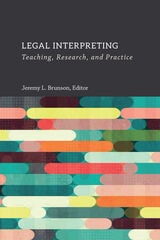
Legal Interpreting
Teaching, Research, and PracticeJeremy L. Brunson
Gallaudet University Press, 2022
Each chapter features discussion questions and prompts that interpreter educators can use in the classroom. While intended as a foundational text for use in courses, this body of work also provides insight into the current state of the legal interpreting field and will be a valuable resource for scholars, practitioners, and consumers.
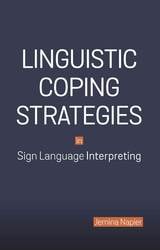
Linguistic Coping Strategies in Sign Language Interpreting
Jemina Napier
Gallaudet University Press, 2016
The concept of strategic omissions is explored here as a tool that is consciously used by interpreters as a coping strategy. Instead of being a mistake, omitting part of the source language can actually be part of an active decision-making process that allows the interpreter to convey the correct meaning when faced with challenges. For the first time, Napier found that omission potential existed within every interpretation and, furthermore, she proposed a new taxonomy of five different conscious and unconscious omission types. Her findings also indicate that Auslan/English interpreters use both a free and literal interpretation approach, but that those who use a free approach occasionally switch to a literal approach as a linguistic coping strategy to provide access to English terminology. Both coping strategies help negotiate the demands of interpretation, whether it be lack of subject-matter expertise, dealing with dense material, or the context of the situation.
Napier also analyzes the interpreters’ reflections on their decision-making processes as well as the university students’ perceptions and preferences of their interpreters’ linguistic choices and styles. Linguistic Coping Strategies in Sign Language Interpreting is a foundational text in interpretation studies that can be applied to interpreting in different contexts and to interpreter training.
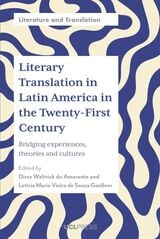
Literary Translation in Latin America in the Twenty-First Century
Bridging Experiences, Theories and CulturesEdited by Dirce Waltrick do Amarante and Letícia Maria Vieira de Souza Goellner
University College London, 2026
Encompassing hegemonic, nonhegemonic, and pidgin languages, this compilation explores the state of literary translation studies in Latin America.
Literary Translation in Latin America in the Twenty-First Century provides an in-depth exploration of the current landscape of literary translation studies and translation practices across Latin America. The unparalleled linguistic diversity of Latin America, with nearly five hundred languages spoken, makes translation a vital aspect of daily life. This volume aims to contribute to the analysis from a Latin American perspective, presenting a fresh reading of translation theories that originate in Latin America, as well as theoretical reflections and practical examples of literary translation by poets and artists situated in the continent.