Results by title
171 books match the query 'True Crime' and 12 start with l

L.A. Private Eyes
Dahlia Schweitzer
Rutgers University Press, 2019
Watch a video of the author speaking about this topic: https://goo.gl/Xr9RFD
And also: https://www.dropbox.com/s/mkqw3mplruf7jje/Detective%20Talk%20Full.mp4?dl=0 (https://www.dropbox.com/s/mkqw3mplruf7jje/Detective%20Talk%20Full.mp4?dl=0)
LAST ONE OVER THE WALL
The Massachusetts Experiment in Closing Reform SchoolsJerome G. Miller
The Ohio State University Press, 1998
Last Gangster in Austin
Frank Smith, Ronnie Earle, and the End of a Junkyard MafiaJesse Sublett
University of Texas Press, 2021
Ronnie Earle was a Texas legend. During his three decades as the district attorney responsible for Austin and surrounding Travis County, he prosecuted corrupt corporate executives and state officials, including the notorious US congressman Tom DeLay. But Earle maintained that the biggest case of his career was the one involving Frank Hughey Smith, the ex-convict millionaire, alleged criminal mastermind, and Dixie Mafia figure.
With the help of corrupt local authorities, Smith spent the 1970s building a criminal empire in auto salvage and bail bonds. But there was one problem: a rival in the salvage business threatened his dominance. Smith hired arsonists to destroy the rival; when they botched the job, he sent three gunmen, but the robbery they planned was a bloody fiasco. Investigators were convinced that Smith was guilty, but many were skeptical that the newly elected and inexperienced Earle could get a conviction. Amid the courtroom drama and underworld plots the book describes, Willie Nelson makes a cameo. So do the private eyes, hired guns, and madams who kept Austin not only weird but also riddled with vice. An extraordinary true story, Last Gangster in Austin paints an unusual picture of the Texas capital as a place that was wild, wonderful, and as crooked as the dirt road to paradise.
Last Rampage
The Escape of Gary TisonJames W. Clarke
University of Arizona Press, 1999
Last Words of the Executed
Robert K. Elder
University of Chicago Press, 2010
Some beg for forgiveness. Others claim innocence. At least three cheer for their favorite football teams.
Death waits for us all, but only those sentenced to death know the day and the hour—and only they can be sure that their last words will be recorded for posterity. Last Words of the Executed presents an oral history of American capital punishment, as heard from the gallows, the chair, and the gurney.
The product of seven years of extensive research by journalist Robert K. Elder, the book explores the cultural value of these final statements and asks what we can learn from them. We hear from both the famous—such as Nathan Hale, Joe Hill, Ted Bundy, and John Brown—and the forgotten, and their words give us unprecedented glimpses into their lives, their crimes, and the world they inhabited. Organized by era and method of execution, these final statements range from heartfelt to horrific. Some are calls for peace or cries against injustice; others are accepting, confessional, or consoling; still others are venomous, rage-fueled diatribes. Even the chills evoked by some of these last words are brought on in part by the shared humanity we can’t ignore, their reminder that we all come to the same end, regardless of how we arrive there.
Last Words of the Executed is not a political book. Rather, Elder simply asks readers to listen closely to these voices that echo history. The result is a riveting, moving testament from the darkest corners of society.
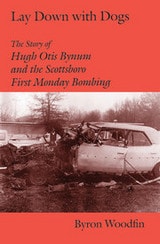
Lay Down with Dogs
Hugh Otis Bynum and the Scottsboro First Monday BombingByron Woodfin
University of Alabama Press, 2002
The gripping story of the attempted murder of Scottsboro attorney and state legislator Loy Campbell
“As with any good book about a great event, this one has a little of everything—suspense, humor, pathos, melodrama.” —Journal of Southern History
On a quiet December morning in 1972, Scottsboro attorney and former state legislator Loy Campbell started his car and detonated a bomb hidden beneath the hood. The explosion tore through the vehicle, cost him both legs, and nearly killed him, shattering the calm of the northeast Alabama town. Lay Down with Dogs reconstructs the attempted assassination of Campbell and subsequent trial. As Alabama’s young and ambitious attorney general, Bill Baxley took personal charge of the case. He led the state’s investigation and prosecution against those accused of planning and financing the assassination attempt, most notably Hugh Otis Bynum Jr., one of the most powerful local figures in Scottsboro. More than a crime story, it is a gripping account of violence, power, and survival at a volatile moment in modern Southern history.
Drawing on court records, investigative files, contemporary journalism, and firsthand testimony, Byron Woodfin offers the most comprehensive account of the bombing and its aftermath. With the skill of an experienced historian and storyteller, the narrative follows both the painstaking investigation and the dramatic prosecution that ultimately exposed the forces behind the attack. The author’s deep familiarity with Alabama history and legal culture lends authority and insight, while a clear, compelling prose style keeps the story moving with the momentum of a true‑crime classic.
Lay Down with Dogs will appeal to readers of Southern history, legal history, and true crime, as well as anyone interested in justice, civic life, and unsolved tensions in twentieth‑century America. It is ideal for scholars, students, and general readers seeking a powerful, unsettling, and unforgettable story rooted in real events.
Legacies Of Lynching
Racial Violence And MemoryJonathan Markovitz
University of Minnesota Press, 2004
Traces the changing meanings of lynching and examines the political power of lynching as metaphor
Between 1880 and 1930, thousands of African Americans were lynched in the United States. Beyond the horrific violence inflicted on these individuals, lynching terrorized whole communities and became a defining characteristic of Southern race relations in the Jim Crow era. As spectacle, lynching was intended to serve as a symbol of white supremacy. Yet, Jonathan Markovitz notes, the act's symbolic power has endured long after the practice of lynching has largely faded away.
Legacies of Lynching examines the evolution of lynching as a symbol of racial hatred and a metaphor for race relations in popular culture, art, literature, and political speech. Markovitz credits the efforts of the antilynching movement with helping to ensure that lynching would be understood not as a method of punishment for black rapists but as a terrorist practice that provided stark evidence of the brutality of Southern racism and as America’s most vivid symbol of racial oppression. Cinematic representations of lynching, from Birth of a Nation to Do the Right Thing, he contends, further transform the ways that American audiences remember and understand lynching, as have disturbing recent cases in which alleged or actual acts of racial violence reconfigured stereotypes of black criminality. Markovitz further reveals how lynching imagery has been politicized in contemporary society with the example of Clarence Thomas, who condemned the Senate's investigation into allegations of sexual harassment during his Supreme Court confirmation hearings as a “high-tech lynching.”Even today, as revealed by the 1998 dragging death of James Byrd in Jasper, Texas, and the national soul-searching it precipitated, lynching continues to pervade America's collective memory. Markovitz concludes with an analysis of debates about a recent exhibition of photographs of lynchings, suggesting again how lynching as metaphor remains always in the background of our national discussions of race and racial relations.
Leopold and Loeb
THE CRIME OF THE CENTURYHal Higdon
University of Illinois Press, 1975
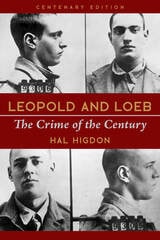
Leopold and Loeb
The Crime of the CenturyHal Higdon
University of Illinois Press, 2024
The 1924 murder of fourteen-year-old Bobby Franks by Nathan Leopold and Richard Loeb shocked the nation. One hundred years later, the killing and its aftermath still reverberate through popular culture and the history of American crime.
Hal Higdon’s true crime classic offers an unprecedented examination of the case. Higdon details Leopold and Loeb’s journey from privilege and promise to the planning and execution of their monstrous vision of the perfect crime. Drawing on secret testimony, Higdon follows the police investigation through the pair’s confessions of guilt and recreates the sensational hearing where Clarence Darrow, the nation’s most famous attorney, saved the pair from the death penalty.
In-depth and definitive, Leopold and Loeb tells the dramatic story of a notorious crime and its long afterlife in the American imagination.
Life after Death Row
Exonerees' Search for Community and IdentitySaundra D. Westervelt and Kimberly J. Cook
Rutgers University Press, 2012
Life after Death Row examines the post-incarceration struggles of individuals who have been wrongly convicted of capital crimes, sentenced to death, and subsequently exonerated.
Saundra D. Westervelt and Kimberly J. Cook present eighteen exonerees’ stories, focusing on three central areas: the invisibility of the innocent after release, the complicity of the justice system in that invisibility, and personal trauma management. Contrary to popular belief, exonerees are not automatically compensated by the state or provided adequate assistance in the transition to post-prison life. With no time and little support, many struggle to find homes, financial security, and community. They have limited or obsolete employment skills and difficulty managing such daily tasks as grocery shopping or banking. They struggle to regain independence, self-sufficiency, and identity.
Drawing upon research on trauma, recovery, coping, and stigma, the authors weave a nuanced fabric of grief, loss, resilience, hope, and meaning to provide the richest account to date of the struggles faced by people striving to reclaim their lives after years of wrongful incarceration.
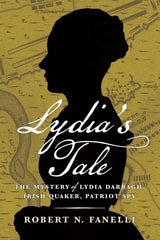
Lydia's Tale
The Mystery of Lydia Darragh, Irish Quaker, Patriot SpyRobert N. Fanelli
Westholme Publishing, 2025
Lydia’s Tale:The Mystery of Lydia Darragh, Irish Quaker, Patriot Spy by Robert N. Fanelli uncovers a myriad of previously unknown records, knitting together for the first time the life and experiences of this remarkable heroine of the American Revolution who lived in the heart of Philadelphia. Behind her story we find an assertive woman who took an active hand in the affairs of her family and her community. Drawing on genealogical sources, legal documents, and other correspondence, the author reconstructs Lydia Darragh’s early life in Dublin, her livelihood in Pennsylvania, and how the Revolution shaped her and her children’s lives. Exploring the context of Lydia’s tale sheds light on the activities of women in Revolutionary Philadelphia, reveals the complex issues faced by pacifist Quakers in a time of war, and brings to light the contributions of Irish immigrants in securing America’s freedom.
The author’s careful research reveals little known details and corrects historians’ common misapprehensions about the Revolutionary period. Along the way, we meet often overlooked figures, including diarist Christopher Marshall and his family, the irascible Quaker recluse Bathsheba Bowers, and Blair McClenachan, the wealthy Patriot financier who also served his adopted country as a common soldier. Lydia Darragh is frequently included among that small group of women cited as Revolutionary heroines. This detailed microhistory demonstrates how legend can inform the study of history, describing how one woman’s personal reminiscence morphed into a piece of American mythology, now recovered in the historical context it deserves.
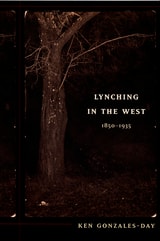
Lynching in the West
1850-1935Ken Gonzales-Day
Duke University Press, 2006
An artist and writer, Gonzales-Day began this study by photographing lynching sites in order to document the absences and empty spaces that are emblematic of the forgotten history of lynching in the West. Drawing on newspaper articles, periodicals, court records, historical photographs, and souvenir postcards, he attempted to reconstruct the circumstances surrounding the lynchings that had occurred in the spaces he was photographing. The result is an unprecedented textual and visual record of a largely unacknowledged manifestation of racial violence in the United States. Including sixteen color illustrations, Lynching in the West juxtaposes Gonzales-Day’s evocative contemporary photographs of lynching sites with dozens of historical images.
Gonzales-Day examines California’s history of lynching in relation to the spectrum of extra-legal vigilantism common during the nineteenth century—from vigilante committees to lynch mobs—and in relation to race-based theories of criminality. He explores the role of visual culture as well, reflecting on lynching as spectacle and the development of lynching photography. Seeking to explain why the history of lynching in the West has been obscured until now, Gonzales-Day points to popular misconceptions of frontier justice as race-neutral and to the role of the anti-lynching movement in shaping the historical record of lynching in the United States.