Results by title
97 books match the query 'United States. Congress' and 7 start with l
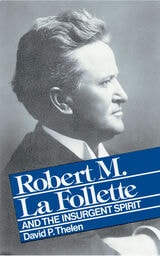
La Follette Insurgent Spirit
David P. Thelen
University of Wisconsin Press, 1986
Robert M. La Follette and the Insurgent Spirit is a closely argued, lively, and readable biography of the central figure in the American Progressive movement. Wisconsin's “Fighting Bob” La Follette embodied the heart of Progressive sentiment and principle. He was a powerful force in shaping national political events between the eras of Populism and the New Deal
[more]
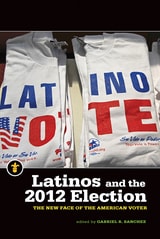
Latinos and the 2012 Election
The New Face of the American VoterGabriel R. Sanchez
Michigan State University Press, 2015
In giving President Obama a record level of support (75 percent) and reaching a watershed 10 percent of the voting population, Latinos proved to be decisive in the 2012 election outcome—an unprecedented mark of influence for this segment of the wider electorate. This shift also signaled a radical reenvisioning of mobilization strategies by both parties and created a sea change in the way political organizations conduct outreach and engagement efforts. In this groundbreaking volume, experts in Latino politics ask: What is the scope of Latino voter influence, where does this electorate have the greatest impact, and what issues matter to them most? They examine a key national discussion—immigration reform—as it relates to voter behavior, and also explore the influence of Latinos within key states, including California, Colorado, New Mexico, Virginia, North Carolina, Ohio, Nevada, and Florida. While some of these states have traditionally had strong Latino voting blocs, in others Latinos are just emerging as major players electorally. The book also discusses the extent to which Latinos were mobilized during the 2012 campaign and analyzes election outcomes using new tools created by Latino Decisions. A blend of rigorous data analysis and organizational commentary, the book offers a variety of perspectives on the past, present, and future of the Latino electorate.
[more]
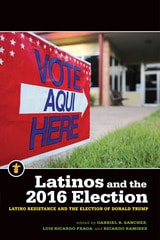
Latinos and the 2016 Election
Latino Resistance and the Election of Donald TrumpGabriel R. Sanchez
Michigan State University Press, 2020
The 2016 election saw more Latino votes than the record voter turnout of the 2012 election. The essays in this volume provide a highly detailed analysis of the state and national impact Latino voters had in what will be remembered as one of the biggest surprises in presidential election history. Contrary to much commentary, Latino voters increased their participation rates in all states beyond the supposed peak levels that they attained in 2012. Moreover, they again displayed their overwhelming support of Democratic candidates and even improved their Democratic support in Florida. Nonetheless, their continued presence and participation in national elections was not sufficient to prevent the election of Donald Trump, the Republican presidential candidate who vilified Latinos and especially Latino immigrants. Each essay provides insights as to how these two competing realities coexist, while the conclusion addresses the implications of this coexistence for the future of Latinos in American politics.
[more]
Legislative Style
William Bernhard and Tracy Sulkin
University of Chicago Press, 2018
Once elected, members of Congress face difficult decisions about how to allocate their time and effort. On which issues should they focus? What is the right balance between working in one’s district and on Capitol Hill? How much should they engage with the media to cultivate a national reputation? William Bernhard and Tracy Sulkin argue that these decisions and others define a “legislative style” that aligns with a legislator’s ambitions, experiences, and personal inclinations, as well as any significant electoral and institutional constraints.
Bernhard and Sulkin have developed a systematic approach for looking at legislative style through a variety of criteria, including the number of the bills passed, number of speeches given, amount of money raised, and the percentage of time a legislator voted in line with his or her party. Applying this to ten congresses, representing twenty years of congressional data, from 1989 to 2009, they reveal that legislators’ activity falls within five predictable styles. These styles remain relatively consistent throughout legislators’ time in office, though a legislator’s style can change as career goals evolve, as well as with changes to individual or larger political interests, as in redistricting or a majority shift. Offering insight into a number of enduring questions in legislative politics, Legislative Style is a rich and nuanced account of legislators’ activity on Capitol Hill.
Bernhard and Sulkin have developed a systematic approach for looking at legislative style through a variety of criteria, including the number of the bills passed, number of speeches given, amount of money raised, and the percentage of time a legislator voted in line with his or her party. Applying this to ten congresses, representing twenty years of congressional data, from 1989 to 2009, they reveal that legislators’ activity falls within five predictable styles. These styles remain relatively consistent throughout legislators’ time in office, though a legislator’s style can change as career goals evolve, as well as with changes to individual or larger political interests, as in redistricting or a majority shift. Offering insight into a number of enduring questions in legislative politics, Legislative Style is a rich and nuanced account of legislators’ activity on Capitol Hill.
[more]
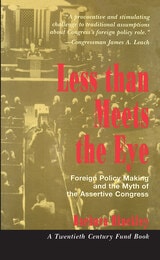
Less than Meets the Eye
Foreign Policy Making and the Myth of the Assertive CongressBarbara Hinckley
University of Chicago Press, 1994
Focusing on cases involving major military action, foreign aid authorization, and key controversial votes in both legislative branches, Hinckley shows that—appearances to the contrary—Congress more often than not votes with the President, and has done so for the last few decades. Despite occasional flurries of activity on carefully chosen symbolic issues, most foreign policy issues never even make the Congressional agenda. Those that do are often dispatched with demands for reports that are left unread or with tough restrictions having built-in "escape provisions." Both branches, Hinckley argues, encourage this image of conflict and profit from the symbolic political capital it produces. This process comes to light in her analysis of aid to Nicaragua.
What Hinckley reveals is sharply at odds with conventional wisdom and unflattering to both the executive and the legislative branches of government. More than a critical reassessment, this book also proposes reforms than might result in real congressional participation in the making of foreign policy. With its insight into how our system of checks and balances works—and doesn't—this book takes a first step toward making the peoples' representatives accountable for crucial American interests in foreign matters.
What Hinckley reveals is sharply at odds with conventional wisdom and unflattering to both the executive and the legislative branches of government. More than a critical reassessment, this book also proposes reforms than might result in real congressional participation in the making of foreign policy. With its insight into how our system of checks and balances works—and doesn't—this book takes a first step toward making the peoples' representatives accountable for crucial American interests in foreign matters.
[more]
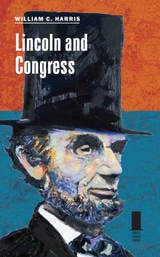
Lincoln and Congress
William C. Harris
Southern Illinois University Press, 2017
Winner, ISHS Annual Award for a Scholarly Publication, 2018
In Lincoln and Congress, William C. Harris reveals that the relationship between the president and Congress, though sometimes contentious, was cooperative rather than adversarial. During his time as president, Abraham Lincoln embodied his personal conviction that the nation’s executive should not interfere with the work of the legislature, and though often critical of him privately, in public congressional leaders compromised with and assisted the president to unite the North and minimize opposition to the war.
Despite the turbulence of the era and the consequent tensions within the government, the executive and legislative branches showed restraint in their dealings with each other. In fact, except in his official messages to Congress, Lincoln rarely lobbied for congressional action, and he vetoed only one important measure during his tenure as president. Many congressmen from Lincoln’s own party, although publicly supportive, doubted his leadership and sought a larger role for Congress in setting war policies. Though they controlled Congress, Republican legislators frequently differed among themselves in shaping legislation and in their reactions to events as well as in their relationships both with each other and with the president. Harris draws intriguing sketches of nineteenth-century congressional leaders and shows that, contrary to what historians have traditionally concluded, radical Republicans such as Representative Thaddeus Stevens and Senator Charles Sumner did not dominate their party or Congress. Harris includes the minority party’s role, showing that Northern Democrats and conservative Unionists of the border states generally opposed Republican policies but worked with them on support for the troops and on nonwar issues like the Pacific Railroad Bill.
Lincoln and Congress sheds new light on the influence of members of Congress and their relationship with Lincoln on divisive issues such as military affairs, finance, slavery, constitutional rights, reconstruction, and Northern political developments. Enjoyable both for casual Civil War readers and professional historians, this book provides an engaging narrative that helps readers redefine and understand the political partnership that helped the Union survive.
[more]
Losing to Win
Why Congressional Majorities Play Politics Instead of Make LawsJeremy Gelman
University of Michigan Press, 2020
Most everyone, voters, political scientists, even lawmakers, think Congress is dysfunctional. Instead of solving problems, Democrats and Republicans spend their time playing politics. These days Capitol Hill seems more a place to bicker, not to pass laws. The reality is more complicated. Yes, sometimes Congress is broken. But sometimes it is productive. What explains this variation? Why do Democrats and Republicans choose to legislate or score political points? And why do some issues become so politicized they devolve into partisan warfare, while others remain safe for compromise?
Losing to Win answers these questions through a novel theory of agenda-setting. Unlike other research that studies bills that become law, Jeremy Gelman begins from the opposite perspective. He studies why majority parties knowingly take up dead-on-arrival (DOA) bills, the ideas everyone knows are going to lose. In doing so, he argues that congressional parties’ decisions to play politics instead of compromising, and the topics on which they choose to bicker, are strategic and predictable. Gelman finds that legislative dysfunction arises from a mutually beneficial relationship between a majority party in Congress, which is trying to win unified government, and its allied interest groups, which are trying to enact their policies. He also challenges the conventional wisdom that DOA legislation is political theater. By tracking bills over time, Gelman shows that some former dead-on-arrival ideas eventually become law. In this way, ideas viewed as too extreme or partisan today can produce long-lasting future policy changes.
Through his analysis, Gelman provides an original explanation for why both parties pursue the partisan bickering that voters find so frustrating. He moves beyond conventional arguments that our discordant politics are merely the result of political polarization. Instead, he closely examines the specific circumstances that give rise to legislative dysfunction. The result is a fresh, straightforward perspective on the question we have all asked at some point, “Why can’t Democrats and Republicans stop fighting and just get something done?”
[more]