Results by title
1296 books match the query 'Women authors' and 51 start with l
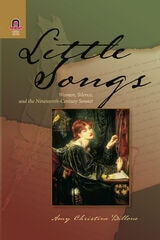
LITTLE SONGS
WOMEN, SILENCE, AND THE NINETEENTH-CENTURY SONNETAMY CHRISTINE BILLONE
The Ohio State University Press, 2002
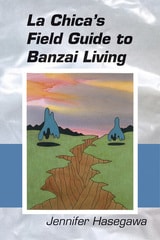
La Chica's Field Guide to Banzai Living
Jennifer Hasegawa
Omnidawn, 2019
Hasegawa’s poems not only rearrange our ways of seeing the world, but they also reset the language we use in it. Banzai, with a literal translation of “10,000 years,” was used by the Japanese as a rallying cry in imperialistic and militaristic contexts. Today, the understanding of this word has shifted to a comparatively neutral translation of the enthusiastic expression “Hurrah!” in both in Japan and beyond. In La Chica’s Field Guide to Banzai Living, Hasegawa aims to reclaim banzai, recasting the language of war and unwavering loyalty and forming it into one that stands against aggression and racism and embraces tolerance and self-acceptance. Here banzai becomes a rallying cry not of war but of grand potential. La Chica’s Field Guide to Banzai Living chronicles a celebratory life and poetry filled with wonder.
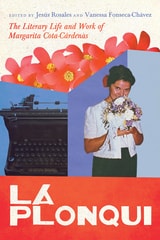
La Plonqui
The Literary Life and Work of Margarita Cota-CárdenasEdited by Jesús Rosales and Vanessa Fonseca-Chávez
University of Arizona Press, 2023
Nicknamed “La Plonky” by her family after a made-up childhood song, Cota-Cárdenas grew up in California, taught almost exclusively in Arizona, and produced five major works (two novels and three books of poetry) that offer an expansive literary production spanning from the 1960s to today. Her perspectives on Chicana identity, the Chicanx movement, and the sociopolitical climate of Arizona and the larger U.S.-Mexico border region represent a significant contribution to the larger body of Chicanx literature. Additionally, the volume explores her perspectives on issues of gender, sexuality, and identity related to the Chicanx experience over time.
Divided into three major parts, this collection begins with an introduction, followed by two testimonial essays written by the author herself and a longtime colleague, as well as an interview with the author. The second section contains nine essays by well-established literary critics that analyze Cota-Cárdenas’s literary output within a Chicano Movement literary context and offer new readings of Cota-Cárdenas’s fiction and poetry. The third part presents poetry and fiction from Cota-Cárdenas, including an excerpt from a work in progress. As a whole, the collection aims to affirm Margarita Cota-Cárdenas’s significant role in shaping the field of Chicana literature and emphasizes the importance of honoring a celebrated author who wrote a majority of her works in Spanish—one of the few Chicana writers to do so.
Contributors
Laura Elena Belmonte
Margarita Cota-Cárdenas
José R. Flores
Vanessa Fonseca-Chávez
Carolyn González
Gabriella Gutiérrez y Muhs
Manuel M. Martín-Rodríguez
Kirsten F. Nigro
Margarita E. Pignataro
Tey Diana Rebolledo
Jesús Rosales
Charles St-Georges
Javier Villarreal
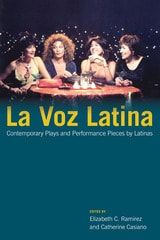
La Voz Latina
Contemporary Plays and Performance Pieces by LatinasEdited by Elizabeth C. Ramirez and Catherine Casiano
University of Illinois Press, 2011
Contributors: Yareli Arizmendi, Josefina Báez, The Colorado Sisters, Migdalia Cruz, Evelina Fernández, Cherríe Moraga, Carmen Peláez, Carmen Rivera, Celia H. Rodríguez, Diane Rodriguez, and Milcha Sanchez-Scott. The volume also includes commentary by Kathy Perkins and Caridad Svich.
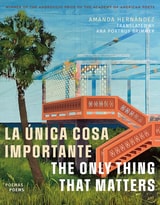
La única cosa importante / The Only Thing That Matters
Poemas / PoemsAmanda Hernández; Translated by Ana Portnoy Brimmer
University of Arizona Press, 2027
The poems featured in this award-winning collection contemplate the realities of the contemporary Puerto Rican experience. Rooted in the archipelago’s landscapes and the emotional topographies of diaspora, this collection confronts the fallout from colonialism while celebrating the sustaining power of friendship, memory, artistry, and collective love.
Holding together a scattered geography, the poems recognize land as both tangible territory and collective imaginary, reflecting on interconnected political, social, and economic crises that shape the intimacies of everyday life. With striking clarity and intimate reverence, Amanda Hernández names the fractures—and the hopes—that shape contemporary Puerto Rican life, ultimately affirming love as the force that endures.
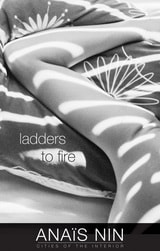
Ladders to Fire
Anaïs Nin
Ohio University Press, 2014
Anaïs Nin’s Ladders to Fire interweaves the stories of several women, each emotionally inhibited in her own way: through self-doubt, fear, guilt, moral drift, and distrust. The novel follows their inner struggles to overcome these barriers to happiness and wholeness. The author’s own experiences, as recorded in her famous diaries, supplied the raw material for her fiction. It was her intuitive, experimental, and always original style that transformed one into the other. Nin herself memorably claimed that “it was the fiction writer who edited the diary.”
Ladders to Fire is the first book of Nin’s continuous novel, Cities of the Interior, which also includes Children of the Albatross,The Four-Chambered Heart,A Spy in the House of Love, and Seduction of the Minotaur. These loosely interlinked stories develop the characters and themes established in the first volume, leading slowly toward a resolution of inner turmoil and conflict.
This Swallow Press reissue of Ladders to Fire includes a new introduction by Nin scholar Benjamin Franklin V, as well as Gunther Stuhlmann’s classic foreword to the 1995 edition.
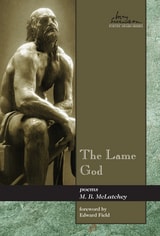
Lame God
M. B. McLatchey
Utah State University Press, 2013
In The Lame God, author M. B. McLatchey reminds us of the inevitable bond between art and empathy. With a controlled language that finds its echo chamber in the immortal themes and characters of classical literature, this courageous work accompanies the author on her journey through a parent’s anguish in the face of a horrific crime. Using the art of poetry she gives voice to a suffering—and a love—that might otherwise go unheard.
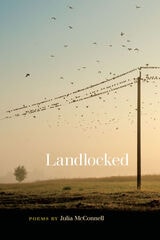
Landlocked
Julia McConnell
Michigan State University Press, 2023
Landscape with Bloodfeud
Wendy Barnes
University of Massachusetts Press, 2022
Landsickness
Leigh Lucas
Tupelo Press, 2024
Landsickness explores the inelegant progress of grief and pursues a relentless search for evidence of the beloved’s presence through the physics of splashes, the history of seasickness, and the science of depression. While full of tenderness, the poems employ humor and honesty to observe the ugliness of grief and the failure of elegy to restore the dead.
From the funeral to the office of her dead-end job to navigating the streets of New York, the speaker experiences a series of false starts as she learns to cope with her new life. Still, there is a real sense of progression in the collection’s end, even as the speaker continues to ask herself: “Why am I obsessed with the physics of his fall?"
Las Raras
Feminine Style, Intellectual Networks, and Women Writers during Spanish-American ModernismoSarah Moody
Vanderbilt University Press, 2024
Premio al Mejor Libro en Humanidades, Latin American Studies Association–Nineteenth-Century Section, 2025
Premio Victoria Urbano de Monografía Crítica, Association of Gender and Sexuality Studies, 2025 (co-winner)
Segundo Premio, Adela Zamudio Prize, Feministas Unidas, 2025
Las Raras proposes that the Modernistas’ advocacy for a writing style they considered feminine helps us to understand why so few (and perhaps no) women were accepted as active participants in Modernismo. Author Sarah Moody studies how particular writers contributed to the idea of a feminine aesthetic and tracks the intellectual networks of Modernismo through periodicals and personal papers, such as albums and correspondence. Buenos Aires, Paris, and Montevideo figure prominently in this transatlantic study, which reexamines some of the most important period writers in Spanish, including Rubén Darío, Amado Nervo, and Enrique Gómez Carrillo.
This book also considers the critiques launched by women writers, such as Aurora Cáceres, Clorinda Matto de Turner, and María Eugenia Vaz Ferreira, who experienced Modernista exclusion firsthand, deconstructed the Modernista discourse of a modern, “feminine” style, and built literary success in alternative terms. These writers reoriented the discussion about women in modernity to address women’s education, professionalization, and advocacy for social and civic improvements. In this study, Modernismo emerges as both a literary style and an intellectual network, in which style and sociability are mutually determining and combine to form a system of prestige and validation that excluded women writers.
Late Self-Portraits
Mary Morris
Michigan State University Press, 2022
From “Dinner with Hades”:
He shows me a birthday cake, candled. My name is written in pomegranate
seeds. It’s like vertigo. Just before he seeks to devour, he halts to birdsong—
sound of goldfinch, bluebird, hawk, lilting of sparrows. Of whippoorwill
and dove. Wings flap, so many wings, a cool breeze as leaves unfurl into a
once forgotten green and I am back on earth, held in my mother’s arms.
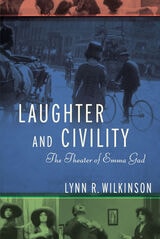
Laughter and Civility
The Theater of Emma GadLynn R. Wilkinson
University of Wisconsin Press, 2020
Laughter and Civility, the first biographical and scholarly volume to examine and contextualize her dramas, deeply explores how and why influential women are so often excluded from the canon. Lynn R. Wilkinson provides insightful readings into all twenty-five of Gad’s plays and demonstrates how writers and intellectuals of the time, including Georg and Edvard Brandes, took her critically acclaimed work seriously. This volume rightfully reinstates Emma Gad’s work into the repertory of European drama and is crucial for scholars interested in turn‐of‐the‐century Scandinavian drama, literature, culture, and politics.
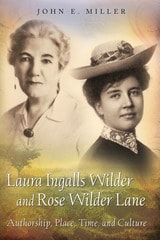
Laura Ingalls Wilder and Rose Wilder Lane
Authorship, Place, Time, and CultureJohn E. Miller
University of Missouri Press, 2008
Interpreting these writers in their larger historical and cultural contexts, Miller reconsiders their formidable artistic, political, and literary contributions to American cultural life in the 1930s. He looks at what was happening in 1932—from depression conditions and politics to chain stores and celebrity culture—to shed light on Wilder’s life, and he shows how actual “little houses” established ideas of home that resonated emotionally for both writers.
In considering each woman’s ties to history, Miller compares Wilder with Frederick Jackson Turner as a frontier mythmaker and examines Lane’s unpublished history of Missouri in the context of a contemporaneous project, Thomas Hart Benton’s famous Jefferson City mural. He also looks at Wilder’s Missouri Ruralist columns to assess her pre–Little House values and writing skills, and he readdresses her literary treatment of Native Americans. A final chapter shows how Wilder’s and Lane’s conservative political views found expression in their work, separating Lane’s more libertarian bent from Wilder’s focus on writing moralist children’s fiction.
These nine thoughtful essays expand the critical discussion on Wilder and Lane beyond the Little House. Miller portrays them as impassioned and dedicated writers who were deeply involved in the historical changes and political challenges of their times—and contends that questions over the books’ authorship do not do justice to either woman’s creative investment in the series. Miller demystifies the aura of nostalgia that often prevents modern readers from seeing Wilder as a real-life woman, and he depicts Lane as a kindred artistic spirit, helping readers better understand mother and daughter as both women and authors.
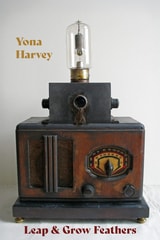
Leap & Grow Feathers
Yona Harvey
Four Way Books, 2026
Both an instruction and a divination, Leap & Grow Feathers is an extraordinary transmission. In her third full-length collection, Yona Harvey listens — to her predecessors, her instincts, and her environment — gleaning sense from the static fraying our nerves, knowing the personal and the historical travel along the same frequency. Responding to the physical disruption and emotional disassociation of of the COVID-19 pandemic, the poet argues that the societal insistence on returning to “business as usual” reflects an institutional, academic, and political ineptitude to provide either physiological healing or social repair, a structural denial that erodes our humanity. As authoritarianism and ecological devastation progressively encroach on our lives, these poems prioritize hoodoo, spirit, intuition, and ancestral conversations in their readings, invoking the carekeeping and persistence of Harriet Tubman, Nikki Giovanni, and the countless forbears, unnamed and named, who traveled the Middle Passage and the Kalunga Crossing. This book channels the power and promise of that legacy as well as the full emotional range of sisterhood, the heartache and borrowed strength and shared laughter. Its humor, whitespace, sparseness, and longform narratives elicit reader participation and, in turn, enduring consideration. "This float. This bob. This drown. This rock. // (This Rock. This Rock.) // This Great Goddamn." What do we find in this vastness, the simultaneity of the ever expanding time that lies ahead and full presence of history consolidating here now? An invitation to join Harvey in her vow: “May I never pretend, / May eye be I.” This collection unveils our vision so we can see it all, not only yesterday’s “Nina Simone lyric / Spun out over a newborn Sunday” in this very moment but also the music unfurling over each incipient morning of the future world we might build together. Leap & Grow Feathers describes and directs: everything we need to survive, to shelter one another, and to protect the Earth lives already in our bodies, our lineages, and our lore.
Leaving Tulsa
Jennifer Elise Foerster
University of Arizona Press, 2013
In her first magical collection of poetry, Jennifer Elise Foerster weaves together a mythic and geographic exploration of a woman’s coming of age in a dislocated time. Leaving Tulsa, a book of road elegies and laments, travels from Oklahoma to the edges of the American continent through landscapes at once stark and lush, ancient and apocalyptic. The imagery that cycles through the poems—fire, shell, highway, wing—gives the collection a rich lyrical-dramatic texture. Each poem builds on a theme of searching for a lost “self”—an “other” America—that crosses biblical, tribal, and ecological mythologies.
In Leaving Tulsa, Foerster is not afraid of the strange or of estrangement. The narrator occupies a space in between and navigates the offbeat experiences of a speaker that is of both Muscogee and European heritage. With bold images and candid language, Foerster challenges the perceptions of what it means to be Native, what it means to be a woman, and what it means to be an American today. Ultimately, these brave and luminous poems engage and shatter the boundaries of time, self, and continent.
Foerster’s journey transcends both geographic space and the confines of the page to live vividly in the mind of the reader.
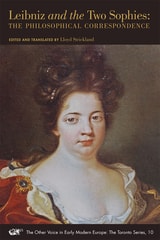
Leibniz and the Two Sophies
The Philosophical CorrespondenceGottfried Wilhelm Leibniz, Sophie Electress of Hanover, Queen Sophie Charlotte of Prussia
Iter Press, 2011

Lesbian Empire
Radical Crosswriting in the TwentiesGay Wachman
Rutgers University Press, 2001
Wachman places at the center of this tradition Sylvia Townsend Warner's achievement in undermining the inhibitions that faced women writing about forbidden love. She discusses Warner's use of crosswriting to transpose the otherwise unrepresentable lives of invisible lesbians into narratives about gay men, destabilizing the borders of race, class, and gender and challenging the codes of expression on which imperialist patriarchy and capitalism depended.
Let Me Tell You Where I've Been
New Writing by Women of the Iranian DiasporaPersis M. Karim
University of Arkansas Press, 2006
Let Them Tell You
New and Selected Short StoriesNancy Lord
University of Alaska Press, 2026
Nancy Lord, one of Alaska’s best-known writers, has been writing fiction and nonfiction in Alaska for more than fifty years. Let Them Tell You gathers selected stories from her three previous short fiction books, each first published in a different decade, alongside newer work, some published in journals and some unpublished until now.
Lord first wrote as a way to think about her life in Alaska when she was a young woman, and her curiosity took her farther afield with each book. Some stories draw on personal experience; others from newspaper headlines, historical events, and myths. Some respond to earlier writers and their literary works. Some are serious about social concerns and matters of justice; some are seriously funny. Animals and children, seekers and dreamers—in one case an entire community—all take turns as central characters. This collection traces Lord’s writerly influences and her concerns for both humankind and the natural world and suggests the ways writers and readers alike travel through time and imagined lives, learning as they go about cruelties, compassion, and the human heart. An introduction by the author and an afterword by scholar Eric Heyne supplement the stories with context about the writer’s journey and the evolution of Alaska literature.
Lord’s close observation of the natural world is a hallmark of her work, as is her attention to environmental themes and social issues. Let Them Tell You demonstrates the range of her talent for presenting not only variations on life in Alaska but the human condition on a larger and timeless scale.
Lethal Theater
Susannah Nevison
The Ohio State University Press, 2019
Reckons with the rituals of violence that underpin the American prison system, asking readers to consider the act and complications of looking at violence and suffering.
In Lethal Theater, Susannah Nevison offers a stark and lyrical reckoning with the hidden architectures of the American prison system. These poems inhabit the charged territory where medicine and punishment converge, revealing how the body becomes both patient and instrument under state control. Moving through histories of wartime confinement, interrogation, and isolation, Nevison writes a poetry of witness to the carceral state, illuminating what is so often kept from view.
With precision and moral force, Nevison examines the shadows cast by medical experimentation on imprisoned bodies, the blurred boundary between hospital anesthesia and the drugs used in lethal injection protocols, and the rituals of surveillance that shape life behind bars. This is a work rooted in the medical humanities of confinement, an inquiry into how suffering is recorded, observed, and, at times, rendered invisible.
Lethal Theater makes visible the brutal logics beneath state-sanctioned pain and insists on the urgency—and responsibility—of looking closely at what the nation asks its incarcerated to endure.
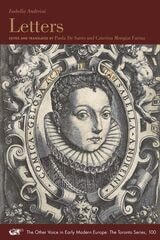
Letters
Isabella Andreini
Iter Press, 2023
Isabella Andreini (1562–1604) was a commedia dell’arte diva who toured Italy and France as part of the Compagnia dei Comici Gelosi. Letters is a collection of epistles written by Andreini in fictional, anonymous, male, and female voices, a “hermaphroditic” alternation of gender unlike any that had been seen in letter writing to that time. In her letters, Andreini remade the humanistic epistolary genre into a distinctive fusion of literary and dramatic performance. The guise of epistolary intimacy cedes to a knowing artificiality, which allows for the emergence of Andreini’s modern critique of the gendered self as a uniform entity. The collection centers on love and examines—from surprising perspectives—pertinent issues such as death, the birth of a girl, prostitution, patriarchal marital practices, love in old age, courtiership, country and city life, human nature, and defenses and critiques of both sexes.
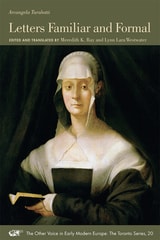
Letters Familiar and Formal
Arcangela Tarabotti
Iter Press, 2012
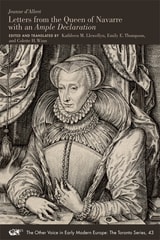
Letters from the Queen of Navarre with an Ample Declaration
Jeanne d’Albret
Iter Press, 2016
This edition presents in English, for the first time, Jeanne d’Albret’s Letters to the king, his mother, his brother, her own brother-in-law, and the queen of England, together with her Ample Declaration (1568) defending her decampment to the Protestant stronghold of La Rochelle. A historical-biographical introduction situates these writings in the larger context of Reformation politics and examines in detail the specific literary characteristics of her memoir. In her works, Jeanne d’Albret asserts her own position as legal sovereign of Béarn and Navarre and situates herself at the nexus of overlapping political, religious, and familial tensions.
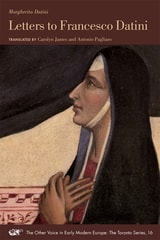
Letters to Francesco Datini
Margherita Datini
Iter Press, 2012
—Jane Tylus
Professor of Italian Studies and vice provost for academic affairs, New York University
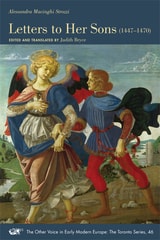
Letters to Her Sons, 1447–1470
Alessandra Macinghi Strozzi
Iter Press, 2016
The seventy-three surviving letters written by Florentine widow, Alessandra Macinghi Strozzi (c.1406–1471), to her distant sons first appeared in print well over a century ago, but are here translated into English in their entirety for the first time. Whether for the professional historian or for the general reader interested in Renaissance Florence, they constitute a most precious testimony regarding both private and public life in the mid-fifteenth century, with themes ranging from familial relations, motherhood, marriage, and aspects of material culture to the harsh realities of political exile meted out by the Medici to their perceived opponents, these latter including her husband and, subsequently, her sons.
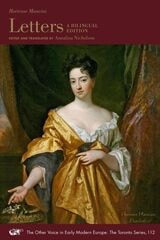
Letters
A Bilingual EditionHortense Mancini
Iter Press, 2025
During the seventeenth century, Hortense Mancini, Duchess of Mazarin (1646–99), became an icon of women’s emancipation. In 1668, she shocked Europe when she fled her coercive husband and began a nomadic exile. Her notoriety increased in 1675 with the publication of her memoir—one of the first to appear in French by a woman—and was later magnified by her stint as the royal mistress of Charles II of England and by her establishment of a freethinking salon in London. As a salonnière, an exile, and a litigant fighting for legal separation from her husband, Mancini’s letters were a means of connection, collusion, and survival as well as cultural collaboration. Collected and translated here for the first time, this correspondence charts her struggle for autonomy in her own words.
Lewd and Notorious
Female Transgression in the Eighteenth CenturyKatharine Kittredge, Editor
University of Michigan Press, 2003
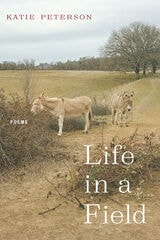
Life in a Field
PoemsKatie Peterson
Omnidawn, 2021
A lyric fable, Life in a Field intersperses Katie Peterson’s slow-moving, cinematic, and sensual writing with three folios of photographs by Young Suh. Introspection, wish, dream, and memory mark this tale, which is set in a location resembling twenty-first-century California—with vistas and orchards threatened by drought and fires. This is also a place of enchantment, a fairy-tale landscape where humans and animals live as equals. As the girl and the donkey grow up, they respond to the difficulties of contemporary civilization, asking a question that meets our existential moment: What do you do with the story you didn’t wish for? A narrator’s voice combines candor with distance, attempting to find a path through our familiar strife, toward a future that feels all but impossible, and into what remains of beauty and pleasure. Life in a Field tries to reverse our accelerating destruction of the natural world, reminding us of “the cold clarity we need to continue on this earth.”
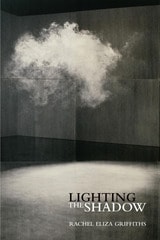
Lighting the Shadow
Rachel Eliza Griffiths
Four Way Books, 2015
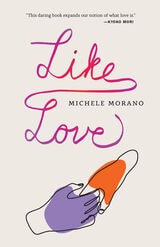
Like Love
Michele Morano
The Ohio State University Press, 2020
Crushes. Infatuations. Attractions. Unexpected, inexplicable allure. Entanglements steeped in taboo and disruption. In Like Love, nothing is off limits.
In these remarkable essays, Michele Morano explores the pleasures, possibilities, strangeness, and lessons of unconsummated romance. With insight and imagination, Like Love interweaves poignant, humorous episodes from adulthood with the backstory of a young family’s turbulent breakup. When Morano was an adolescent in blue-collar Poughkeepsie, New York, her mother left her father for a woman in an era when LGBTQ parents were widely viewed as “unfit.” Through the turmoil, adolescent Morano paid attention, tucking away the stories that were shaping her and guiding her understanding of love.
Turning romantic clichés inside out and challenging us to rethink our notions about what it means to love, Like Love tells hard and necessary truths about the importance of desire in growing, traveling, mourning, parenting, and figuring out who you are in the world. With precision and depth, Morano explores what it means to find ourselves in relationships that are not quite—but almost—like love.
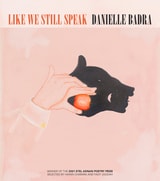
Like We Still Speak
Danielle Badra
University of Arkansas Press, 2021
Conversation and memory are at the heart of Danielle Badra’s Like We Still Speak, winner of the 2021 Etel Adnan Poetry Prize. In her elegiac and formally inventive debut, Badra carries on talking with the sister and father she has lost, often setting her words alongside theirs and others’ in polyphonic poems that can be read in multiple directions. Badra invites the reader to engage in this communal space where she investigates inheritance, witnessing, intimacy, and survival.
“This is a deeply spiritual book, all the more so because of its clarity and humility. Yet, we cannot walk away from the addictive command that so many of these poems ask us to follow: to read them along plural paths whose order changes while their immeasurable spirit remains unbound. Each poem is a singular vessel—of narratives, embodiments that correspond with memories, memories that recollect passion. . . . Like We Still Speak is a sanctum. Inside it, we are enthralled by beauty, consoled by light, sustained by making.”
—Fady Joudah and Hayan Charara, from the Preface
Literary Identification from Charlotte Brontë to Tsitsi Dangarembga
Laura Green
The Ohio State University Press, 2012
Literary Sisters
Dorothy West and Her Circle, A Biography of the Harlem RenaissanceMitchell, Verner D
Rutgers University Press, 2012
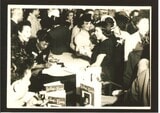
Harlem Renaissance writer Dorothy West led a charmed life in many respects. Born into a distinguished Boston family, she appeared in Gershwin’s Porgy and Bess, then lived in the Soviet Union with a group that included Langston Hughes, to whom she proposed marriage. She later became friends with Jacqueline Kennedy Onassis, who encouraged her to finish her second novel, The Wedding, which became the octogenarian author’s first bestseller.
Literary Sisters reveals a different side of West’s personal and professional lives—her struggles for recognition outside of the traditional literary establishment, and her collaborations with talented African American women writers, artists, and performers who faced these same problems. West and her “literary sisters”—women like Zora Neale Hurston and West’s cousin, poet Helene Johnson—created an emotional support network that also aided in promoting, publishing, and performing their respective works. Integrating rare photos, letters, and archival materials from West’s life, Literary Sisters is not only a groundbreaking biography of an increasingly important author but also a vivid portrait of a pivotal moment for African American women in the arts.
Little Sound
Katherine Gibbel
University of Chicago Press, 2026
Attentive to echo and resonance, this debut collection ranges across and makes connections among natural, musical, and literary histories.
The title for Katherine Gibbel’s debut collection plays with the etymology of the sonnet, or sonnetto in Italian: a little song or little sound. Exploring the possibility of words and the limits inherent in both language and form, Little Sound asks its reader, “Did you hear that?” and tunes in to what echoes when we listen.
Divided into three long poems, Little Sound explores language, gossip, reading practices, love, and death, tracing webs of meaning across a range of seemingly disparate topics. Gibbel’s speaker interrogates partial histories and turns them into meditations on the literary, the natural, and the personal, including the subdivided memorial prairies of the Midwest, family history, pipe organs, and medieval theology. Associative, funny, curious, bell-like, and elaborately architectural, Gibbel’s poems offer a study in emotional nuance, knowing winks, and sonic attentiveness.
Lives in Play
Autobiography and Biography on the Feminist StageRyan Claycomb
University of Michigan Press, 2014
Lives in Play explores the centrality of life narratives to women's drama and performance from the 1970s to the present moment. In the early days of second-wave feminism, the slogan was "The personal is the political." These autobiographical and biographical "true stories" have the political impact of the real and have also helped a range of feminists tease out the more complicated aspects of gender, sex, and sexuality in a Western culture that now imagines itself to be "postfeminist."
The book covers a broad range of texts and performances, from performance artists like Karen Finley, Holly Hughes, and Bobby Baker to playwrights like Suzan-Lori Parks, Maria Irene Fornes, and Sarah Kane. The book examines biography and autobiography together to link their narrative tactics and theatrical approaches and show the persistent and important uses of life writing strategies for theater artists committed to advancing women's rights and remaking women's representations.
Lives in Play argues that these writers and artists have not only responded to the vibrant conversations in feminist theory but also have anticipated and advanced these ideas, theorizing gender onstage for specific ends. Ryan Claycomb demonstrates how these performances work through tensions between performative identity and the essentialized body, between the truth value of life stories and the constructed nature of gender and narrative alike, and between writing and performing as modes of feminist representation.
The book will appeal to scholars in performance studies, women's studies, and literature, including those in the growing field of auto/biography studies.
Lizzie Borden in Love
Poems in Women's VoicesJulianna Baggott
Southern Illinois University Press, 2006
Women’s voices offering an intimate view into women’s lives
Lizzie Borden in Love, a collection of poems by national bestselling author Julianna Baggott, offers poignant commentary in the voices of women as varied as Mary Todd Lincoln and Monica Lewinsky. The poems often focus on a particular moment in life: Katherine Hepburn discovers the dead body of her brother in an attic, or painter Mary Cassatt mourns the failure of her eyesight. Sometimes heartbreaking, sometimes ecstatic, the poems in this collection never fail the trust of the subjects of their intimate portrayals
Loner Forensics
PoemsThea Brown
Northwestern University Press, 2023
In Loner Forensics, Thea Brown dreams up and dissects a city beset by unexplained disappearances, roving silences, and climate collapse. This sprawling collection comprises a series of interviews with denizens of the shifting city, each mediated through the lonely lens of the Detective, a character whose refractive investigation atomizes the scene. As much a study of complicity as a critique of capitalism’s distortive effects on human emotional response, Loner Forensics questions what happens when our innermost terrains become newly unfamiliar in an unraveling natural world.
Dark, fractured, and canny, Brown’s shimmering third collection draws on parallel universes, 1980s video games, social media pop-speak, and ghost towns to immerse the reader in grief, utopia, disaster—and, ultimately, love.

Lost Property
The Woman Writer and English Literary History, 1380-1589Jennifer Summit
University of Chicago Press, 2000
Lost Property traces the representation of women writers from Margery Kempe and Christine de Pizan to Elizabeth I and Mary Queen of Scots, exploring how the woman writer became a focal point for emerging theories of literature and authorship in English precisely because of her perceived alienation from tradition. Through original archival research and readings of key literary texts, Summit writes a new history of the woman writer that reflects the impact of such developments as the introduction of printing, the Reformation, and the rise of the English court as a literary center.
A major rethinking of the place of women writers in the histories of books, authorship, and canon-formation, Lost Property demonstrates that, rather than being an unimaginable anomaly, the idea of the woman writer played a key role in the invention of English literature.
Lotería
Nocturnal SweepstakesElizabeth Torres
University of Arizona Press, 2023
The vision begins with a river. From this river, you can see a village, marine life, and ancestral rituals. It is here that you recognize origins, and a poison beginning to spread through paradise. Suddenly, a premonition: a wounded animal. The certainty of war cries. What you take with you is what you become, each movement a gamble, a lottery of life that transforms you until this moment, when uncertainty becomes an ally.
Lotería: Nocturnal Sweepstakes is a collection of deeply evocative coming-of-age poems that take the reader on a voyage through the intimate experiences of displacement. Conjuring dreamlike visions of extravagant fruits and rivers animated by the power of divination, these poems follow the speaker from the lash of war’s arrival through an urgent escape and reinvention in a land that saves with maternal instinct but also smothers its children.
In this bilingual collection, Colombian American poet Elizabeth Torres threads together the stories of family dynamics and the realities of migration with the archetypes of tarot and the traditional Lotería game, used for centuries as an object of divination and entertainment. Through these themes and images, the poems in Lotería narrate intimate moments in the lives and journeys of migrants, refugees, and all who have been forced into metamorphosis in order to reach the other side of the river.
Winner of the 2022 Ambroggio Prize of the Academy of American Poets, this collection showcases masterfully crafted and translated poems.
Louise Erdrich's Justice Trilogy
Cultural and Critical ContextsConnie A. Jacobs
Michigan State University Press, 2021
Love Enamored and Driven Mad
Lucrezia Marinella
Iter Press, 2020
The Other Voice in Early Modern Europe - The Toronto Series, volume 72

Love Letter To Who Owns The Heavens
Corey Van Landingham
Tupelo Press, 2021
“What love poem / could be written when men can no longer / look up?” this book asks, always in a state of flux between doubt and belief—in wars, in gods, in fathers, in love. Through epistolary addresses to these figures of power and others, these poems attempt to make bodies concrete and dangerous, immediate and addressable, once again.
Love, Like Pronouns
Rosmarie Waldrop
Omnidawn, 2003
Love’s Long Line
Sophfronia Scott
The Ohio State University Press, 2018
Sophfronia Scott turns an unflinching eye on her life to deliver a poignant collection of essays ruminating on faith, motherhood, race, and the search for meaningful connection in an increasingly disconnected world.
In Love’s Long Line, Scott contemplates what her son taught her about grief after the shootings at his school, Sandy Hook Elementary; how a walk with Lena Horne became a remembrance of love for Scott’s illiterate and difficult steelworker father; the unexpected heartache of being a substitute school bus driver; and the satisfying fantasy of paying off a mortgage. Scott’s road is also a spiritual journey ignited by an exploration of her first name, the wonder of her physical being, and coming to understand why her soul must dance like Saturday Night Fever’s Tony Manero.
Inspired by Annie Dillard’s observation in Holy the Firm that we all “reel out love’s long line alone . . . like a live wire loosed in space to longing and grief everlasting,” Scott’s essays acknowledge the loneliness, longing, and grief exacted by a fearless engagement with the everyday world. But she shows that by holding the line, there is an abundance of joy and forgiveness and grace to be had as well.
Lucrece and Brutus
Glory in the Land of TenderMadeleine de Scudéry
Iter Press, 2021
Comprising texts by Madeleine de Scudéry, including many from her novel Clélie, this volume focuses on the story of Lucretia, the Roman matron whose rape and suicide led to the downfall of the Roman monarchy. Through her work, Scudéry seeks to contrast the enormous cultural contributions of women with their physical vulnerability and to propose an alternative to sexual violation, as envisioned on the Map of the Land of Tender that charts an imaginary land in the novel and outlines a path toward love. In Scudéry’s version of this tale, Lucrece and her beloved, Brutus, follow the path of tender friendship. Scudéry contradicts history’s characterization of Lucrece as craving glory in the form of fame. Indeed, contrary to ancient sources, Lucrece’s glory will be her decision to sacrifice herself secretly for her tender friend.
Luminaries of the Humble
Elizabeth Woody
University of Arizona Press, 1994
In opening remarks, Woody shares anecdotes of her youth that contributed to her sense of personal history and her development as a poet. "The petroglyphs on rock in the Columbia River Gorge are part of my literary heritage," she writes. Now through the medium of the printed word, Luminaries of the Humble marks an important continuation of that tradition.
Luminous Blue Variables
and Other Major PoemsMichelle Boisseau
BkMk Press, 2021

Lunacy of Light
Emily Dickinson and the Experience of MetaphorWendy Barker
Southern Illinois University Press, 0
"Are you afraid of the sun?" Emily Dickinson asked a friend in 1859.
Wendy Barker states here that that apparently casual query reveals a major theme of Dickinson’s poetry, a theme she shares with women writers ranging from Anne Finch to Anne Sexton. It is a tradition based upon the inversion of the traditional male-centered metaphors of light and dark. Through time the light-giving sun has represented vitality, order, God; the light-swallowing night death, chaos, Satan. These metaphors are reinforced in the writing of Emerson, Thoreau, Hawthorne, and Keats,but Eliot, Brontë, Browning, and Dickinson use the sun and images of light quite differently.
Barker argues that since light was a masculine tradition, ithad come to represent male power, energy, sexuality—not only to Dickinson but to other women writing during the era. To these writers the inversion of the light/darkness metaphor became a countertradition used as a means to express their energies in a society that was hostile to their intelligence. Dickinson, who read avidly, could not have been insensitive to this usage of light as a masculine symbol—of her Calvinist God, of her father, of all that was male—and of darkness as a feminine symbol.
Emily Dickinson thought in a richly symbolic manner. Her most frequently used metaphor is one of light in contrast to darkness, employing single-word references to light more than one thousand times in her 1,775 poems. Barker offers close readings and new interpretations of some previously overlooked or misunderstood poems and demonstrates that "Many of her most ecstatic images are oflittle lights created from darkness." Inanswer to those critics who have characterized her poems as being piecemeal, Barker argues that Dickinson’s consistent use of light as a metaphor unifies her poetry.
In her final chapter, Barker explores the ways in which twentieth-century female writers have carried on the countertradition of the light/darkness metaphor. "That Dickinson was able so brilliantly to transform and transcend the normative metaphoric patterning of her culture, creating, in effect, a metaphor of her own, has much to do with the genius of her art."
Lyric Interventions
Feminism, Experimental Poetry, DiscourseLinda A. Kinnahan
University of Iowa Press, 1998
Lyric Interventions explores linguistically innovative poetry by contemporary women in North America and Britain whose experiments give rise to fresh feminist readings of the lyric subject. The works discussed by Linda Kinnahan explore the lyric subject in relation to the social: an “I” as a product of social discourse and as a conduit for change.
Contributing to discussions of language-oriented poetries through its focus on women writers and feminist perspectives, this study of lyric experimentation brings attention to the cultural contexts of nation, gender, and race as they significantly shift the terms by which the “experimental” is produced, defined, and understood.
This study focuses upon lyric intervention in distinct but related spheres as they link public and ideological norms of identity. Firstly, lyric innovations with visual and spatial realms of cultural practice and meaning, particularly as they naturalize ideologies of gender and race in North America and the post-colonial legacies of the Caribbean, are investigated in the works of Barbara Guest, Kathleen Fraser, Erica Hunt, and M. Nourbese Philip. Secondly, experimental engagements with nationalist rhetorics of identity, marking the works of Carol Ann Duffy, Denise Riley, Wendy Mulford, and Geraldine Monk, are explored in relation to contemporary evocations of “self” in Britain. And thirdly, in discussions of all of the poets, but particularly accenuated in regard to Guest, Fraser, Riley, Mulford, and Monk, formal experimentation with the lyric “I” is considered through gendered encounters with critical and avant-garde discourses of poetics.
This fresh, energetic study will be of great interest to literary critics and womens studies scholars, as well as poets on both sides of the Atlantic.