Results by title
104 books match the query 'Writings' and 10 start with l
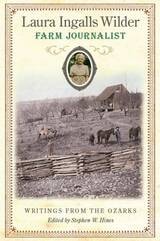
Laura Ingalls Wilder, Farm Journalist
Writings from the OzarksEdited by Stephen W. Hines
University of Missouri Press, 2007
Before Laura Ingalls Wilder found fame with her Little House books, she made a name for herself with short nonfiction pieces in magazines and newspapers. Read today, these pieces offer insight into her development as a writer and depict farm life in the Ozarks—and also show us a different Laura Ingalls Wilder from the woman we have come to know.
This volume collects essays by Wilder that originally appeared in the Missouri Ruralist between 1911 and 1924. Building on the initial compilation of these articles under the title Little House in the Ozarks, this revised edition marks a more comprehensive collection by adding forty-two additional Ruralist articles and restoring passages previously omitted from other articles.
Writing as “Mrs. A. J. Wilder” about modern life in the early twentieth-century Ozarks, Laura lends her advice to women of her generation on such timeless issues as how to be an equal partner with their husbands, how to support the new freedoms they’d won with the right to vote, and how to maintain important family values in their changing world. Yet she also discusses such practical matters as how to raise chickens, save time on household tasks, and set aside time to relax now and then.
New articles in this edition include “Making the Best of Things,” “Economy in Egg Production,” and “Spic, Span, and Beauty.” “Magic in Plain Foods” reflects her cosmopolitanism and willingness to take advantage of new technologies, while “San Marino Is Small but Mighty” reveals her social-political philosophy and her interest in cooperation and community as well as in individualism and freedom. Mrs. Wilder was firmly committed to living in the present while finding much strength in the values of her past.
A substantial introduction by Stephen W. Hines places the essays in their biographical and historical context, showing how these pieces present Wilder’s unique perspective on life and politics during the World War I era while commenting on the challenges of surviving and thriving in the rustic Ozark hill country. The former little girl from the little house was entering a new world and wrestling with such issues as motor cars and new “labor-saving” devices, but she still knew how to build a model small farm and how to get the most out of a dollar.
Together, these essays lend more insight into Wilder than do even her novels and show that, while technology may have improved since she wrote them, the key to the good life hasn’t changed much in almost a century. Laura Ingalls Wilder, Farm Journalist distills the essence of her pioneer heritage and will delight fans of her later work as it sheds new light on a vanished era.
Leaving Art
Writings on Performance, Politics, and Publics, 1974-2007Suzanne Lacy
Duke University Press, 2010
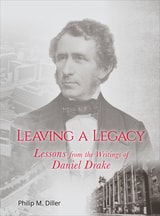
Leaving a Legacy
Lessons from the Writings of Daniel DrakePhilip Diller
University of Minnesota Press, 2019
Leaving a Legacy: Lessons from the Writings of Daniel Drake is a selective collection of excerpts from the vast writings from the nineteenth-century doctor and medical pioneer Daniel Drake. From Drake’s life, documented here in his own words from excerpts of lectures, personal journal entries, presentations, speeches, books, and letters to his children, readers learn about the scope of his accomplishments in medicine, contributions to his community, and dedication to his family. Diller goes beyond biography to contextualize Drake’s life choices and what made him a role model for today’s physicians. Diller selected one hundred and eighty thematically arranged excerpts, which he paired with original reflection questions to guide the reader through thought-provoking prompts. In doing so, Diller presents the lessons from Drake’s remarkable life and work as a guide for others who wish to build an enduring legacy.

Leon Trotsky
Writings in ExileLeon Trotsky
Pluto Press, 2012
Leon Trotsky was a key political figure of the twentieth century – a leader of the Russian Revolution, founder of the Red Army, author of books on literature, history, morality and politics.
Leon Trotsky: Writings in Exile contains some of his most insightful and penetrating works. Exiled and isolated by Stalin, Trotsky used the only weapon he had left – words. In these writings he defends the 1917 revolution, warns prophetically of fascism and analyses anti-colonial movements in the global south.
This collection gives a sense of the real Trotsky – passionate, humanist, Marxist. It will introduce the writings of one of history's great revolutionaries to a new generation.
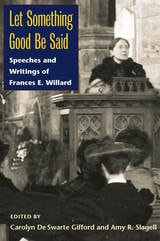
Let Something Good Be Said
Speeches and Writings of Frances E. WillardFrances E. Willard. Edited by Carolyn De Swarte Gifford and Amy R. Slagell
University of Illinois Press, 2007
Celebrated as the most famous woman in America at the time of her death in 1898, Frances E. Willard was a leading nineteenth-century American temperance and women's rights reformer and a powerful orator. President of Evanston College for Ladies (before it merged with Northwestern University) and then professor of rhetoric and aesthetics and the first dean of women at Northwestern, Willard is best known for leading the Woman's Christian Temperance Union (WCTU), America's largest women's organization. The WCTU shaped both domestic and international opinion on major political, economic, and social reform issues, including temperance, women's rights, and the rising labor movement. In what Willard regarded as her most important and far-reaching reform, she championed a new ideal of a powerful, independent womanhood and encouraged women to become active agents of social change. Willard's reputation as a powerful reformer reached its height with her election as president of the National Council of Women in 1888.
This definitive collection follows Willard's public reform career, providing primary documents as well as the historical context necessary to clearly demonstrate her skill as a speaker and writer who addressed audiences as diverse as political conventions, national women's organizations, teen girls, state legislators, church groups, and temperance advocates. Including Willard's representative speeches and published writings on everything from temperance and women's rights to the new labor movement and Christian socialism, Let Something Good Be Said is the first volume to collect the messages of one of America's most important social reformers who inspired a generation of women to activism.
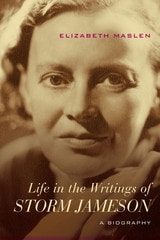
Life in the Writings of Storm Jameson
A BiographyElizabeth Maslen
Northwestern University Press, 2014
Margaret Storm Jameson (1891–1986) is primarily known as a compelling essayist; her stature as a novelist and champion of the dispossessed is largely forgotten. In Life in the Writings of Storm Jameson, Elizabeth Maslen reveals a figure who held her own beside fellow British women writers, including Virginia Woolf; anticipated the Angry Young Women, such as Doris Lessing; and was an early champion of such European writers as Arthur Koestler and Czesław Miłosz. Jameson was a complex character whose politics were grounded in social justice; she was passionately antifascist—her novel In the Second Year (1936) raised the alarm about Nazism—but always wary of communism. An eloquent polemicist, Jameson was, as president of the British P.E.N. during the 1930s and 1940s, of invaluable assistance to refugee writers. Elizabeth Maslen’s biography introduces a true twentieth century hedgehog, whose essays and subtly experimental fiction were admired in Europe and the States.
Literary Nevada
Writings from the Silver StateCheryll Glotfelty
University of Nevada Press, 2008

Logic and Sin in the Writings of Ludwig Wittgenstein
Philip R. Shields
University of Chicago Press, 1992
"Shields argues that the appearance throughout Wittgenstein's writings of such concepts as ritual, limit, transgression, a change of will, pride, temptation, and judgment implies a relation between religion and the logical aspects of Wittgenstein's philosophy."—Choice
"Of the many recent books about Wittgenstein, Logic and Sin is one of the very few that are well worth having"—Fergus Kerr, Modern Theology
"What Shields has uncovered in Wittgenstein's religious sensibility is something genuine and profound. . . . Shields has not just written an important book on Wittgenstein but an enlightening work that invites further reflection."—Eric O. Springsted, Cross Currents
Looking North
Writings from Spanish America on the US, 1800 to the PresentEdited by John J. Hassett and Braulio Muñoz
University of Arizona Press, 2012
Given recent changes in politics and demographics, Latin America and the United States are becoming increasingly important to one another. Recognition of the two regions' differences and similarities may facilitate a more fruitful relationship, with increased respect and understanding.
It is with this in mind that editors John J. Hassett and Braulio Muñoz present a collection of writings that provides a look into the ways in which Spanish America has viewed its northern neighbor over the past two centuries. Gathered here are pieces by well-known figures from the worlds of Spanish American politics, history, philosophy, creative writing, and culture—names like Mario Vargas Llosa, Gabriel Garcia Marquez and Pablo Neruda.
Divided into three sections, Looking North begins by underscoring the cultural and political differences between the two Americas. It opens with a speech by Simón Bolívar to the Venezuelan Congress in 1819 and closes with an essay by Mario Vargas Llosa from 2006 on the controversial wall being constructed between the United States and Mexico. The second section explores the experiences of Spanish American travelers in the US, beginning with an account of former Argentine president Domingo Sarmiento's fascination with the United States during his travels in 1847 and ending with a 2008 essay by Vargas Llosa on the city of New York. The final section encompasses creative writing and commentaries by some of Spanish America's most gifted poets and novelists. It opens with Rubén Darío's "To Roosevelt" from 1905 and ends with Christine Granados's humorous and profound short story "Inner View," first published in 2006.
Touching on history, sociology, politics, and religion, the writings assembled here will be of interest to humanists, social scientists, and anyone intrigued by the ever-growing connection between the United Sates and Spanish America at all levels.
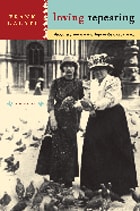
Loving Repeating
A Musical Adapted from the Writings of Gertrude SteinFrank Galati
Northwestern University Press, 2009