Results by title
18284 books match the query 'United States' and 698 start with l

Lizards on the Mantel, Burros at the Door
A Big Bend MemoirBy Etta Koch with June Cooper Price
University of Texas Press, 1999
A woman who went West with her husband in the 1840s must have expected hardships and privation, but during the 1940s, when Etta Koch stopped off in Big Bend with her young family and a 23-foot travel trailer in tow, she anticipated no more than a civilized camping trip between her old home in Ohio and a new one in Arizona. It was only when she found herself moving into an old rock house without plumbing or electricity in the new Big Bend National Park that Etta realized, "From the sheltered life of a city girl of moderate circumstances, I too would have to face the reality of frontier living."
In this book based on her journals and letters, Etta Koch and her daughter June Cooper Price chronicle their family's first years (1944-1946) in the Big Bend. Etta describes how her photographer husband Peter Koch became captivated by the region as a place for natural history filmmaking-and how she and their three young daughters slowly adapted to a pioneer lifestyle during his months' long absences on the photo-lecture circuit. In vivid, often humorous anecdotes, she describes making the rock house into a home, getting to know the Park Service personnel and other neighbors, coping with the local wildlife, and, most of all, learning to love the rugged landscape and the hardy individuals who call it home.
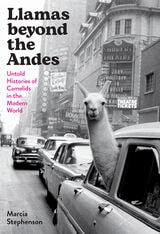
Llamas beyond the Andes
Untold Histories of Camelids in the Modern WorldMarcia Stephenson
University of Texas Press, 2023
Camelids are vital to the cultures and economies of the Andes. The animals have also been at the heart of ecological and social catastrophe: Europeans overhunted wild vicuña and guanaco and imposed husbandry and breeding practices that decimated llama and alpaca flocks that had been successfully tended by Indigenous peoples for generations. Yet the colonial encounter with these animals was not limited to the New World. Llamas beyond the Andes tells the five-hundred-year history of animals removed from their native habitats and transported overseas.
Initially Europeans prized camelids for the bezoar stones found in their guts: boluses of ingested matter that were thought to have curative powers. Then the animals themselves were shipped abroad as exotica. As Europeans and US Americans came to recognize the economic value of camelids, new questions emerged: What would these novel sources of protein and fiber mean for the sheep industry? And how best to cultivate herds? Andeans had the expertise, but knowledge sharing was rarely easy. Marcia Stephenson explores the myriad scientific, commercial, and cultural interests that have attended camelids globally, making these animals a critical meeting point for diverse groups from the North and South.
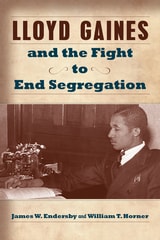
Lloyd Gaines and the Fight to End Segregation
James W. Endersby and William T. Horner
University of Missouri Press, 2016
Winner, 2017 Missouri Conference on History Book Award
In 1936, Lloyd Gaines’s application to the University of Missouri law school was denied based on his race. Gaines and the NAACP challenged the university’s decision. Missouri ex rel. Gaines v. Canada (1938) was the first in a long line of decisions by the U.S. Supreme Court regarding race, higher education, and equal opportunity. The court case drew national headlines, and the NAACP moved Gaines to Chicago after he received death threats. Before he could attend law school, he vanished.
This is the first book to focus entirely on the Gaines case and the vital role played by the NAACP and its lawyers—including Charles Houston, known as “the man who killed Jim Crow”—who advanced a concerted strategy to produce political change. Horner and Endersby also discuss the African American newspaper journalists and editors who mobilized popular support for the NAACP’s strategy. This book uncovers an important step toward the broad acceptance of racial segregation as inherently unequal.
This is the inaugural volume in the series Studies in Constitutional Democracy, edited by Justin Dyer and Jeffrey Pasley of the Kinder Institute on Constitutional Democracy.
Lobbying and Policy Change
Who Wins, Who Loses, and WhyFrank R. Baumgartner, Jeffrey M. Berry, Marie Hojnacki, David C. Kimball, and Beth L. Leech
University of Chicago Press, 2009
During the 2008 election season, politicians from both sides of the aisle promised to rid government of lobbyists’ undue influence. For the authors of Lobbying and Policy Change, the most extensive study ever done on the topic, these promises ring hollow—not because politicians fail to keep them but because lobbies are far less influential than political rhetoric suggests.
Based on a comprehensive examination of ninety-eight issues, this volume demonstrates that sixty percent of recent lobbying campaigns failed to change policy despite millions of dollars spent trying. Why? The authors find that resources explain less than five percent of the difference between successful and unsuccessful efforts. Moreover, they show, these attempts must overcome an entrenched Washington system with a tremendous bias in favor of the status quo.
Though elected officials and existing policies carry more weight, lobbies have an impact too, and when advocates for a given issue finally succeed, policy tends to change significantly. The authors argue, however, that the lobbying community so strongly reflects elite interests that it will not fundamentally alter the balance of power unless its makeup shifts dramatically in favor of average Americans’ concerns.
Lobbying for Higher Education
How Colleges and Universities Influence Federal PolicyConstance Ewing Cook
Vanderbilt University Press, 1998
Lobbying for Higher Education is about how the major higher education associations and the constituent American colleges and universities try to influence federal policy, especially congressional policy. In clear prose Cook explains how the higher education community organizes itself in Washington, how it lobbies, and how its major interest groups are perceived both by their own members and by public officials. The book focuses on the crucial development in 1995-1996 of a new lobbying paradigm, which included the greater use of campus-based resources and ad hoc coalitions. The most engrossing part of its story is higher education's creative response to the policy turmoil and disruption of the status quo that resulted from the shift in congressional party control.
The author, Constance Cook, uses sources unique to this project: over 1,500 survey responses from college and university presidents (a 62% return rate) and nearly 150 interviews with institutional and association leaders. Fortuitously, the 1994 electoral upheaval provided her with an opportunity to capture, analyze, and interpret the responses of her subjects in a period of unusually sweeping change.
Lobbying for Higher Education is a timely book with an interesting and important story at its core.
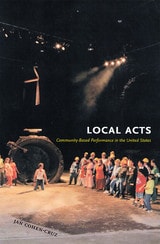
Local Acts
Community-Based Performance in the United StatesCohen-Cruz, Jan
Rutgers University Press, 2005
An eclectic mix of art, theatre, dance, politics, experimentation, and ritual,community-based performance has become an increasingly popular art movement in the United States. Forged by the collaborative efforts of professional artists and local residents, this unique field brings performance together with a range of political, cultural, and social projects, such as community-organizing, cultural self-representation, and education. Local Acts presents a long-overdue survey of community-based performance from its early roots, through its flourishing during the politically-turbulent 1960s, to present-day popular culture. Drawing on nine case studies, including groups such as the African American Junebug Productions, the Appalachian Roadside Theater, and the Puerto Rican Teatro Pregones, Jan Cohen-Cruz provides detailed descriptions of performances and processes, first-person stories, and analysis. She shows how the ritual side of these endeavors reinforces a sense of community identification while the aesthetic side enables local residents to transgress cultural norms, to question group habits, and to incorporate a level of craft that makes the work accessible to individuals beyond any one community. The book concludes by exploring how community-based performance transcends even national boundaries, connecting the local United States with international theater and cultural movements.

Local History Reference Collections for Public Libraries
Kathy Marquis
American Library Association, 2015
Local Interests
Politics, Policy, and Interest Groups in US City GovernmentsSarah F. Anzia
University of Chicago Press, 2022
Local politics in the United States once seemed tranquil compared to the divisiveness and dysfunction of the country’s national politics. Those days have passed. As multiple wide-ranging crises have thrust America’s local governments into the spotlight, they have also exposed policy failures and systemic problems that have mounted for years. While issues such as policing and the cost of housing are debated nationally, much of the policymaking surrounding these issues occurs locally. In Local Interests, Sarah F. Anzia explores how local governments—and the interest groups that try to influence them—create the policies that drive the national conversation: policing, economic development, housing, and challenges of taxing and spending.
Anzia examines local interest groups in terms of the specific policies they pursue, including how these groups get active in politics and what impact they have. By offering new perspectives on these issues, Anzia contributes to our knowledge of how interest groups function and the significant role they play in shaping broader social outcomes.
Local Justice in America
Jon Elster
Russell Sage Foundation, 1995
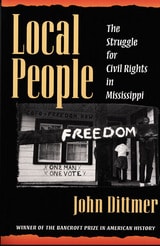
Local People
The Struggle for Civil Rights in MississippiJohn Dittmer
University of Illinois Press, 1994
Publication of this book was supported by a grant from DePauw University, Greencastle, Indiana.
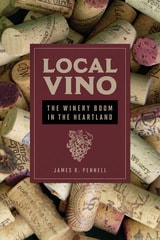
Local Vino
The Winery Boom in the HeartlandJames R. Pennell
University of Illinois Press, 2016
In Local Vino, James R. Pennell tracks among the hardy vines and heartland terroir of wineries across Illinois, Iowa, Indiana, and Ohio. Blending history and observation, Pennell gives us a top-down view of the business from cuttings and cultivation to sales and marketing. He also invites entrepreneurs to share stories of their ambitions, hard work, and strategies. Together, author and subjects trace the hows and whys of progress toward that noblest of goals: a great vintage that puts their winery on the map.
Locating Filipino Americans
Rick Bonus
Temple University Press, 2000
Locating Filipino Americans, an ethnographic study of Filipino American communities in Los Angeles and San Diego, present a multi-disciplinary cultural analysis of the relationship between ethnic identity and social space. Author Rick Bonus argues that alternative community spaces enable Filipino Americans to respond to and resist the ways in which the larger society has historically and institutionally rendered them invisible, silenced, and racialized. Bonus focuses on the "Oriental" stores, the social halls and community centers, and the community newspapers to demonstrate how ethnic identities are publicly constituted and communities are transformed. Delineating the spaces formed by diasporic consciousness, Bonus shows how community members appropriate elements from their former homeland and from their new settlements in ways defined by their critical stances against racism, homogenization, complete assimilation, and exclusionary citizenship. Locating Filipino Americans is one of the few books that offers a grounded approach to theoretical analyses of ethnicity and contemporary culture in the U.S.
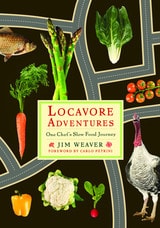
Locavore Adventures
One Chef's Slow Food JourneyWeaver, Jim
Rutgers University Press, 2012
America’s fast food culture reflects not only what we eat—foods that are processed and packaged for convenience—but also how we eat—munching as we multitask and not really tasting the super-sized meals we ingest. But in recent years, a more thoughtful philosophy about food has emerged. Developed in Italy, where fresh ingredients and artisanal techniques are prized, the Slow Food movement has rapidly gained a following in North America. The skeptics among us might wonder if it is possible truly to enjoy a Slow Food lifestyle—one based around local, seasonal ingredients—in our fast-paced world.
In Locavore Adventures, acclaimed New Jersey chef and restaurateur Jim Weaver shares his personal story of how he came to solve this problem—building a local slow food culture that is ecologically responsible and also yields delicious results. Weaver tells of his odyssey founding the Central New Jersey chapter of Slow Food, connecting local farmers, food producers, and chefs with the public to forge communities that value the region’s unique bounty. More than forty recipes throughout the book, from Hot Smoked Brook Trout with Asparagus Puree and Pickled Cippollini Onions to Zuppa di Mozzarella, will inspire readers to be creative in their own kitchens. Locavore Adventures is a thoughtful memoir about growing a sustainable food culture and a guide to slowing down, savoring locally grown food, and celebrating life.

Locked Up, Locked Out
Young Men in the Juvenile Justice SystemAnne M. Nurse
Vanderbilt University Press, 2010
Status is key to everyday life in prison, and it is often played out in demonstrations of masculinity, misogyny, and violence. Some gangs and some "area codes" (as the old neighborhoods are called) are seen as tougher than others and are given more respect. Even letters from family members and girlfriends are important signs of whether a prisoner matters: one young man says, "I'd write letters every day to people to beg 'em to write me back." Another reports, "There would be people in there writing girls, saying, hey, write me this nasty letter of things we're going to do and things we did. And they'd write back with these letters. And now he'll get to walk around with his letter bragging, like, hey, check this out. These are the kind of girls I got."
Incarcerated youth also work hard at impression management. Coping with prison requires a young man to present one face to fellow prisoners and another to the authorities who will decide his release date.
The author pays substantial attention to the programs youth are offered, including those focusing on education, anger management, job training, and parenting skills. Another section looks at contact between incarcerated youth and the outside world, including a discussion of the impact of incarceration on families.
Based on her extensive knowledge of policies in other states, the author also provides a broad overview of the juvenile justice system nationally, describing how the system is organized, administered, and funded. Readers are taken through the juvenile justice process from conviction through parole with special attention paid to new state initiatives and sentencing structures.
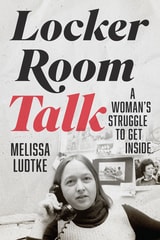
Locker Room Talk
A Woman’s Struggle to Get InsideMelissa Ludtke
Rutgers University Press, 2024
While sportswriters rushed into Major League Baseball locker rooms to talk with players, MLB Commissioner Bowie Kuhn barred the lone woman from entering along with them. That reporter, 26-year-old Sports Illustrated reporter Melissa Ludtke, charged Kuhn with gender discrimination, and after the lawyers argued Ludtke v. Kuhn in federal court, she won. Her 1978 groundbreaking case affirmed her equal rights, and the judge’s order opened the doors for several generations of women to be hired in sports media.
Locker Room Talk is Ludtke’s gripping account of being at the core of this globally covered case that churned up ugly prejudices about the place of women in sports. Kuhn claimed that allowing women into locker rooms would violate his players’ “sexual privacy.” Late-night television comedy sketches mocked her, as newspaper cartoonists portrayed her as a sexy, buxom looker who wanted to ogle the naked athletes’ bodies. She weaves these public perspectives throughout her vivid depiction of the court drama overseen by Judge Constance Baker Motley, the first Black woman to serve on the federal bench. She recounts how her lawyer, F.A.O. “Fritz” Schwarz, employed an ingenious legal strategy that persuaded Judge Motley to invoke the Fourteenth Amendment’s Equal Protection Clause in giving Ludtke access identical to that of her male counterparts. Locker Room Talk is both an inspiring story of one woman’s determination to do a job dominated by men and an illuminating portrait of a defining moment for women’s rights.
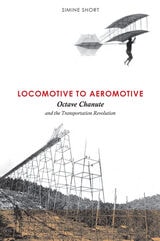
Locomotive to Aeromotive
Octave Chanute and the Transportation RevolutionSimine Short. Foreword by Tom D. Crouch
University of Illinois Press, 2014
Aviation researcher and historian Simine Short brings to light in colorful detail many previously overlooked facets of Chanute's professional and personal life. In the late nineteenth century, few considered engineering as a profession on par with law or medicine, but Chanute devoted much time and energy to the newly established professional societies that were created to set standards and serve the needs of civil engineers. Though best known for his aviation work, he became a key figure in the opening of the American continent by laying railroad tracks and building bridges, experiences that later gave him the engineering knowledge to build the first stable aircraft structure. Chanute also introduced a procedure to treat wooden railroad ties with an antiseptic that increased the wood’s lifespan in the tracks. Establishing the first commercial plants, he convinced railroad men that it was commercially feasible to make money by spending money on treating ties to conserve natural resources. He next introduced the date nail to help track the age and longevity of railroad ties.
A versatile engineer, Chanute was known as a kind and generous colleague during his career. Using correspondence and other materials not previously available to scholars and biographers, Short covers Chanute's formative years in antebellum America as well as his experiences traveling from New Orleans to New York, his apprenticeship on the Hudson River Railroad, and his early engineering successes. His multiple contributions to railway expansion, bridge building, and wood preservation established his reputation as one of the nation's most successful and distinguished civil engineers. Instead of retiring, he utilized his experiences and knowledge as a bridge builder in the development of motorless flight. Through the reflections of other engineers, scientists, and pioneers in various fields who knew him, Short characterizes Chanute as a man who believed in fostering and supporting people who were willing to learn. This well-researched biography cements Chanute's place as a preeminent engineer and mentor in the history of transportation in the United States and the development of the airplane.
Logorrhea
PoemsAdrian C. Louis
Northwestern University Press, 2006
In a torrent of rage, love, and irony, Adrian C. Louis explodes all the myths and hypocrisy of Middle America in the twenty-first century. This is how Walt Whitman or Allen Ginsburg might have written about our post-9/11 world--where the realities of poverty on Indian reservations and the plight of Hurricane Katrina victims come in second place to the vagaries of Homeland Security. For Louis, both he and our nation face an uncertain future. Like many of us he is trapped in a surreal void of the present, where he is faced with middle age and isolation, the death of loved ones, an unsatisfying job, and the battle against loneliness and self-destruction. He writes as if he has nothing left to lose but then fills the page with bittersweet sorrow for everything that has been lost. Armed with unforgettable images, relentless rhythms, and a dark and scathing humor, Louis takes aim at this American life.
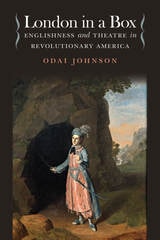
London in a Box
Englishness and Theatre in Revolutionary AmericaOdai Johnson
University of Iowa Press, 2017
If one went looking for the tipping point in the prelude to the American Revolution, it would not be the destruction of the tea in Boston Harbor, or the blockade of Boston by British warships, or even the gathering of the first Continental Congress; rather, it was the Congress’s decision in late October of 1774 to close the theatres. In this remarkable feat of historical research, Odai Johnson pieces together the surviving fragments of the story of the first professional theatre troupe based in the British North American colonies. In doing so, he tells the story of how colonial elites came to decide they would no longer style themselves British gentlemen, but instead American citizens.
London in a Box chronicles the enterprise of David Douglass, founder and manager of the American Theatre, from the 1750s to the climactic 1770s. The ambitious Scotsman’s business was teaching provincial colonials to dress and behave as genteel British subjects. Through the plays he staged, the scenery and costumes, and the bearing of his actors, he displayed London fashion and London manners. He counted among his patrons the most influential men in America, from British generals and governors to local leaders, including the avid theatre-goers George Washington and Thomas Jefferson. By 1774, Douglass operated a monopoly of theatres in six colonies and the Anglophone Caribbean, from Jamaica to Charleston and northward to New York City. (Boston remained an impregnable redoubt against theatre.)
How he built this network of patrons and theatres and how it all went up in flames as the revolution began is the subject of this witty history. A treat for anyone interested in the world of the American Revolution and an important study for historians of the period.
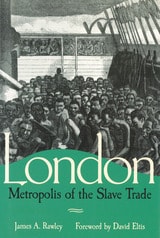
London, Metropolis of the Slave Trade
James A. Rawley & Foreword by David Eltis
University of Missouri Press, 2003
"The recognition that ordinary people could and did trade in slaves, as well as the fact that ordinary people became slaves, is, indeed, the beginning of comprehending the enormity of the forced migration of eleven million people and the attendant deaths of many more."
Rawley draws on material from the year 1700 to the American Civil War as he explores the role of London in the trade. He covers its activity as a port of departure for ships bound for Africa; its continuing large volume after the trade extended to Bristol and Liverpool; and the controversy between London’s parliamentary representatives, who defended the trade, and the abolitionist movement that was quartered there.
Sweeping in scope and thorough in its analysis, this collection of essays from a seasoned scholar will be welcomed by historians concerned with slavery and the slave trade, as well as by students just beginning their exploration of this subject.

Lone Star Vistas
Travel Writing on Texas, 1821-1861By Astrid Haas
University of Texas Press, 2021
Every place is a product of the stories we tell about it—stories that do not merely describe but in fact shape geographic, social, and cultural spaces. Lone Star Vistas analyzes travelogues that created the idea of Texas. Focusing on the forty-year period between Mexico’s independence from Spain (1821) and the beginning of the US Civil War, Astrid Haas explores accounts by Anglo-American, Mexican, and German authors—members of the region’s three major settler populations—who recorded their journeys through Texas. They were missionaries, scientists, journalists, emigrants, emigration agents, and military officers and their spouses. They all contributed to the public image of Texas and to debates about the future of the region during a time of political and social transformation. Drawing on sources and scholarship in English, Spanish, and German, Lone Star Vistas is the first comparative study of transnational travel writing on Texas. Haas illuminates continuities and differences across the global encounter with Texas, while also highlighting how individual writers’ particular backgrounds affected their views on nature, white settlement, military engagement, Indigenous resistance, African American slavery, and Christian mission.

Lone Stars III
A Legacy of Texas Quilts, 1986-2011By Karoline Patterson Bresenhan and Nancy O'Bryant Puentes
University of Texas Press, 2011
From frontier times in the Republic of Texas until today, Texans have been making gorgeous quilts. Karoline Patterson Bresenhan and Nancy O'Bryant Puentes documented the first 150 years of the state's rich heritage of quilt art in Lone Stars: A Legacy of Texas Quilts, 1836–1936 and Lone Stars II: A Legacy of Texas Quilts, 1936–1986. Now in Lone Stars III, they bring the Texas quilt story into the twenty-first century, presenting two hundred traditional and art quilts that represent "the best of the best" quilts created since 1986.
The quilts in Lone Stars III display the explosion of creativity that has transformed quilting over the last quarter century. Some of the quilts tell stories, create landscapes, record events, and memorialize people. Others present abstract designs that celebrate form and color. Their makers have embraced machine quilting, as well as hand sewing, and they often embellish their quilts with buttons, beads, lace, ribbon, and even more exotic items. Each quilt is pictured in its entirely, and some entries also include photographs of quilt details. The accompanying text describes the quilt's creation, its maker, and its physical details.
With 16.3 million American quilters who spend $3.6 billion annually on their pastime, the quilting community has truly become a force to reckon with both artistically and socially. Lone Stars III is the perfect introduction to this world of creativity.

Lonesome Cowgirls and Honky-Tonk Angels
The Women of Barn Dance RadioKristine M. McCusker
University of Illinois Press, 2007
Drawing on personal interviews and rich archival material from the Grand Ole Opry, Kristine M. McCusker examines the gendered politics of the images through the lives and careers of six women performers: Linda Parker, the Girls of the Golden West (Milly and Dolly Good), Lily May Ledford, Minnie Pearl, and Rose Lee Maphis.
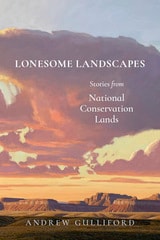
Lonesome Landscapes
Stories from National Conservation LandsAndrew Gulliford
University of Utah Press, 2026
While the National Park Service is widely known, far fewer Americans are familiar with the Bureau of Land Management’s vast National Conservation Lands—thirty-seven million acres spanning eleven western states and Alaska. Lonesome Landscapes is the first comprehensive history of this system from public domain lands to the designation of national monuments and conservation areas in the twenty-first century.
Drawing from archives, interviews, and field reporting, Gulliford reveals the unsung heroes who safeguarded these lands, from pioneering rangers to grassroots advocates in Native American and Hispanic communities. With vivid stories of explorers, cowboys, hermits, and even an alligator named Clem, this book blends scholarship with storytelling. Lonesome Landscapes is both a definitive history and a call to keep America’s wild places in public hands—an essential read for anyone passionate about the West.
Lonesome Roads and Streets of Dreams
Place, Mobility, and Race in Jazz of the 1930s and '40sAndrew S. Berish
University of Chicago Press, 2012
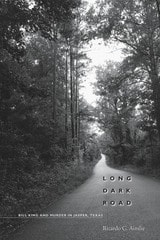
Long Dark Road
Bill King and Murder in Jasper, TexasBy Ricardo C. Ainslie
University of Texas Press, 2004
On a long dark road in deep East Texas, James Byrd Jr. was dragged to his death behind a pickup truck one summer night in 1998. The brutal modern-day lynching stunned people across America and left everyone at a loss to explain how such a heinous crime could possibly happen in our more racially enlightened times. Many eventually found an answer in the fact that two of the three men convicted of the murder had ties to the white supremacist Confederate Knights of America. In the ex-convict ringleader, Bill King, whose body was covered in racist and satanic tattoos, people saw the ultimate monster, someone so inhuman that his crime could be easily explained as the act of a racist psychopath. Few, if any, asked or cared what long dark road of life experiences had turned Bill King into someone capable of committing such a crime.
In this gripping account of the murder and its aftermath, Ricardo Ainslie builds an unprecedented psychological profile of Bill King that provides the fullest possible explanation of how a man who was not raised in a racist family, who had African American friends in childhood, could end up on death row for viciously killing a black man. Ainslie draws on exclusive in-prison interviews with King, as well as with Shawn Berry (another of the perpetrators), King's father, Jasper residents, and law enforcement and judicial officials, to lay bare the psychological and social forces—as well as mere chance—that converged in a murder on that June night. Ainslie delves into the whole of King's life to discover how his unstable family relationships and emotional vulnerability made him especially susceptible to the white supremacist ideology he adopted while in jail for lesser crimes.
With its depth of insight, Long Dark Road not only answers the question of why such a racially motivated murder happened in our time, but it also offers a frightening, cautionary tale of the urgent need to intervene in troubled young lives and to reform our violent, racist-breeding prisons. As Ainslie chillingly concludes, far from being an inhuman monster whom we can simply dismiss, "Bill King may be more like the rest of us than we care to believe."
Long Is the Way and Hard
One Hundred Years of the NAACPKevern Verney
University of Arkansas Press, 2009
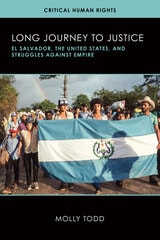
Long Journey to Justice
El Salvador, the United States, and Struggles against EmpireMolly Todd
University of Wisconsin Press, 2023
Drawing on two decades of work with former refugees from El Salvador as well as unprecedented access to private archives and oral histories, Molly Todd’s compelling history provides the first in-depth look at “grassroots sistering.” This model of citizen diplomacy emerged in the mid-1980s out of relationships between a few repopulated villages in Chalatenango, El Salvador, and US cities.
Todd shows how the leadership of Salvadorans and left-leaning activists in the US concerned with the expansion of empire as well as the evolution of human rights–related discourses and practices created a complex dynamic of cross-border activism that continues today.
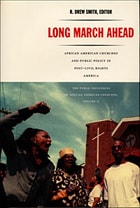
Long March Ahead
African American Churches and Public Policy in Post-Civil Rights AmericaR. Drew Smith ed.
Duke University Press, 2004
Long March Ahead emphasizes the need for African American churches to complement the excellent work they do in implementing policies set by others by getting more involved in shaping public policy. The contributors explore the efficacy of different means of public policy advocacy and social service delivery, including faith-based initiatives. At the same time, they draw attention to trends that have constrained political involvement by African American churches: the increased professionalization of policy advocacy and lobbying, the underdevelopment of church organizational structures devoted to policy work, and tensions between religious imperatives and political activism. Long March Ahead takes an important look at the political role of African American churches after the great policy achievements of the civil rights era.
Contributors
Cathy J. Cohen
Megan McLaughlin
Columba Aham Nnorum
Michael Leo Owens
Desiree Pedescleaux
Barbara D. Savage
R. Drew Smith
Emilie Townes
Christopher Winship

Long Road to Harpers Ferry
The Rise of the First American LeftMark A. Lause
Pluto Press, 2018
Offering new and fascinating insights into the cast of characters who created a homegrown socialist movement in America—from Thomas Paine’s revolution to Robert Owen’s utopianism, and from Thomas Skidmore’s agrarianism to George Henry Evans’s industrial workers’ reforms—Long Road to Harpers Ferry captures the spirit of the times. Showing how class solidarity and consciousness became more important to a generation of workers than notions of American citizenship, the book offers a fascinating historical background to help us understand the rise of radicalism in the United States today.

Long Ships Passing
The Story Of The Great LakesWalter Havighurst
University of Minnesota Press, 2002
A dramatic account of three centuries of people and ships that sailed the Great Lakes
A popular history of navigation on the Great Lakes and life on their shores, The Long Ships Passing brings us aboard the crafts that have plowed the waves of the treacherous "five sisters" carrying the grain, lumber, and minerals that fed and built the cities of America. Walter Havighurst paints vivid pictures of life—and death—on the lakes, mysterious accounts of wooden ships and iron men that sank to freshwater graves, especially along the immigrant route where the wrecks lie thick. In rich and marvelous detail, this classic history recounts the saga of an inland marine empire.

Long Steel Rail
Norm Cohen
University of Illinois Press, 2000
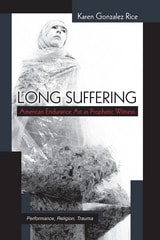
Long Suffering
American Endurance Art as Prophetic WitnessKaren Gonzalez Rice
University of Michigan Press, 2016
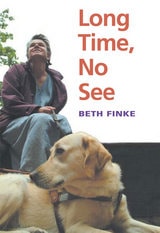
Long Time, No See
Beth Finke
University of Illinois Press, 2003
With unflinching candor and acerbic wit, Finke chronicles the progress of the juvenile diabetes that left her blind at the age of twenty-six as well as the seemingly endless spiral of adversity that followed. First she was forced out of her professional job. Then she bore a multiply handicapped son. But she kept moving forward, confronting marital and financial problems and persevering through a rocky training period with a seeing-eye dog.
Finke’s life story and her commanding knowledge of her situation give readers a clear understanding of diabetes, blindness, and the issues faced by parents of children with significant disabilities. Because she has taken care to include accurate medical information as well as personal memoir, Long Time, No See serves as an excellent resource for others in similar situations and for professionals who deal with disabled adults or children.

Long Walk Home
Reflections on Bruce SpringsteenJonathan D. Cohen
Rutgers University Press, 2019
Contributors to Long Walk Home include novelists like Richard Russo, rock critics like Greil Marcus and Gillian Gaar, and other noted Springsteen scholars and fans such as A. O. Scott, Peter Ames Carlin, and Paul Muldoon. They reveal how Springsteen’s albums served as the soundtrack to their lives while also exploring the meaning of his music and the lessons it offers its listeners. The stories in this collection range from the tale of how “Growin’ Up” helped a lonely Indian girl adjust to life in the American South to the saga of a group of young Australians who turned to Born to Run to cope with their country’s 1975 constitutional crisis. These essays examine the big questions at the heart of Springsteen’s music, demonstrating the ways his songs have resonated for millions of listeners for nearly five decades.
Commemorating the Boss’s seventieth birthday, Long Walk Home explores Springsteen’s legacy and provides a stirring set of testimonials that illustrate why his music matters.
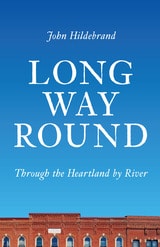
Long Way Round
Through the Heartland by RiverJohn Hildebrand
University of Wisconsin Press, 2022
Wisconsin is in the midst of an identity crisis, torn by new political divisions and the old gulf between city and countryside. Cobbling rivers together, from the burly Mississippi to the slender wilds of Tyler Forks, Hildebrand navigates the beautiful but complicated territory of home. In once prosperous small towns, he discovers unsung heroes—lockmasters, river rats, hotelkeepers, mechanics, environmentalists, tribal leaders, and perennial mayors—struggling to keep their communities afloat.
While history doesn't flow in a circle, it doesn't always move in a straight line either. Hildebrand charts the improbable ox-bows along its course. Long Way Round shows us the open road as a river with possibility around the next bend.
Long-Term Factors in American Economic Growth
Edited by Stanley L. Engerman and Robert E. Gallman
University of Chicago Press, 1986
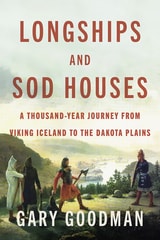
Longships and Sod Houses
A Thousand-Year Journey from Viking Iceland to the Dakota PlainsGary Goodman
University of Minnesota Press, 2026
A direct descendant of a tenth-century Viking marauder traces his lineage from medieval Iceland to the Dakota plains
Gary Goodman first heard that his 24x great-grandfather was a tenth-century Viking pirate and mercenary at a family reunion, when a cousin told him that they were the direct descendants of an Icelandic poet and cold-blooded killer named Egil Skallagrímsson. Also known as “Egil the Bastard,” Goodman’s forefather was the subject of Egil’s Saga, one of the great Icelandic epics of the early Middle Ages. Spurred by this revelation of his family’s lineage, Goodman set out to discover the route his ancestors had traveled from medieval Iceland to the North Dakota plains in the later 1800s.
Drawing on Egil’s Saga, family records, and travels through Iceland, England, and Ireland, Goodman traces his ancestral line from Iceland—the family’s homeland for over a thousand years until a volcanic eruption forced them to migrate—to the hardscrabble plains of the Dakota Territory. His panoramic view ranges from the Viking invasion of England in the early Middle Ages to the disappearance of a short-lived Icelandic settlement on the Mouse River in North Dakota in the late 1800s. Along the way, Goodman sketches the highlights of Egil’s Saga, making the centuries-old epic accessible to today’s readers.
With candor, dry wit, and some bemusement, Goodman shares his trip through history from the perspective of a descendant of an original Viking marauder. An innovative, time-bending family history, Longships and Sod Houses is a noteworthy saga in its own right.
Retail e-book files for this title are screen-reader friendly with images accompanied by short alt text and/or extended descriptions.

Look Closer
Suburban Narratives and American Values in Film and TelevisionCoon, David R
Rutgers University Press, 2013
In recent years, the media landscape in the United States has followed a pattern similar to that of the physical landscape by becoming increasingly suburbanized. Although it is a far cry from reality, the fantasy of a perfect suburban life still exists in the collective imagination of millions of Americans. This dream of suburban perfection is built around a variety of such ideologically conservative values and ideals as the importance of tradition, the centrality of the nuclear family, the desire for a community of like-minded neighbors, the need for clearly defined gender roles, and the belief that with hard work and determination, anyone can succeed.
Building on the relationships between suburban life and American identity, Look Closer examines and interprets recent narratives that challenge the suburban ideal to reveal how directors and producers are mobilizing the spaces of suburbia to tell new kinds of stories about America. David R. Coon argues that the myth of suburban perfection, popularized by postwar sitcoms and advertisements, continues to symbolize a range of intensely debated issues related to tradition, family, gender, race, and citizenship. Through close examinations of such films as American Beauty, The Truman Show, and Mr. & Mrs. Smith as well as such television series as Desperate Housewives, Weeds, and Big Love, the book demonstrates how suburbia is used to critique the ideologies that underpin the suburban American Dream.
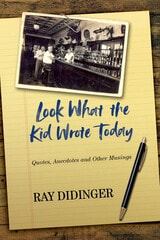
Look What the Kid Wrote Today
Quotes, Anecdotes and Other MusingsRay Didinger
Temple University Press, 2026
When Ray Didinger was a young sports columnist, his proud grandfather would tape his articles on the mirror of his Southwest Philadelphia bar and tell his customers, “Look what the kid wrote today.” That phrase is now the title of Didinger’s latest book, a fond look back on his award-winning career.
In Look What the Kid Wrote Today, Didinger reflects on walking the historic Merion golf course with Jack Nicklaus, shooting pool with Mean Joe Greene, touring Foxcatcher Farms with John du Pont and hanging out with Mark Wahlberg on the set of Invincible. He also writes about helping to heal the rift between the Philadelphia Eagles and arguably their greatest player, Chuck Bednarik. It is a story that went untold until now.
Didinger takes the reader through the many stages of his fifty-plus years in sports media, from his time as an Emmy Award-winning producer at NFL Films, which involved writing scripts for the likes of Tom Selleck, Gary Busey, and Oscar winner James Coburn. Now a playwright, Didinger also devotes a chapter to the 2025 premiere of his critically acclaimed production Spinner.
Candid and insightful, Look What the Kid Wrote Today is Didinger at his best.
Looking Back on the Vietnam War
Twenty-first-Century PerspectivesBoyle, Brenda M
Rutgers University Press, 2016
Looking Back to See Ahead
Helen Harris Perlman
University of Chicago Press, 1989
Looking Back to See Ahead offers pieces chosen for their centrality to Perlman's thinking on some of the major problems of social work practice and education. To each essay she has added her current, informal comments. Refreshingly original is the section "After Hours," in which she captures, in sketches and verse, the humor and heartache that are inevitable in any profession that deals with hurt and troubled people.
Looking Back to See
A Country Music MemoirMaxine Brown
University of Arkansas Press, 2005
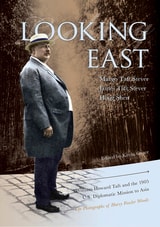
Looking East
William Howard Taft and the 1905 U.S. Diplomatic Mission to Asia: the Photographs of Harry Fowler WoodsMargo Taft Stever, James Taft Stever, and Hong Shen
University of Minnesota Press, 2015
Since the mid-19th century, relations between the United States in the West and Asian countries in the East have been an aggregate of diplomatic miscues and achievements, of trade policy successes and failures, and of cultural chasms and bridges. From the Treaty of Wangxia in 1844 that provided America with trading rights in China on a par with European countries to the contemporary political debates and educational partnerships in nations like Japan, Vietnam, India, and China, the element of understanding and appreciating differences has been paramount.
A singular event in this heritage of almost 150 years in the 1905 mission that sent William Howard Taft on a combination trade and culture junket to Asian countries. Occurring just a few years after U.S. Secretary of State's John Hay's 1899 Open Door Note that sought to keep China open to equitable trade with all countries, the Taft delegation primarily visited China, Japan, and the Philippines to shore up America's interests and to learn more about their emerging partners in the new century.
In Looking East, authors Margo Taft Stever, James Taft Stever, and Hong Shen explore this journey not only by an assiduous use of archives and historical analyses, but especially through the extraordinary images captured by photographer Harry Fowler Woods. Both Taft and Woods are ancestors of two of the authors so there is a particular interest on their part. With scholar Shen, they uncovered these photos and created exhibitions and published the initial Chinese-language edition of this volume by Zhejiang University Press in 2012. In this new, English-language edition, William Howard Taft's 1905 endeavors in Asia are freshly accorded the insight and appreciation they deserve in American diplomatic history.
Looking Forward, Looking Upward
My Life, My Friendship with Sir John, and the Early Years of the John Templeton FoundationRobert L. Herrmann
Templeton Press, 2013
Looking Forward
Prediction and Uncertainty in Modern AmericaJamie L. Pietruska
University of Chicago Press, 2017
Pietruska argues that this late nineteenth-century quest for future certainty had an especially ironic consequence: it led Americans to accept uncertainty as an inescapable part of both forecasting and twentieth-century economic and cultural life. Drawing together histories of science, technology, capitalism, environment, and culture, Looking Forward explores how forecasts functioned as new forms of knowledge and risk management tools that sometimes mitigated, but at other times exacerbated, the very uncertainties they were designed to conquer. Ultimately Pietruska shows how Americans came to understand the future itself as predictable, yet still uncertain.
Looking High and Low
Art and Cultural IdentityBrenda Jo Bright
University of Arizona Press, 1995
Arguing that art is constituted across cultural boundaries rather than merely inside them, the contributors explore the relations between art, cultural identity, and the social languages of evaluation—among artists, art critics, art institutions, and their audiences—in the Southwest and in Mexico. The authors use anthropological methods in art communities to uncover compelling evidence of how marginalized populations make meaning for themselves, how images of ethnicity function in commercial culture, how Native populations must negotiate sentimental marketing and institutional appropriation of their art work, and how elite populations use culture and ritual in ways that both reveal and obscure their power and status. The authors make dramatic revelations concerning the construction and contestation of ideas of art as they circulate between groups where notions of what art "should" be are often at odds with each other.
This volume challenges conventional modes of analyzing art. Its ethnographic explorations illuminate the importance of art as a cultural force while creating a greater awareness of the roles that scholars, museum curators, and critics play in the evaluation of art.
Contents
Introduction: Art Hierarchies, Cultural Boundaries, and Reflexive Analysis, Brenda Jo Bright
Bellas Artes and Artes Populares: The Implications of Difference in the Mexico City Art World, Liza Bakewell
Space, Power, and Youth Culture: Mexican American Graffiti and Chicano Murals in East Los Angeles, 1972-1978, Marcos Sanchez-Tranquilino
Remappings: Los Angeles Low Riders, Brenda Jo Bright
Marketing Maria: The Tribal Artist in the Age of Mechanical Reproduction, Barbara Babcock
Aesthetics and Politics: Zuni War God Repatriation and Kachina Representation, Barbara Tedlock
Middlebrow into Highbrow at the J. Paul Getty Trust, Los Angeles, George E. Marcus
Looking Like the Enemy
Japanese Mexicans, the Mexican State, and US Hegemony, 1897–1945Jerry García
University of Arizona Press, 2014
Japanese citizens were initially lured to Mexico with promises of cheap and productive land in Chiapas. Many of the promises were false, and the immigrants were forced to fan out across the country, especially to the lands along the US border. As Jerry García reveals, they were victims of discrimination based on “difference,” but they also displayed “markers of whiteness” that linked them positively to Europeans and Americans, who were perceived as powerful and socially advanced. And, García reports, many Mexicans looked favorably on the Japanese as hardworking and family-centered.
The book delves deeply into the experiences of the Japanese on both sides of the border during World War II, illuminating the similarities and differences in their treatment. Although some Japanese Mexicans were eventually interned (at the urging of the US government), in general the fear and vitriol that Japanese Americans encountered never reached the same levels in Mexico.
Looking Like the Enemy is an ambitious study of a tumultuous half-century in Mexico. It is a significant contribution to our understanding of the immigrant experience in the Western Hemisphere and to the burgeoning field of borderlands studies.
Looking North
Writings from Spanish America on the US, 1800 to the PresentEdited by John J. Hassett and Braulio Muñoz
University of Arizona Press, 2012
Given recent changes in politics and demographics, Latin America and the United States are becoming increasingly important to one another. Recognition of the two regions' differences and similarities may facilitate a more fruitful relationship, with increased respect and understanding.
It is with this in mind that editors John J. Hassett and Braulio Muñoz present a collection of writings that provides a look into the ways in which Spanish America has viewed its northern neighbor over the past two centuries. Gathered here are pieces by well-known figures from the worlds of Spanish American politics, history, philosophy, creative writing, and culture—names like Mario Vargas Llosa, Gabriel Garcia Marquez and Pablo Neruda.
Divided into three sections, Looking North begins by underscoring the cultural and political differences between the two Americas. It opens with a speech by Simón Bolívar to the Venezuelan Congress in 1819 and closes with an essay by Mario Vargas Llosa from 2006 on the controversial wall being constructed between the United States and Mexico. The second section explores the experiences of Spanish American travelers in the US, beginning with an account of former Argentine president Domingo Sarmiento's fascination with the United States during his travels in 1847 and ending with a 2008 essay by Vargas Llosa on the city of New York. The final section encompasses creative writing and commentaries by some of Spanish America's most gifted poets and novelists. It opens with Rubén Darío's "To Roosevelt" from 1905 and ends with Christine Granados's humorous and profound short story "Inner View," first published in 2006.
Touching on history, sociology, politics, and religion, the writings assembled here will be of interest to humanists, social scientists, and anyone intrigued by the ever-growing connection between the United Sates and Spanish America at all levels.
Looking Past the Screen
Case Studies in American Film History and MethodJon Lewis and Eric Smoodin, eds.
Duke University Press, 2007
Focusing on Hollywood cinema from the teens to the 1970s, these case studies show the value of this extraordinary range of historical materials in developing interdisciplinary approaches to film stardom, regulation, reception, and production. The contributors examine State Department negotiations over the content of American films shown abroad; analyze the star image of Clara Smith Hamon, who was notorious for having murdered her lover; and consider film journalists’ understanding of the arrival of auteurist cinema in Hollywood as it was happening during the early 1970s. One contributor chronicles the development of film studies as a scholarly discipline; another offers a sociopolitical interpretation of the origins of film noir. Still another brings to light Depression-era film reviews and Production Code memos so sophisticated in their readings of representations of sexuality that they undermine the perception that queer interpretations of film are a recent development. Looking Past the Screen suggests methods of historical research, and it encourages further thought about the modes of inquiry that structure the discipline of film studies.
Contributors. Mark Lynn Anderson, Janet Bergstrom, Richard deCordova, Kathryn Fuller-Seeley, Sumiko Higashi, Jon Lewis, David M. Lugowski, Dana Polan, Eric Schaefer, Andrea Slane, Eric Smoodin, Shelley Stamp
Looking South
The Evolution of Latin Americanist Scholarship in the United States, 1850-1975Helen Delpar
University of Alabama Press, 2007
The definitive history of how Latin American studies became a major field in American scholarship.
Looking South: The Evolution of Latin Americanist Scholarship in the United States, 1850-1975 is the first comprehensive history of the development of Latin American studies as a field of academic inquiry in the United States. In this ambitious and insightful work, historian Helen Delpar traces more than a century of intellectual engagement with Latin America, revealing how generations of historians, anthropologists, geographers, economists, sociologists, and political scientists shaped American understandings of the region and transformed Latin American studies into a recognized academic discipline.
A central contribution of the book lies in its exploration of the relationship between scholarship and historical context. Delpar demonstrates that academic interest in Latin America was never isolated from larger political, economic, and cultural developments in the United States. The expansion of hemispheric trade, the Good Neighbor era, World War II, the Cold War, and the Cuban Revolution all influenced how American scholars approached the region and what questions they considered important. By examining these intersections, she reveals how academic knowledge is shaped by changing national priorities, international events, and institutional support networks.
Beyond its contributions to Latin American history, Looking South is a major work of intellectual and academic history. It offers a compelling account of how scholarly fields are created, how academic communities develop, and how knowledge about world regions is produced, organized, and disseminated. Delpar's careful attention to both individual scholars and larger institutional structures makes the book an essential resource for understanding the history of area studies, the social sciences, and higher education in the United States.
Looking South remains an indispensable guide to the origins and evolution of Latin Americanist scholarship. It is essential reading for historians, Latin Americanists, anthropologists, political scientists, educators, and anyone interested in the intellectual history of the Americas and the development of knowledge across national and cultural boundaries.