Results by title
372 books match the query 'Language' and 55 start with l
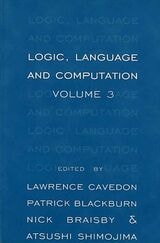
Logic, Language and Computation, Volume 3
Edited by Patrick Blackburn, Nick Braisby, Lawrence Cavedon, and Atsushi Shimoji
CSLI, 2001
With the rise of the internet and the proliferation of technology to gather and organize data, our era has been defined as "the information age." With the prominence of information as a research concept, there has arisen an increasing appreciation of the intertwined nature of fields such as logic, linguistics, and computer science that answer the questions about information and the ways it can be processed. The many research traditions do not agree about the exact nature of information. By bringing together ideas from diverse perspectives, this book presents the emerging consensus about what a conclusive theory of information should be. The book provides an introduction to the topic, work on the underlying ideas, and technical research that pins down the richer notions of information from a mathematical point of view.
The book contains contributions to a general theory of information, while also tackling specific problems from artificial intelligence, formal semantics, cognitive psychology, and the philosophy of mind. There is focus on the dynamics of information flow, and also a consideration of static approaches to information content; both quantitative and qualitative approaches are represented.
The book contains contributions to a general theory of information, while also tackling specific problems from artificial intelligence, formal semantics, cognitive psychology, and the philosophy of mind. There is focus on the dynamics of information flow, and also a consideration of static approaches to information content; both quantitative and qualitative approaches are represented.
[more]
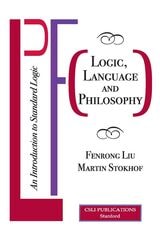
Logic, Language and Philosophy
An Introduction to Standard LogicFenrong Liu and Martin Stokhof
CSLI, 2024
A fresh introduction to the field of logic, this book provides a fascinating encounter between linguistics and philosophy utilizing logic.
This book explores the systematic and formal study of reasoning. It introduces the core systems of logic, discusses a portion of its extensions, and illustrates the application of logic in philosophy and linguistics utilizing classical and contemporary sources. In doing so, it provides the students with a rich set of tools along with first-hand experience regarding their applications in the study of rationality and meaning. With lots of exercises, and study and discussion questions, it provides a complete set of materials for courses for a variety of audiences at different levels.
This book explores the systematic and formal study of reasoning. It introduces the core systems of logic, discusses a portion of its extensions, and illustrates the application of logic in philosophy and linguistics utilizing classical and contemporary sources. In doing so, it provides the students with a rich set of tools along with first-hand experience regarding their applications in the study of rationality and meaning. With lots of exercises, and study and discussion questions, it provides a complete set of materials for courses for a variety of audiences at different levels.
[more]
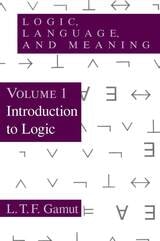
Logic, Language, and Meaning, Volume 1
Introduction to LogicL. T. F. Gamut
University of Chicago Press, 1990
Although the two volumes of Logic, Language, and Meaning can be used independently of one another, together they provide a comprehensive overview of modern logic as it is used as a tool in the analysis of natural language. Both volumes provide exercises and their solutions.
Volume 1, Introduction to Logic, begins with a historical overview and then offers a thorough introduction to standard propositional and first-order predicate logic. It provides both a syntactic and a semantic approach to inference and validity, and discusses their relationship. Although language and meaning receive special attention, this introduction is also accessible to those with a more general interest in logic.
In addition, the volume contains a survey of such topics as definite descriptions, restricted quantification, second-order logic, and many-valued logic. The pragmatic approach to non-truthconditional and conventional implicatures are also discussed. Finally, the relation between logic and formal syntax is treated, and the notions of rewrite rule, automation, grammatical complexity, and language hierarchy are explained.
[more]
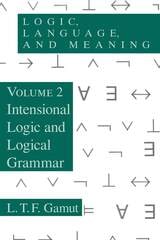
Logic, Language, and Meaning, Volume 2
Intensional Logic and Logical GrammarL. T. F. Gamut
University of Chicago Press, 1990
Although the two volumes of Logic, Language, and Meaning can be used independently of one another, together they provide a comprehensive overview of modern logic as it is used as a tool in the analysis of natural language. Both volumes provide exercises and their solutions.
[more]
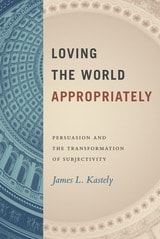
Loving the World Appropriately
Persuasion and the Transformation of SubjectivityJames L. Kastely
University of Chicago Press, 2022
A revolutionary approach to rhetoric that asks why audiences need persuading.
What is persuasion? For some, it is the ideal alternative to violence. For others, persuasion is simply a neutral instrumentality—a valued source of soft power. Both positions rest on a fundamental belief: persuasion is a power that resides in a speaker acting on an audience. Loving the World Appropriately asks a different, more fundamental, question: why does an audience need persuasion? In shifting our focus, James Kastely delivers a provocative new history of rhetoric and philosophy, one that describes rhetoric as more than a matter of effective communication and recasts persuasion as a philosophical concern central to notions of human subjectivity. Ultimately, Kastely insists, persuasion enables us to love the world appropriately.
What is persuasion? For some, it is the ideal alternative to violence. For others, persuasion is simply a neutral instrumentality—a valued source of soft power. Both positions rest on a fundamental belief: persuasion is a power that resides in a speaker acting on an audience. Loving the World Appropriately asks a different, more fundamental, question: why does an audience need persuasion? In shifting our focus, James Kastely delivers a provocative new history of rhetoric and philosophy, one that describes rhetoric as more than a matter of effective communication and recasts persuasion as a philosophical concern central to notions of human subjectivity. Ultimately, Kastely insists, persuasion enables us to love the world appropriately.
[more]