Results by title
8642 books match the query '20th Century' and 251 start with l
Lessons and Legacies II
Teaching the Holocaust in a Changing WorldDonald G. Schilling
Northwestern University Press, 1998
Lessons and Legacies II focuses on matters unique to Holocaust education. Consisting of selected papers delivered at the second Lessons and Legacies conference in 1992, the volume is organized in three sections: Issues, Resources, and Applications. Taken individually, the essays speak directly to specific concerns surrounding Holocaust education: the growing maturity of the Holocaust as a field of study; the difficult issue of explaining the perpetrators' behavior; the process of decision-making within Jewish communities during the Holocaust; issues of gender and family; the scope and content of survivor literature; and the structure of courses and the implications of being an educator in the field. Taken as a whole, the volume speaks to the reciprocal and mutually reinforcing relationship between teaching and scholarship in this important field.
Lessons and Legacies III
Memory, Memorialization, and DenialPeter Hayes
Northwestern University Press, 1999
A collection of nineteen essays, this book is organized into four sections: the first focuses on how various fields of study can open new perspectives on the Holocaust and sharpen old ones; the second examines culture and politics in Germany before and after 1933; the third addresses the problems associated with the memorialization of those years; and the final section examines the shocking denials of the Holocaust.
Lessons and Legacies IV
Reflections on Religion, Justice, Sexuality, and GenocideLarry V. Thompson
Northwestern University Press, 2003
Variously concerned with issues of guilt and victimization, the essays examine individuals like Pius XII and Romano Guardini and the institutions of organized religion as well as the roles of the Jewish Councils and the retributive judicial proceedings in Hungary. They reveal that victimization within the Holocaust experience is surprisingly open-ended, with Jewish women doubly victimized by their gender; postwar Germans viewing themselves as the epoch's greatest victims; Poles, whether Jewish or not, victimized beyond others because of their proximity to the epicenter of the Holocaust; and German university students corrupted by ideological inculcation and racist propaganda.
Though offering no "positive lessons" or comforting assurances, these essays add to the ongoing examination of Holocaust consequences and offer insightful analyses of facets previously minimized or neglected. Together they illustrate that matters of gender, sexuality, and proximity are crucial for shaping perceptions of a Holocaust reality that will always remain elusive.
Lessons and Legacies V
The Holocaust and JusticeRonald Smelser
Northwestern University Press, 2002
Seeking a historical context, the contributors ask, What were the political, social, psychological, and ideological prerequisites for this tragedy? Considering the courts and trials both during and immediately after World War II, and recent cases against aging perpetrators, the contributors examine the legal circumstances for trying to provide justice, the dimming impact of passing time, and other issues that complicate litigation. Their inquiry extends to questions about memory--how it is shaped and reshaped and whether it can be reliable--and about the re-creation of events of the Holocaust by a second generation. Does reassembling the evidence through the lenses of a later generation provide a deeper understanding, and does this understanding include a sense of justice accomplished?
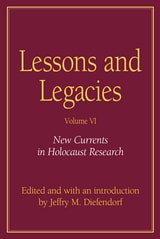
Lessons and Legacies VI
New Currents in Holocaust ResearchJeffry Diefendorf
Northwestern University Press, 2004
Several of the essays-such as one on nonarmed "amidah" or resistance and others on the role of gender in the behavior of perpetrators and victims-provide innovative and potentially significant interpretive frameworks for the field of Holocaust studies. Others; for instance, the rounding up of Jews in Italy, Nazi food policy in Eastern Europe, and Nazi anti-Jewish scholarship, emphasize the importance of new sources for reconstructing the historical record. Still others, including essays on the 1964 Frankfurt trial of Auschwitz guards and on the response of the Catholic Church to the question of German guilt, bring a new depth and sophistication to highly charged, sharply politicized topics. Together these essays will inform the future of the Holocaust in scholarly research and in popular understanding.
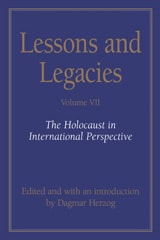
Lessons and Legacies VII
The Holocaust in International PerspectiveDagmar Herzog
Northwestern University Press, 2006
A thorough, thoughtful, and insightful introduction clarifies the volume's themes and concisely places them within the larger context of Holocaust scholarship; and an introductory essay by Omer Bartov brings into focus the numerous paradoxes structuring early twenty-first-century retrospective thinking about the significance of the Holocaust as a central theme of the twentieth century.
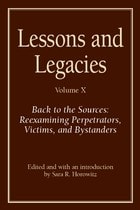
Lessons and Legacies X
Back to the Sources: Reexamining Perpetrators, Victims, and BystandersSara R Horowitz
Northwestern University Press, 2012
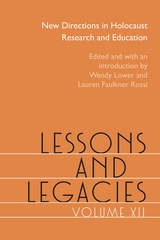
Lessons and Legacies XII
New Directions in Holocaust Research and EducationEdited and with an introduction by Wendy Lower and Lauren Faulkner Rossi
Northwestern University Press, 2017
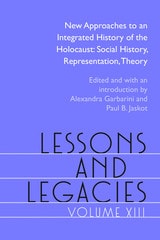
Lessons and Legacies XIII
New Approaches to an Integrated History of the Holocaust: Social History, Representation, TheoryEdited and with an introduction by Alexandra Garbarini and Paul B. Jaskot
Northwestern University Press, 2018
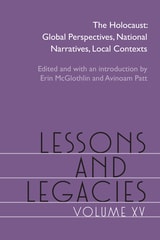
Lessons and Legacies, Volume XV
The Holocaust: Global Perspectives, National Narratives, Local ContextsErin McGlothlin; Avinoam Patt
Northwestern University Press, 2024
The contributions to this volume not only indicate the intellectual vibrancy and diversity of cutting-edge research in Holocaust studies but also reflect multiple approaches to the necessary work of expanding the canon of research in the field and of adopting varied disciplinary perspectives, engaging with global perspectives as well as local studies.
This collection’s chapters manifest three broad categories: history, literature, and memory; at the same time, however, as the interdisciplinary nature of these chapters indicate, these categories should not be regarded as mutually exclusive or discrete. On the contrary, they overlap and intersect in compelling ways, demonstrating the dynamic character of contemporary Holocaust studies, which views history, narrative representation, and commemoration as mutually informative. Further, the contributors continue the recent trend in Holocaust studies whereby specific regional and national narratives are integrated into a more global approach to the event: Newer studies have continued to incorporate what was once termed the periphery into a more global examination of the experiences of Jewish refugees in flight to Latin America, Africa, and the Soviet Union. At the same time, very specific local studies deepen our knowledge of the mechanics of genocide, along with the experiences of refugees in flight, and the subsequent dimensions of Holocaust memory and representation.
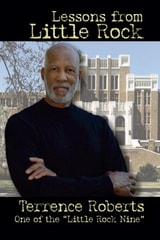
Lessons from Little Rock
Terrance Roberts
Butler Center for Arkansas Studies, 2009
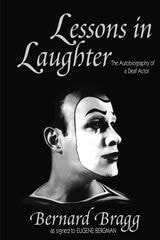
Lessons in Laughter
The Autobiography of a Deaf ActorBernard Bragg
Gallaudet University Press, 1989
To succeed as an actor is a rare feat. To succeed as a deaf actor is nothing short of amazing. Lessons in Laughter is the story of Bernard Bragg and his astonishing lifelong achievements in the performing arts.
Born deaf of deaf parents, Bernard Bragg has won international renown as an actor, director, playwright, and lecturer. Lessons in Laughter recounts in stories that are humorous, painful, touching, and outrageous, the growth of his dream of using the beauty of sign language to act. He starred in his own television show “The Quiet Man,” helped found The National Theatre of the Deaf, and traveled worldwide to teach his acting methods.
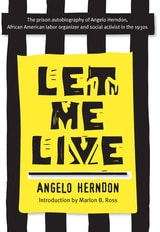
Let Me Live
Angelo Herndon
University of Michigan Press, 2007
Let Me Live tells the remarkable story of Angelo Herndon, a coal miner who worked as a labor organizer in Alabama and Georgia in the 1930s. Herndon led a racially integrated march of the unemployed in 1932 and was subsequently arrested when Communist Party literature was found in his bedroom. His trial made only small headlines at first, but eventually an international campaign to free him emerged, thanks to the efforts of the Communist Party and of labor unions interested in protecting the right to organize in the South. Herndon was finally set free by the U.S. Supreme Court, with the help of well-known leaders including C. Vann Woodward, Thurgood Marshall, A. Philip Randolph, and Whitney North Seymour, Sr.
Written while Herndon was in prison, Let Me Live tells the story behind his arrest and his struggle through the courts. It also describes his early life as a young boy in poverty, as a laborer in the Kentucky mines, and as a construction gang worker and traces the birth and development of his passion for the Communist Party. Originally published in 1937, this is the first new edition of Let Me Live since 1969, when Howard N. Meyer rescued it from obscurity. The book features texts from the Georgia and U.S. Supreme Court decisions, the text of Herndon’s speech, and newspaper editorials from the era. A substantive and thought-provoking introduction by Marlon B. Ross of the University of Virginia sheds light on this unique story and its importance to our understanding of the intersection of race and class in America—past and present.
“A book which every thoughtful American may do well to read. It is moving and challenging as the story of one man’s life and the question of one man’s fate.”
—New York Times
Let Me Tell You Where I've Been
New Writing by Women of the Iranian DiasporaPersis M. Karim
University of Arkansas Press, 2006
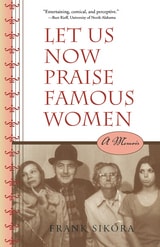
Let Us Now Praise Famous Women
A MemoirFrank Sikora
University of Alabama Press, 2005
An affectionate, humorous account of small town Alabama during the civil rights era.
When Frank Sikora's six-year-old daughter contracted pneumonia in 1962, his wife Millie vowed that would be the last winter she would spend in Ohio. Despite their misgivings about the racial tensions erupting there, they moved their family of six south, where Frank hoped to fulfill his dream of becoming a newspaper reporter. But when those dreams didn't materialize immediately, mounting bills, repossession, and eviction forced them to move in with Millie's parents, Dan and Minnie Belle Helms, in rural Wellington, Alabama.
With even slimmer prospects for employment in impoverished Calhoun County, the Sikoras came to depend heavily upon the Helmses and extended family members and all their lives became closely intertwined. The Helmses were uneducated, unpolished people, but Sikora's narration of his life with them—often humorous but never condescending—provides a compelling portrait of the attitudes and lifestyle of poor whites in Alabama during the second half of the 20th century, just as James Agee's monumental work, Let Us Now Praise Famous Men, illuminated the Depression years in Hale County, Alabama. Sikora illustrates how resourceful, southern women, in particular, held their families together through trying times.
Interwoven with this commentary on rural white culture in the Deep South is the story of Sikora's developing career as a newsman. Determined to succeed, he finally lands a job with the Gadsden Times reporting the news of black citizens. From that introduction to journalism, Sikora becomes one of Alabama's most acclaimed chroniclers of the civil rights movement, eventually writing some of the acknowledged masterpieces about the subject. Like his landmark book, Selma, Lord, Selma, Sikora's newest work tells the stories of ordinary Alabamians and their perspectives on extraordinary times.
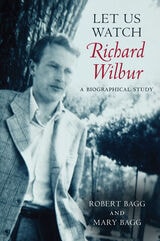
Let Us Watch Richard Wilbur
A Biographical StudyRobert Bagg
University of Massachusetts Press, 2017
Pulitzer Prize–winning poet Richard Wilbur (b. 1921) is part of a notable literary cohort, American poets who came to prominence in the mid-twentieth century. Wilbur's verse is esteemed for its fluency, wit, and optimism; his ingeniously rhymed translations of French drama by Molière, Racine, and Corneille remain the most often staged in the English-speaking world; his essays possess a scope and acumen equal to the era's best criticism. This biography examines the philosophical and visionary depth of his world-renowned poetry and traces achievements spanning seventy years, from political editorials about World War II to war poems written during his service to his theatrical career, including a contentious collaboration with Leonard Bernstein and Lillian Hellman.
Wilbur's life has been mistakenly seen as blessed, lacking the drama of his troubled contemporaries. Let Us Watch Richard Wilbur corrects that view and explores how Wilbur's perceived “normality” both enhanced and limited his achievement. The authors augment the life story with details gleaned from access to his unpublished journals, family archives, candid interviews they conducted with Wilbur and his wife, Charlee, and his correspondence with Robert Lowell, Elizabeth Bishop, John Berryman, John Malcolm Brinnin, James Merrill, and others.
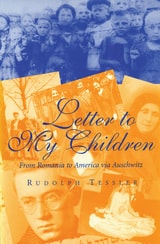
Letter to My Children
From Romania to America via AuschwitzRudolph Tessler
University of Missouri Press, 1999
"Sixty-seven members of my family—my mother, her father, my three sisters, three of my brothers, aunts, uncles, and cousins—were murdered at Auschwitz."
As Rudolph Tessler's mother stepped from the train in Auschwitz, shortly before she was sent to the gas chamber, she heard "Hello, Esther." In a polite tone, a young German SS officer greeted her as he would any old friend. His family lived down the road from the Tessler family in Viseu, their hometown in northern Romania. They, like the rest of the town, admired Esther for her wonderful cooking, particularly the delicious cakes she brought them each Christmas. Now he ushered her and six of her children to their deaths.Throughout Letter to My Children, Tessler offers vivid glimpses of the senselessness that surrounded him during World War II. Of the thousands packed in trains and transported from Viseu to Auschwitz, just a small group survived to see liberation. Among the survivors were Tessler, his father, and two of his brothers. This is the amazing story of their experiences as Hasidic Jews caught in the chaos and terror of the Holocaust.
Tessler's upbringing had emphasized community and family devotion—traits not forgotten in the concentration camps, where he and his family members often rescued one another from certain death. Few fathers and sons survived the concentration camps together. In spite of the odds, Tessler and his brother Buroch managed to stick together, sharing their father's labor assignments to protect him from death, preserving not only their family bond but also their spirituality. Tessler's father, always a source of strength and guidance to his family, provided counsel to many prisoners in the camp and eventually assumed the role of rabbi.
Despite an environment in which their captors tried to reduce them to animals, Tessler's remaining family and seven other Jews from Viseu made a special effort to observe their faith. Bending rules in ways that risked their lives, they worked together to smuggle wheat, grind it into flour, and bake matzos to distribute for Passover. The group also secretly gathered to pray on the eve of Rosh Hashanah. These religious observances offered some comfort in the camp.
In addition to vividly portraying the daily struggles of camp life, Letter to My Children follows Tessler beyond liberation, recounting his days as a displaced person struggling for a new life in the midst of the devastation of postwar Europe, as an American immigrant striving to rebuild his family and succeed in business, and as a philanthropist for education and health care. Recalling the age-old way of life in Viseu that was erased by the Holocaust, this inspiring story conveys the hope, determination, and perseverance that made Tessler a survivor.
Letterpress Revolution
The Politics of Anarchist Print CultureKathy E. Ferguson
Duke University Press, 2023
Letters from the Front, 1898-1945
Michael E. Stevens
Wisconsin Historical Society Press, 1992
This volume tells the stories of 62 men and women from Wisconsin who served in the Spanish-American War, World War I, and World War II. Letters from the Front is a vivid social history of wartime as told by those who took part in these foreign conflicts. Most of them are "ordinary" people, uprooted from farms, factories, and offices, who took part in extraordinary events. This work explores how war changed their lives and reveals the emotions they felt in uniform, in remote outposts, in combat, and in prison camps. These letters, diaries, oral histories, newspapers, and contemporary accounts provide a history of adaptation to military life; they also reflect the changes that occurred over the half-century encompassing these confilcts, an era of great technological innovation — and one in which America's vision of itself also changed.
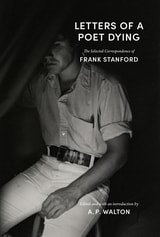
Letters of a Poet Dying
The Selected Correspondence of Frank StanfordFrank Stanford
University of Arkansas Press, 2026
Letters of a Poet Dying is a watershed publication—the first collection of correspondence by the virtuosic poet Frank Stanford (1948–78). Born in southeast Mississippi, Stanford lived most of his brief life in northern Arkansas, where he studied, loved, founded a publishing company, and wrote prolifically before ending his life at the age of twenty-nine. These strikingly original letters, postcards, and book inscriptions written in Stanford’s twenties to several dozen recipients—poets, editors, friends, lovers, and family members—illuminate his complicated and often tumultuous creative process.
Enhanced by A. P. Walton’s painstaking scholarship, Stanford’s correspondence reveals a poet intent on crafting and shaping his oeuvre as he approached the death he long anticipated. “I have never feared Death,” he wrote in 1972. For him, “Death was always there, a pale master holding the reins of my horse.” Yet these letters are much more than a contemplation of the poet’s own mortality—they demonstrate a lust for life and contain untold moments of beauty, providing intimate, moving glimpses into Stanford’s creativity, aesthetic beliefs, friendships, romances, and fears.
That these letters have survived obscurity for the many decades since the poet’s death is a small miracle. Stanford’s letters offer a clear window into the genius of one of the most gifted and prodigious poets of the twentieth century and stand in their own right as significant works of literature.
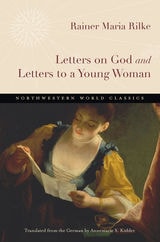
Letters on God and Letters to a Young Woman
Rainer Maria Rilke, Translated from the German by Annemarie S. Kidder
Northwestern University Press, 2012
For Rainer Maria Rilke, letter writing was a discipline and art unto itself. Some seven thousand of his letters have survived, among them works of profound beauty and insight to rival his poems and fiction. For the first time, this volume makes available to an English-speaking audience two of the earliest collections of Rilke letters published after his death, each with a nuanced introduction and notes by Annemarie S. Kidder.
The thematic collection Letters on God contains two letters by Rilke, the first an actual letter written during World War I, in 1915 in Munich, the second a fictional one composed after the war, in 1922 at Muzot in Switzerland. In these letters, Rilke builds on the mystical view of God conceived in The Book of Hours, but he moves beyond it, demonstrating a unique vision of God and Christ, the church and religious experience, friendship and death.
Like his famous Letters to a Young Poet, Rilke’s Letters to a Young Woman presents an intimate series of letters written to a young admirer. The nine letters collected here were written to Lisa Heise over the course of five years, from 1919 to 1924. Though Rilke and Heise never met, the poet emerges in these letters as a compassionate listener and patient teacher who with levelheaded sensitivity affirms and guides the movements of another person’s soul.
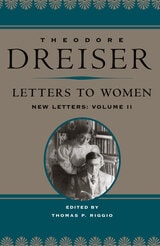
Letters to Women
New Letters, volume 2Theodore Dreiser. Edited by Thomas P. Riggio
University of Illinois Press, 2008
Theodore Dreiser led a long and controversial life, almost always pursuing some serious question, and not rarely pursuing women. This collection, the second volume of Dreiser correspondence to be published by the University of Illinois Press, gathers previously unpublished letters Dreiser wrote to women between 1893 and 1945, many of them showing personal feelings Dreiser revealed nowhere else. Here he both preens and mocks himself, natters and scolds, relates his jaunts with Mencken and his skirmishes with editors and publishers. He admits his worries, bemoans his longings, and self-consciously embarks on love letters that are unafraid to smolder and flame. To one reader he sends “Kisses, Kisses, Kisses, for your sweety mouth” and urges his needy requests: “Write me a love-letter Honey girl.” Alongside such amorous play, he often expressed his deepest feelings on philosophical, religious, and social issues that characterize his public writing.
Chronologically arranged and meticulously edited by Thomas P. Riggio, these letters reveal how wide and deep Dreiser’s needs were. Dreiser often discussed his writing in his letters to women friends, telling them what he wanted to do, where he thought he succeeded and failed, and seeking approval or criticism. By turns seductive, candid, coy, and informative, these letters provide an intimate view of a master writer who knew exactly what he was after.
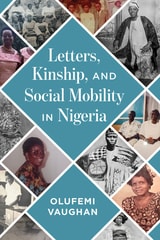
Letters, Kinship, and Social Mobility in Nigeria
Olufemi Vaughan
University of Wisconsin Press, 2023
Letter writing was a dominant form of communication for Western-educated elites in colonial Africa, especially in Nigeria. Exposure to the modern world and a growing sense of nationalism were among the factors that led people to begin exchanging letters, particularly in their interactions with British colonial authorities. Through careful textual analysis and broad contextualization, Vaughan reconstructs dominant storylines, including themes such as kinship, social mobility, Western education, modernity, and elite consolidation in colonial and post-colonial Nigeria. Vaughan brings his prodigious skills as an interdisciplinary scholar to bear on this wealth of information, bringing to life a portrait, at once intimate and expansive, of a community during a transformative period in African history.
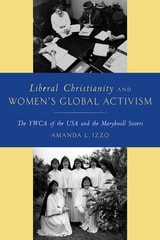
Liberal Christianity and Women's Global Activism
The YWCA of the USA and the Maryknoll SistersAmanda L. Izzo
Rutgers University Press, 2018
Focusing on the histories of two highly influential groups, the Young Women’s Christian Association of the USA, an interdenominational Protestant organization, and the Maryknoll Sisters, a Roman Catholic religious order, Izzo offers new perspectives on the contributions of these women to transnational social movements, women’s history, and religious studies, as she traces the connections between turn-of-the-century Christian women’s reform culture and liberal and left-wing religious social movements of the 1960s and 1970s. Izzo suggests that shared ethical, theological, and institutional underpinnings can transcend denominational divides, and that strategies for social change often associated with secular feminism have ties to spiritually inspired social movements.
Liberalism and Leadership
The Irony of Arthur Schlesinger, Jr.Emile Lester
University of Michigan Press, 2019
Most scholars and pundits today view Franklin Delano Roosevelt and John F. Kennedy as aggressive liberal leaders, while viewing Schlesinger’s famous histories of their presidencies as celebrations of their steadfast progressive leadership. A more careful reading of Schlesinger’s work demonstrates that he preferred an ironic political outlook emphasizing the virtues of restraint, patience, and discipline. For Schlesinger, Roosevelt and Kennedy were liberal heroes and models as much because they respected the constraints on their power and ideals as because they tested traditional institutions and redefined the boundaries of presidential power.
Aggressive liberalism involves the use of inspirational rhetoric and cunning political tactics to expand civil liberties and insure economic equality. Schlesinger’s emphasis on the crucial role that irony has played and should play in liberalism poses a challenge to the aggressive liberalism advocated by liberal activists, political thinkers, and pundits. That his counsel was grounded in conservative insights as well as liberal values makes it accessible to leaders across the political spectrum.
Liberals, Conservatives, and Mavericks
On Christian Churches of Eastern Europe since 1980. A Festschrift for Sabrina P. RametFrank Cibulka
Central European University Press, 2025
No Church is monolithic—this is the preliminary premise of this volume on the public place of religion in a representative number of post-communist countries. The studies confirm that within any religious organization we can expect to find fissures, factions, theological or ideological quarrels, and perhaps even competing interest groups, such as missionary workers, regular clergy versus secular clergy, and sometimes even competing ecclesiastical hierarchies. The main focus of the book rests on the divisions arising within select Christian Churches, as they confront the processes of secularization and atheization. The coverage area includes Russia and the Ukraine, East-Central Europe and South-Eastern Europe. Some chapters focus on individual clergy who challenge the mainstream of their given Church either from a more liberal or from a more conservative perspective, while others deal with the divisive forces impacting the religious organizations.
This festschrift to honor Sabrina Ramet’s seminal contribution to the study of religion in the politics of the communist and post-communist world, brings together several generations of scholars from a variety of countries, both those well established in their fields of study as well as young promising academics.
Liberated Territory
Untold Local Perspectives on the Black Panther PartyYohuru Williams and Jama Lazerow, eds.
Duke University Press, 2008
The histories and character of the party branches vary as widely as their locations. The Cape Verdeans of New Bedford, Massachusetts, were initially viewed as a particular challenge for the local Panthers but later became the mainstay of the Boston-area party. In the early 1970s, the Winston-Salem, North Carolina, chapter excelled at implementing the national Black Panther Party’s strategic shift from revolutionary confrontation to mainstream electoral politics. In Detroit, the Panthers were defined by a complex relationship between their above-ground activities and an underground wing dedicated to armed struggle. While the Milwaukee chapter was born out of a rising tide of black militancy, it ultimately proved more committed to promoting literacy and health care and redressing hunger than to violence. The Alabama Black Liberation Front did not have the official imprimatur of the national party, but it drew heavily on the Panthers’ ideas and organizing strategies, and its activism demonstrates the broad resonance of many of the concerns articulated by the national party: the need for jobs, for decent food and housing, for black self-determination, and for sustained opposition to police brutality against black people. Liberated Territory reveals how the Black Panther Party’s ideologies, goals, and strategies were taken up and adapted throughout the United States.
Contributors: Devin Fergus, Jama Lazerow, Ahmad A. Rahman, Robert W. Widell Jr., Yohuru Williams
Liberating Hollywood
Women Directors and the Feminist Reform of 1970s American CinemaSmukler, Maya M
Rutgers University Press, 2019
Liberating Hollywood examines the professional experiences and creative output of women filmmakers during a unique moment in history when the social justice movements that defined the 1960s and 1970s challenged the enduring culture of sexism and racism in the U.S. film industry. Throughout the 1970s feminist reform efforts resulted in a noticeable rise in the number of women directors, yet at the same time the institutionalized sexism of Hollywood continued to create obstacles to closing the gender gap. Maya Montañez Smukler reveals that during this era there were an estimated sixteen women making independent and studio films: Penny Allen, Karen Arthur, Anne Bancroft, Joan Darling, Lee Grant, Barbara Loden, Elaine May, Barbara Peeters, Joan Rivers, Stephanie Rothman, Beverly Sebastian, Joan Micklin Silver, Joan Tewkesbury, Jane Wagner, Nancy Walker, and Claudia Weill. Drawing on interviews conducted by the author, Liberating Hollywood is the first study of women directors within the intersection of second wave feminism, civil rights legislation, and Hollywood to investigate the remarkable careers of these filmmakers during one of the most mythologized periods in American film history.
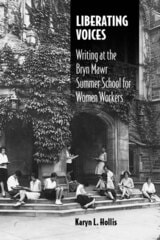
Liberating Voices
Writing at the Bryn Mawr Summer School for Women WorkersKaryn L. Hollis
Southern Illinois University Press, 2004
During the 1920s and 1930s at the Bryn Mawr Summer School for Women Workers, working-class women were educated in the liberal arts and instructed in writing to assume more powerful roles in the industrial workplace. In Liberating Voices: Writing at the Bryn Mawr Summer School for Women Workers, Karyn L. Hollis tells the remarkable story of how this multiclass, multiethnic American institution rooted in composition pedagogy, literary history, and leftist thought emerged from the broad social, economic, and ideological trends of the era. The summer school curriculum, Hollis shows, enhanced the individual and collective self-confidence of the 1,800 women who studied there between 1921 and 1938.
Drawing heavily on the women’s writings—including autobiography, poetry, labor drama, humor, and economic reporting—Liberating Voices adds significantly to the small oeuvre of published writing by working-class women, who were, in this case, mostly nontraditional students, immigrants, and minorities. Outlining a materialist pedagogy that centers on the women’s daily economic struggles as well as their family and community experiences, Hollis reveals the tensions that stemmed from differences in race, ethnicity, class, and religion. She also shows how the students exploited cultural scripts and drew strength from their diversity, eventually insisting on a democratic sharing of power with faculty and administrators at the Summer School.
Hollis provides a thorough ethnography of the Summer School with respect to its place in the social and political history of the 1920s and 1930s, and then situates the school’s pedagogy within the history of American education and composition instruction. Concepts from literary criticism and composition theory provide the framework for an analysis of the working women’s autobiographical writing, revealing how the narrative voice of their prose grew from weak and individualized to empowered and collective as the women described their families, childhood, work, unions, and education over time. The volume is complemented by sixteen illustrations.
Additional analysis of the women’s poetry points to their skill as both producers and consumers of literature. The common theme of body versus a powerful machine in the workplace bears witness to the industrial exploitation the women endured. Taking up postmodern questions of agency and voice, Hollis argues that the women used a variety of cultural texts to construct discourses that reflected their needs and desires. Liberating Voices not only provides a previously untold chapter in the history of American worker education, it also showcases a liberating pedagogy that has salient implications for contemporary classrooms.
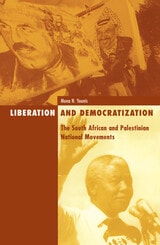
Liberation and Democratization
The South African and Palestinian National MovementsMona N. Younis
University of Minnesota Press, 2000
The first comprehensive comparison of two of the century’s most important liberation movements.
Arising in the 1910s and emerging as legitimate governing bodies in the 1990s, the South African and the Palestinian national liberation movements have exhibited remarkable parallels over the course of their development. The fortunes of the African National Congress and the Palestinian Liberation Organization, however, have proven strikingly different. How the movements, despite similar circumstances and experiences, have arrived at such dissimilar outcomes is described in Liberation and Democratization.
Younis traces the evolution of the movements, from early domination by elites to the ascendancy of mass-based forces in their last phases of expansion. She shows how this latest shift, accompanied by a democratization of the process of liberation, made the movements more effective in the 1980s. Liberation and Democratization also identifies dissimilarities—the balance of class forces and resources—that led to the A.N.C.’s greater success relative to the P.L.O.’s achievements. The first comprehensive comparison of two of the most significant liberation movements of this century, Younis’s work brings to light problems and dynamics that will remain at work well into the future.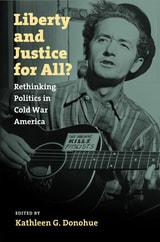
Liberty and Justice for All?
Rethinking Politics in Cold War AmericaKathleen G. Donohue
University of Massachusetts Press, 2012
From the congressional debate over the “fall of China” to the drama of the Army–McCarthy hearings to the kitchen faceoff between Richard Nixon and Nikita Khrushchev, the political history of the early Cold War was long dominated by studies of presidential administrations, anticommunism, and foreign policy. In Liberty and Justice for All? a group of distinguished historians representing a variety of disciplinary perspectives—social history, cultural history, intellectual history, labor history, urban history, women's history, African American studies, and media studies—expand on the political history of the early Cold War by rethinking the relationship between politics and culture. How, for example, did folk music help to keep movement culture alive throughout the 1950s? How did the new medium of television change fundamental assumptions about politics and the electorate? How did American experiences with religion in the 1950s strengthen the separation of church and state? How did race, class, and gender influence the relationship between citizens and the state? These are just some of the questions addressed in this wide-ranging set of essays.
In addition to volume editor Kathleen G. Donohue, contributors include Howard Brick, Kari Frederickson, Andrea Friedman, David Greenberg, Grace Elizabeth Hale, Jennifer Klein, Laura McEnaney, Kevin M. Schultz, Jason Scott Smith, Landon R. Y. Storrs, and Jessica Weiss.
Libidinal Currents
Sexuality and the Shaping of ModernismJoseph Allen Boone
University of Chicago Press, 1997
Challenging overarching theories of the novel by carefully mapping the historical contexts that have influenced modern experimental narratives, Boone constructs a model for interpreting sexuality that reaches from Freud's theory of the libidinal instincts to Foucault's theory of sexual discourse. The most ambitious study yet written on the links between literary modernity and the psychology of sex, Boone's Libidinal Currents will be a landmark book in the study of modernist fiction, gay studies/queer theory, feminist criticism, and studies in sexuality and gender.
Libraries and the Reading Public in Twentieth-Century America
Edited by Christine Pawley and Louise S. Robbins
University of Wisconsin Press, 2013
Lie Of The Land
Migrant Workers and the California LandscapeDon Mitchell
University of Minnesota Press, 1996
A hard-hitting look at the story behind California's famous scenery.
The beauty of the California landscape is integral to its place in the imagination of generations of people around the world. In The Lie of the Land, geographer Don Mitchell looks at the human costs associated with this famous scenery. Through an account of the labor history of the state, Mitchell examines the material and ideological struggles over living and working conditions that played a large part in the construction of the contemporary California landscape.
The Lie of the Land examines the way the California landscape was built on the backs of migrant workers, focusing on migratory labor and agribusiness before World War II. The book relates the historical geography of California to the processes of labor that made it, discussing not only significant strikes but also on the everyday existence of migrant workers in the labor camps, fields, and “Hoovervilles” where they lived. Mitchell places class struggle at the heart of social development, demonstrating concretely how farm workers affected their social and material environment, as well as exploring how farm owners responded to their workers’ efforts to improve their living and working conditions. Mitchell also places “reformers” in context, revealing the actual nature of their role in relation to migrant workers’ efforts—that of undermining the struggle for genuine social change. In addition, this volume captures the significance of the changing composition of the agricultural workforce, particularly in racial terms, as the class struggle evolved over a period of decades. Mitchell has written a narrative history that describes the intimate connection between landscape representations and the material form of geography. The Lie of the Land places people squarely in the middle of the landscapes they inhabit, shedding light on the complex and seemingly contradictory interactions between progressive state agents, radical workers, and California growers as they seek to remake the land in their own image.
Lies, Passions, and Illusions
The Democratic Imagination in the Twentieth CenturyFrançois Furet
University of Chicago Press, 2014
This conversation would be, sadly, Furet’s last—he died while Ricoeur was completing his edits. Ricoeur did not want to publish his half without Furet’s approval, so what remains is Furet’s alone, an astonishingly cohesive meditation on the political passions of the twentieth century. With strokes at once broad and incisive, he examines the many different trajectories that nations of the West have followed over the past hundred years. It is a dialogue with history as it happened but also as a form of thought. It is a dialogue with his critics, with himself, and with those major thinkers—from Tocqueville to Hannah Arendt—whose ideas have shaped our understanding of the tragic dramas and upheavals of the modern era. It is a testament to the crucial role of the historian, a reflection on how history is made and lived, and how the imagination is a catalyst for political change. Whether new to Furet or deeply familiar with his work, readers will find thought-provoking assessments on every page, a deeply moving look back at one of the most tumultuous periods of history and how we might learn and look forward from it.
Life Stages and Native Women
Memory, Teachings, and Story MedicineKim Anderson
University of Manitoba Press, 2011
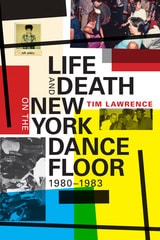
Life and Death on the New York Dance Floor, 1980–1983
Tim Lawrence
Duke University Press, 2016
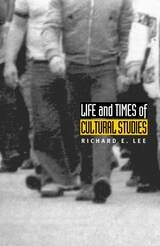
Life and Times of Cultural Studies
The Politics and Transformation of the Structures of KnowledgeRichard E. Lee
Duke University Press, 2003
Lee tracks the intellectual project of cultural studies as it developed over three decades, beginning with its institutional foundation at the University of Birmingham’s Centre for Contemporary Cultural Studies (CCCS). He links work at the CCCS to the events of 1968 and explores cultural studies’ engagement with theory in the debates on structuralism. He considers the shift within the discipline away from issues of working-class culture toward questions of identity politics in the fields of race and gender. He follows the expansion of the cultural studies project from Britain to Australia, Canada, South Africa, and the United States. Contextualizing the development and spread of cultural studies within the longue durée structures of knowledge in the modern world-system, Lee assesses its past and future as an agent of political and social change.
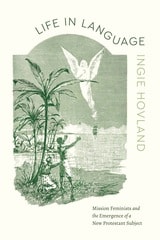
Life in Language
Mission Feminists and the Emergence of a New Protestant SubjectIngie Hovland
University of Chicago Press, 2025
The language of the Bible is a powerful lens through which many Protestants understand themselves and their world, and its prohibitions on women’s speech pose complicated challenges to women. Nevertheless, women frequently serve as vocal leaders in Protestant organizations, including the early twentieth-century Norwegian Mission Society. In Life in Language, Ingie Hovland offers a unique biography of Henny Dons, a leader of the society’s so-called mission feminists, that grapples with ways Protestant women crafted innovative, expansive self-understandings through Christian language. More than their male peers, the mission feminists turned to religious speech to express material, as well as heavenly, desires for paid work, voting rights, and more, and Hovland argues that these experiments in women speaking, reading, writing, and listening paved the way for a new way of being in the world.
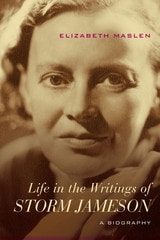
Life in the Writings of Storm Jameson
A BiographyElizabeth Maslen
Northwestern University Press, 2014
Margaret Storm Jameson (1891–1986) is primarily known as a compelling essayist; her stature as a novelist and champion of the dispossessed is largely forgotten. In Life in the Writings of Storm Jameson, Elizabeth Maslen reveals a figure who held her own beside fellow British women writers, including Virginia Woolf; anticipated the Angry Young Women, such as Doris Lessing; and was an early champion of such European writers as Arthur Koestler and Czesław Miłosz. Jameson was a complex character whose politics were grounded in social justice; she was passionately antifascist—her novel In the Second Year (1936) raised the alarm about Nazism—but always wary of communism. An eloquent polemicist, Jameson was, as president of the British P.E.N. during the 1930s and 1940s, of invaluable assistance to refugee writers. Elizabeth Maslen’s biography introduces a true twentieth century hedgehog, whose essays and subtly experimental fiction were admired in Europe and the States.
Life of a Poet
Rainer Maria RilkeRalph Freedman
Northwestern University Press, 1998
Life on Ice
A History of New Uses for Cold BloodJoanna Radin
University of Chicago Press, 2017
The Cold War projects Radin tracks were meant to form an enduring total archive of indigenous blood before it was altered by the polluting forces of modernity. Freezing allowed that blood to act as a time-traveling resource. Radin explores the unique cultural and technical circumstances that created and gave momentum to the phenomenon of life on ice and shows how these preserved blood samples served as the building blocks for biomedicine at the dawn of the genomic age. In an era of vigorous ethical, legal, and cultural debates about genetic privacy and identity, Life on Ice reveals the larger picture—how we got here and the promises and problems involved with finding new uses for cold human blood samples.
Life should be Transparent
Conversations about Lithuania and Europe in the Twentieth Century and TodayAurimas Svedas
Central European University Press, 2020
This book of thirteen conversations introduces us to the life of an exceptional person—theatre critic, Germanist, and long-time chair of the Open Lithuania Fund board—Irena Veisaitė. The dialogue between Lithuanian historian Aurimas Švedas and a woman who reflects deeply on her experiences reveals both one individual’s historically dramatic life and the fate of Europe and Lithuania in the twentieth century.
Through the complementary lenses of history and memory, we confront with Veisaitė the horrific events of the Holocaust, which brought about the end of the Lithuanian Jewish world. We also meet an array of world-class cultural figures, see fragments of legendary theatre performances, and hear meaningful words that were spoken or heard decades ago.
This book’s interlocutors do not so much seek to answer the question “What was it like?” but instead repeatedly ask each other: “What, how, and why do we remember? What is the meaning of our experiences? How can history help us to live in the present and create the future? How do we learn to understand and forgive?”
A series of Veisaitė’s texts, statements, and letters, presented at the end of the book suggest further ways of answering these questions.
Lifespan Narratives
Ten Stories from a Time of Disruption; Chronicle of Emotions, Notebook 3Alexander Kluge
Seagull Books, 2025
A poignant exploration of post–World War II life, blending fictional and non-fictional stories that challenge traditions and reflect on the enduring impact of historical disruptions.
Lifespan Narratives has to do with stories, fictitious and not, which present a sad chronicle and question tradition from several different perspectives. Originally comprising Alexander Kluge’s first book, these stories were written between the years 1958 and 1962, in which he emphasizes the importance of continuously questioning our past. He underscores the necessity of recounting lifespan narratives even from today’s viewpoint, proposing that “life in a time of disruption” should be viewed as a constant experiential substance, transcending any single era.
In Lifespan Narratives, readers are invited to explore the enduring impact of historical disruptions through Kluge’s masterful storytelling, which remains as relevant today as it was in the years following the Second World War. For this edition, the English translation of a selection of stories by Leila Vennewitz has been expanded by Alexander Booth in conjunction with the author.
Light of Reason, Light of Faith
Joseph Ratzinger and the German EnlightenmentMaurice Ashley Agbaw-Ebai
St. Augustine's Press, 2021
Ratzinger’s extraordinary and sympathetic understanding of the sources of contemporary secularism equipped him to appreciate the gains of the Enlightenment, while still being a fierce critic of the losses humanity has suffered when reason falsely excludes faith. Fr. Agbaw-Ebai’s account reveals Ratzinger, in relation to his various interlocutors, to be the truly “enlightened” one because he demonstrates a truly balanced understanding of the human mind. To be truly rational one must be able to hold to faith and reason both, reason informed by faith in Jesus Christ.
A particular merit of this book is Agbaw-Ebai’s presentation of Ratzinger’s treatment of the German Enlightenment’s greatest contributors: Kant, Nietzche, Hegel and Habermas, among others. In the postscript George Weigel characterizes what this study accomplishes in the larger framework of scholarship. “[Ratzinger’s] position remains too often misunderstood, and sometimes deliberately misinterpreted, throughout the whole Church. And to misunderstand, or misinterpret, Ratzinger is to misunderstand or misinterpret both the modern history of theology and the Second Vatican Council.” Agbaw-Ebai masterfully positions Ratzinger correctly in the history of ideas, and exhibits why Ratzinger will be remembered as one of its main players. Pure rationalists and true believers are equally indebted to him.
Like Cattle and Horses
Nationalism and Labor in Shanghai, 1895-1927S. A. Smith
Duke University Press, 2002
While the massive wave of labor protest in the 1920s was principally an expression of militant nationalism rather than of class consciousness, Smith argues, elements of a precarious class identity were in turn forged by the very discourse of nationalism. By linking work-related demands to the defense of the nation, anti-imperialist nationalism legitimized participation in strikes and sensitized workers to the fact that they were worthy of better treatment as Chinese citizens. Smith shows how the workers’ refusal to be treated “like cattle and horses” (a phrase frequently used by workers to describe their condition) came from a new but powerfully felt sense of dignity. In short, nationalism enabled workers to interpret the anger they felt at their unjust treatment in the workplace in political terms and to create a link between their position as workers and their position as members of an oppressed nation. By focusing on the role of the working class, Like Cattle and Horses is one of very few studies that examines nationalism “from below,” acknowledging the powerful agency of nonelite forces in promoting national identity.
Like Cattle and Horses will interest historians of labor, modern China, and nationalism, as well as those engaged in the study of revolutions and revolt.
Like Friends, Like Foes
Japanese Americans and Nevada through World War IIAndrew B. Russell
University of Nevada Press, 2026
Like Friends, Like Foes offers a comprehensive analysis of how Nevada residents responded and reacted to the “Japanese Question” during World War II. Both before and during the war, the experience of Japanese American residents of Nevada varied widely. Once the war started, Japanese immigrants experienced an unusual case of mass internment from the mining towns of Ruth and McGill, Nevada, while Japanese American railroad workers and their families, scattered across the state, faced sudden layoffs and evictions. At the same time, most of the Japanese Americans living in Nevada fared much better than their counterparts who resided in the surrounding states.
Andrew Russell’s study examines how variations in local history and local circumstances generated starkly different perspectives and responses to the supposed “Japanese problems” confronting Nevada’s small communities, the state, and the larger region. While Russell’s interpretive history spotlights some highly unusual developments, it nevertheless offers fresh evidence of how individuals or small groups can play significant roles in combating the abuse of civil rights during times of fear and uncertainty.
Like Thunder
Poets Respond to Violence in AmericaVirgil & Ryan G. Suarez & Van Cleave
University of Iowa Press, 2002
More than 140 poems by 120 of America's best poets that focus on the effects of violence in contemporary America.
From Waco to Columbine, from Oklahoma City to New York City, from domestic abuse and drive-by shootings to religious fanaticism and acts of terrorism, the poems in Like Thunder are for those who have perished and those who have survived. More than 140 poems by 120 poets focus, in the editors' words, on “the violence in the news, the violence in our schools, the violence in our homes, as well as the violence in our own minds.”
The poets gathered here articulate terror and suffering but also present images of hope and redemption; they write of individual menaces and individual victims and the melding of the two that potentially exists in everyone. By transforming horrifying details into larger truths, they create a poetry of witness, of survival, and of remembrance.
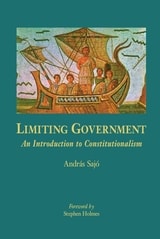
Limiting Government
An Introduction to ConstitutionalismAndrás Sajó
Central European University Press, 1999
Until the previous decade, constitutionalism in Eastern Europe was considered to be an outmoded concept of the nineteenth century. Changes in the region, however, have brought back the fundamental question of the need to restrict government power through social self-binding.
This book discusses the mechanisms of such restriction, including different forms of the separation of powers and constitutional review. It relates the theoretical and practical importance of the issue to the present world-wide discontent with majoritarian democracy and the growing disrepute of parliaments. Increasing executive efficiency is, however, a threat to fundamental rights, and the battlecry of efficiency is often only a means to new despotism and inefficiency. A careful re-evaluation of the concept of constitutionalism assists in the search for a useful balance between majoritarianism and rights, and in the avoidance of all forms of public tyranny.
Written in non-technical language and using the most important English, American, French, and German examples of constitutional history, the book also examines East European (in particular, Russian) and Latin American examples, in part to illustrate certain dead-ends in constitutional development. It is intended to be an introduction for all those concerned with liberty.

Limiting Secularism
The Ethics of Coexistence in Indian Literature and FilmPriya Kumar
University of Minnesota Press, 2008
With a backdrop of religious violence and escalating regional tensions in South Asia, Priya Kumar’s Limiting Secularism probes the urgent topic of secularism and tolerance in Indian culture and life. Kumar explores Partition as the founding trauma of the Indian nation-state and traces the consequences of its marking off of “Indian” from “Pakistani” and the positioning of Indian Muslims as strangers within the nation.
Kumar unpacks the implications of the Nehruvian doctrine of tolerance-with all of its resonances of condescension and inequality-and asks whether more ethical cohabitation can replace the “arrogant compulsive tolerance” of the state and the majority. Informed by Jacques Derrida’s recent work on hospitality and living together, Kumar argues for the emergence of an “ethics of coexistence” in Indian fiction and film. Considering narratives ranging from the cosmopolitan English novels of Rushdie and Ghosh to literature in South Asian languages as well as recent Hindi cinema, Kumar demonstrates that these fictions are important resources for reimagining tolerance and coexistence.
Distinctive and timely in its investigation of secularism and communalism, Limiting Secularism works to envision the radical possibilities of going beyond tolerance to living well together.
Priya Kumar is associate professor of English at the University of Iowa.