Results by title
8812 books match the query 'Political Science' and 280 start with l
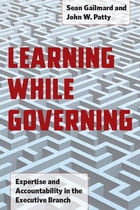
Learning While Governing
Expertise and Accountability in the Executive BranchSean Gailmard and John W. Patty
University of Chicago Press, 2013
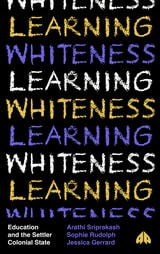
Learning Whiteness
Education and the Settler Colonial StateArathi Sriprakash
Pluto Press, 2022
Learning Whiteness examines the material conditions, knowledge politics and complex feelings that create and relay systems of racial domination. Focusing on Australia, the authors demonstrate how whiteness is fundamentally an educational project – taught within education institutions and through public discourse – in active service of the settler colonial state.
To see whiteness as learned is to recognize that it can be confronted. This book invites readers to reckon with past and present politics of education in order to imagine a future thoroughly divested from racism.

Learning by Voting
Sequential Choices in Presidential Primaries and Other ElectionsRebecca B. Morton and Kenneth C. Williams
University of Michigan Press, 2001
Does the movement to a large number of early presidential primaries reduce the ability of voters to learn about the candidates? Do voters who vote early miss important information by not following the entire campaign, or are they, as some argue, more partisan? In a unique study Rebecca B. Morton and Kenneth C. Williams investigate the impact these changes have on the choices voters make. The authors combine a formal, theoretical model to derive hypotheses with experiments, elections conducted in labs, to test the hypotheses.
Their analysis finds that sequence in voting does matter. In simultaneous voting elections well-known candidates are more likely to win, even if that candidate is the first preference of only a minority of the voters and would be defeated by another candidate, if that candidate were better known. These results support the concerns of policy makers that front-loaded primaries prevent voters from learning during the primary process. The authors also find evidence that in sequential elections those who vote on election day have the benefit of information received throughout the whole course of the campaign, thus supporting concerns with mail-in ballots and other early balloting procedures.
This book will interest scholars interested in elections, the design of electoral systems, and voting behavior as well as the use of formal modeling and experiments in the study of politics. It is written in a manner that can be easily read by those in the public concerned with presidential elections and voting.
Rebecca B. Morton is Associate Professor of Political Science, University of Iowa. Kenneth C. Williams is Associate Professor of Political Science, Michigan State University.
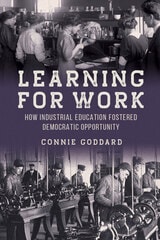
Learning for Work
How Industrial Education Fostered Democratic OpportunityConnie Goddard
University of Illinois Press, 2024
Rooting her account in John Dewey’s ideas, Goddard moves from early nineteenth century supporters of the union of learning and labor to the interconnected histories of CMTS, New Jersey’s Manual Training and Industrial School for Colored Youth, North Dakota’s Normal and Industrial School, and related programs elsewhere. Goddard analyzes the work of movement figures like abolitionist Theodore Weld, educators Calvin Woodward and Booker T. Washington, social critic W.E.B. Du Bois, Dewey himself, and his influential Chicago colleague Ella Flagg Young. The book contrasts ideas about manual training held by advocate Nicholas Murray Butler with those of opponent William Torrey Harris and considers overlooked connections between industrial education and the Arts and Crafts Movement.
An absorbing merger of history and storytelling, Learning for Work looks at the people who shaped industrial education while offering a provocative vision of realizing its potential today.
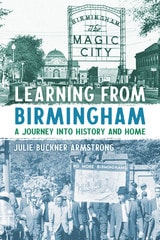
Learning from Birmingham
A Journey into History and HomeJulie Buckner Armstrong
University of Alabama Press, 2023
A steel town daughter’s search for truth and beauty in Birmingham, Alabama
“As Birmingham goes, so goes the nation,” Fred Shuttlesworth observed when he invited Martin Luther King Jr. to the city for the transformative protests of 1963. From the height of the Civil Rights Movement through its long aftermath, images of police dogs, fire hoses and four girls murdered when Ku Klux Klan members bombed the Sixteenth Street Baptist Church have served as an uncomfortable racial mirror for the nation. Like many white people who came of age in the Civil Rights Movement’s wake, Julie Buckner Armstrong knew little about this history. Only after moving away and discovering writers like Toni Morrison and Alice Walker did she realize how her hometown and family were part of a larger, ongoing story of struggle and injustice.
When Armstrong returned to Birmingham decades later to care for her aging mother, Shuttlesworth’s admonition rang in her mind. By then an accomplished scholar and civil rights educator, Armstrong found herself pondering the lessons Birmingham holds for a twenty-first century America. Those lessons extended far beyond what a 2014 Teaching Tolerance report describes as the common distillation of the Civil Rights Movement into “two names and four words: Martin Luther King Jr, Rosa Parks, and ‘I have a dream.’” Seeking to better understand a more complex local history, its connection to broader stories of oppression and resistance, and her own place in relation to it, Armstrong embarked on a journey to unravel the standard Birmingham narrative to see what she would find.
Beginning at the center, with her family’s 1947 arrival to a housing project near the color line, within earshot of what would become known as Dynamite Hill, Armstrong works her way over time and across the map. Weaving in stories of her white working-class family, classmates, and others not traditionally associated with Birmingham’s civil rights history, including members of the city’s LGBTQ community, she forges connections between the familiar and lesser-known. The result is a nuanced portrait of Birmingham--as seen in public housing, at old plantations, in segregated neighborhoods, across contested boundary lines, over mountains, along increasingly polluted waterways, beneath airport runways, on highways cutting through town, and under the gaze of the iconic statue of Vulcan.
In her search for truth and beauty in Birmingham, Armstrong draws on the powers of place and storytelling to dig into the cracks, complicating easy narratives of civil rights progress. Among the discoveries she finds in America’s racial mirror is a nation that has failed to recognize itself in the horrific images from Birmingham’s past and to acknowledge the continuing inequalities that make up the Civil Right’s Movement’s unfinished business. Learning from Birmingham reminds us that stories of civil rights, structural oppression, privilege, abuse, race and gender bias, and inequity are difficult and complicated, but their telling, especially from multiple stakeholder perspectives, is absolutely necessary.
Learning on the Left
Political Profiles of Brandeis UniversityStephen J. Whitfield
Brandeis University Press, 2020
Stephen J. Whitfield makes the case for the pertinence of Brandeis University in understanding the vicissitudes of American liberalism since the mid-twentieth century. Founded to serve as a refuge for qualified professors and students haunted by academic antisemitism, Brandeis University attracted those who generally envisioned the republic as worthy of betterment. Whether as liberals or as radicals, figures associated with the university typically adopted a critical stance toward American society and sometimes acted upon their reformist or militant beliefs. This volume is not an institutional history, but instead shows how one university, over the course of seven decades, employed and taught remarkable men and women who belong in our accounts of the evolution of American politics, especially on the left. In vivid prose, Whitfield invites readers to appreciate a singular case of the linkage of political influence with the fate of a particular university in modern America.
Learning to Change
The Experience of Transforming Education in South East EuropeTerrice Bassler
Central European University Press, 2005
Learning to Eat Soup with a Knife
Counterinsurgency Lessons from Malaya and VietnamJohn A. Nagl
University of Chicago Press, 2005
In examining these two events, Nagl argues that organizational culture is key to the ability to learn from unanticipated conditions, a variable which explains why the British army successfully conducted counterinsurgency in Malaya but why the American army failed to do so in Vietnam, treating the war instead as a conventional conflict. Nagl concludes that the British army, because of its role as a colonial police force and the organizational characteristics created by its history and national culture, was better able to quickly learn and apply the lessons of counterinsurgency during the course of the Malayan Emergency.
With a new preface reflecting on the author's combat experience in Iraq, Learning to Eat Soup with a Knife is a timely examination of the lessons of previous counterinsurgency campaigns that will be hailed by both military leaders and interested civilians.
Learning to Love Form 1040
Two Cheers for the Return-Based Mass Income TaxLawrence Zelenak
University of Chicago Press, 2013
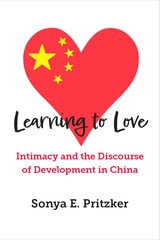
Learning to Love
Intimacy and the Discourse of Development in ChinaSonya E. Pritzker
University of Michigan Press, 2024
Learning to Love offers a range of perspectives on the embodied, relational, affective, and sociopolitical project of “learning to love” at the New Life Center for Holistic Growth, a popular “mind-body-spirit” bookstore and practice space in northeast China, in the early part of the 21st century. This intimate form of self-care exists alongside the fast-moving, growing capitalist society of contemporary China and has emerged as an understandable response to the pressures of Chinese industrialized life in the early 21st century. Opening with an investigation of the complex ways newcomers to the center suffered a sense of being “off,” both in and with the world at multiple scales, Learning to Love then examines how new horizons of possibility are opened as people interact with one another as well as with a range of aesthetic objects at New Life.
Author Sonya Pritzker draws upon the core concepts of scalar intimacy—a participatory, discursive process in which people position themselves in relation to others as well as dominant ideologies, concepts, and ideals—and scalar inquiry—the process through which speakers interrogate these forms, their relationship with them, and their participation in reproducing them. In demonstrating the collaborative interrogation of culture, history, and memory, she examines how these exercises in physical, mental, and spiritual self-care allow participants to grapple with past social harms and forms of injustice, how historical systems of power—including both patriarchal and governance structures—continue in the present, and how they might be transformed in the future. By examining the interactions and relational experiences from New Life, Learning to Love offers a range of novel theoretical interventions into political subjectivity, temporality, and intergenerational trauma/healing.
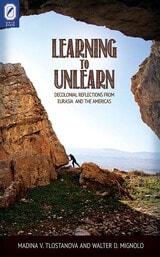
Learning to Unlearn
Decolonial Reflections from Eurasia and the AmericasMadina V. Tlostanova and Walter D. Mignolo
The Ohio State University Press, 2012
Learning to Unlearn: Decolonial Reflections from Eurasia and the Americas is a complex, multisided rethinking of the epistemic matrix of Western modernity and coloniality from the position of border epistemology. Colonial and imperial differences are the two key concepts to understanding how the logic of coloniality creates ontological and epistemic exteriorities. Being at once an enactment of decolonial thinking and an attempt to define its main grounds, mechanisms, and concepts, the book shifts the politics of knowledge from “studying the other” (culture, society, economy, politics) toward “the thinking other” (the authors).
Addressing areas as diverse as the philosophy of higher education, gender, citizenship, human rights, and indigenous agency, and providing fascinating and little-known examples of decolonial thinking, education, and art, Madina V. Tlostanova and Walter D. Mignolo deconstruct the modern architecture of knowledge—its production and distribution as manifested in the corporate university. In addition, the authors dwell on and define the echoing global decolonial sensibilities as expressed in the Americas and in peripheral Eurasia. The book is an important addition to the emerging transoceanic inquiries that introduce decolonial thought and non-Western border epistemologies not only to update or transform disciplines but also to act and think decolonially in the global futures to come.
Leave Me Alone and I'll Make You Rich
How the Bourgeois Deal Enriched the WorldDeirdre Nansen McCloskey and Art Carden
University of Chicago Press, 2020
For readers looking for a distillation of McCloskey’s magisterial work, Leave Me Alone and I’ll Make You Rich is what you’ve been waiting for. In this lively volume, McCloskey and the economist and journalist Carden bring together the trilogy’s key ideas and its most provocative arguments. The rise of the west, and now the rest, is the story of the rise of ordinary people to a dignity and liberty inspiring them to have a go. The outcome was an explosion of innovation after 1800, and a rise of real income by an astounding 3,000 percent. The Great Enrichment, well beyond the conventional Industrial Revolution, did not, McCloskey and Carden show, come from the usual suspects, capital accumulation or class struggle. It came from the idea of economic liberty in Holland and the Anglosphere, then Sweden and Japan, then Italy and Israel and China and India, an idea that bids fair in the next few generations to raise up the wretched of the earth. The original shift to liberalism arose from 1517 to 1789 from theological and political revolutions in northwest Europe, upending ancient hierarchies. McCloskey and Carden contend further that liberalism and “innovism” made us better humans as well as richer ones. Not matter but ideas. Not corruption but improvement.
Leave Me Alone and I’ll Make You Rich draws in entertaining fashion on history, economics, literature, philosophy, and popular culture, from growth theory to the Simpsons. It is the perfect introduction for a broad audience to McCloskey’s influential explanation of how we got rich. At a time when confidence in the economic system is under challenge, the book mounts an optimistic and persuasive defense of liberal innovism, and of the modern world it has wrought.
Left Legalism/Left Critique
Wendy Brown and Janet Halley, eds.
Duke University Press, 2002
Brown and Halley have assembled essays from diverse contributors—law professors, philosophers, political theorists, and literary critics—united chiefly by their willingness to think critically from the left about left legal projects. The essays themselves vary by topic, by theoretical approach, and by conclusion. While some contributors attempt to rework particular left legal projects, others insist upon abandoning or replacing those projects. Still others leave open the question of what is to be done as they devote their critical attention to understanding what we are doing. Above all, Left Legalism/Left Critique is a rare contemporary argument and model for the intellectually exhilarating and politically enriching dimensions of left critique—dimensions that persist even, and perhaps especially, when critique is unsure of the intellectual and political possibilities it may produce.
Contributors: Lauren Berlant, Wendy Brown, Judith Butler, Drucilla Cornell, Richard T. Ford, Katherine M. Franke, Janet Halley, Mark Kelman, David Kennedy, Duncan Kennedy, Gillian Lester, Michael Warner
Left Populism in Europe
Lessons from Jeremy Corbyn to PodemosMarina Prentoulis
Pluto Press, 2021
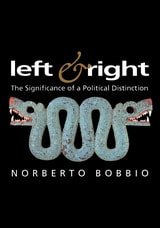
Left and Right
The Significance of a Political DistinctionNorberto Bobbio
University of Chicago Press, 1996
Bobbio argues that left and right are not absolute terms, but represent a shifting map of the political spectrum, relative to the particular cultural and historical contexts of a given time. The distinction continues to endure because it reflects the essentially antithetical nature and dynamics of democratic politics. In his accessible yet provocative style, Bobbio constructs a historically informed, analytic division of the political universe along two foundational axes, from equality to inequality, from liberty to authoritarianism. He then charts the past and present tendencies of the left and the right, in both their more moderate and more virulently extreme forms. Ultimately, for Bobbio, the measure of post-modern democracy will indeed lie in where and how we situate ourselves relative to these critical left/right parameters, in whether we cast ourselves, our votes, and our era in terms of political expediency, social viability, or moral responsibility.
A bestseller in Italy, where it sold over three hundred thousand copies, Left and Right is an important contribution to our understanding of global political developments in the 1990s and beyond.
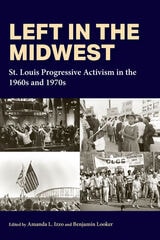
Left in the Midwest
St. Louis Progressive Activism in the 1960s and 1970sAmanda L. Izzo
University of Missouri Press, 2023
Despite St. Louis’s mid-twentieth-century reputation as a conservative and sleepy midwestern metropolis, the city and its surrounding region have long played host to dynamic forms of social-movement organizing. This was especially the case during the 1960s and 1970s, when a new generation of local activists lent their energies to the ongoing struggles for Black freedom, lesbian and gay liberation, feminist social transformations, environmental protection, an end to the Vietnam War, and more. This volume, the first of its kind, offers fifteen scholarly contributions that together bring into focus the exceptional range of progressive activist projects that took shape in a single midwestern city during these tumultuous decades.
In contrast to scholarship that seeks to interpret the era’s social-movement initiatives in a primarily national context, the works presented in this expansive collection emphasize the importance of locality, neighborhood, community institutions, and rooted social networks. Documenting wrenching forces of metropolitan change as well as grassroots resilience, Left in the Midwest shows us how place powerfully shaped agendas, worldviews, and opportunities for the disparate groups that dedicated themselves to progressive visions for their city. By revising our sense of the region’s past, this volume also expands our sense of the possibilities that the future may hold for activist movements seeking change in St. Louis and beyond.
Legacies of Losing in American Politics
Jeffrey K. Tulis and Nicole Mellow
University of Chicago Press, 2017
With Legacies of Losing in American Politics, Jeffrey K. Tulis and Nicole Mellow rethink three pivotal moments in American political history: the founding, when anti-Federalists failed to stop the ratification of the Constitution; the aftermath of the Civil War, when President Andrew Johnson’s plan for restoring the South to the Union was defeated; and the 1964 presidential campaign, when Barry Goldwater’s challenge to the New Deal order was soundly defeated by Lyndon B. Johnson. In each of these cases, the very mechanisms that caused the initial failures facilitated their eventual success. After the dust of the immediate political defeat settled, these seemingly discredited ideas and programs disrupted political convention by prevailing, often subverting, and occasionally enhancing constitutional fidelity. Tulis and Mellow present a nuanced story of winning and losing and offer a new understanding of American political development as the interweaving of opposing ideas.

Legacies of the War on Poverty
Martha J. Bailey
Russell Sage Foundation, 2013
Legacy and Legitimacy
Black Americans and the Supreme CourtRosalee A. Clawson and Eric N. Waltenburg
Temple University Press, 2008
Thoroughly grounded in the latest scholarly literature, theoretical sources, and experimental results, Legacy and Legitimacy substantially advances understanding of Black Americans’ attitudes toward the Supreme Court, the Court’s ability to influence Blacks’ opinions about the legitimacy of public institutions and policies, and the role of media in shaping Blacks’ judgments.
Drawing on legitimacy theory—which explains the acceptance of or tolerance for controversial policies—the authors begin by reexamining the significance of “diffuse support” in establishing legitimacy. They provide a useful overview of the literature on legitimacy and a concise history of the special relationship between Blacks and the Court. They investigate the influences of group attitudes and media “framing.” And they employ data from large-scale surveys to show that Blacks with greater levels of diffuse support for the Court are more likely to adopt positions consistent with Court rulings.
With its broad scope and inclusion of new experimental findings, Legacy and Legitimacy will interest students and scholars of judicial politics, racial politics, media and politics, black studies and public opinion.
Legal Advocacy
Lawyers and Nonlawyers at WorkHerbert M. Kritzer
University of Michigan Press, 1998
The analysis shows clearly that nonlawyers can be effective advocates and, in some situations, more effective than many lawyers. Kritzer combines an examination of case outcomes with a systematic observation of advocates in the hearing room, providing a compelling portrait of their work and a solid basis for understanding the differences in the effectiveness of advocates with different training. The author's findings have important implications for our policies toward restrictions on those who can provide legal assistance, specialization in training and practice, and the meaning of professional monopolies in a world of increasing complexity.
This book will appeal to student of the legal process, the sociology of professions, and all concerned with the operation of the U.S. legal system.
Herbert M. Kritzer is Professor of Political Science and Law, University of Wisconsin--Madison. He is the author of Let's Make a Deal and The Justice Broker.

Legal Care
Advocacy and Friction in Family DetentionErin Routon
University of Arizona Press, 2026
Family detention garnered much public attention when it expanded dramatically in 2014 as significantly increased numbers of migrant groups began arriving and requesting asylum at the Mexico-U.S. border. During this period, the Obama administration designated three detention facilities, two in South Texas, to hold such families while they underwent part of the asylum legal process. One became the largest immigrant detention facility in the country.
In Legal Care anthropologist Erin Routon explores the operations of these facilities through the unique perspectives of volunteer legal advocates. Routon offers a compelling ethnographic account of the hidden labor and emotional resilience of those advocates. Through the lens of “legal care,” Routon reframes legal aid as a form of caregiving, revealing how these advocates resist the structural and legal violence of family detention while supporting asylum-seeking parents and children. Drawing on immersive fieldwork and firsthand narratives, the book exposes the human cost of administrative incarceration and the quiet power of care in spaces designed to exclude.
Timely, urgent, and deeply humane, this work speaks to scholars and practitioners across anthropology, law and society, migration studies, and carceral justice. Routon’s accessible and evocative writing invites readers to reconsider activism and advocacy, offering new language for understanding resistance and solidarity in the face of institutional violence. This book is essential reading for anyone committed to justice, care, and the future of immigration policy in the United States.
Legal Plunder
The Predatory Dimensions of Criminal JusticeJoshua Page and Joe Soss
University of Chicago Press, 2025
A searing, historically rich account of how US policing and punishment have been retrofitted over the last four decades to extract public and private revenues from America’s poorest and most vulnerable communities.
Alongside the rise of mass incarceration, a second profound and equally disturbing development has transpired. Since the 1980s, US policing and punishment have been remade into tools for stripping resources from the nation’s most oppressed communities and turning them into public and private revenues. Legal Plunder analyzes this development’s origins, operations, consequences, and the political struggles that it has created.
Drawing on historical and contemporary evidence, including original ethnographic research, Joshua Page and Joe Soss examine the predatory dimensions of criminal legal governance to show how practices that criminalize, police, and punish have been retrofitted to siphon resources from subordinated groups, subsidize governments, and generate corporate profits. As tax burdens have declined for the affluent, this financial extraction—now a core function of the country’s sprawling criminal legal apparatus—further compounds race, class, and gender inequalities and injustices. Legal Plunder shows that we can no longer afford to overlook legal plunder or the efforts to dismantle it.

Legal Plunder
The Predatory Dimensions of Criminal JusticeJoshua Page and Joe Soss
University of Chicago Press, 2025
This is an auto-narrated audiobook version of this book.
A searing, historically rich account of how US policing and punishment have been retrofitted over the last four decades to extract public and private revenues from America’s poorest and most vulnerable communities.
Alongside the rise of mass incarceration, a second profound and equally disturbing development has transpired. Since the 1980s, US policing and punishment have been remade into tools for stripping resources from the nation’s most oppressed communities and turning them into public and private revenues. Legal Plunder analyzes this development’s origins, operations, consequences, and the political struggles that it has created.
Drawing on historical and contemporary evidence, including original ethnographic research, Joshua Page and Joe Soss examine the predatory dimensions of criminal legal governance to show how practices that criminalize, police, and punish have been retrofitted to siphon resources from subordinated groups, subsidize governments, and generate corporate profits. As tax burdens have declined for the affluent, this financial extraction—now a core function of the country’s sprawling criminal legal apparatus—further compounds race, class, and gender inequalities and injustices. Legal Plunder shows that we can no longer afford to overlook legal plunder or the efforts to dismantle it.
Legal Rights
Historical and Philosophical PerspectivesAustin Sarat and Thomas R. Kearns, Editors
University of Michigan Press, 1997
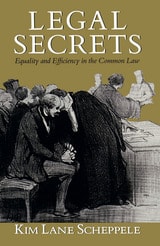
Legal Secrets
Equality and Efficiency in the Common LawKim Lane Scheppele
University of Chicago Press, 1988
Kim Lane Scheppele answers the question, Which secrets are legal secrets and what makes them so? She challenges the economic theory of law, which argues that judges decide cases in ways that maximize efficiency, and she shows that judges use equality as an important principle in their decisions. In the course of thinking about secrets, Scheppele also explores broader questions about judicial reasoning—how judges find meaning in legal texts and how they infuse every fact summary with the values of their legal culture. Finally, the specific insights about secrecy are shown to be consistent with a general moral theory of law that indicates what the content of law should be if the law is to be legitimate, a theory that sees legal justification as the opportunity to attract consent.
This is more than a book about secrets. It is also a book about the limits of an economic view of law. Ultimately, it is a work in constructive legal theory, one that draws on moral philosophy, sociology, economics, and political theory to develop a new view of legal interpretation and legal morality.
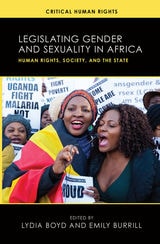
Legislating Gender and Sexuality in Africa
Human Rights, Society, and the StateEdited by Lydia Boyd and Emily Burrill
University of Wisconsin Press, 2020
Legislating Gender and Sexuality in Africa details how legal efforts in the continent can often be moralizing enterprises, illuminating how these processes are closely tied to notions of ethics, personhood, and citizenship. The contributors provide new appraisals of recent events, with fresh arguments about the relationships between local and global fights for rights. This interdisciplinary approach will appeal to scholars in African studies, anthropology, history, and gender studies.
Legislating in the Dark
Information and Power in the House of RepresentativesJames M. Curry
University of Chicago Press, 2015
The answer? They aren’t. With Legislating in the Dark, James M. Curry reveals that the availability of information about legislation is a key tool through which Congressional leadership exercises power. Through a deft mix of legislative analysis, interviews, and participant observation, Curry shows how congresspersons—lacking the time and resources to study bills deeply themselves—are forced to rely on information and cues from their leadership. By controlling their rank-and-file’s access to information, Congressional leaders are able to emphasize or bury particular items, exploiting their information advantage to push the legislative agenda in directions that they and their party prefer.
Offering an unexpected new way of thinking about party power and influence, Legislating in the Dark will spark substantial debate in political science.
Legislative Entrepreneurship in the U.S. House of Representatives
Gregory Wawro
University of Michigan Press, 2001
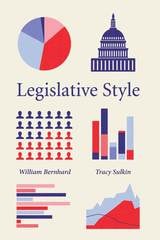
Legislative Style
William Bernhard and Tracy Sulkin
University of Chicago Press, 2018
Bernhard and Sulkin have developed a systematic approach for looking at legislative style through a variety of criteria, including the number of the bills passed, number of speeches given, amount of money raised, and the percentage of time a legislator voted in line with his or her party. Applying this to ten congresses, representing twenty years of congressional data, from 1989 to 2009, they reveal that legislators’ activity falls within five predictable styles. These styles remain relatively consistent throughout legislators’ time in office, though a legislator’s style can change as career goals evolve, as well as with changes to individual or larger political interests, as in redistricting or a majority shift. Offering insight into a number of enduring questions in legislative politics, Legislative Style is a rich and nuanced account of legislators’ activity on Capitol Hill.
Legislators and Politicians
Iowa's Women LawmakersSuzanne O'Dea Schenken
University of Iowa Press, 1995
Legislatures
Comparative Perspectives on Representative AssembliesGerhard Loewenberg, Peverill Squire, and D. Roderick Kiewiet, Editors
University of Michigan Press, 2002
Consisting of fourteen essays, this volume incorporates major areas of legislative research, including studies of recruitment of legislators and an overview of their careers, the evolution of legislatures, and the electoral systems by which legislatures are chosen. Each contributor reviews the principal research findings and emphasizes those concepts and methods that facilitate comparative research. The book assesses the state of knowledge in regard to U.S., European, Asian, and Latin American legislatures. The introductory chapter by the editors identifies how to comparatively test research findings while taking into account data availability and questions of conceptual equivalence. Each chapter provides an extensive bibliography, making the book an excellent guide to literature on legislative research. The contributors are David T. Canon, John M. Carey, Gary W. Cox, Frantisek Formanek, John R. Hibbing, Ewa Karpowicz, Junko Kato, Sadafumi Kawato, Michael Laver, Gary F. Moncrief, Chan Wook Park, Werner J. Patzelt, Bjorn Erik Rasch, Kenneth A. Shepsle, Steven S. Smith, and Rick K. Wilson.
This book is designed for faculty and graduate students in political science and will also be of interest to members of legislative research staffs in this country and overseas, and to specialists on legislatures in history and law.
Gerhard Loewenberg is University of Iowa Foundation Distinguished Professor of Political Science. D. Roderick Kiewiet is Dean of Graduate Studies and Professor of Political Science, California Institute of Technology, Pasadena. Peverill Squire is Professor of Political Science, University of Iowa.
Legitimating Nationalism
Political Identity in Russia's Ethnic RepublicsKatie L. Stewart
University of Wisconsin Press, 2024
Even in the current autocratic system, however, Russia’s multiethnic nature and fractured political history mean that not all political symbols work the same way everywhere; not every story finds the same audience in the same way. The message may emanate from Moscow, but regional actors—including local governments, civic organizations, and cultural institutions—have some agency in how they spread the message: some regionalization of identity work is permitted to ensure that Russian national symbols and narratives resonate with people, and to avoid protest. This book investigates how nation building works on the ground through close studies of three of Russia’s ethnic republics: Karelia, Tatarstan, and Buryatia. Understanding how the project of legitimating nationalism, in support of a unified country and specifically Putin’s regime, works in practice offers crucial context in understanding the shape and story of contemporary Russia.
Legitimizing Empire
Filipino American and U.S. Puerto Rican Cultural CritiqueFaye Caronan
University of Illinois Press, 2015
Faye Caronan's examination interprets the pivotal engagement of novels, films, performance poetry, and other cultural productions as both symptoms of and resistance against American military, social, economic, and political incursions. Though the Philippines became an independent nation and Puerto Rico a U.S. commonwealth, both remain subordinate to the United States. Caronan's juxtaposition reveals two different yet simultaneous models of U.S. neocolonial power and contradicts American exceptionalism as a reluctant empire that only accepts colonies for the benefit of the colonized and global welfare. Her analysis, meanwhile, demonstrates how popular culture allows for alternative narratives of U.S. imperialism, but also functions to contain those alternatives.
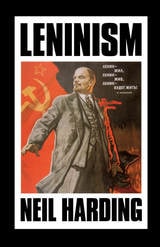
Leninism
Neil Harding
Duke University Press, 1996
Rather than tracing the roots of Leninism to the details of Lenin’s biography, Harding shows how it emerged as a revolutionary Marxist response to the First World War and to the perceived treachery—the support of that war—by social democratic leaders. The economics, politics, and philosophy of Leninism, he argues, were rapidly theorized between 1914 and 1918 and deeply imprinted with the peculiarities of the wartime experience. Its complementary metaphysics of history and science was as intrinsic to its confidence and sureness of purpose as it was to its contempt for democratic practice and tolerance. But, as Harding also shows, although Leninism articulated a complex and coherent critique of capitalist civilization and held a powerful appeal to a variety of constituencies, it was itself caught in a timewarp that fatally limited its capacity to adapt. This book will engage not only Russian and Soviet specialists, but also readers concerned with the varieties of twentieth-century socialism.
Leo Strauss On Plato's Symposium
Leo Strauss
University of Chicago Press, 2001
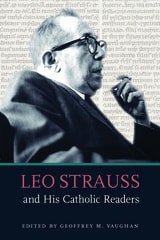
Leo Strauss and His Catholic Readers
Geoffrey M. Vaughan
Catholic University of America Press, 2018
Leo Strauss and the Politics of Exile
The Making of a Political PhilosopherEugene Sheppard
Brandeis University Press, 2007
Leo Strauss and the Problem of Political Philosophy
Michael P. Zuckert and Catherine H. Zuckert
University of Chicago Press, 2014
Leo Strauss and the Rediscovery of Maimonides
Kenneth Hart Green
University of Chicago Press, 2013
An invaluable companion to Green’s comprehensive collection of Strauss’s writings on Maimonides, this volume shows how Strauss confronted the commonly accepted approaches to the medieval philosopher, resulting in both a new understanding of Maimonides and a new depth and direction for his own thought. It will be welcomed by anyone engaged with the work of either philosopher.

Leo Strauss on Hegel
Leo Strauss
University of Chicago Press, 2019
Leo Strauss on Hegel reconstructs Strauss’s seminar on Hegel, supplemented by passages from an earlier version of the seminar from which only fragments of a transcript remain. Strauss focused his seminar on the lectures collected in The Philosophy of History, which he considered more accessible than Hegel’s written works. In his own lectures on Hegel, Strauss continues his project of demonstrating how modern philosophers related to ancient thought and explores the development and weaknesses of modern political theory. Strauss is especially concerned with the relationship in Hegel between empirical history and his philosophy of history, and he argues for the primacy of religion in Hegel’s understanding of history and society. In addition to a relatively complete transcript, Leo Strauss on Hegel also includes annotations, which bring context and clarity to the text.
Leo Strauss on Hobbes
Leo Strauss
University of Chicago Press, 0
Leo Strauss’s final seminar on Thomas Hobbes, representing the culmination of more than four decades of close engagement.
Leo Strauss spent more than four decades studying the work of Thomas Hobbes. In Strauss’s distinctive genealogy of political thought, Hobbes emerges as a decisive counterpoint, not only to the Ancients, but also to Strauss’s own project. Strauss saw Hobbes as both the founder of modern natural rights and the modern esoteric writer par excellence.
Strauss’s final seminar on Hobbes from 1964 is the culmination of his engagement with Hobbes’s corpus and contains the richest account of Strauss’s final insight into the nerve of Hobbes’s thought, linking human consciousness to power and passion. The seminar reflects on the tension between Hobbes’s scientific and political frameworks, Hobbes’s emphasis on rights over duties, Hobbes’s atheism, and Hobbes’s attention to causal thinking as the core capacity that sets humans apart from other animals. It also includes Strauss’s most sustained exchange with the Marxist political theorist, C. B. Macpherson. Their rival interpretations of why the state of nature takes the form of a war of all against all led Strauss to reconsider his earlier writings on Hobbes, including those parts that pertain to other thinkers, such as Aristotle, Locke, and Spinoza.
With an introductory essay by Karl Dahlquist that traces the evolution of Strauss’s thinking on Hobbes and frames Strauss’s dialogue with Macpherson, this 1964 seminar on Hobbes is a vital contribution to political thought and intellectual history.
Leo Strauss on Maimonides
The Complete WritingsLeo Strauss
University of Chicago Press, 2013
With Leo Strauss on Maimonides, Kenneth Hart Green presents for the first time a comprehensive, annotated collection of Strauss’s writings on Maimonides, comprising sixteen essays, three of which appear in English for the first time. Green has also provided careful translations of materials that had originally been quoted in Hebrew, Arabic, Latin, German, and French; written an informative introduction highlighting the original contributions found in each essay; and brought references to out-of-print editions fully up to date. The result will become the standard edition of Strauss’s writings on Maimonides.
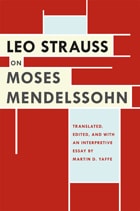
Leo Strauss on Moses Mendelssohn
Leo Strauss
University of Chicago Press, 2012
Moses Mendelssohn (1729–86) was the leading Jewish thinker of the German Enlightenment and the founder of modern Jewish philosophy. His writings, especially his attempt during the Pantheism Controversy to defend the philosophical legacies of Spinoza and Leibniz against F. H. Jacobi’s philosophy of faith, captured the attention of a young Leo Strauss and played a critical role in the development of his thought on one of the fundamental themes of his life’s work: the conflicting demands of reason and revelation.
Leo Strauss on Moses Mendelssohn is a superbly annotated translation of ten introductions written by Strauss to a multi-volume critical edition of Mendelssohn’s work. Commissioned in Weimar Germany in the 1920s, the project was suppressed and nearly destroyed during Nazi rule and was not revived until the 1960s. In addition to Strauss’s introductions, Martin D. Yaffe has translated Strauss’s editorial remarks on each of the passages he annotates in Mendelssohn’s texts and brings those together with the introductions themselves. Yaffe has also contributed an extensive interpretive essay that both analyzes the introductions on their own terms and discusses what Strauss writes elsewhere about the broader themes broached in his Mendelssohn studies.
Strauss’s critique of Mendelssohn represents one of the largest bodies of work by the young Strauss on a single thinker to be made available in English. It illuminates not only a formerly obscure phase in the emergence of his thought but also a critical moment in the history of the German Enlightenment.
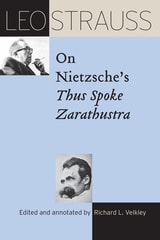
Leo Strauss on Nietzsche's "Thus Spoke Zarathustra"
Leo Strauss
University of Chicago Press, 2017
With Leo Strauss on Nietzsche’s “Thus Spoke Zarathustra,” eminent Strauss scholar Richard L. Velkley presents Strauss’s lectures on Zarathustra with superb annotations that bring context and clarity to the critical role played by Nietzsche in shaping Strauss’s thought. In addition to the broad relationship between Nietzsche and political philosophy, Strauss adeptly guides readers through Heidegger’s confrontations with Nietzsche, laying out Heidegger’s critique of Nietzsche’s “will to power” while also showing how Heidegger can be read as a foil for his own reading of Nietzsche. The lectures also shed light on the relationship between Heidegger and Strauss, as both philosophers saw Nietzsche as a central figure for understanding the crisis of philosophy and Western civilization.
Strauss’s reading of Nietzsche is one of the important—yet little appreciated—philosophical inquiries of the past century, both an original interpretation of Nietzsche’s thought and a deep engagement with the core problems that modernity posed for political philosophy. It will be welcomed by anyone interested in the work of either philosopher.

Leo Strauss on Plato’s "Protagoras"
Leo Strauss
University of Chicago Press, 2022
This book offers a transcript of Strauss’s seminar on Plato’s Protagoras taught at the University of Chicago in the spring quarter of 1965, edited and introduced by renowned scholar Robert C. Bartlett. These lectures have several important features. Unlike his published writings, they are less dense and more conversational. Additionally, while Strauss regarded himself as a Platonist and published some work on Plato, he published little on individual dialogues. In these lectures Strauss treats many of the great Platonic and Straussian themes: the difference between the Socratic political science or art and the Sophistic political science or art of Protagoras; the character and teachability of virtue, its relation to knowledge, and the relations among the virtues, courage, justice, moderation, and wisdom; the good and the pleasant; frankness and concealment; the role of myth; and the relation between freedom of thought and freedom of speech.
In these lectures, Strauss examines Protagoras and the sophists, providing a detailed discussion of Protagoras as it relates to Plato’s other dialogues and the work of modern thinkers. This book should be of special interest to students both of Plato and of Strauss.
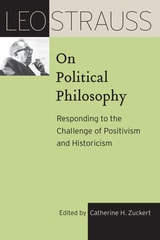
Leo Strauss on Political Philosophy
Responding to the Challenge of Positivism and HistoricismLeo Strauss
University of Chicago Press, 2018
Leo Strauss on Political Philosophy brings together the lectures that comprise Strauss’s “Introduction to Political Philosophy.” Strauss begins by emphasizing the importance of political philosophy in determining the common good of society and critically examining the two most powerful contemporary challenges to the possibility of using political theory to learn about and develop the best political order: positivism and historicism. In seeking the common good, classical political philosophers like Plato and Aristotle did not distinguish between political philosophy and political science. Today, however, political philosophy must contend with the contemporary belief that it is impossible to know what the good society really is. Strauss emphasizes the need to study the history of political philosophy to see whether the changes in the understanding of nature and conceptions of justice that gradually led people to believe that it is not possible to determine what the best political society is are either necessary or valid. In doing so, he ranges across the entire history of political philosophy, providing a valuable, thematically coherent foundation, including explications of many canonical thinkers, such as Auguste Comte and Immanuel Kant, about whom Strauss did not write extensively in his published writings.
Leo Strauss's Defense of the Philosophic Life
Reading "What Is Political Philosophy?"Edited by Rafael Major
University of Chicago Press, 2012
Leo Strauss, Max Weber, and the Scientific Study of Politics
Nasser Behnegar
University of Chicago Press, 2002
Behnegar's impressive book argues that Strauss was not against the scientific study of politics, but he did reject the idea that it could be built upon political science's unexamined assumption of the distinction between facts and values. Max Weber was, for Strauss, the most profound exponent of values relativism in social science, and Behnegar's explication artfully illuminates Strauss's critique of Weber's belief in the ultimate insolubility of all value conflicts.
Strauss's polemic against contemporary political science was meant to make clear the contradiction between its claim of value-free premises and its commitment to democratic principles. As Behnegar ultimately shows, values—the ethical component lacking in a contemporary social science—are essential to Strauss's project of constructing a genuinely scientific study of politics.
Leon Trotsky
Writings in ExileLeon Trotsky
Pluto Press, 2012
Leon Trotsky was a key political figure of the twentieth century – a leader of the Russian Revolution, founder of the Red Army, author of books on literature, history, morality and politics.
Leon Trotsky: Writings in Exile contains some of his most insightful and penetrating works. Exiled and isolated by Stalin, Trotsky used the only weapon he had left – words. In these writings he defends the 1917 revolution, warns prophetically of fascism and analyses anti-colonial movements in the global south.
This collection gives a sense of the real Trotsky – passionate, humanist, Marxist. It will introduce the writings of one of history's great revolutionaries to a new generation.