Results by title
468 books match the query 'Industries' and 37 start with a

A History of Tourism in Africa
Exoticization, Exploitation, and EnrichmentTodd Cleveland
Ohio University Press, 2021
An engaging social history of foreign tourists’ dreams, the African tourism industry’s efforts to fulfill them, and how both sides affect each other.
Since the nineteenth century, foreign tourists and resident tourism workers in Africa have mutually relied upon notions of exoticism, but from vastly different perspectives. Many of the countless tourists who have traveled to the African continent fail to acknowledge or even realize that skilled African artists in the tourist industry repeatedly manufacture “authentic” experiences in order to fulfill foreigners’ often delusional, or at least uninformed, expectations. These carefully nurtured and controlled performances typically reinforce tourists’ reductive impressions—formed over centuries—of the continent, its peoples, and even its wildlife. In turn, once back in their respective homelands, tourists’ accounts of their travels often substantiate, and thereby reinforce, prevailing stereotypes of “exotic” Africa. Meanwhile, Africans’ staged performances not only impact their own lives, primarily by generating remunerative opportunities, but also subject the continent’s residents to objectification, exoticization, and myriad forms of exploitation.
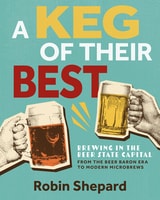
A Keg of Their Best
Brewing in the Beer State Capital—From the Beer Baron Era to Modern MicrobrewsRobin Shepard
Wisconsin Historical Society Press, 2026
Wisconsin has long been known as “The Beer State,” and the history of its capital city brims with stories of brewing innovation—from the city’s earliest beer-makers and long-forgotten farmstead breweries to today’s experimental microbrewers and enterprising taprooms. In A Keg of Their Best: Brewing in the Beer State Capital—From the Beer Baron Era to Modern Microbrews, journalist and beer expert Robin Shepard offers an authoritative history of Madison’s brewing legacy and its key figures from the 1830s to the present.
A Keg of Their Best documents how the beer industry emerged before Madison became a city, starting with the arrival of its first white residents, Roseline and Eben Peck, who opened a tavern in the back room of their cabin in 1837. Subsequent waves of German and English immigrants brought their lager and ale recipes and brewing traditions—some of which live on today. The book also explores how the region’s environment—its rich soil and abundant water sources—made it ideal for beer-making. And it reveals how beer barons created and funded much of the early infrastructure that established Madison as the territorial capital.
Readers will discover how brewmasters, bootleggers, and homebrewers survived during Prohibition and the ways the post-Prohibition beer-making renaissance gave rise to the modern craft beer movement. Shepard brings Wisconsin’s brewing history up through today by highlighting the craft brewers, microbrewers, and regional breweries that are producing inspiring pilsners, IPAs, stouts, sours, and other tasty brews in Madison and Dane County’s thriving beer scene.
Drawing from newspaper accounts, ancestry and property records, and hundreds of personal interviews, Shepard has compiled a thorough and engrossing tribute to Madison’s beer-making heritage—including every known brewery in Dane County since the 1840s. Richly illustrated with historical and modern photos, maps, and breweriana, A Keg of Their Best is a must-have for beer enthusiasts, history lovers, and anyone who has raised a pint in the Beer State Capital.

A Land of Milk and Butter
How Elites Created the Modern Danish Dairy IndustryMarkus Lampe and Paul Sharp
University of Chicago Press, 2018
This book presents a radical retelling of this story, placing (largely German-speaking) landed elites—rather than the Danish peasantry—at center stage. After acquiring estates in Denmark, these elites imported and adapted new practices from outside the kingdom, thus embarking on an ambitious program of agricultural reform and sparking a chain of events that eventually led to the emergence of Denmark’s famous peasant cooperatives in 1882. A Land of Milk and Butter presents a new interpretation of the origin of these cooperatives with striking implications for developing countries today.
A Most Promising Weed
A History of Tobacco Farming and Labor in Colonial Zimbabwe, 1890–1945Steven C. Rubert
Ohio University Press, 1998

A Rainbow Palate
How Chemical Dyes Changed the West’s Relationship with FoodCarolyn Cobbold
University of Chicago Press, 2020
We live in a world saturated by chemicals—our food, our clothes, and even our bodies play host to hundreds of synthetic chemicals that did not exist before the nineteenth century. By the 1900s, a wave of bright coal tar dyes had begun to transform the Western world. Originally intended for textiles, the new dyes soon permeated daily life in unexpected ways, and by the time the risks and uncertainties surrounding the synthesized chemicals began to surface, they were being used in everything from clothes and home furnishings to cookware and food.
In A Rainbow Palate, Carolyn Cobbold explores how the widespread use of new chemical substances influenced perceptions and understanding of food, science, and technology, as well as trust in science and scientists. Because the new dyes were among the earliest contested chemical additives in food, the battles over their use offer striking insights and parallels into today’s international struggles surrounding chemical, food, and trade regulation.

A Tough Little Patch of History
Gone with the Wind and the Politics of MemoryJennifer W. Dickey
University of Arkansas Press, 2014
More than seventy-five years after its publication, Gone with the Wind remains thoroughly embedded in American culture. Margaret Mitchell’s novel and the film produced by David O. Selznick have melded with the broader forces of southern history, southern mythology, and marketing to become, and remain, a cultural phenomenon.
A Tough Little Patch of History (the phrase was coined by a journalist in 1996 to describe the Margaret Mitchell home after it was spared from destruction by fire) explores how Gone with the Wind has remained an important component of public memory in Atlanta through an analysis of museums and historic sites that focus on this famous work of fiction. Jennifer W. Dickey explores how the book and film threw a spotlight on Atlanta, which found itself simultaneously presented as an emblem of both the Old South and the New South. Exhibitions produced by the Atlanta History Center related to Gone with the Wind are explored, along with nearby Clayton County’s claim to fame as “the Home of Gone with the Wind,” a moniker bestowed on the county by Margaret Mitchell’s estate in 1969. There’s a recounting of the saga of “the Dump,” the tiny apartment in midtown Atlanta where Margaret Mitchell wrote the book, and how this place became a symbol for all that was right and all that was wrong with Mitchell’s writing.

ALA Guide to Economics and Business Reference
American Library Association, 2011

Across the Waves
How the United States and France Shaped the International Age of RadioDerek Vaillant
University of Illinois Press, 2017
Drawing on a broad range of American and French archives, Derek Vaillant joins textual and aural materials with original data analytics and maps to illuminate U.S.-French broadcasting's political and cultural development. Vaillant focuses on the period from 1931 until France dismantled its state media system in 1974. His analysis examines mobile actors, circulating programs, and shifting institutions that shaped international radio's use in times of war and peace. He explores the extraordinary achievements, the miscommunications and failures, and the limits of cooperation between America and France as they shaped a new media environment. Throughout, Vaillant explains how radio's power as an instantaneous mass communications tool produced, legitimized, and circulated various notions of states, cultures, ideologies, and peoples as superior or inferior.
A first comparative history of its subject, Across the Waves provocatively examines how different strategic agendas, aesthetic aims and technical systems shaped U.S.-French broadcasting and the cultural politics linking the United States and France.

Agricultural Productivity and Producer Behavior
Edited by Wolfram Schlenker
University of Chicago Press, 2019

All the Boats on the Ocean
How Government Subsidies Led to Global OverfishingCarmel Finley
University of Chicago Press, 2017
In this transnational, interdisciplinary history, Carmel Finley answers these questions and more as she explores how government subsidies propelled the expansion of fishing from a coastal, in-shore activity into a global industry. While nation states struggling for ocean supremacy have long used fishing as an imperial strategy, the Cold War brought a new emphasis: fishing became a means for nations to make distinct territorial claims. A network of trade policies and tariffs allowed cod from Iceland and tuna canned in Japan into the American market, destabilizing fisheries in New England and Southern California. With the subsequent establishment of tuna canneries in American Samoa and Puerto Rico, Japanese and American tuna boats moved from the Pacific into the Atlantic and Indian Oceans after bluefin. At the same time, government subsidies in nations such as Spain and the Soviet Union fueled fishery expansion on an industrial scale, with the Soviet fleet utterly depleting the stock of rosefish (or Pacific ocean perch) and other groundfish from British Columbia to California. This massive global explosion in fishing power led nations to expand their territorial limits in the 1970s, forever changing the seas.
Looking across politics, economics, and biology, All the Boats on the Ocean casts a wide net to reveal how the subsidy-driven expansion of fisheries in the Pacific during the Cold War led to the growth of fisheries science and the creation of international fisheries management. Nevertheless, the seas are far from calm: in a world where this technologically advanced industry has enabled nations to colonize the oceans, fish literally have no place left to hide, and the future of the seas and their fish stocks is uncertain.

Amber Waves
The Extraordinary Biography of Wheat, from Wild Grass to World MegacropCatherine Zabinski
University of Chicago Press, 2020
At breakfast tables and bakeries, we take for granted a grain that has made human civilization possible, a cereal whose humble origins belie its world-shaping power: wheat. Amber Waves tells the story of a group of grass species that first grew in scattered stands in the foothills of the Middle East until our ancestors discovered their value as a source of food. Over thousands of years, we moved their seeds to all but the polar regions of Earth, slowly cultivating what we now know as wheat, and in the process creating a world of cuisines that uses wheat seeds as a staple food. Wheat spread across the globe, but as ecologist Catherine Zabinski shows us, a biography of wheat is not only the story of how plants ensure their own success: from the earliest bread to the most mouthwatering pasta, it is also a story of human ingenuity in producing enough food for ourselves and our communities.
Since the first harvest of the ancient grain, we have perfected our farming systems to grow massive quantities of food, producing one of our species’ global mega crops—but at a great cost to ecological systems. And despite our vast capacity to grow food, we face problems with undernourishment both close to home and around the world. Weaving together history, evolution, and ecology, Zabinski’s tale explores much more than the wild roots and rise of a now-ubiquitous grain: it illuminates our complex relationship with our crops, both how we have transformed the plant species we use as food, and how our society—our culture—has changed in response to the need to secure food sources. From the origins of agriculture to gluten sensitivities, from our first selection of the largest seeds from wheat’s wild progenitors to the sequencing of the wheat genome and genetic engineering, Amber Waves sheds new light on how we grow the food that sustains so much human life.
American Agriculture, Water Resources, and Climate Change
Edited by Gary D. Libecap and Ariel Dinar
University of Chicago Press, 2024
A collection of the most advanced and authoritative agricultural-economic research in the face of increasing water scarcity.
Agriculture has been critical in the development of the American economy. Except in parts of the western United States, water access has not been a critical constraint on agricultural productivity, but with climate change, this may no longer be the case. This volume highlights new research on the interconnections between American agriculture, water resources, and climate change. It examines climatic and geologic factors that affect the agricultural sector and highlights historical and contemporary farmer responses to varying conditions and water availability. It identifies the potential effects of climate change on water supplies, access, agricultural practices, and profitability, and analyzes technological, agronomic, management, and institutional adjustments. Adaptations such as new crops, production practices, irrigation technologies, water conveyance infrastructure, fertilizer application, and increased use of groundwater can generate both social benefits and social costs, which may be internalized with various institutional innovations. Drawing on both historical and present experiences, this volume provides valuable insights into the economics of water supply in American agriculture as climate change unfolds.

American Cinema of the 2010s
Themes and VariationsDennis Bingham
Rutgers University Press, 2022
The newest installment in the Screen Decades series, American Cinema in the 2010s takes a close look at the memorable movies, visionary filmmakers, and behind-the-scenes drama that made this decade such an exciting time to be a moviegoer. Each chapter offers an in-depth examination of a specific year, covering a wide variety of films, from blockbuster superhero movies like Black Panther and animated films like Frozen to smaller-budget biopics like I, Tonya and horror films like Hereditary. This volume introduces readers to a decade in which established auteurs like Quentin Tarantino were joined by an exceptionally diverse set of new talents, taking American cinema in new directions.
American Journal of Health Economics, volume 10 number 1 (Winter 2024)
The University of Chicago Press
University of Chicago Press Journals, 2024
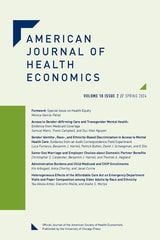
American Journal of Health Economics, volume 10 number 2 (Spring 2024)
The University of Chicago Press
University of Chicago Press Journals, 2024
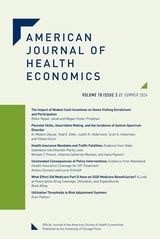
American Journal of Health Economics, volume 10 number 3 (Summer 2024)
The University of Chicago Press
University of Chicago Press Journals, 2024
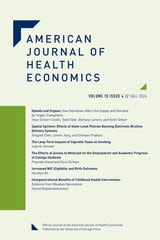
American Journal of Health Economics, volume 10 number 4 (Fall 2024)
The University of Chicago Press
University of Chicago Press Journals, 2024
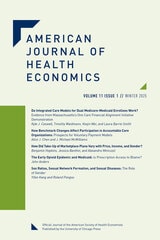
American Journal of Health Economics, volume 11 number 1 (Winter 2025)
The University of Chicago Press
University of Chicago Press Journals, 2025
American Journal of Health Economics, volume 11 number 2 (Spring 2025)
The University of Chicago Press
University of Chicago Press Journals, 2025
American Journal of Health Economics, volume 11 number 3 (Summer 2025)
The University of Chicago Press
University of Chicago Press Journals, 2025
American Journal of Health Economics, volume 11 number 4 (Fall 2025)
The University of Chicago Press
University of Chicago Press Journals, 2025
American Journal of Health Economics, volume 12 number 1 (Winter 2026)
The University of Chicago Press
University of Chicago Press Journals, 2026
American Journal of Health Economics, volume 12 number 2 (Spring 2026)
The University of Chicago Press
University of Chicago Press Journals, 2026
American Journal of Health Economics, volume 12 number 3 (Summer 2026)
The University of Chicago Press
University of Chicago Press Journals, 2026
American Journal of Health Economics, volume 12 number 4 (Fall 2026)
The University of Chicago Press
University of Chicago Press Journals, 2026

American Journal of Health Economics, volume 8 number 3 (Summer 2022)
The University of Chicago Press
University of Chicago Press Journals, 2022
American Journal of Health Economics, volume 8 number 4 (Fall 2022)
The University of Chicago Press
University of Chicago Press Journals, 2022
American Journal of Health Economics, volume 9 number 1 (Winter 2023)
The University of Chicago Press
University of Chicago Press Journals, 2023
American Journal of Health Economics, volume 9 number 2 (Spring 2023)
The University of Chicago Press
University of Chicago Press Journals, 2023
American Journal of Health Economics, volume 9 number 3 (Summer 2023)
The University of Chicago Press
University of Chicago Press Journals, 2023
American Journal of Health Economics, volume 9 number 4 (Fall 2023)
The University of Chicago Press
University of Chicago Press Journals, 2023
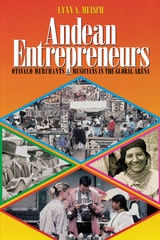
Andean Entrepreneurs
Otavalo Merchants and Musicians in the Global ArenaBy Lynn A. Meisch
University of Texas Press, 2002
Native to a high valley in the Andes of Ecuador, the Otavalos are an indigenous people whose handcrafted textiles and traditional music are now sold in countries around the globe. Known as weavers and merchants since pre-Inca times, Otavalos today live and work in over thirty countries on six continents, while hosting more than 145,000 tourists annually at their Saturday market.
In this ethnography of the globalization process, Lynn A. Meisch looks at how participation in the global economy has affected Otavalo identity and culture since the 1970s. Drawing on nearly thirty years of fieldwork, she covers many areas of Otavalo life, including the development of weaving and music as business enterprises, the increase in tourism to Otavalo, the diaspora of Otavalo merchants and musicians around the world, changing social relations at home, the growth of indigenous political power, and current debates within the Otavalo community over preserving cultural identity in the face of globalization and transnational migration. Refuting the belief that contact with the wider world inevitably destroys indigenous societies, Meisch demonstrates that Otavalos are preserving many features of their culture while adopting and adapting modern technologies and practices they find useful.

Animals as Food
(Re)connecting Production, Processing, Consumption, and ImpactsAmy J. Fitzgerald
Michigan State University Press, 2015

Anti-Politics Machine
Development, Depoliticization, and Bureaucratic Power in LesothoJames Ferguson
University of Minnesota Press, 1994
Arise
Power, Strategy and Union ResurgenceJane Holgate
Pluto Press, 2021
'Jane Holgate is a brilliant thinker' - Jane McAlevey
In Arise, Jane Holgate argues that unions must revisit their understanding of power in order to regain influence and confront capital. Drawing on two decades of research and organizing experience, Holgate examines the structural inertia of today’s unions from a range of perspectives: from strategic choice, leadership and union democracy to politics, tactics and the agency afforded to rank-and-file members.
In the midst of a neoliberal era of economic crisis and political upheaval, the labor movement stands at a crossroads. Union membership is on the rise, but the ‘turn to organizing’ has largely failed to translate into meaningful gains for workers. There is considerable discussion about the lack of collectivism among workers due to casualization, gig work and precarity, yet these conditions were standard in the UK when workers built the foundations of the 19th-century trade union movement.
Drawing on history and case studies of unions developing and using power effectively, this book offers strategies for moving beyond the pessimism that prevails in much of today’s union movement. By placing power analysis back at the heart of workers’ struggle, Holgate shows us that transformational change is not only possible, but within reach.

Arms and Innovation
Entrepreneurship and Alliances in the Twenty-First Century Defense IndustryJames Hasik
University of Chicago Press, 2008
For all their advantages, small firms also face significant challenges in access to capital and customers. To overcome such problems, they can form alliances either with each other or with larger companies. Hasik traces the trade-offs of such alliances and provides crucial insight into their promises and pitfalls.
This ground-breaking study is a significant contribution to understanding both entrepreneurship and alliances, two crucial factors in business generally. It will be of interest to readers in the defense sector as well as the wider business community.