Results by title
5159 books match the query 'Biography' and 234 start with l
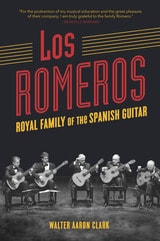
Los Romeros
Royal Family of the Spanish GuitarWalter Aaron Clark
University of Illinois Press, 2018
Loss within Loss
Artists in the Age of AIDSEdited by Edmund White; In Cooperation with the Estate Project for Artists with AIDS, a project of the Alliance for the Arts
University of Wisconsin Press, 2002
This landmark book is published in association with the Estate Project for Artists with AIDS, a national organization that preserves art works created by artists living with HIV or lost to AIDS. Loss within Loss stands as a powerful reminder of the devastating impact of the AIDS epidemic on the arts community and as the first real survey of that devastation. Though these accounts are often intensely sad, Loss within Loss is an invigorating, sometimes even exuberant, testimony to the sheer joy of being an artist . . . and being alive.
Lost Among the Baining
Adventure, Marriage, and Other FieldworkGail Pool
University of Missouri Press, 2015
In the late sixties, Gail Pool and her husband set off for an adventure in New Guinea. He was a graduate student in anthropology; she was an aspiring writer. They prepared, as academics do, by reading, practicing with language tapes, consulting with the nearest thing to experts, and then, excited and optimistic, off they went. But all their research could not prepare them for the reality of life in the jungle. As they warded off gargantuan insects, slogged through seemingly endless mud, and turned on each other in fatigue and frustration, they struggled to somehow connect with their enigmatic hosts, the Baining—a people who showed no desire to be studied.
Sixteen months later they returned home. Despite months of trying, they had not been able to make sense of the Baining’s culture. Worse yet, their lives no longer seemed to make sense. Pool put her journals away. Her husband abandoned the study of anthropology.
Decades later, Pool returned to her journals and found in her jumbled notes the understanding that had eluded her twenty-three–year-old self. Finally, she and her husband returned to New Guinea for a shorter visit and a warm reunion with the tribe that challenged them on so many levels and, Pool now realized, made their journey and lives deeper and richer.
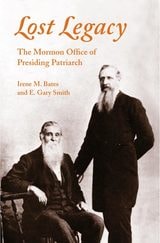
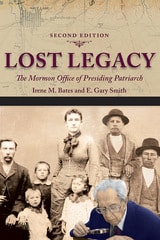
Lost Legacy
THE MORMON OFFICE OF PRESIDING PATRIARCHIrene Bates and E. Gary Smith
University of Illinois Press, 1996
Lost Legacy
The Mormon Office of Presiding PatriarchIrene M. Bates
University of Illinois Press, 2018
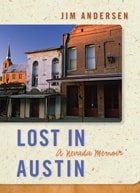
Lost in Austin
A Nevada MemoirJim Andersen
University of Nevada Press, 2009
In 1974 Jim Andersen and his wife, tired of the congestion and high taxes in California, decided to start a new life in rural Nevada. They settled on Austin, a town of about 250 people perched on a mountainside along the legendary Highway 50, “the loneliest road in America.” In the middle of the nineteenth century, Austin was a free-wheeling boomtown at the center of a silver bonanza. By the time the Andersens arrived, it had shrunk to a quiet, isolated community of self-sufficient souls who ran their lives, economy, and local government their own way, with ingenuity, wit, and a certain disregard for convention. Andersen’s account of his life in Austin is a charming, sometimes hilarious account of city folks adapting to life in a small town. He addresses such matters as making a living from a variety of odd jobs, some of them odder than others; serving as a deputy sheriff, deputy coroner, and elected justice of the peace, and administering Austin’s unique version of justice; raising a family; finding ways to have fun; and exploring the austerely beautiful backcountry of central Nevada. He also introduces some of Austin’s residents and their stories, and describes the way the community comes together for entertainment or to respond to crises.Lost in Austin is fascinating reading for anyone who cherishes nostalgic memories of living in a small town, or who contemplates moving to one. It offers an engaging portrait of a Nevada that exists far from the glitz and glitter of Las Vegas and Reno, “a happy Bermuda Triangle” where rugged individualism and community spirit flourish amidst sagebrush and vast open spaces.
Lost in a Labyrinth of Red Tape
The Story of an Immigration that FailedArmin Schmid and Renate Schmid
Northwestern University Press, 1996
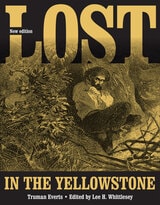
Lost in the Yellowstone
"Thirty-Seven Days of Peril" and a Handwritten Account of Being LostTruman Everts; Edited by Lee H. Whittlesey
University of Utah Press, 2015
In 1870, Truman Everts visited what would two years later become Yellowstone National Park, traveling with an exploration party intent on mapping and investigating that mysterious region. Scattered reports of a mostly unexplored wilderness filled with natural wonders had caught the public’s attention and the fifty-four-year-old Everts, near-sighted and an inexperienced woodsman, had determined to join the expedition. He was soon separated from the rest of the party and from his horse, setting him on a grueling quest for survival. For over a month he wandered Yellowstone alone and injured, with little food, clothing, or other equipment. In “Thirty-seven Days of Peril” he recounted his experiences for the readers of Scribner’s Monthly.
In June 1996, Everts’s granddaughter arrived at Mammoth Hot Springs in Yellowstone National Park to meet with park archivist Lee Whittlesey. She brought two documents that her father had kept hidden and both were handwritten by Everts. One was a brief autobiography that gave new insight into his early life. The other was a never-published alternative account of his confused 1870 journey through Yellowstone. Both have been added to this volume, further enhancing Everts’s unlikely tale of survival.
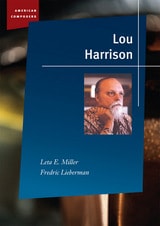
Lou Harrison
Leta E. Miller and Fredric Lieberman
University of Illinois Press, 2010
Leta E. Miller and Fredric Lieberman take readers into Harrison's rich world of cross-fertilization through an exploration of his outspoken stance on pacifism, gay rights, ecology, and respect for minorities--all major influences on his musical works. Though Harrison was sometimes accused by contemporaries of "cultural appropriation," Miller and Lieberman make it clear why musicians and scholars alike now laud him as an imaginative pioneer for his integration of Asian and Western musics. They also delve into Harrison's work in the development of the percussion ensemble, his use of found and invented instruments, and his explorations of alternative tuning systems. An accompanying compact disc of representative recordings allows readers to examine Harrison's compositions in further detail.
Louder Than Bombs
A Life with Music, War, and PeaceEd Vulliamy
University of Chicago Press, 2020
Describing the artists, songs, and concerts that most influenced him, Vulliamy brings together the two largest threads of his life—music and war. Louder Than Bombs covers some of the most important musical milestones of the past fifty years, from Jimi Hendrix playing “Machine Gun” at the Isle of Wight Festival in 1970 to the Bataclan in Paris under siege in 2015. Vulliamy was present for many of these historic moments, and with him as our guide, we see them afresh, along the way meeting musicians like B. B. King, Graham Nash, Patti Smith, Daniel Barenboim, Gustavo Dudamel, and Bob Dylan. Vulliamy peppers the book with short vignettes—which he dubs 7" singles—recounting some of his happiest memories from a lifetime with music. Whether he’s working as an extra in the Vienna State Opera’s production of Aida, buying blues records in Chicago, or drinking coffee with Joan Baez, music is never far from his mind. As Vulliamy discovers, when horror is unspeakable, when words seem to fail us, we can turn to music for expression and comfort, or for rage and pain. Poignant and sensitively told, Louder Than Bombs is an unforgettable record of a life bursting with music.
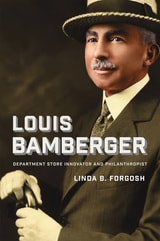
Louis Bamberger
Department Store Innovator and PhilanthropistLinda B. Forgosh
Brandeis University Press, 2016
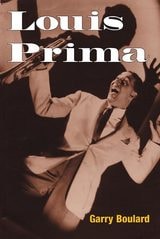
Louis Prima
Garry Boulard
University of Illinois Press, 1998
Louis Prima infused the grit and grace of Dixieland jazz with swing and big band sounds, the first whiffs of rock 'n' roll, and a vaudevillian stage presence. Garry Boulard pens the biography of the underrated jazz musician, Las Vegas mainstay, and popular entertainer.
A native of New Orleans, Prima was a Guy Lombardo protégé known as "The Italian Satchmo" who became the country's new jazz sensation at New York's Famous Door in the 1930s. He went on to success as a big band leader before virtually creating the lounge act as a Las Vegas nightclub staple. Employing and later marrying singer Keely Smith, Prima rode high with a series of hit songs and smash albums in the Fifties. But Boulard also looks past the over-the-top stage antics to restore Prima's legacy as an overlooked jazz musician and vocalist, and as a bandleader with an uncanny ability to fuse disparate styles into music that kept audiences cheering and dancing for decades.
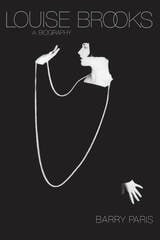
Louise Brooks
A BiographyBarry Paris
University of Minnesota Press, 2000
The long-awaited republication of this captivating account of the star’s life.
Louise Brooks left Wichita, Kansas, for New York City at age fifteen and lived the kind of life of which legends are made. From her beginnings as a dancer to her years in Hollywood, Berlin, and beyond, she was hailed and reviled as a new type of woman: independent, intellectually daring, and sexually free. In this widely acclaimed, first and only comprehensive biography, Barry Paris traces Brooks’s trajectory from her childhood through her fall into obscurity and subsequent "resurrection" as a brilliant writer and enduring film icon.
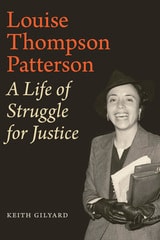
Louise Thompson Patterson
A Life of Struggle for JusticeKeith Gilyard
Duke University Press, 2017
Love Across the Color Line
Helen Lefkowitz Horowitz
University of Massachusetts Press, 1996
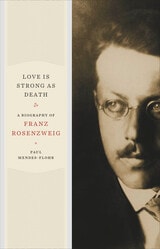
Love Is Strong as Death
A Biography of Franz RosenzweigPaul Mendes-Flohr
University of Chicago Press, 2026
Franz Rosenzweig (1886–1929) was one of the central figures of the Jewish cultural and intellectual renaissance in Weimar Germany. His masterwork, The Star of Redemption (1921), is a classic of existential thought and Jewish philosophy, and his considerable legacy also includes his collaboration with Martin Buber on a key translation of the Hebrew Bible into German and the establishment of an education center in Frankfurt that brought together the most important young German-Jewish intellectuals of its time.
Rosenzweig’s personal biography is no less fascinating than his ideas and accomplishments. Drawing on unprecedented access to Rosenzweig’s unpublished personal correspondence, Paul Mendes-Flohr skillfully weaves together the threads of Rosenzweig’s life to give us a moving portrait of this towering figure—from his near-conversion to Christianity to his tragic diagnosis with ALS. Mendes-Flohr also closely explores Rosenzweig’s relationship with Margrit Huessy, who was a vital intellectual partner for Rosenzweig, as well as a muse and lover. He worked out many of his ideas about love both in conversation and consort with her, and Mendes-Flohr shows the importance of intimacy—both romantic and platonic—in the development of Rosenzweig’s thought.
Love Is Strong as Death provides a unique and insightful look at one of the most important modern Jewish thinkers.
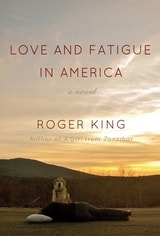
Love and Fatigue in America
Roger King
University of Wisconsin Press, 2012
Love and Fatigue in America records an Englishman’s decade-long journey through his newly adopted country in the company of a mystifying illness and a charismatic dog.
When he receives an unexpected invitation from an unfamiliar American university, he embraces it as a triumphant new beginning. Instead, on arrival, he is stricken with a persistent inability to stand up or think straight, and things quickly go wrong. Diagnosed with ME disease—chronic fatigue syndrome—he moves restlessly from state to state, woman to woman, and eccentric doctor to eccentric doctor, in a search for a love and a life suited to his new condition. The journey is simultaneously brave, absurd, and instructive.
Finding himself prostrate on beds and couches from Los Alamos to Albany, he hears the intimate stories offered by those he encounters—their histories, hurts, and hopes—and from these fragments an unsentimental map emerges of the inner life of a nation. Disability has shifted his interest in America from measuring its opportunities to taking the measure of its humanity. Forced to consider for himself the meaning of a healthy life and how best to nurture it, he incidentally delivers a report on the health of a country.
By turns insightful, comic, affecting, and profound, Roger King’s Love and Fatigue in America briskly compresses an illness, a nation, and an era through masterly blending of literary forms. In a work that defies categorization, and never loses its pace or poise, the debilitated narrator is, ironically, the most lively and fully awake figure in the book.
“As the disease drives the narrator city to city, woman to woman, and doctor to doctor, it brings into relief many of America’s follies and excesses, most notably our health-care system, which King portrayed as antiquated, bureaucratic, and inhumane. After more than fifteen years, America brings the narrator ‘not aspiration realized, nor a largeness of life fitting to its open spaces, but the nascent ability to be satisfied with less.’”—The New Yorker
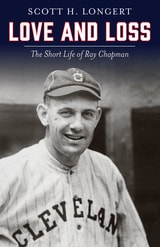
Love and Loss
The Short Life of Ray ChapmanScott H. Longert
Ohio University Press, 2024
The son of a coal miner from a small Illinois town, Cleveland Indians shortstop Ray Chapman lived the American dream until his untimely death at age twenty-nine. In his brief life, he reached the pinnacle of baseball success as the best shortstop in the American League. While many professional ballplayers struggled with meager salaries, the handsome Chapman had married heiress Kathleen Daly, one of Cleveland’s wealthiest women. With a child on the way and an executive job in the offseason, Chapman was moving toward a privileged place in society until an errant fastball fractured his skull and ended his life the next day. Late in the 1920 pennant race, the Indians were in New York for a key series against the Yankees. New York pitcher Carl Mays threw a high hard one that Chapman could not evade. He was taken to a nearby hospital, where doctors tried in vain to save his life. The tragedy did not end there. His widow took her own life eight years later, and their daughter, Rae, subsequently died from meningitis. Today, people visit Chapman’s impressive grave in Cleveland’s Lake View Cemetery, leaving baseballs and gloves in his memory. Though gone over a hundred years, he is well remembered as a Cleveland icon. This book goes far beyond the well-worn accounts of Chapman’s untimely death to illustrate the fullness of his short life.
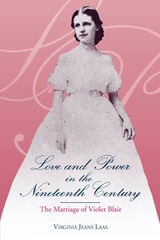
Love and Power in the Nineteenth Century
The Marriage of Violet BlairVirginia Jeans Laas
University of Arkansas Press, 1998
Winner, 1999 Missouri Conference on History Book Award
This fascinating biography of a marriage in the Gilded Age closely examines the dynamic flow of power, control, and love between Washington blue blood Violet Blair and New Orleans attorney Albert Janin. Based on their voluminous correspondence as well as Violet’s extensive diaries, it offers a thoroughly intimate portrait of a fifty-four-year union which, in many ways, conformed to societal strictures, yet always created its own definition of itself in order to fit the flux of needs of both husband and wife.
Central to their story is Violet’s fierce determination to maintain her autonomy within the patriarchic institution of marriage. An enduring belle who thought, talked, and acted with the assurance and self-confidence of one whose wishes demanded obedience, she rejected the Victorian ideal of women as silent, submissive consorts. Yet her feminism was a private one, not played out on a public stage but kept to the confines of her own daily life and marriage.
With abundant documentary evidence to draw upon, Laas ties this compelling story to broader themes of courtiship behavior, domesticity, gender roles, extended family bonds, elitism, and societal stereotyping. Deeply researched and beautifully written, Love and Power in the Nineteenth Century has the dual virtue of making an important historical contribution while also appealing to a broad popular audience.
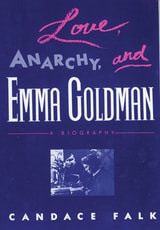
Love, Anarchy, & Emma Goldman
A BiographyFalk, Candace
Rutgers University Press, 1990
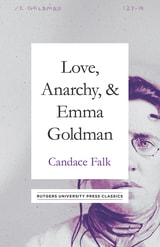
Love, Anarchy, & Emma Goldman
A BiographyCandace Serena Falk
Rutgers University Press, 2019
“Fascinating …With marvelous clarity and depth, Candace Falk illuminates for us an Emma Goldman shaped by her time yet presaging in her life the situation and conflicts of women in our time.” —Tillie Olsen
One of the most famous political activists of all time, Emma Goldman was also infamous for her radical anarchist views and her “scandalous” personal life. In public, Goldman was a firebrand, confidently agitating for labor reform, anarchism, birth control, and women’s independence. But behind closed doors she was more vulnerable, especially when it came to the love of her life.
Love, Anarchy, & Emma Goldman is an account of Goldman’s legendary career as a political activist. But it is more than that—it is a biography that offers an intimate look at how Goldman’s passion for social reform dovetailed with her passion for one man: Chicago activist, hobo king, and red-light district gynecologist Ben Reitman. Candace Falk takes us into the heart of their tumultuous love affair, finding that even as Goldman lectured on free love, she confronted her own intense jealousy.
As director of the Emma Goldman papers, Falk had access to over 40,000 writings by Goldman—including her private letters and notes—and she draws upon these archives to give us a rare insight into this brilliant, complex woman’s thoughts. The result is both a riveting love story and a primer on an exciting, explosive era in American politics and intellectual life.
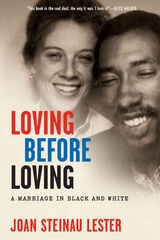
Loving Before Loving
A Marriage in Black and WhiteJoan Steinau Lester
University of Wisconsin Press, 2026
Braiding intellectual, personal, and political history, Lester tells the story of a writer and activist fighting for love and justice before, during, and after the Supreme Court’s 1967 decision striking down bans on interracial marriage in Loving v. Virginia. She describes her own shifts in consciousness, from an activist climbing police barricades by day and reading and writing late into the night to a woman navigating the coming-out process in midlife, before finding the publishing success she had dreamed of. Speaking candidly about every facet of her life, Lester illuminates her journey to fulfillment and healing.
Loving Dr. Johnson
Helen Deutsch
University of Chicago Press, 2005
Loving Dr. Johnson uses the enormous popularity of Johnson to understand a singular case of author love and to reflect upon what the love of authors has to do with the love of literature. Helen Deutsch's work is driven by several impulses, among them her affection for both Johnson's work and Boswell's biography of him, and her own distance from the largely male tradition of Johnsonian criticism—a tradition to which she remains indebted and to which Loving Dr. Johnson is ultimately an homage. Limning sharply Johnson's capacious oeuvre, Deutsch's study is also the first of its kind to examine the practices and rituals of Johnsonian societies around the world, wherein Johnson's literary work is now dwarfed by the figure of the writer himself.
An absorbing look at one iconic author and his afterlives, Loving Dr. Johnson will be of enormous value to students of English literature and literary scholars keenly interested in canon formation.
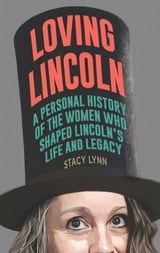
Loving Lincoln
A Personal History of the Women Who Shaped Lincoln's Life and LegacyStacy Lynn
Southern Illinois University Press, 2025
WINNER, 2026 Illinois State Historical Society Russell P. Strange Book of the Year Award!
Rediscovering Lincoln through the female gaze
Abraham Lincoln belongs to everybody. The women he interacted with helped forge the outstanding moral character of America's greatest president. This unique Abraham Lincoln biography features thirty historical and personal essays, and within them, the stories of more than ninety women, each with their own mini biographies in an appendix. Among them are Lincoln’s friends, clients, and extended family, as well as writers, artists, and—blurring the lines between history and memoir—author Stacy Lynn herself.
As a professional Lincoln scholar and editor, Lynn was often frustrated that male historians often overlooked Lincoln’s love for and friendship with women. Here, she posits a new paradigm—one that, instead of downplaying women, lifts up their interactions with Lincoln.
Lincoln understood the importance of the women in his life, and he put women’s wellbeing at the center of his personal, professional, and political ethos. He was loved by two strong pioneer mothers as well as sisters, friends, nieces, friends’ daughters, and his wife. He served women clients during his long legal career. As president, he met with women, dedicating time to hear their concerns despite the burdens of office. He replied to letters women wrote him. He believed in their capabilities and revolutionized the role of women in the workforce. After Lincoln’s death, women continued to shape his legacy. Mary Lincoln ensured his burial among friends, artist Vinnie Ream sculpted his statue in the US Capitol, and biographer Ida Tarbell provided a nuanced portrayal of his life. Harriet Monroe and Ruth Painter Randall further cemented his place in literature and history.
Lynn presents a fresh perspective on Lincoln, connecting his story to the stories of women and showcasing his kindness, sensitivity, and moral center. She explores how women shaped Lincoln’s inspirational legacy and pays homage to all the women who gave Lincoln to the world. Lynn’s unique blending of history, biography, and her own story reveals the ways in which an emotional connection to the historical figures one studies opens the door to richer human and historical understanding. By inviting readers to feel the past as well as read it, Lynn demonstrates that history matters most when it engages our minds and hearts.
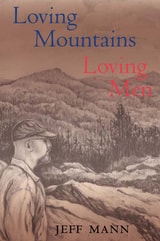
Loving Mountains, Loving Men
Memoirs of a Gay AppalachianJeff Mann
Ohio University Press, 2005
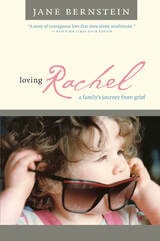
Loving Rachel
A Family's Journey from GriefJane Bernstein
University of Illinois Press, 2007
In 1983, Jane Bernstein had everything she ever wanted: a healthy four-year-old daughter, Charlotte; a happy marriage; a highly praised first novel; and a brand new baby, Rachel. But by the time Rachel was six weeks old,
a neuro-ophthalmologist told Jane and her husband that their baby was blind. Although there was some hope that Rachel might gain partial vision as she grew, her condition was one that often resulted in seizure disorders and intellectual impairment. So began a series of medical and emotional setbacks that were to plague Rachel and her parents and strain their marriage to the breaking point. Spanning the first four years of Rachel’s life, Loving Rachel is a heartbreaking chronicle of a marriage and a compelling story of parental love told with searing honesty and surprising humor.
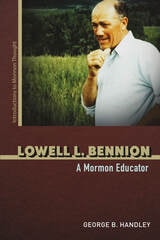
Lowell L. Bennion
A Mormon EducatorGeorge B. Handley
University of Illinois Press, 2023
Known in his lifetime for a tireless dedication to humanitarian causes, Lowell L. Bennion was also one of the most important theologians and ethicists to emerge in the Church of Jesus Christ of Latter-day Saints in the twentieth century.
George B. Handley’s intellectual biography delves into Bennion’s thought and extraordinary intellectual life. Rejecting the idea that individual LDS practice might be at odds with lived experience, Bennion insisted the gospel favored the growth of individuals acting and living in the present. He also focused on the need for ongoing secular learning alongside religious practice and advocated for an idea of social morality that encouraged Latter-day Saints to seek out meaningful transformations of character and put their ethical commitments into practice. Handley examines Bennion’s work against the background of a changing institution that once welcomed his common-sense articulation of LDS ideas and values but became discomfited by how his thought cast doubt on the Church’s beliefs about race and other issues.
Lowest White Boy
Greg Bottoms
West Virginia University Press, 2019
An innovative, hybrid work of literary nonfiction, Lowest White Boy takes its title from Lyndon Johnson’s observation during the civil rights era: “If you can convince the lowest white man he’s better than the best colored man, he won’t notice you’re picking his pocket.”
Greg Bottoms writes about growing up white and working class in Tidewater, Virginia, during school desegregation in the 1970s. He offers brief stories that accumulate to reveal the everyday experience of living inside complex, systematic racism that is often invisible to economically and politically disenfranchised white southerners—people who have benefitted from racism in material ways while being damaged by it, he suggests, psychologically and spiritually. Placing personal memories against a backdrop of documentary photography, social history, and cultural critique, Lowest White Boy explores normalized racial animus and reactionary white identity politics, particularly as these are collected and processed in the mind of a child.
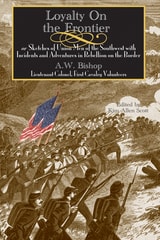
Loyalty on the Frontier
Sketches of Union Men of the South-West with Incidents and Adventures in Rebellion on the BorderA.W. Bishop
University of Arkansas Press, 2003
First published in 1863, this book has the immediacy, passion, and intimacy of its wartime context. It tells the remarkable story of Albert Webb Bishop, a New York lawyer turned Union soldier, who in 1862 accepted a commission as lieutenant colonel in a regiment of Ozark mountaineers. While maintaining Union control of northwest Arkansas, he collected stories of the social coercion, political secession, and brutal terrorism that scarred the region.
His larger goal, however, was to popularize and inspire sympathy for the South’s Unionists and to chronicle the triumph of Unionism in a Confederate state. His account points to the complex and divisive nature of Confederate society and in doing so provides a perspective that has long been absent from discussions of the Civil War
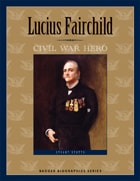
Lucius Fairchild
Civil War HeroStuart Stotts
Wisconsin Historical Society Press, 2010
Lucy Stone
Speaking Out for EqualityKerr, Andrea M
Rutgers University Press, 1992
Lucy Stone was a Massachusetts newspaper editor, abolitionist, and charismatic orator for the women's rights movement in the last half of the nineteenth century. She was deeply involved in almost every reform issue of her time. Charles Sumner, Frederick Douglass, William Lloyd Garrison, Julia Ward Howe, Horace Greeley, and Louisa May Alcott counted themselves among her friends. Through her public speaking and her newspaper, the Woman's Journal, Stone became the most widely admired woman's rights spokeswoman of her era. In the nineteenth century, Lucy Stone was a household name.
Kerr begins with Stone's early roots in a poor family in western Massachusetts. She eventually graduated from Oberlin College and then became a full-time public speaker for an anti-slavery society and for women's rights. Despite Stone's strident anti-marriage ideology, she eventually wed Henry Brown Blackwell, and had her first child at the age of thirty-nine.
Although Kerr tells us about Stone's public accomplishments, she emphasizes Stone's personal struggle for autonomy. "Lucy Stone (Only)" was Stone's trademark signature following her marriage. Her refusal to surrender her birth name was one example of her determination to retain her individuality in an era where a woman's right to a separate identity ended with marriage.
Of equal importance is Kerr's discussion of Stone's relationship with Susan B. Anthony and Elizabeth Cady Stanton, as well as her revisionist treatment of the schism which eventually divided Stone from Stanton and Anthony. Stone urged legislators not to ignore the need for women's suffrage as they rushed to enfranchise black males. Stanton and Anthony dwelt only on the need for women's suffrage, at the expense of black suffrage. Women's historians, the general reader, and historians of the family will appreciate the story of Stone's attempt to balance the conflicting demands of career and family.
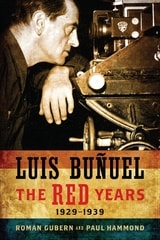
Luis Buñuel
The Red Years, 1929–1939Román Gubern
University of Wisconsin Press, 2011
The turbulent years of the 1930s were of profound importance in the life of Spanish film director Luis Buñuel (1900–1983). He joined the Surrealist movement in 1929 but by 1932 had renounced it and embraced Communism. During the Spanish Civil War (1936–39), he played an integral role in disseminating film propaganda in Paris for the Spanish Republican cause.
Luis Buñuel: The Red Years, 1929–1939 investigates Buñuel’s commitment to making the politicized documentary Land without Bread (1933) and his key role as an executive producer at Filmófono in Madrid, where he was responsible in 1935–36 for making four commercial features that prefigure his work in Mexico after 1946. As for the republics of France and Spain between which Buñuel shuttled during the 1930s, these became equally embattled as left and right totalitarianisms fought to wrest political power away from a debilitated capitalism.
Where it exists, the literature on this crucial decade of the film director’s life is scant and relies on Buñuel’s own self-interested accounts of that complex period. Román Gubern and Paul Hammond have undertaken extensive archival research in Europe and the United States and evaluated Buñuel’s accounts and those of historians and film writers to achieve a portrait of Buñuel’s “Red Years” that abounds in new information.
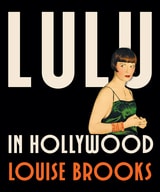
Lulu In Hollywood
Expanded EditionLouise Brooks
University of Minnesota Press, 2000
Essential writings by this icon of the silent era—rereleased in print and now available as an e-book 100 years after Louise Brooks arrived in Hollywood
Lulu in Hollywood is an intimate collection of eight autobiographical essays by Louise Brooks, silent film darling and icon of the flapper era. Ranging from her childhood in Kansas and her early days as a Denishawn and Ziegfeld Follies dancer to her friendships with Martha Graham, Charles Chaplin, W. C. Fields, Humphrey Bogart, William Paley, G. W. Pabst, and others, Brooks’s writing offers a rare glimpse into her extraordinary life. Including her revelatory “Why I Will Never Write My Memoirs,” Lulu in Hollywood also features Kenneth Tynan’s 1979 essay “The Girl in the Black Helmet,” which revived interest in Brooks’s work and was the best discussion of her film work to appear in her lifetime.
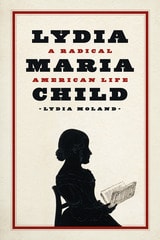
Lydia Maria Child
A Radical American LifeLydia Moland
University of Chicago Press, 2022
By 1830, Lydia Maria Child had established herself as something almost unheard of in the American nineteenth century: a beloved and self-sufficient female author. Best known today for the immortal poem “Over the River and through the Wood,” Child had become famous at an early age for spunky self-help books and charming children’s stories. But in 1833, Child shocked her readers by publishing a scathing book-length argument against slavery in the United States—a book so radical in its commitment to abolition that friends abandoned her, patrons ostracized her, and her book sales plummeted. Yet Child soon drew untold numbers to the abolitionist cause, becoming one of the foremost authors and activists of her generation.
Lydia Maria Child: A Radical American Life tells the story of what brought Child to this moment and the extraordinary life she lived in response. Through Child’s example, philosopher Lydia Moland asks questions as pressing and personal in our time as they were in Child’s: What does it mean to change your life when the moral future of your country is at stake? When confronted by sanctioned evil and systematic injustice, how should a citizen live? Child’s lifetime of bravery, conviction, humility, and determination provides a wealth of spirited guidance for political engagement today.