Results by title
18284 books match the query 'United States' and 698 start with l

Learning from the Land
Wisconsin Land Use; 2nd EditionBobbie Malone
Wisconsin Historical Society Press, 2011
How has the landscape of Wisconsin affected its history? How have people living here changed that landscape over time? What are the implications for the future? The second edition of Learning from the Land addresses these and other questions, asking elementary and middle school readers to think about land use issues throughout Wisconsin's history. This revised edition includes expanded chapters on logging and the lumber industry, land use and planning, and agriculture in the 20th century from farmers' markets to organic farming. New profiles of Gaylord Nelson, pioneer of Earth Day, and Will Allen, founder of Growing Power in Milwaukee, round out this history of land use in Wisconsin.
Learning the Hard Way
Masculinity, Place, and the Gender Gap in EducationMorris, Edward
Rutgers University Press, 2012
An avalanche of recent newspapers, weekly newsmagazines, scholarly journals, and academic books has helped to spark a heated debate by publishing warnings of a “boy crisis” in which male students at all academic levels have begun falling behind their female peers. In Learning the Hard Way, Edward W. Morris explores and analyzes detailed ethnographic data on this purported gender gap between boys and girls in educational achievement at two low-income high schools—one rural and predominantly white, the other urban and mostly African American. Crucial questions arose from his study of gender at these two schools. Why did boys tend to show less interest in and more defiance toward school? Why did girls significantly outperform boys at both schools? Why did people at the schools still describe boys as especially “smart”?
Morris examines these questions and, in the process, illuminates connections of gender to race, class, and place. This book is not simply about the educational troubles of boys, but the troubled and complex experience of gender in school. It reveals how particular race, class, and geographical experiences shape masculinity and femininity in ways that affect academic performance. His findings add a new perspective to the “gender gap” in achievement.
Learning to Be Latino
How Colleges Shape Identity PoliticsReyes, Daisy Verduzco
Rutgers University Press, 2018
Drawing on extensive ethnographic observations, Reyes shows how college campuses shape much more than students’ academic and occupational trajectories; they mold students’ ideas about inequality and opportunity in America, their identities, and even how they intend to practice politics.
Learning to Eat Soup with a Knife
Counterinsurgency Lessons from Malaya and VietnamJohn A. Nagl
University of Chicago Press, 2005
In examining these two events, Nagl argues that organizational culture is key to the ability to learn from unanticipated conditions, a variable which explains why the British army successfully conducted counterinsurgency in Malaya but why the American army failed to do so in Vietnam, treating the war instead as a conventional conflict. Nagl concludes that the British army, because of its role as a colonial police force and the organizational characteristics created by its history and national culture, was better able to quickly learn and apply the lessons of counterinsurgency during the course of the Malayan Emergency.
With a new preface reflecting on the author's combat experience in Iraq, Learning to Eat Soup with a Knife is a timely examination of the lessons of previous counterinsurgency campaigns that will be hailed by both military leaders and interested civilians.
Learning to Glow
A Nuclear ReaderJohn Bradley
University of Arizona Press, 2000
In Learning to Glow, twenty-four essays testify to many of the unsuspected human and environmental costs of atomic science. They show that Americans have paid a terrible price for supposedly "winning" the Cold War--for although the nuclear nightmare may be over, we are still living with nuclear threats every day. Writers such as Scott Russell Sanders, Terry Tempest Williams, and Barbara Kingsolver reveal the psychic and emotional fallout of the Cold War and of subsequent developments in nuclear science. The essays include personal testimonies of what it was like to grow up with family members in nuclear-related jobs; hard-hitting journalism on the health and environmental costs of our nuclear policies and practices; and poignant stories of coming to terms with nuclear power, including contributions by writers who revisit Hiroshima in an attempt to heal the wounds left by the Bomb.
These essays offer an alternative to the official version of nuclear history as told to us by school textbooks, government authorities, and nuclear industry officials. They are stories of and by ordinary people who have suffered the consequences of the decisions made by those in power-stories that have been largely ignored, dismissed, or suppressed. They will challenge readers to re-examine their preconceptions about the way we deal with issues of nuclear arms and radioactive waste because they show that nuclear history does not belong to experts but to us all.
Contributors:
Marilou Awiakta
John Bradley
Jim Carrier
Alison Hawthorne Deming
Mary Dickson
Edward Dougherty
Ray Gonzalez
Karl Grossman
Sonya Huber
Barbara Kingsolver
Valerie Kuletz
Mary Laufer
Kay Mack
Craig McGrath
Bill Mesler
Richard H. Minear
Randy Morris
Mayumi Oda
Catherine Quigg
Richard Rawles
Kenneth Robbins
Scott Russell Sanders
David Seaborg
Terry Tempest Williams
Bill Witherup
Phil Woods
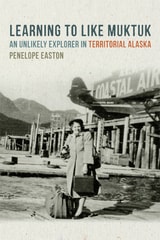
Learning to Like Muktuk
An Unlikely Explorer in Territorial AlaskaPenelope S. Easton
Oregon State University Press, 2014
Learning to Live with Crime
American Crime Narrative in the Neoconservative TurnChristopher P. Wilson
The Ohio State University Press, 2010
Since the mid-1960s, the war on crime has reshaped public attitudes about state authority, criminal behavior, and the responsibilities of citizenship. But how have American writers grappled with these changes? What happens when a journalist approaches the workings of organized crime not through its legendary Godfathers but through a workaday, low-level figure who informs on his mob? Why is it that interrogation scenes have become so central to prime-time police dramas of late? What is behind writers’ recent fascination with “cold case” homicides, with private security, or with prisons?
In Learning to Live with Crime, Christopher P. Wilson examines this war on crime and how it has made its way into cultural representation and public consciousness. Under the sway of neoconservative approaches to criminal justice and public safety, Americans have been urged to see crime as an inevitable risk of modern living and to accept ever more aggressive approaches to policing, private security, and punishment. The idea has been not simply to fight crime but to manage its risks; to inculcate personal vigilance in citizens; and to incorporate criminals’ knowledge through informants and intelligence gathering. At its most scandalous, this study suggests, contemporary law enforcement has even come to mimic crime’s own operations.
Learning to Love Form 1040
Two Cheers for the Return-Based Mass Income TaxLawrence Zelenak
University of Chicago Press, 2013
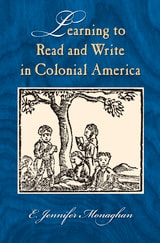
Learning to Read and Write in Colonial America
E. Jennifer Monaghan
University of Massachusetts Press, 2005
An experienced teacher of reading and writing and an award-winning historian, E. Jennifer Monaghan brings to vibrant life the process of learning to read and write in colonial America. Ranging throughout the colonies from New Hampshire to Georgia, she examines the instruction of girls and boys, Native Americans and enslaved Africans, the privileged and the poor, revealing the sometimes wrenching impact of literacy acquisition on the lives of learners.
For the most part, religious motives underlay reading instruction in colonial America, while secular motives led to writing instruction. Monaghan illuminates the history of these activities through a series of deeply researched and readable case studies. An Anglican missionary battles mosquitoes and loneliness to teach the New York Mohawks to write in their own tongue. Puritan fathers model scriptural reading for their children as they struggle with bereavement. Boys in writing schools, preparing for careers in counting houses, wield their quill pens in the difficult task of mastering a “good hand.” Benjamin Franklin learns how to compose essays with no teacher but himself. Young orphans in Georgia write precocious letters to their benefactor, George Whitefield, while schools in South Carolina teach enslaved black children to read but never to write.
As she tells these stories, Monaghan clears new pathways in the analysis of colonial literacy. She pioneers in exploring the implications of the separation of reading and writing instruction, a topic that still resonates in today's classrooms.
Monaghan argues that major improvements occurred in literacy instruction and acquisition after about 1750, visible in rising rates of signature literacy. Spelling books were widely adopted as they key text for teaching young children to read; prosperity, commercialism, and a parental urge for gentility aided writing instruction, benefiting girls in particular. And a gentler vision of childhood arose, portraying children as more malleable than sinful. It promoted and even commercialized a new kind of children's book designed to amuse instead of convert, laying the groundwork for the “reading revolution” of the new republic.
Learning to Work
The Case for Reintegrating Job Training and EducationW. Norton Grubb
Russell Sage Foundation, 1996
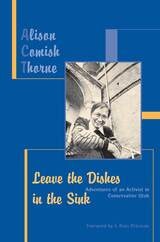
Leave The Dishes In The Sink
Alison Comish Thorne
Utah State University Press, 2002
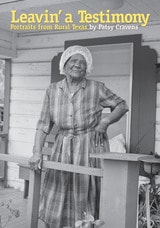
Leavin' a Testimony
Portraits from Rural TexasBy Patsy Cravens
University of Texas Press, 2006
First settled by Stephen F. Austin's colonists in the early nineteenth century, Colorado County has deep roots in Texas history. Mainly rural and agrarian until late in the twentieth century, Colorado County was a cotton-growing region whose population was about evenly divided between blacks and whites. These life-long neighbors led separate and unequal lives, memories of which still linger today. To preserve those memories, Patsy Cravens began interviewing and photographing the older residents of Colorado County in the 1980s. In this book, she presents photographs and recollections of the last generation, black and white, who grew up in the era of Jim Crow segregation.
The folks in Colorado County have engrossing stories to tell. They recall grinding poverty and rollicking fun in the Great Depression, losing crops and livestock to floods, working for the WPA, romances gone wrong and love gone right, dirty dancing, church and faith, sharecropping, quilting, raising children, racism and bigotry, and even the horrific lynching of two African American teenagers in 1935. The Colorado County residents' stories reveal an amazing resiliency and generosity of spirit, despite the hardships that have filled most of their lives. They also capture a rural way of life that was once common across the South, but is now gone forever.
Leaving College
Rethinking the Causes and Cures of Student AttritionVincent Tinto
University of Chicago Press, 1994
Leaving Readers Behind
The Age of Corporate NewspaperingGene Roberts
University of Arkansas Press, 2001

Leaving Science
Anne E. Preston
Russell Sage Foundation, 2004
Leaving a Legacy
Lessons from the Writings of Daniel DrakePhilip Diller
University of Minnesota Press, 2019
Leaving a Legacy: Lessons from the Writings of Daniel Drake is a selective collection of excerpts from the vast writings from the nineteenth-century doctor and medical pioneer Daniel Drake. From Drake’s life, documented here in his own words from excerpts of lectures, personal journal entries, presentations, speeches, books, and letters to his children, readers learn about the scope of his accomplishments in medicine, contributions to his community, and dedication to his family. Diller goes beyond biography to contextualize Drake’s life choices and what made him a role model for today’s physicians. Diller selected one hundred and eighty thematically arranged excerpts, which he paired with original reflection questions to guide the reader through thought-provoking prompts. In doing so, Diller presents the lessons from Drake’s remarkable life and work as a guide for others who wish to build an enduring legacy.
Leaving the Gay Place
Billy Lee Brammer and the Great SocietyBy Tracy Daugherty
University of Texas Press, 2018
Acclaimed by critics as a second F. Scott Fitzgerald, Billy Lee Brammer was once one of the most engaging young novelists in America. “Brammer’s is a new and major talent, big in scope, big in its promise of even better things to come,” wrote A. C. Spectorsky, a former staffer at the New Yorker. When he published his first and only novel, The Gay Place, in 1961, literary luminaries such as David Halberstam, Willie Morris, and Gore Vidal hailed his debut. Morris deemed it “the best novel about American politics in our time.” Halberstam called it “a classic . . . [a] stunning, original, intensely human novel inspired by Lyndon Johnson. . . . It will be read a hundred years from now.” More recently, James Fallows, Gary Fisketjon, and Christopher Lehmann have affirmed The Gay Place’s continuing relevance, with Lehmann asserting that it is “the one truly great modern American political novel.”
Leaving the Gay Place tells a sweeping story of American popular culture and politics through the life and work of a writer who tragically exemplifies the highs and lows of the country at mid-century. Tracy Daugherty follows Brammer from the halls of power in Washington, DC, where he worked for Senate majority leader Johnson, to rock-and-roll venues where he tripped out with Janis Joplin, and ultimately to back alleys of self-indulgence and self-destruction. Constantly driven to experiment with new ways of being and creating—often fueled by psychedelics—Brammer became a cult figure for an America on the cusp of monumental change, as the counterculture percolated through the Eisenhower years and burst out in the sixties. In Daugherty’s masterful recounting, Brammer’s story is a quintessential American story, and Billy Lee is our wayward American son.
Lee Konitz
Conversations on the Improviser's ArtAndy Hamilton
University of Michigan Press, 2007
“Meticulously researched, detailed and documented, this long awaited overview justly establishes Konitz as one of the most consistently brilliant, adventurous and original improvisers in the jazz tradition—a genius as rare as Bird himself.”
—John Zorn
“Hamilton’s work may well mark the inception of a format new to writing on Western music, one which avoids both the self-aggrandizing of autobiography and the stylized subjectification of biography.”
—The Wire
“An extraordinary approach to a biography, with the man himself speaking for extended sessions. The main vibration I felt from Lee’s words was total honesty, almost to a fault. Konitz shows himself to be an acute observer of the scene, full of wisdom and deep musical insights, relevant to any historical period regardless of style. The asides by noted musicians are beautifully woven throughout the pages. I couldn’t put the book down—it is the definition of a living history.”
—David Liebman
The preeminent altoist associated with the “cool” school of jazz, Lee Konitz was one of the few saxophonists of his generation to forge a unique sound independent of the influence of Charlie Parker. In the late 1940s, Konitz began his career with the Claude Thornhill band, during which time he came into contact with Miles Davis, with whom he would later work on the legendary Birth of the Cool sessions. Konitz is perhaps best known through his association with Lennie Tristano, under whose influence much of his sound evolved, and for his work with Stan Kenton and Warne Marsh. His recordings have ranged from cool bop to experimental improvisation and have appeared on such labels as Prestige, Atlantic, Verve, and Polydor.
Crafted out of numerous interviews between the author and his subject, the book offers a unique look at the story of Lee Konitz’s life and music, detailing Konitz’s own insights into his musical education and his experiences with such figures as Miles Davis, Stan Kenton, Warne Marsh, Lennie Tristano, Charles Mingus, Bud Powell, and Bill Evans.
Andy Hamilton is a jazz pianist and contributor to major jazz and contemporary music magazines. He teaches philosophy, and the history and aesthetics of jazz, at Durham University in the United Kingdom. He is also the author of the book Aesthetics and Music (Continuum 2007).
Joe Lovano is a Grammy Award–winning tenor saxophonist. His most recent album is Streams of Expression.
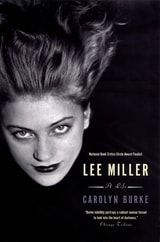
Lee Miller
A LifeCarolyn Burke
University of Chicago Press, 2007
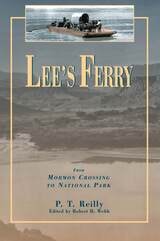
Lee's Ferry
From Mormon Crossing to National ParkP. T. Reilly and Robert H. Webb
Utah State University Press, 1999
The Colorado River and its deeply entrenched canyons create a lengthy barrier to travel in the interior West. Here and there, ancient Indian foot trails descend canyon walls and find access to the river, but one of the few places between California and Nevada where wheeled vehicles can approach it is at the mouth of the Pahreah River, between Glen Canyon and the river's steep drop toward Grand Canyon. Here, from the mid-19th until well into the 20th century, Lee's Ferry was a primary link between Utah and Arizona. Mormons trying to reach potential Indian converts and new lands for colonization to the south first developed the site. John D. Lee and parts of his family, seeking an inconspicuous spot after the Mountain Meadows massacre, first took up residence at what they called Lonely Dell. In subsequent decades, many interesting and important western characters passed through this topographical and historical funnel, from John Wesley Powell to Buffalo Bill. As river exploration and adventure increased, the place became as important to those using the river-surveyors, miners, river runners-as to folks crossing it. In recognition of its importance, Lee's Ferry has been partially restored as a historic site in the national park system.
P. T. Reilly, himself a legend on the river as boatman and chronicler, wrote the detailed and colorful history this place demanded, focusing on stories of the hodgepodge of people it attracted. He died before he finished reworking his massive narrative into book form, but Robert H. Webb, author of Grand Canyon: A Century of Change, completed that job and selected rare historical photos from the Reilly collection at Northern Arizona University to illustrate it. An epilogue by Richard Quartaroli provides a biographical sketch of P. T. Reilly.
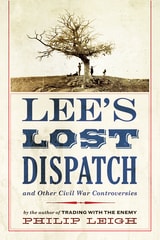
Lee's Lost Dispatch and Other Civil War Controversies
Philip Leigh
Westholme Publishing, 2015
Which over-arching decisions made by the Confederacy or Union had a greater effect on the course of the war than generally thought? Were there lauded command changes that may not have been as beneficial as presumed? How intertwined were the business aspirations on both sides of the conflict and what role did disinformation play in key battles? In Lee’s Lost Dispatch and Other Civil War Controversies, New York Times “Disunion” contributor Philip Leigh presents twelve stories from these turbulent times that afford a better understanding of how the war unfolded and how it was fought. The stories range from the Union’s delayed introduction of repeating arms and why a commercial steamer and not a warship was sent to relieve Fort Sumter to how Robert E. Lee’s critical dispatch at the battle of Antietam may have been lost and whether Southern poverty is the most protracted legacy of the war. Written to promote discussion and debate, this volume will intrigue those who enjoy Civil War history and contemplating alternatives to many assumed conclusions.
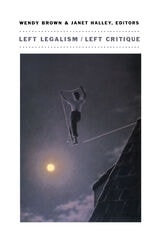
Left Legalism/Left Critique
Wendy Brown and Janet Halley, eds.
Duke University Press, 2002
Brown and Halley have assembled essays from diverse contributors—law professors, philosophers, political theorists, and literary critics—united chiefly by their willingness to think critically from the left about left legal projects. The essays themselves vary by topic, by theoretical approach, and by conclusion. While some contributors attempt to rework particular left legal projects, others insist upon abandoning or replacing those projects. Still others leave open the question of what is to be done as they devote their critical attention to understanding what we are doing. Above all, Left Legalism/Left Critique is a rare contemporary argument and model for the intellectually exhilarating and politically enriching dimensions of left critique—dimensions that persist even, and perhaps especially, when critique is unsure of the intellectual and political possibilities it may produce.
Contributors: Lauren Berlant, Wendy Brown, Judith Butler, Drucilla Cornell, Richard T. Ford, Katherine M. Franke, Janet Halley, Mark Kelman, David Kennedy, Duncan Kennedy, Gillian Lester, Michael Warner

Left Turns in Brown Study
Sandra Ruiz
Duke University Press, 2024
Left in the Midwest
St. Louis Progressive Activism in the 1960s and 1970sAmanda L. Izzo
University of Missouri Press, 2023
Despite St. Louis’s mid-twentieth-century reputation as a conservative and sleepy midwestern metropolis, the city and its surrounding region have long played host to dynamic forms of social-movement organizing. This was especially the case during the 1960s and 1970s, when a new generation of local activists lent their energies to the ongoing struggles for Black freedom, lesbian and gay liberation, feminist social transformations, environmental protection, an end to the Vietnam War, and more. This volume, the first of its kind, offers fifteen scholarly contributions that together bring into focus the exceptional range of progressive activist projects that took shape in a single midwestern city during these tumultuous decades.
In contrast to scholarship that seeks to interpret the era’s social-movement initiatives in a primarily national context, the works presented in this expansive collection emphasize the importance of locality, neighborhood, community institutions, and rooted social networks. Documenting wrenching forces of metropolitan change as well as grassroots resilience, Left in the Midwest shows us how place powerfully shaped agendas, worldviews, and opportunities for the disparate groups that dedicated themselves to progressive visions for their city. By revising our sense of the region’s past, this volume also expands our sense of the possibilities that the future may hold for activist movements seeking change in St. Louis and beyond.
Left in the West
Literature, Culture, and Progressive Politics in the American WestGioia Woods
University of Nevada Press, 2018
From the early 19th century to the present, a remarkably complex and varied body of literary and cultural production has emerged out of progressive social movements. While the literary left in the West shared many interests with other regional expressions—labor, class, anti-fascism, and anti-imperialism, the influence of Manifest Destiny—the distinct history of settler colonialism in western territories caused western leftists to develop concerns unique to the region.
Chapters in the volume provide an impressive range of analysis, covering artists and movements from suffragist writers to bohemian Californian photographers, from civil rights activists to popular folk musicians, from Latinx memoirists to Native American experimental writers, to name just a few.
The unique consideration of the West as a socio-political region establishes a framework for political critique that moves beyond class consequences, anti-fascism, and civil liberties, and into distinct Western concerns such as Native American sovereignty, environmental exploitation, and the legacies of settler colonialism. What emerges is a deeper understanding of the region and its unique people, places, and concerns.
Left of Hollywood
Cinema, Modernism, and the Emergence of U.S. Radical Film CultureBy Chris Robé
University of Texas Press, 2010
In the 1930s as the capitalist system faltered, many in the United States turned to the political Left. Hollywood, so deeply embedded in capitalism, was not immune to this shift. Left of Hollywood offers the first book-length study of Depression-era Left film theory and criticism in the United States. Robé studies the development of this theory and criticism over the course of the 1930s, as artists and intellectuals formed alliances in order to establish an engaged political film movement that aspired toward a popular cinema of social change. Combining extensive archival research with careful close analysis of films, Robé explores the origins of this radical social formation of U.S. Left film culture.
Grounding his arguments in the surrounding contexts and aesthetics of a few films in particular—Sergei Eisenstein's Que Viva Mexico!, Fritz Lang's Fury, William Dieterle's Juarez, and Jean Renoir's La Marseillaise—Robé focuses on how film theorists and critics sought to foster audiences who might push both film culture and larger social practices in more progressive directions. Turning at one point to anti-lynching films, Robé discusses how these movies united black and white film critics, forging an alliance of writers who championed not only critical spectatorship but also the public support of racial equality. Yet, despite a stated interest in forging more egalitarian social relations, gender bias was endemic in Left criticism of the era, and female-centered films were regularly discounted. Thus Robé provides an in-depth examination of this overlooked shortcoming of U.S. Left film criticism and theory.
Left of Karl Marx
The Political Life of Black Communist Claudia JonesCarole Boyce Davies
Duke University Press, 2007
Claudia Cumberbatch Jones was born in Trinidad. In 1924, she moved to New York, where she lived for the next thirty years. She was active in the Communist Party from her early twenties onward. A talented writer and speaker, she traveled throughout the United States lecturing and organizing. In the early 1950s, she wrote a well-known column, “Half the World,” for the Daily Worker. As the U.S. government intensified its efforts to prosecute communists, Jones was arrested several times. She served nearly a year in a U.S. prison before being deported and given asylum by Great Britain in 1955. There she founded The West Indian Gazette and Afro-Asian Caribbean News and the Caribbean Carnival, an annual London festival that continues today as the Notting Hill Carnival. Boyce Davies examines Jones’s thought and journalism, her political and community organizing, and poetry that the activist wrote while she was imprisoned. Looking at the contents of the FBI file on Jones, Boyce Davies contrasts Jones’s own narration of her life with the federal government’s. Left of Karl Marx establishes Jones as a significant figure within Caribbean intellectual traditions, black U.S. feminism, and the history of communism.
Left to Chance
Hurricane Katrina and the Story of Two New Orleans NeighborhoodsBy Steve Kroll-Smith, Vern Baxter, and Pam Jenkins
University of Texas Press, 2015
How do survivors recover from the worst urban flood in American history, a disaster that destroyed nearly the entire physical landscape of a city, as well as the mental and emotional maps that people use to navigate their everyday lives? This question has haunted the survivors of Hurricane Katrina and informed the response to the subsequent flooding of New Orleans across many years.
Left to Chance takes us into two African American neighborhoods—working-class Hollygrove and middle-class Pontchartrain Park—to learn how their residents have experienced “Miss Katrina” and the long road back to normal life. The authors spent several years gathering firsthand accounts of the flooding, the rushed evacuations that turned into weeks- and months-long exile, and the often confusing and exhausting process of rebuilding damaged homes in a city whose local government had all but failed. As the residents’ stories make vividly clear, government and social science concepts such as “disaster management,” “restoring normality,” and “recovery” have little meaning for people whose worlds were washed away in the flood. For the neighbors in Hollygrove and Pontchartrain Park, life in the aftermath of Katrina has been a passage from all that was familiar and routine to an ominous world filled with raw existential uncertainty. Recovery and rebuilding become processes imbued with mysteries, accidental encounters, and hasty adaptations, while victories and defeats are left to chance.
Legacies Of Lynching
Racial Violence And MemoryJonathan Markovitz
University of Minnesota Press, 2004
Traces the changing meanings of lynching and examines the political power of lynching as metaphor
Between 1880 and 1930, thousands of African Americans were lynched in the United States. Beyond the horrific violence inflicted on these individuals, lynching terrorized whole communities and became a defining characteristic of Southern race relations in the Jim Crow era. As spectacle, lynching was intended to serve as a symbol of white supremacy. Yet, Jonathan Markovitz notes, the act's symbolic power has endured long after the practice of lynching has largely faded away.
Legacies of Lynching examines the evolution of lynching as a symbol of racial hatred and a metaphor for race relations in popular culture, art, literature, and political speech. Markovitz credits the efforts of the antilynching movement with helping to ensure that lynching would be understood not as a method of punishment for black rapists but as a terrorist practice that provided stark evidence of the brutality of Southern racism and as America’s most vivid symbol of racial oppression. Cinematic representations of lynching, from Birth of a Nation to Do the Right Thing, he contends, further transform the ways that American audiences remember and understand lynching, as have disturbing recent cases in which alleged or actual acts of racial violence reconfigured stereotypes of black criminality. Markovitz further reveals how lynching imagery has been politicized in contemporary society with the example of Clarence Thomas, who condemned the Senate's investigation into allegations of sexual harassment during his Supreme Court confirmation hearings as a “high-tech lynching.”Even today, as revealed by the 1998 dragging death of James Byrd in Jasper, Texas, and the national soul-searching it precipitated, lynching continues to pervade America's collective memory. Markovitz concludes with an analysis of debates about a recent exhibition of photographs of lynchings, suggesting again how lynching as metaphor remains always in the background of our national discussions of race and racial relations.
Legacies of Losing in American Politics
Jeffrey K. Tulis and Nicole Mellow
University of Chicago Press, 2017
With Legacies of Losing in American Politics, Jeffrey K. Tulis and Nicole Mellow rethink three pivotal moments in American political history: the founding, when anti-Federalists failed to stop the ratification of the Constitution; the aftermath of the Civil War, when President Andrew Johnson’s plan for restoring the South to the Union was defeated; and the 1964 presidential campaign, when Barry Goldwater’s challenge to the New Deal order was soundly defeated by Lyndon B. Johnson. In each of these cases, the very mechanisms that caused the initial failures facilitated their eventual success. After the dust of the immediate political defeat settled, these seemingly discredited ideas and programs disrupted political convention by prevailing, often subverting, and occasionally enhancing constitutional fidelity. Tulis and Mellow present a nuanced story of winning and losing and offer a new understanding of American political development as the interweaving of opposing ideas.
Legacies of the War on Poverty
Martha J. Bailey
Russell Sage Foundation, 2013
Legacy and Legitimacy
Black Americans and the Supreme CourtRosalee A. Clawson and Eric N. Waltenburg
Temple University Press, 2008
Thoroughly grounded in the latest scholarly literature, theoretical sources, and experimental results, Legacy and Legitimacy substantially advances understanding of Black Americans’ attitudes toward the Supreme Court, the Court’s ability to influence Blacks’ opinions about the legitimacy of public institutions and policies, and the role of media in shaping Blacks’ judgments.
Drawing on legitimacy theory—which explains the acceptance of or tolerance for controversial policies—the authors begin by reexamining the significance of “diffuse support” in establishing legitimacy. They provide a useful overview of the literature on legitimacy and a concise history of the special relationship between Blacks and the Court. They investigate the influences of group attitudes and media “framing.” And they employ data from large-scale surveys to show that Blacks with greater levels of diffuse support for the Court are more likely to adopt positions consistent with Court rulings.
With its broad scope and inclusion of new experimental findings, Legacy and Legitimacy will interest students and scholars of judicial politics, racial politics, media and politics, black studies and public opinion.
Legacy of a False Promise
A Daughter's ReckoningMargaret Fuchs Singer
University of Alabama Press, 2009
Margaret Fuchs was thirteen in June 1955 when she learned that her parents had been Communists while working for the U.S. government in the 1930s and '40s. This book chronicles the years during which her parents were exposed and her father was subpoenaed before the House Un-American Activities Committee. Eventually he named names, and subsequently lost his job as a law professor at American University, and was blacklisted from teaching ever again. Legacy of a False Promise also details the author's quest as an adult to learn whether or not her parents ever spied for the Soviet Union.
Based on eight years of research using family records, FBI files, American University archives, personal interviews, and the recently declassified Venona cables, Legacy of a False Promise offers unique insights into the McCarthy Era. Most "red-diaper babies" who have written on the subject had parents who refused to give in to HUAC's demands. Singer's work instead recounts the shame and series of betrayals that her father's decision to name names brought to her family. Furthermore, it explores the campaign of the liberal anti-Communist movement to publicize its political position while defending a fired ex-Communist professor, the nature and activities of secret Communist underground cells, and the motivation of New Deal government workers who spied for the Soviets.
This is a poignant meditation on family secrets, father-daughter relationships in times of crisis, teenage loneliness in the midst of trauma, and the effects of parents' actions on the lives of their children. It also serves as a timely reminder of the dangers of sacrificing civil liberties in the name of national security.

Legacy on Ice
Blake Geoffrion and the Fastest Game on EarthSam Jefferies, Foreword by John Buccigross
University of Wisconsin Press, 2023
With sure-footed and swift-moving prose, Sam Jefferies tells Geoffrion’s story against the backdrop of modern North American hockey. Thorough research and scores of interviews fuel this tale of soaring success and terrible tragedy, offering insight not only into one man’s athletic journey but also into the rise of American hockey on the national and international stage. Geoffrion’s brief career, marked by tribulation and triumph, illustrates the subtle but omnipresent currents of American media, sports labor, and the interplay between college and professional athletics. It tells the story of what was, what is, and what may yet be for the fastest game on earth.
Legal Advocacy
Lawyers and Nonlawyers at WorkHerbert M. Kritzer
University of Michigan Press, 1998
The analysis shows clearly that nonlawyers can be effective advocates and, in some situations, more effective than many lawyers. Kritzer combines an examination of case outcomes with a systematic observation of advocates in the hearing room, providing a compelling portrait of their work and a solid basis for understanding the differences in the effectiveness of advocates with different training. The author's findings have important implications for our policies toward restrictions on those who can provide legal assistance, specialization in training and practice, and the meaning of professional monopolies in a world of increasing complexity.
This book will appeal to student of the legal process, the sociology of professions, and all concerned with the operation of the U.S. legal system.
Herbert M. Kritzer is Professor of Political Science and Law, University of Wisconsin--Madison. He is the author of Let's Make a Deal and The Justice Broker.
Legal Bases
Baseball And The LawRoger Abrams
Temple University Press, 1998
But how does collective bargaining and labor arbitration work in the major leagues? Why is baseball exempt from the antitrust laws? In Legal Bases, Roger Abrams has assembled an all-star baseball law team whose stories illuminate the sometimes uproarious, sometimes ignominious relationship between law and baseball that has made the business of baseball a truly American institution.

Legal Care
Advocacy and Friction in Family DetentionErin Routon
University of Arizona Press, 2026
Family detention garnered much public attention when it expanded dramatically in 2014 as significantly increased numbers of migrant groups began arriving and requesting asylum at the Mexico-U.S. border. During this period, the Obama administration designated three detention facilities, two in South Texas, to hold such families while they underwent part of the asylum legal process. One became the largest immigrant detention facility in the country.
In Legal Care anthropologist Erin Routon explores the operations of these facilities through the unique perspectives of volunteer legal advocates. Routon offers a compelling ethnographic account of the hidden labor and emotional resilience of those advocates. Through the lens of “legal care,” Routon reframes legal aid as a form of caregiving, revealing how these advocates resist the structural and legal violence of family detention while supporting asylum-seeking parents and children. Drawing on immersive fieldwork and firsthand narratives, the book exposes the human cost of administrative incarceration and the quiet power of care in spaces designed to exclude.
Timely, urgent, and deeply humane, this work speaks to scholars and practitioners across anthropology, law and society, migration studies, and carceral justice. Routon’s accessible and evocative writing invites readers to reconsider activism and advocacy, offering new language for understanding resistance and solidarity in the face of institutional violence. This book is essential reading for anyone committed to justice, care, and the future of immigration policy in the United States.
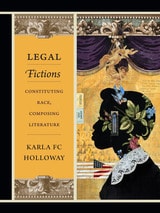
Legal Fictions
Constituting Race, Composing LiteratureKarla FC Holloway
Duke University Press, 2014
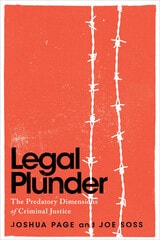
Legal Plunder
The Predatory Dimensions of Criminal JusticeJoshua Page and Joe Soss
University of Chicago Press, 2025
A searing, historically rich account of how US policing and punishment have been retrofitted over the last four decades to extract public and private revenues from America’s poorest and most vulnerable communities.
Alongside the rise of mass incarceration, a second profound and equally disturbing development has transpired. Since the 1980s, US policing and punishment have been remade into tools for stripping resources from the nation’s most oppressed communities and turning them into public and private revenues. Legal Plunder analyzes this development’s origins, operations, consequences, and the political struggles that it has created.
Drawing on historical and contemporary evidence, including original ethnographic research, Joshua Page and Joe Soss examine the predatory dimensions of criminal legal governance to show how practices that criminalize, police, and punish have been retrofitted to siphon resources from subordinated groups, subsidize governments, and generate corporate profits. As tax burdens have declined for the affluent, this financial extraction—now a core function of the country’s sprawling criminal legal apparatus—further compounds race, class, and gender inequalities and injustices. Legal Plunder shows that we can no longer afford to overlook legal plunder or the efforts to dismantle it.

Legal Reference for Librarians
How and Where to Find the AnswersPaul D. Healey
American Library Association, 2014
Legal Rights, 5th Ed.
The Guide for Deaf and Hard of Hearing PeopleGallaudet University Press, 2000

Legal Rights, 6th Ed.
The Guide for Deaf and Hard of Hearing PeopleGallaudet University Press, 2015
The new Legal Rights also explains the significant amendments to these laws, including the ADA Amendments Act (ADAAA) and new regulations to its Title II concerning public entities and Title III pertaining to public accommodations and commercial facilities. The reauthorization of IDEA expanded the No Child Left Behind Act requirement for highly qualified teachers to all students with disabilities. This new edition also tracks the trend of passing a Deaf and Hard of Hearing Children’s Bill of Rights in a growing number of state legislatures.
This completely new resource also delineates new legislation such as the Twenty-First Century Communications Video and Accessibility Act, which ensures access to the newest communications technology for deaf and hard of hearing people. Legal Rights also includes information on the use of interpreters in the legal system, securing its position as the most comprehensive reference of legal information for deaf and hard of hearing people now available.
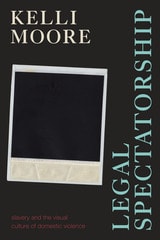
Legal Spectatorship
Slavery and the Visual Culture of Domestic ViolenceKelli Moore
Duke University Press, 2022
Duke University Press Scholars of Color First Book Award recipient
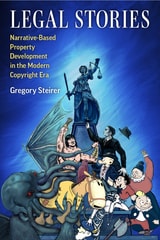
Legal Stories
Narrative-Based Property Development in the Modern Copyright EraGregory Steirer
University of Michigan Press, 2024
Steirer’s expansive view of intellectual property law encompasses not only statutes and judicial opinions, but also the everyday practices and productions of authors, editors, fans, and other legal laypersons. The result is a history of the law as improvisatory and accident-prone, taking place as often outside the courtroom as inside, and shaped as much by laypersons as lawyers. Through the examination of influential legal disputes involving early properties such as Dashiell Hammett’s Sam Spade, H. P. Lovecraft’s Cthulhu Mythos, and Robert E. Howard’s Conan the Barbarian, Steirer provides a ground’s eye view of how copyright law has operated and evolved in practice.
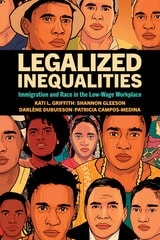
Legalized Inequalities
Immigration and Race in the Low-wage WorkplaceKati L. Griffith
Russell Sage Foundation, 2025
Drawing on interviews with over three hundred low-wage Haitian and Central American workers and worker advocates, Griffith, Gleeson, Dubuisson, and Campos-Medina reveal how U.S. policies produce and sustain job instability and insecurity. Together, contemporary U.S. labor and employment law, immigration policy, and enduring racial inequality work in tandem to keep workers’ wages low, lock them into substandard working conditions, and minimize opportunities to push for change. Workplace regulations meant to protect workers are weak and underenforced, privileging employers over workers. At-will employment policies, which allow employers to terminate employees without cause, discourage workers from bargaining for better jobs or holding employers accountable for even the most egregious mistreatment. Federal immigration policy further disempowers workers by deputizing employers to act as immigration enforcement agents through immigration status verification requirements. Undocumented workers often believe they must endure maltreatment or risk deportation. Anti-immigrant sentiment—encouraged by U.S. policy—impacts workers across all status groups. Additionally, despite a proliferation of civil rights legislation, racial disparities remain in the workplace. Workers of color are often paid less, forced to complete more dangerous and demeaning tasks, and subjected to racial harassment.
While these workers face formidable barriers to fighting for their rights, they are not entirely powerless. Some low-wage workers filed formal complaints with government agencies. Others, on their own or collectively, confronted their employers to demand fair and dignified treatment. Some even quit in protest of their poor working conditions. The authors argue that reforming labor and employment law, immigration law, and Civil Rights law is necessary to reshape the low-wage workplace. They suggest increasing funding for workers’ rights enforcement agencies, removing the mandate for employers to verify a worker’s immigration status, and making it easier to prove that employment discrimination has occurred, among other policy proposals, to help empower and protect low-wage immigrant workers of color.
Legalized Inequalities not only highlights the crushing consequences of U.S. policy on low-wage immigrant workers of color but showcases their resilience in the face of these obstacles.
Legalizing Gay Marriage
Vermont And The National DebateMichael Mello, foreword by David Chambers
Temple University Press, 2004
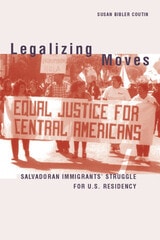
Legalizing Moves
Salvadoran Immigrants' Struggle for U.S. ResidencySusan Bibler Coutin
University of Michigan Press, 2003
Susan Bibler Coutin is Assistant Professor in the Department of Criminology, Law, and Society, at the University of California, Irvine.

Legalizing Plural Marriage
The Next Frontier in Family LawMark Goldfeder
Brandeis University Press, 2017
Legend Tripping
A Contemporary Legend CasebookLynne S. McNeill
Utah State University Press, 2018
The volume presents both insightful research and useful pedagogy, making this an invaluable resource in the classroom. Selected major articles on legend tripping, with introductory sections written by the editors, are followed by discussion questions and projects designed to inspire readers to engage critically with legend traditions and customs of legend tripping and to explore possible meanings and symbolics at work. Suggested projects incorporate digital technology as it appears both in legends and in modes of legend tripping.
Legend Tripping is appropriate for students, general readers, and folklorists alike. It is the first volume in the International Society for Contemporary Legend Research series, a set of casebooks providing thorough and up-to-date studies that showcase a variety of scholarly approaches to contemporary legends, along with variants of legend texts, discussion questions, and projects for students.
Contributors: S. Elizabeth Bird, Bill Ellis, Carl Lindahl, Patricia M. Meley, Tim Prizer
Legends and Lore of Southern Illinois
John W. Allen
Southern Illinois University Press, 1963
In the 1950s and ‘60s, John W. Allen told the people of southern Illinois about themselves—about their region, its history, and its folkways—in his series of newspaper articles, “It Happened in Southern Illinois.” Each installment of the series depicted a single item of interest—a town, a building, an enterprise, a person, an event, a custom. Originally published in 1963, Legends & Lore of Southern Illinois brings together a selection of these articles preserving a valuable body of significant local history and cultural lore.
During territorial times and early statehood, southern Illinois was the most populous and most influential part of the state. But the advent of the steamboat and the building of the National Road made the lands to the west and north more easily accessible, and the later settlers struck out for the more expansive and fertile prairies. The effect of this movement was to isolate that section of the state known as Egypt and halt its development, creating what Allen termed “an historical eddy.” Bypassed as it was by the main current of westward expansion and economic growth, its culture changed very slowly. Methods, practices, and the tools of the pioneer continued in use for a long time. The improved highways and better means of communication of the twentieth century brought a marked change upon the region, and daily life no longer differed materially from that of other areas.
Against such a cultural and historical backdrop, Mr. Allen wrote these sketches of the people of southern Illinois—of their folkways and beliefs, their endeavors, successes, failures, and tragedies, and of the land to which they came. There are stories here of slaves and their masters, criminals, wandering peddlers, politicians, law courts and vigilantes, and of boat races on the rivers. Allen also looks at the region’s earlier history, describing American Indian ruins, monuments, and artifacts as well as the native population’s encounters with European settlers.
Many of the vestiges of the region’s past culture have all but disappeared, surviving only in museums and in the written record. This new paperback edition of Legends & Lore of Southern Illinois brings that past culture to life again in Allen’s descriptive, engaging style.