Results by title
28167 books match the query 'History' and 932 start with l
Law and the Shaping of Public Education, 1785-1954
Edited by David Tyack, Thomas James, and Aaron Benavot
University of Wisconsin Press, 1991
Law by Night
Jonathan Goldberg-Hiller
Duke University Press, 2023

Law in Everyday Japan
Sex, Sumo, Suicide, and StatutesMark D. West
University of Chicago Press, 2005
Compiling case studies based on seven fascinating themes—karaoke-based noise complaints, sumo wrestling, love hotels, post-Kobe earthquake condominium reconstruction, lost-and-found outcomes, working hours, and debt-induced suicide—Law in Everyday Japan offers a vibrant portrait of the way law intermingles with social norms, historically ingrained ideas, and cultural mores in Japan. Each example is informed by extensive fieldwork. West interviews all of the participants-from judges and lawyers to defendants, plaintiffs, and their families-to uncover an everyday Japan where law matters, albeit in very surprising ways.
Law in a Lawless Land
Diary of a Limpieza in ColombiaMichael Taussig
University of Chicago Press, 2005
Law in a Lawless Land offers a rare and penetrating insight into the nature of Colombia's present peril. In a nuanced account of the human consequences of a disintegrating state, anthropologist Michael Taussig chronicles two weeks in a small town in Colombia's Cauca Valley taken over by paramilitaries that brazenly assassinate adolescent gang members. Armed with automatic weapons and computer-generated lists of names and photographs, the paramilitaries have the tacit support of the police and even many of the desperate townspeople, who are seeking any solution to the crushing uncertainty of violence in their lives. Concentrating on everyday experience, Taussig forces readers to confront a kind of terror to which they have become numb and complacent.
"If you want to know what it is like to live in a country where the state has disintegrated, this moving book by an anthropologist well known for his writings on murderous Colombia will tell you."—Eric Hobsbawm
Law, Family, and Women
Toward a Legal Anthropology of Renaissance ItalyThomas Kuehn
University of Chicago Press, 1991
influence of law on Italian society during the Renaissance,
especially in the spheres of family and women. Kuehn's use
of legal sources along with letters, diaries, and
contemporary accounts allows him to present a compelling
image of the social processes that affected the shape and
function of the law.
The numerous law courts of Italian city-states
constantly devised and revised statutes. Kuehn traces the
permutations of these laws, then examines their use by
Florentines to arbitrate conflict and regulate social
behavior regarding such issues as kinship, marriage,
business, inheritance, illlegitimacy, and gender. Ranging
from one man's embittered denunciation of his father to
another's reaction to his kinsmen's rejection of him as
illegitimate, Law, Family, and Women provides
fascinating evidence of the tensions riddling family life in
Renaissance Florence. Kuehn shows how these same tensions,
often articulated in and through the law, affected women. He
examines the role of the mundualdus—a male legal guardian
for women—in Florence, the control of fathers over their
married daughters, and issues of inheritance by and through
women. An ambitious attempt to reformulate the agenda of
Renaissance social history, Kuehn's work will be of value to
both legal anthropologists and social historians.
Thomas Kuehn is professor of history at Clemson
University.

Law, Sex, and Christian Society in Medieval Europe
James A. Brundage
University of Chicago Press, 1990
"Brundage's book is consistently learned, enormously useful, and frequently entertaining. It is the best we have on the relationships between theological norms, legal principles, and sexual practice."—Peter Iver Kaufman, Church History

Lawless Liberators
Political Banditry and Cuban IndependenceRosalie Schwartz
Duke University Press, 1989
Manuel Garcia, a hero-villian of Cuban folklore to this day, was the most notorious of the brigand-patriots and led a gang that spread terror throughout Havana province, contributing to the breakdown of rural order that preceded full-scale rebellion in 1895. Lawless Liberators examines the origins, actions, and ends (often sudden and violent) of the bandit groups such as Garcia’s that paved the way for the revolution and offers a reasoned and balanced analysis of their role in those dramatic events.

Laws of Chance
Brazil's Clandestine Lottery and the Making of Urban Public LifeAmy Chazkel
Duke University Press, 2011

Laws of Early Iceland
Gragas IAndrew Dennis
University of Manitoba Press, 2007

Laws of Early Iceland
Gragas IIAndrew Dennis
University of Manitoba Press, 2000
Laws of Our Fathers
Popular Culture and the U.S. ConstitutionEdited by Ray B. Browne and Glenn J. Browne
University of Wisconsin Press, 1986
Laws of the Postcolonial
Eve Darian-Smith and Peter Fitzpatrick, Editors
University of Michigan Press, 1999
In perceptions of Western law there is an enduring disparity between law's pervasive power and its fragility. Many of these essays provide graphic accounts of law's tremendous shaping power in that massive occidental movement which settled and unsettled the globe. These accounts point to the West's encompassing and transforming of other peoples and other legal systems in ways which constitute and confirm the West in its own self-creation. Other essays deal with situations "within" the West which show how its identity is created, sustained, and also challenged in a constant reference to those contrary "others" which a powerful law has shaped and transformed. This challenge comes not least from the resistance of those "others" --resistances that profoundly disrupt the West and its law, revealing them as fractured at the seemingly confident core of their own self-constitution.
Contributors include Antony Anghie, Rolando Gaete, Alan Norrie, Dianne Otto, Paul Passavant, Jeannine Perdy, Colin Perrin, Annelise Riles, Roshan de Silva, and John Strawson, in addition to the editors.
Eve Darian-Smith is Assistant Professor of Anthropology, University of California, Santa Barbara. Peter Fitzpatrick is Professor of Law, Queen Mary and Westfield College, University of London.
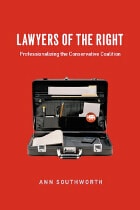
Lawyers of the Right
Professionalizing the Conservative CoalitionAnn Southworth
University of Chicago Press, 2008
Drawing on in-depth interviews with more than seventy lawyers who represent conservative and libertarian nonprofit organizations, Ann Southworth explores their values and identities and traces the implications of their shared interest in promoting political strategies that give lawyers leading roles. She goes on to illuminate the function of mediator organizations—such as the Heritage Foundation and the Federalist Society for Law and Public Policy—that have succeeded in promoting cooperation among different factions of conservative lawyers. Such cooperation, she finds, has aided efforts to drive law and the legal profession politically rightward and to give lawyers greater prominence in the conservative movement. Southworth concludes, though, that tensions between the conservative law movement’s elite and populist elements may ultimately lead to its undoing.
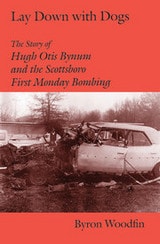
Lay Down with Dogs
Hugh Otis Bynum and the Scottsboro First Monday BombingByron Woodfin
University of Alabama Press, 2002
The gripping story of the attempted murder of Scottsboro attorney and state legislator Loy Campbell
“As with any good book about a great event, this one has a little of everything—suspense, humor, pathos, melodrama.” —Journal of Southern History
On a quiet December morning in 1972, Scottsboro attorney and former state legislator Loy Campbell started his car and detonated a bomb hidden beneath the hood. The explosion tore through the vehicle, cost him both legs, and nearly killed him, shattering the calm of the northeast Alabama town. Lay Down with Dogs reconstructs the attempted assassination of Campbell and subsequent trial. As Alabama’s young and ambitious attorney general, Bill Baxley took personal charge of the case. He led the state’s investigation and prosecution against those accused of planning and financing the assassination attempt, most notably Hugh Otis Bynum Jr., one of the most powerful local figures in Scottsboro. More than a crime story, it is a gripping account of violence, power, and survival at a volatile moment in modern Southern history.
Drawing on court records, investigative files, contemporary journalism, and firsthand testimony, Byron Woodfin offers the most comprehensive account of the bombing and its aftermath. With the skill of an experienced historian and storyteller, the narrative follows both the painstaking investigation and the dramatic prosecution that ultimately exposed the forces behind the attack. The author’s deep familiarity with Alabama history and legal culture lends authority and insight, while a clear, compelling prose style keeps the story moving with the momentum of a true‑crime classic.
Lay Down with Dogs will appeal to readers of Southern history, legal history, and true crime, as well as anyone interested in justice, civic life, and unsolved tensions in twentieth‑century America. It is ideal for scholars, students, and general readers seeking a powerful, unsettling, and unforgettable story rooted in real events.
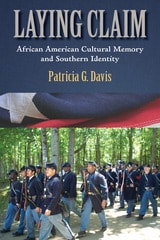
Laying Claim
African American Cultural Memory and Southern IdentityPatricia G. Davis
University of Alabama Press, 2016
Reclaiming Southern history through the voices, memories, and experiences of African Americans.
In Laying Claim: African American Cultural Memory and Southern Identity, Patricia Davis identifies the Civil War as the central narrative around which official depictions of southern culture have been defined. Because that narrative largely excluded African American points of view, the resulting southern identity was monolithically white. Davis traces how the increasing participation of black public voices in the realms of Civil War memory—battlefields, museums, online communities—has dispelled the mirage of “southernness” as a stolid cairn of white culture and has begun to create a more fluid sense of southernness that welcomes contributions by all of the region’s peoples.
Laying Claim offers insightful and penetrating examinations of African American participation in Civil War reenactments; the role of black history museums in enriching representations of the Civil War era with more varied interpretations; and the internet as a forum within which participants exchange and create historical narratives that offer alternatives to unquestioned and dominant public memories. From this evolving cultural landscape, Davis demonstrates how simplistic caricatures of African American experiences are giving way to more authentic, expansive, and inclusive interpretations of southernness.
As a case-study and example of change, Davis cites the evolution of depictions of life at Thomas Jefferson’s Monticello. Where visitors to the site once encountered narratives that repeated the stylized myth of Monticello as a genteel idyll, modern accounts of Jefferson’s day offer a holistic, inclusive, and increasingly honest view of Monticello as the residents on every rung of the social ladder experienced it.
Contemporary violence and attacks about or inspired by the causes, outcomes, and symbols of the Civil War, even one hundred and fifty years after its end, add urgency to Davis’s argument that the control and creation of public memories of that war is an issue of concern not only to scholars but all Americans. Her hopeful examination of African American participation in public memory illuminates paths by which this enduring ideological impasse may find resolutions.

Le Corbusier
The City of Refuge, Paris 1929/33Brian Brace Taylor
University of Chicago Press, 1988
Brian Brace Taylor draws on extensive archival research to reconstruct each step of the architect's attraction to the commission, his design process and technological innovations, the social and philosophical compatibility of the Salvation Army with Le Corbusier's own ideas for urban planning, and finally, the many modifications required, first to eliminate defects and later to accommodate changes in the services the building provided. Throughout, Taylor focuses on Le Corbusier's environmental, technological, and social intentions as opposed to his strictly formal intentions. He shows that the City of Refuge became primarily a laboratory for the architect's own research and not simply a conventional solution to residents' requirements or the Salvation Army's program.
Le Jazz
Jazz and French Cultural IdentityMatthew F. Jordan
University of Illinois Press, 2010
In Le Jazz, Matthew F. Jordan deftly blends textual analysis, critical theory, and cultural history in a wide-ranging and highly readable account of how jazz progressed from a foreign cultural innovation met with resistance by French traditionalists to a naturalized component of the country's identity. Jordan draws on sources including ephemeral critical writing in the press and twentieth-century French literature to trace the country's reception of jazz, from the Cakewalk dance craze and the music's significance as a harbinger of cultural recovery after World War II to its place within French ethnography and cultural hybridity.
Countering the histories of jazz's celebratory reception in France, Jordan delves in to the reluctance of many French citizens to accept jazz with the same enthusiasm as the liberal humanists and cosmopolitan crowds of the 1930s. Jordan argues that some listeners and critics perceived jazz as a threat to traditional French culture, and only as France modernized its identity did jazz become compatible with notions of Frenchness. Le Jazz speaks to the power of enlivened debate about popular culture, art, and expression as the means for constructing a vibrant cultural identity, revealing crucial keys to understanding how the French have come to see themselves in the postwar world.
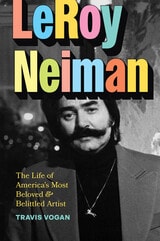
LeRoy Neiman
The Life of America’s Most Beloved and Belittled ArtistTravis Vogan
University of Chicago Press, 2024
LeRoy Neiman—the cigar-smoking and mustachioed artist famous for his Playboy illustrations, sports paintings, and brash interviews—stood among the twentieth century’s most famous, wealthy, and polarizing artists. His stylish renderings of musicians, athletes, and sporting events captivated fans but baffled critics, who accused Neiman of debasing art with popular culture. Neiman cashed in on the controversy, and his extraordinary popularity challenged the norms of what art should be, where it belongs, and who should have access to it.
The story of a Depression-era ragamuffin–turned–army chef–turned–celebrity artist, Neiman’s biography is a rollicking ride through twentieth-century American history, punctuated by encounters with the likes of Muhammad Ali, Frank Sinatra, Joe Namath, and Andy Warhol. In the whirlwind of his life, Neiman himself once remarked that even he didn’t know who he really was—but, he said, the fame and money that came his way made it all worth it. In this first biography of the captivating and infamous man, Travis Vogan hunts for the real Neiman amid the America that made him.
.
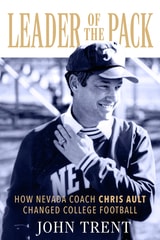
Leader of the Pack
How Nevada Coach Chris Ault Changed College FootballJohn Trent
University of Nevada Press, 2027
Nevada Wolf Pack football coach Chris Ault is unlike any other college football coach in history. He spent his entire coaching career, from 1976 to 2012, at the University of Nevada, Reno, where he elevated a football program with very little notoriety onto the national stage, winning 234 games and earning a place in the College Football Hall of Fame. Ault’s innovative “Pistol” offense, established in the 2004–2005 season, revolutionized college football and ushered in its modern high-scoring offensive style.
Yet perhaps beyond the offensive genius Ault brought to the college game, he was also a masterful showman. He built interest in a previously moribund program with publicity stunts like inviting military tanks into Mackay Stadium and having them blast non-live rounds into the sky whenever the Wolf Pack scored a touchdown. He wrote victory songs for the Wolf Pack to sing in the locker room following every win. His teams marched through downtown Reno in military formation while wearing full game uniforms. He delivered stirring halftime speeches that led to improbable comebacks, including the single greatest football comeback in NCAA history. He found common personal ground with young Wolf Pack athletes and developed talent like Colin Kaepernick, who developed into one of the greatest college quarterbacks the sport had ever seen.
Through his unconventional coaching methods, his fervent belief that the University of Nevada, Reno, was the finest institution of higher learning in the land, and his innate, creative, and intuitive understanding of how a winning football program can unite people, Ault brought the people of Northern Nevada together in a way that no one has replicated since. Chris Ault was the rare college football coach who came to campus as a starting quarterback, stayed throughout his career as a coach, and left a mark that will never be equaled.
Leaders in Plastic Surgery
The Dingman-Grabb Era 1946-1986Robert M. Oneal, MD, and Lauralee A. Lutz
Michigan Publishing Services, 2017
Leaders of Their Race
Educating Black and White Women in the New SouthSarah Case
University of Illinois Press, 2017
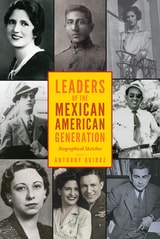
Leaders of the Mexican American Generation
Biographical EssaysAnthony Quiroz
University Press of Colorado, 2016
Leaders of the Mexican American Generation explores the lives of a wide range of influential members of the US Mexican American community between 1920 and 1965 who paved the way for major changes in their social, political, and economic status within the United States.
Including feminist Alice Dickerson Montemayor, to San Antonio attorney Gus García, and labor activist and scholar Ernesto Galarza, the subjects of these biographies include some of the most prominent idealists and actors of the time. Whether debating in a court of law, writing for a major newspaper, producing reports for governmental agencies, organizing workers, holding public office, or otherwise shaping space for the Mexican American identity in the United States, these subjects embody the core values and diversity of their generation.
More than a chronicle of personalities who left their mark on Mexican American history, Leaders of the Mexican American Generation cements these individuals as major players in the history of activism and civil rights in the United States. It is a rich collection of historical biographies that will enlighten and enliven our understanding of Mexican American history.
Leadership in the Time of Covid
Pandemic Responses in Central EuropeMilada Polisenská
Central European University Press, 2023
The Covid pandemic has put all modern societies to a serious test of resilience. The interdisciplinary research on which this book is based examined how four European governments behaved in these circumstances. During the months of the crisis, the team of experts coordinated by the editors of this volume took a close look at the decision-making processes in the Czech Republic, Hungary, Poland, and Slovakia – the so-called Visegrad Four.
The inquiries focused on experiences from the academic, health, economic and social fields. The methods of comparison included surveys, interviews, discourse analysis, for which the adaptive leadership theory provided the conceptual framework.
The conclusions are both academic and practical. Aside the description of the pandemic responses, the research had a formative dimension: how can an adaptive leadership approach better help societies manage the health and societal impacts of similar challenges? The spectrum of emerging anti-democratic tendencies in the region provided the specific context of the exercise. The four states face varying degrees of democratic backsliding as well as illiberal influences that have affected their response to the pandemic, which gives this research on the Visegrad Four a worldwide resonance.
Learned Patriots
Debating Science, State, and Society in the Nineteenth-Century Ottoman EmpireM. Alper Yalçinkaya
University of Chicago Press, 2015
In Learned Patriots, M. Alper Yalçinkaya examines what it meant for nineteenth-century Ottoman elites themselves to have a debate about science. Yalçinkaya finds that for anxious nineteenth-century Ottoman politicians, intellectuals, and litterateurs, the chief question was not about the meaning, merits, or dangers of science. Rather, what mattered were the qualities of the new “men of science.” Would young, ambitious men with scientific education be loyal to the state? Were they “proper” members of the community? Science, Yalçinkaya shows, became a topic that could hardly be discussed without reference to identity and morality.
Approaching science in culture, Learned Patriots contributes to the growing literature on how science travels, representations and public perception of science, science and religion, and science and morality. Additionally, it will appeal to students of the intellectual history of the Middle East and Turkish politics.
Learning Democracy
Citizen Engagement and Electoral Choice in Nicaragua, 1990-2001Leslie E. Anderson and Lawrence C. Dodd
University of Chicago Press, 2005
By analyzing nationwide surveys conducted during the 1990, 1996, and 2001 Nicaraguan presidential elections, Leslie E. Anderson and Lawrence C. Dodd provide insight into one of the most unexpected and intriguing recent advancements in third world politics. They offer a balanced account of the voting patterns and forward-thinking decisions that led Nicaraguans to first support the reformist Sandinista revolutionaries only to replace them with a conservative democratic regime a few years later. Addressing issues largely unexamined in Latin American studies, Learning Democracy is a unique and probing look at how the country's mass electorate moved beyond revolutionary struggle to establish a more stable democratic government by realizing the vital role of citizens in democratization processes.
Learning Legacies
Archive to Action through Women's Cross-Cultural TeachingSarah Ruffing Robbins
University of Michigan Press, 2017
Learning One’s Native Tongue
Citizenship, Contestation, and Conflict in AmericaTracy B. Strong
University of Chicago Press, 2019
With Learning One’s Native Tongue, Tracy B. Strong explores the development of the concept of American citizenship and what it means to belong to this country,
starting with the Puritans in the seventeenth century and continuing to the present day. He examines the conflicts over the meaning of citizenship in the writings and speeches of prominent thinkers and leaders ranging from John Winthrop and Roger Williams to Thomas Jefferson, Nathaniel Hawthorne, Abraham Lincoln, Frederick Douglass, and Franklin Roosevelt, among many others who have participated in these important cultural and political debates. The criteria that define what being a citizen entails change over time and in response to historical developments, and they are thus also often the source of controversy and conflict, as with voting rights for women and African Americans. Strong looks closely at these conflicts and the ensuing changes in the conception of citizenship, paying attention to what difference each change makes and what each particular conception entails socially and politically.
Learning Places
The Afterlives of Area StudiesMasao Miyoshi and H.D. Harootunian, eds.
Duke University Press, 2002
A tremendous amount of money flows—particularly within the sphere of East Asian studies, the contributors claim—from foreign agencies and governments to U.S. universities to underwrite courses on their histories and societies. In the process, this volume argues, such funds have gone beyond support to the wholesale subsidization of students in graduate programs, threatening the very integrity of research agendas. Native authority has been elevated to a position of primacy; Asian-born academics are presumed to be definitive commentators in Asian studies, for example. Area studies, the contributors believe, has outlived the original reason for its construction. The essays in this volume examine particular topics such as the development of cultural studies and hyphenated studies (such as African-American, Asian-American, Mexican-American) in the context of the failure of area studies, the corporatization of the contemporary university, the prehistory of postcolonial discourse, and the problematic impact of unformulated political goals on international activism.
Learning Places points to the necessity, the difficulty, and the possibility in higher education of breaking free from an entrenched Cold War narrative and making the study of a specific area part of the agenda of education generally. The book will appeal to all whose research has a local component, as well as to those interested in the future course of higher education generally.
Contributors. Paul A. Bové, Rey Chow, Bruce Cummings, James A. Fujii, Harry Harootunian, Masao Miyoshi, Tetsuo Najita, Richard H. Okada, Benita Parry, Moss Roberts, Bernard S. Silberman, Stefan Tanaka, Rob Wilson, Sylvia Yanagisako, Mitsuhiro Yoshimoto
Learning To Divide The World
Education at Empire’s EndJohn Willinsky
University of Minnesota Press, 2000
Learning Together
A History of Coeducation in American Public SchoolsDavid Tyack
Russell Sage Foundation, 1992
Learning Whiteness
Education and the Settler Colonial StateArathi Sriprakash
Pluto Press, 2022
Learning Whiteness examines the material conditions, knowledge politics and complex feelings that create and relay systems of racial domination. Focusing on Australia, the authors demonstrate how whiteness is fundamentally an educational project – taught within education institutions and through public discourse – in active service of the settler colonial state.
To see whiteness as learned is to recognize that it can be confronted. This book invites readers to reckon with past and present politics of education in order to imagine a future thoroughly divested from racism.
Learning by Doing in Markets, Firms, and Countries
Edited by Naomi R. Lamoreaux, Daniel M. G. Raff, and Peter Temin
University of Chicago Press, 1998
The first three essays in this volume explore techniques firms have used to both manage information to create valuable asymmetries and to otherwise suppress unwelcome competition. The next three focus on the ways in which firms have built special capabilities over time, capabilities that have been both sources of competitive advantage and resistance to new opportunities. The last two extend the notion of learning from the level of firms to that of nations. The collection as a whole builds on the previous two volumes to make the connection between information structure and product market outcomes in business history.
Learning for Work
How Industrial Education Fostered Democratic OpportunityConnie Goddard
University of Illinois Press, 2024
Rooting her account in John Dewey’s ideas, Goddard moves from early nineteenth century supporters of the union of learning and labor to the interconnected histories of CMTS, New Jersey’s Manual Training and Industrial School for Colored Youth, North Dakota’s Normal and Industrial School, and related programs elsewhere. Goddard analyzes the work of movement figures like abolitionist Theodore Weld, educators Calvin Woodward and Booker T. Washington, social critic W.E.B. Du Bois, Dewey himself, and his influential Chicago colleague Ella Flagg Young. The book contrasts ideas about manual training held by advocate Nicholas Murray Butler with those of opponent William Torrey Harris and considers overlooked connections between industrial education and the Arts and Crafts Movement.
An absorbing merger of history and storytelling, Learning for Work looks at the people who shaped industrial education while offering a provocative vision of realizing its potential today.
Learning from Birmingham
A Journey into History and HomeJulie Buckner Armstrong
University of Alabama Press, 2023
A steel town daughter’s search for truth and beauty in Birmingham, Alabama
“As Birmingham goes, so goes the nation,” Fred Shuttlesworth observed when he invited Martin Luther King Jr. to the city for the transformative protests of 1963. From the height of the Civil Rights Movement through its long aftermath, images of police dogs, fire hoses and four girls murdered when Ku Klux Klan members bombed the Sixteenth Street Baptist Church have served as an uncomfortable racial mirror for the nation. Like many white people who came of age in the Civil Rights Movement’s wake, Julie Buckner Armstrong knew little about this history. Only after moving away and discovering writers like Toni Morrison and Alice Walker did she realize how her hometown and family were part of a larger, ongoing story of struggle and injustice.
When Armstrong returned to Birmingham decades later to care for her aging mother, Shuttlesworth’s admonition rang in her mind. By then an accomplished scholar and civil rights educator, Armstrong found herself pondering the lessons Birmingham holds for a twenty-first century America. Those lessons extended far beyond what a 2014 Teaching Tolerance report describes as the common distillation of the Civil Rights Movement into “two names and four words: Martin Luther King Jr, Rosa Parks, and ‘I have a dream.’” Seeking to better understand a more complex local history, its connection to broader stories of oppression and resistance, and her own place in relation to it, Armstrong embarked on a journey to unravel the standard Birmingham narrative to see what she would find.
Beginning at the center, with her family’s 1947 arrival to a housing project near the color line, within earshot of what would become known as Dynamite Hill, Armstrong works her way over time and across the map. Weaving in stories of her white working-class family, classmates, and others not traditionally associated with Birmingham’s civil rights history, including members of the city’s LGBTQ community, she forges connections between the familiar and lesser-known. The result is a nuanced portrait of Birmingham--as seen in public housing, at old plantations, in segregated neighborhoods, across contested boundary lines, over mountains, along increasingly polluted waterways, beneath airport runways, on highways cutting through town, and under the gaze of the iconic statue of Vulcan.
In her search for truth and beauty in Birmingham, Armstrong draws on the powers of place and storytelling to dig into the cracks, complicating easy narratives of civil rights progress. Among the discoveries she finds in America’s racial mirror is a nation that has failed to recognize itself in the horrific images from Birmingham’s past and to acknowledge the continuing inequalities that make up the Civil Right’s Movement’s unfinished business. Learning from Birmingham reminds us that stories of civil rights, structural oppression, privilege, abuse, race and gender bias, and inequity are difficult and complicated, but their telling, especially from multiple stakeholder perspectives, is absolutely necessary.
Learning from Bogotá
Pedagogical Urbanism and the Reshaping of Public SpaceBy Rachel Berney
University of Texas Press, 2017
Once known as a “drug capital” and associated with kidnappings, violence, and excess, Bogotá, Colombia, has undergone a transformation that some have termed “the miracle of Bogotá.” Beginning in the late 1980s, the city emerged from a long period of political and social instability to become an unexpected model of urban development through the redesign and revitalization of the public realm—parks, transportation, and derelict spaces—under the leadership of two “public space mayors,” Antanas Mockus and Enrique Peñalosa (the latter reelected in 2015). In Learning from Bogotá, Rachel Berney analyzes how these mayors worked to reconfigure the troubled city into a pedagogical one whose public spaces and urban policy have helped shape a more tolerant and aware citizenry.
Berney examines the contributions of Mockus and Peñalosa through the lenses of both spatial/urban design and the city’s history. She shows how, through the careful intertwining of new public space and transportation projects, the reclamation of privatized public space, and the refurbishment of dilapidated open spaces, the mayors enacted an ambitious urban vision for Bogotá without resorting to the failed method of the top-down city master plan. Illuminating the complex interplay between formal politics, urban planning, and improvised social strategies, as well as the negative consequences that accompanied Bogotá’s metamorphosis, Learning from Bogotá offers significant lessons about the possibility for positive and lasting change in cities around the world.
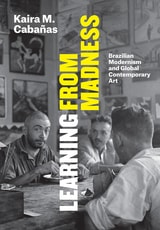
Learning from Madness
Brazilian Modernism and Global Contemporary ArtKaira M. Cabañas
University of Chicago Press, 2018
Kaira M. Cabañas shows that at the center of this advocacy stood such significant proponents as psychiatrists Osório César and Nise da Silveira, who championed treatments that included painting and drawing studios; and the art critic Mário Pedrosa, who penned Gestaltist theses on aesthetic response. Cabañas examines the lasting influence of this unique era of Brazilian modernism, and how the afterlife of this “outsider art” continues to raise important questions. How do we respect the experiences of the mad as their work is viewed through the lens of global art? Why is this art reappearing now that definitions of global contemporary art are being contested?
Learning from Madness offers an invigorating series of case studies that track the parallels between psychiatric patients’ work in Western Europe and its reception by influential artists there, to an analogous but altogether distinct situation in Brazil.
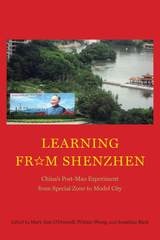
Learning from Shenzhen
China’s Post-Mao Experiment from Special Zone to Model CityEdited by Mary Ann O'Donnell, Winnie Wong, and Jonathan Bach
University of Chicago Press, 2017
Bringing China studies into dialogue with urban studies, the contributors explore how the post-Mao Chinese appropriation of capitalist logic led to a dramatic remodeling of the Chinese city and collective life in China today. These essays show how urban villages and informal institutions enabled social transformation through cases of public health, labor, architecture, gender, politics, education, and more. Offering scholars and general readers alike an unprecedented look at one of the world’s most dynamic metropolises, this collective history uses the urban case study to explore critical problems and possibilities relevant for modern-day China and beyond.
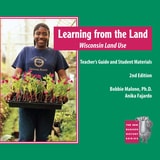
Learning from the Land, Teachers Guide and Student Materials, 2nd Edition
Bobbie Malone
Wisconsin Historical Society Press, 2021
Learning from the Land
Wisconsin Land UseBobbie Malone
Wisconsin Historical Society Press, 1998
Learning from the Land
Wisconsin Land Use, TGBobbie Malone
Wisconsin Historical Society Press, 1999

Learning from the Land
Wisconsin Land Use; 2nd EditionBobbie Malone
Wisconsin Historical Society Press, 2011
How has the landscape of Wisconsin affected its history? How have people living here changed that landscape over time? What are the implications for the future? The second edition of Learning from the Land addresses these and other questions, asking elementary and middle school readers to think about land use issues throughout Wisconsin's history. This revised edition includes expanded chapters on logging and the lumber industry, land use and planning, and agriculture in the 20th century from farmers' markets to organic farming. New profiles of Gaylord Nelson, pioneer of Earth Day, and Will Allen, founder of Growing Power in Milwaukee, round out this history of land use in Wisconsin.
Learning on the Left
Political Profiles of Brandeis UniversityStephen J. Whitfield
Brandeis University Press, 2020
Stephen J. Whitfield makes the case for the pertinence of Brandeis University in understanding the vicissitudes of American liberalism since the mid-twentieth century. Founded to serve as a refuge for qualified professors and students haunted by academic antisemitism, Brandeis University attracted those who generally envisioned the republic as worthy of betterment. Whether as liberals or as radicals, figures associated with the university typically adopted a critical stance toward American society and sometimes acted upon their reformist or militant beliefs. This volume is not an institutional history, but instead shows how one university, over the course of seven decades, employed and taught remarkable men and women who belong in our accounts of the evolution of American politics, especially on the left. In vivid prose, Whitfield invites readers to appreciate a singular case of the linkage of political influence with the fate of a particular university in modern America.
Learning to Change
The Experience of Transforming Education in South East EuropeTerrice Bassler
Central European University Press, 2005
Learning to Cut
Surgical Training and Practice, 1450–1800Edited by Maria Pia Donato, Elaine Leong, and Tillmann Taape
University College London, 2026
The first-ever volume to offer a broader European narrative on surgical training and education in the early modern era.
This volume brings together case studies from the French, Italian, German, and English contexts to reveal diverse modes of surgical teaching and learning that were shaped by local contexts in early modern towns and cities. The chapters reveal the many spaces where practitioners learned and experienced surgery, shedding new light on the practice of early modern surgery.
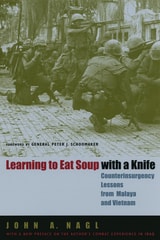
Learning to Eat Soup with a Knife
Counterinsurgency Lessons from Malaya and VietnamJohn A. Nagl
University of Chicago Press, 2005
In examining these two events, Nagl argues that organizational culture is key to the ability to learn from unanticipated conditions, a variable which explains why the British army successfully conducted counterinsurgency in Malaya but why the American army failed to do so in Vietnam, treating the war instead as a conventional conflict. Nagl concludes that the British army, because of its role as a colonial police force and the organizational characteristics created by its history and national culture, was better able to quickly learn and apply the lessons of counterinsurgency during the course of the Malayan Emergency.
With a new preface reflecting on the author's combat experience in Iraq, Learning to Eat Soup with a Knife is a timely examination of the lessons of previous counterinsurgency campaigns that will be hailed by both military leaders and interested civilians.
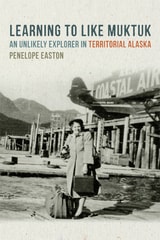
Learning to Like Muktuk
An Unlikely Explorer in Territorial AlaskaPenelope S. Easton
Oregon State University Press, 2014
Learning to Live with the Past
Krishna Kumar
Seagull Books, 2023
How does education shape political rivalry and hostility? The Partition of the Indian subcontinent in 1947—the violence that followed it, and its living legacy of rival nationalisms—has made a deep and pervasive impact on education in both India and Pakistan. In Learning to Live with the Past, educationist Krishna Kumar dwells on the complex terrain every history teacher has to navigate: how to make the past come alive without running the risk of creating a desire to lose this “pastness.”
Substantiating this question with a wealth of experiences gained from his extensive research on history textbooks, as well as his interactions with students and teachers in both countries, Kumar explores the integral function the discipline of history plays in the project of nation-building. To help children learn to live with the past, Kumar amplifies the need for spaces that create possibilities for inquiries into a “longer” common heritage shared by South Asia without necessarily denying a national narrative or encouraging an urge to undo the past.
Learning to Love
Intimacy and the Discourse of Development in ChinaSonya E. Pritzker
University of Michigan Press, 2024
Learning to Love offers a range of perspectives on the embodied, relational, affective, and sociopolitical project of “learning to love” at the New Life Center for Holistic Growth, a popular “mind-body-spirit” bookstore and practice space in northeast China, in the early part of the 21st century. This intimate form of self-care exists alongside the fast-moving, growing capitalist society of contemporary China and has emerged as an understandable response to the pressures of Chinese industrialized life in the early 21st century. Opening with an investigation of the complex ways newcomers to the center suffered a sense of being “off,” both in and with the world at multiple scales, Learning to Love then examines how new horizons of possibility are opened as people interact with one another as well as with a range of aesthetic objects at New Life.
Author Sonya Pritzker draws upon the core concepts of scalar intimacy—a participatory, discursive process in which people position themselves in relation to others as well as dominant ideologies, concepts, and ideals—and scalar inquiry—the process through which speakers interrogate these forms, their relationship with them, and their participation in reproducing them. In demonstrating the collaborative interrogation of culture, history, and memory, she examines how these exercises in physical, mental, and spiritual self-care allow participants to grapple with past social harms and forms of injustice, how historical systems of power—including both patriarchal and governance structures—continue in the present, and how they might be transformed in the future. By examining the interactions and relational experiences from New Life, Learning to Love offers a range of novel theoretical interventions into political subjectivity, temporality, and intergenerational trauma/healing.
Learning to Read and Write in Colonial America
E. Jennifer Monaghan
University of Massachusetts Press, 2005
An experienced teacher of reading and writing and an award-winning historian, E. Jennifer Monaghan brings to vibrant life the process of learning to read and write in colonial America. Ranging throughout the colonies from New Hampshire to Georgia, she examines the instruction of girls and boys, Native Americans and enslaved Africans, the privileged and the poor, revealing the sometimes wrenching impact of literacy acquisition on the lives of learners.
For the most part, religious motives underlay reading instruction in colonial America, while secular motives led to writing instruction. Monaghan illuminates the history of these activities through a series of deeply researched and readable case studies. An Anglican missionary battles mosquitoes and loneliness to teach the New York Mohawks to write in their own tongue. Puritan fathers model scriptural reading for their children as they struggle with bereavement. Boys in writing schools, preparing for careers in counting houses, wield their quill pens in the difficult task of mastering a “good hand.” Benjamin Franklin learns how to compose essays with no teacher but himself. Young orphans in Georgia write precocious letters to their benefactor, George Whitefield, while schools in South Carolina teach enslaved black children to read but never to write.
As she tells these stories, Monaghan clears new pathways in the analysis of colonial literacy. She pioneers in exploring the implications of the separation of reading and writing instruction, a topic that still resonates in today's classrooms.
Monaghan argues that major improvements occurred in literacy instruction and acquisition after about 1750, visible in rising rates of signature literacy. Spelling books were widely adopted as they key text for teaching young children to read; prosperity, commercialism, and a parental urge for gentility aided writing instruction, benefiting girls in particular. And a gentler vision of childhood arose, portraying children as more malleable than sinful. It promoted and even commercialized a new kind of children's book designed to amuse instead of convert, laying the groundwork for the “reading revolution” of the new republic.