Results by title
8113 books match the query 'Literary Criticism' and 255 start with l
Lyric Trade
Reading the Subject in the Postwar Long PoemJulia Bloch
University of Iowa Press, 2024
Engaging with poets such as Gwendolyn Brooks, H.D., Lorine Niedecker, Alice Notley, and Myung Mi Kim, this book asks: What does lyric mean, and why should it matter to poets and readers? Lyric Trade argues that lyric in the postwar long poem not only registers the ideological contradictions of modernism’s insistence on new forms, but that it also maps spaces for formal reimaginings of the subject.
Lyrical Liberators
The American Antislavery Movement in Verse, 1831–1865Monica Pelaez
Ohio University Press, 2018
Before Black Lives Matter and Hamilton, there were abolitionist poets, who put pen to paper during an era when speaking out against slavery could mean risking your life. Indeed, William Lloyd Garrison was dragged through the streets by a Boston mob before a planned lecture, and publisher Elijah P. Lovejoy was fatally shot while defending his press from rioters. Since poetry formed a part of the cultural, political, and emotional lives of readers, it held remarkable persuasive power. Yet antislavery poems have been less studied than the activist editorials and novels of the time.
In Lyrical Liberators, Monica Pelaez draws on unprecedented archival research to recover these poems from the periodicals—Garrison’s Liberator, Frederick Douglass’s North Star, and six others—in which they originally appeared. The poems are arranged by theme over thirteen chapters, a number that represents the amendment that finally abolished slavery in 1865. The book collects and annotates works by critically acclaimed writers, commercially successful scribes, and minority voices including those of African Americans and women.
There is no other book like this. Sweeping in scope and passionate in its execution, Lyrical Liberators is indispensable for scholars and teachers of American literature and history, and stands as a testimony to the power of a free press in the face of injustice.
Lyrical Strategies
The Poetics of the Twentieth-Century American NovelKatie Owens-Murphy
Northwestern University Press, 2018
Owens-Murphy surveys a broad array of writers: poets from the lyrical transatlantic tradition, as well as American novelists including Gertrude Stein, Jean Toomer, William Faulkner, Toni Morrison, Louise Erdrich, and Cormac McCarthy. Through a masterful reexamination of canonical works of twentieth-century American fiction through the lens of lyric poetry, she reveals how many elements in these novels can be better understood as poetic and rhetorical figures (metaphysical conceit, polysyndeton, dramatic monologue, apostrophe, and so on) than as narrative ones.
Making fresh contributions to literary theory and American fiction, Lyrical Strategies will fascinate readers and scholars of the American novel, fiction, poetry, and poetics alike.
Lysias
By S. C. Todd
University of Texas Press, 2000
This is the second volume in the Oratory of Classical Greece series. Planned for publication over several years, the series will present all of the surviving speeches from the late fifth and fourth centuries B.C. in new translations prepared by classical scholars who are at the forefront of the discipline. These translations are especially designed for the needs and interests of today's undergraduates, Greekless scholars in other disciplines, and the general public.
Classical oratory is an invaluable resource for the study of ancient Greek life and culture. The speeches offer evidence on Greek moral views, social and economic conditions, political and social ideology, and other aspects of Athenian culture that have been largely ignored: women and family life, slavery, and religion, to name just a few.
This volume contains all the complete works and eleven of the largest fragments attributed to Lysias, the leading speechwriter of the generation (403-380 B.C.) after the Peloponnesian War, who was also one of the finest and most deceptive storytellers of all time. As a noncitizen resident in Athens, Lysias could take no direct part in politics, but his speeches, written for clients to deliver in court, paint vivid pictures of various private and public disputes: one speaker defends himself on a charge of murdering his wife's lover, while another is accused of having caused the deaths of democratic activists under the short-lived oligarchy of the Thirty (404/3), despite his claim to be protected by the amnesty that accompanied the restoration of democracy in 403.
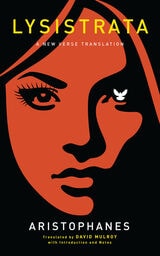
Lysistrata
A New Verse TranslationAristophanes, Translated by David Mulroy, with Introduction and Notes
University of Wisconsin Press, 2020
A perennial classroom and stage favorite as well as the basis of Spike Lee’s Chi-Raq, the play is as relevant today as it was 2,500 years ago. The premise is simplicity itself: to end the Peloponnesian War, women decide to withhold sex from their husbands until the fighting stops.
The play is by turns raucous, bawdy, frantic, and funny. David Mulroy’s exciting new translation retains the original’s verse format, racy jokes, and vibrancy—setting it apart from previous efforts, which are typically reproduced as prose or depart from meaning and meter. His introduction offers a concise summary of Aristophanes’ life and social milieu, including a brief overview of the Peloponnesian War, which took place during the playwright’s lifetime. The appendices include guides on translating meter and Greek pronunciation for aspiring thespians.