Results by title
312 books match the query 'African American authors' and 14 start with m
Mama's Gun
Black Maternal Figures and the Politics of TransgressionMarlo D. David
The Ohio State University Press, 2016
Taking inspiration from African American fiction, historical accounts of black life, Afrofuturism, and black popular culture in music and on screen, David turns her attention to Sapphire’s Push, Octavia Butler’s Dawn, and Suzan-Lori Parks’s Getting Mother’s Body as well as the performance art of Erykah Badu and the films of Tyler Perry. She draws out the implications of black maternal figures in these texts who balk at tradition and are far from “ideal.” David’s study shows how representations of blackness are deeply embedded in the neoliberal language of contemporary American politics and how black writers and performers resist such mainstream ideologies with their own transgressive black maternal figures.
Martin Luther King Jr., Heroism, and African American Literature
Trudier Harris
University of Alabama Press, 2023
Examines how representations of Martin Luther King Jr.’s character and persona in works of African American literature have evolved and reflect the changing values and mores of African American culture
African American writers have incorporated Martin Luther King Jr. into their work since he rose to prominence in the mid-1950s. Martin Luther King Jr., Heroism, and African American Literature is a study by award-winning author Trudier Harris of King’s character and persona as captured and reflected in works of African American literature continue to evolve.
One of the most revered figures in American history, King stands above most as a hero. His heroism, argues Harris, is informed by African American folk cultural perceptions of heroes. Brer Rabbit, John the Slave, Stackolee, and Railroad Bill—folk heroes all—provide a folk lens through which to view King in contemporary literature. Ambiguities and issues of morality that surround trickster figures also surround King. Nonconformist traits that define Stackolee and Railroad Bill also inform King’s life and literary portraits. Defiance of the law, uses of indirection, moral lapses, and bad habits are as much a part of the folk-transmitted biography of King as they are a part of writers’ depictions of him in literary texts.
Harris first demonstrates that during the Black Arts Movement of the 1960s, when writers such as Nikki Giovanni, Sonia Sanchez, and LeRoi Jones (Amiri Baraka) were rising stars in African American poetry, King’s philosophy of nonviolence was out of step with prevailing notions of militancy (Black Power), and their literature reflected that division.
In the quieter times of the 1970s and 1980s and into the twenty-first century, however, treatments of King and his philosophy in African American literature changed. Writers who initially rejected him and nonviolence became ardent admirers and boosters, particularly in the years following his assassination. By the 1980s, many writers skeptical about King had reevaluated him and began to address him as a fallen hero. To the most recent generation of writers, such as Katori Hall, King is fair game for literary creation, no matter what those portrayals may reveal, to a point where King has become simply another source of reference for creativity.
Collectively these writers, among many others, illustrate that Martin Luther King Jr. provides one of the strongest influences upon the creative worlds of multiple generations of African American writers of varying political and social persuasions.
Masculinist Impulses
Toomer, Hurston, Black Writing, and ModernityNathan Grant
University of Missouri Press, 2004
Grant’s book provides close readings of Jean Toomer (Cane and Natalie Mann) and Zora Neale Hurston (Moses, Man of the Mountain, Seraph of the Suwanee, and Their Eyes Were Watching God), for whom the American South was a crucial locus of the African American experience. Toomer and Hurston were virtually alone among the Harlem Renaissance writers of prose who returned to the South for their literary materials. That return, however, allowed their rediscovery of key black masculine values and charted the northern route of those values in the twentieth century to their compromise and destruction.
Grant then moves on to three more recent writers—John Edgar Wideman, Gloria Naylor, and Toni Morrison—who expanded upon and transformed the themes of Toomer and Hurston. Like Toomer and Hurston, these later authors recognized the need for the political union of black men and women in the effort to realize the goals of equity and justice.
Masculinist Impulses discusses nineteenth- and twentieth-century black masculinity as both a feature and a casualty of modernism. Scholars and students of African American literature will find Grant’s nuanced and creative readings of these key literary texts invaluable.
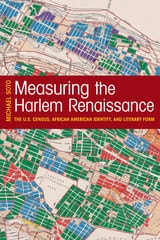
Measuring the Harlem Renaissance
The U.S. Census, African American Identity, and Literary FormMichael Soto
University of Massachusetts Press, 2016
In this provocative study, Michael Soto examines African American cultural forms through the lens of census history to tell the story of how U.S. officialdom—in particular the Census Bureau—placed persons of African descent within a shifting taxonomy of racial difference, and how African American writers and intellectuals described a far more complex situation of interracial social contact and intra-racial diversity. What we now call African American identity and the literature that gives it voice emerged out of social, cultural, and intellectual forces that fused in Harlem roughly one century ago.
Measuring the Harlem Renaissance sifts through a wide range of authors and ideas—from W. E. B. Du Bois, Rudolph Fisher, and Nella Larsen to Zora Neale Hurston, Langston Hughes, and Wallace Thurman, and from census history to the Great Migration—to provide a fresh take on late nineteenth—and twentieth—century literature and social thought. Soto reveals how Harlem came to be known as the “cultural capital of black America,” and how these ideas left us with unforgettable fiction and poetry.
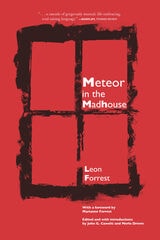
Meteor in the Madhouse
Leon Forrest
Northwestern University Press, 2011
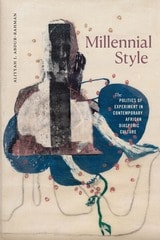
Millennial Style
The Politics of Experiment in Contemporary African Diasporic CultureAliyyah I. Abdur-Rahman
Duke University Press, 2024
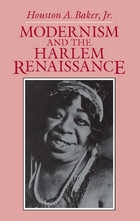
Modernism and the Harlem Renaissance
Houston A. Baker Jr.
University of Chicago Press, 1989
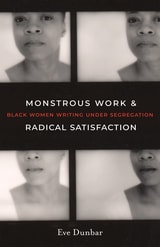
Monstrous Work and Radical Satisfaction
Black Women Writing under SegregationEve Dunbar
University of Minnesota Press, 2024
Radical Black feminist refusal through the works of mid-twentieth-century African American women writers
Monstrous Work and Radical Satisfaction offers new and insightful readings of African American women’s writings in the 1930s–1950s, illustrating how these writers centered Black women’s satisfaction as radical resistance to the false and incomplete promise of liberal racial integration. Eve Dunbar examines the writings of Ann Petry, Dorothy West, Alice Childress, and Gwendolyn Brooks to show how these women explored self-fulfillment over normative and sanctioned models of national belonging.
Paying close attention to literary moments of disruption, miscommunication, or confusion rather than ease, assimilation, or mutual understanding around race and gender, Dunbar tracks these writers’ dissatisfaction with American race relations. She shows how Petry, West, Childress, and Brooks redeploy the idea of monstrous work to offer potential modalities for registering Black women’s capacity to locate satisfaction within the domestic and interpersonal.
While racial integration may satisfy the national idea of equality and inclusion, it has not met the long-term needs of Black people’s quest for equity. Dunbar responds, demonstrating how these mid-century women offer new blueprints for Black life by creating narrative models for radical satisfaction: Black women’s completeness, joy, and happiness outside the bounds of normative racial inclusion.

Moorings and Metaphors
Figures of Culture and Gender in Black Women's LiteratureKarla F. Holloway
Rutgers University Press, 1991
Proceeding from a consideration of the imaginative textual languages of contemporary African-American and West African writers, Holloway asserts the intertextuality of black women's literature across two continents. She argues the subtext of culture as the source of metaphor and language, analyzes narrative structures and linguistic processes, and develops a combined theoretical/critical apparatus and vocabulary for interpreting these writers' works. The cultural sources and spiritual considerations that inhere in these textual languages are discussed within the framework Holloway employs of patterns of revision, (re)membrance, and recursion--all of which are vehicles for expressive modes inscribed at the narrative level. Her critical reading of contemporary black women's writing in the United States and West Africa is unique, radical, and sure to be controversial.
Mother Imagery in the Novels of Afro-Caribbean Women
Simone A. James Alexander
University of Missouri Press, 2000
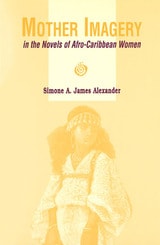
Focusing on specific texts by Jamaica Kincaid, Maryse Condé, and Paule Marshall, this fascinating study explores the intricate trichotomous relationship between the mother (biological or surrogate), the motherlands Africa and the Caribbean, and the mothercountry represented by England, France, and/or North America. The mother-daughter relationships in the works discussed address the complex, conflicting notions of motherhood that exist within this trichotomy. Although mothering is usually socialized as a welcoming, nurturing notion, Alexander argues that alongside this nurturing notion there exists much conflict. Specifically, she argues that the mother-daughter relationship, plagued with ambivalence, is often further conflicted by colonialism or colonial intervention from the "other," the colonial mothercountry.
Mother Imagery in the Novels of Afro-Caribbean Women offers an overview of Caribbean women's writings from the 1990s, focusing on the personal relationships these three authors have had with their mothers and/or motherlands to highlight links, despite social, cultural, geographical, and political differences, among Afro-Caribbean women and their writings. Alexander traces acts of resistance, which facilitate the (re)writing/righting of the literary canon and the conception of a "newly created genre" and a "womanist" tradition through fictional narratives with autobiographical components.
Exploring the complex and ambiguous mother-daughter relationship, she examines the connection between the mother and the mother's land. In addition, Alexander addresses the ways in which the absence of a mother can send an individual on a desperate quest for selfhood and a home space. This quest forces and forges the creation of an imagined homeland and the re-validation of "old ways and cultures" preserved by the mother. Creating such an imagined homeland enables the individual to acquire "wholeness," which permits a spiritual return to the motherland, Africa via the Caribbean. This spiritual return or homecoming, through the living and practicing of the old culture, makes possible the acceptance and celebration of the mother's land.
Alexander concludes that the mothers created by these authors are the source of diasporic connections and continuities. Writing/righting black women's histories as Kincaid, Condé, and Marshall have done provides a clearing, a space, a mother's land, for black women. Mother Imagery in the Novels of Afro-Caribbean Women will be of great interest to all teachers and students of women's studies, African American studies, Caribbean literature, and diasporic literatures.

Moving Against the System
The 1968 Congress of Black Writers and the Shaping of Global Black ConsciousnessEdited by David Austin
Pluto Press, 2018
Against a backdrop of widespread racism in the West and ongoing colonialism and imperialism in the Global South, this group of activists, writers, and political figures gathered to discuss the history and struggles of people of African descent and the meaning of black power.
For the first time since 1968, David Austin brings alive the speeches and debates of the most important international gathering of black radicals of the era. With never-before-seen texts from Stokely Carmichael, Walter Rodney and C.L.R. James, these documents will prove invaluable to anyone interested in black radical thought and political activism of the 1960s.
Moving Home
Gender, Place, and Travel Writing in the Early Black AtlanticSandra Gunning
Duke University Press, 2021
Murderous Feeling
Gender and Retribution in Black and Indigenous LiteratureChad Benito Infante
University of Minnesota Press, 2026
Examining revenge narratives as a feminist response to slavery and settler colonialism
From Octavia Butler’s Kindred to The Round House by Louise Erdrich, themes of retribution resound throughout the work of renowned Black and Indigenous women and queer authors. Revealing how the Black Power Movement and the American Indian Movement influenced literature from the 1960s onward, Murderous Feeling explores how these writers have employed revenge narratives as a response to white supremacy and colonialism.
Chad Benito Infante shows how, rather than using retributive violence to cultivate a heroic, masculine ideal, Black and Native women and queer writers use revenge as a way to raise philosophical questions about justice and the reclamation of power in the face of white supremacy. Pairing canonical texts—including work by James Baldwin, Leslie Marmon Silko, Craig Womack, Toni Morrison, and others—he demonstrates how this uniquely queer and feminist literary tradition, the “grammar of interrogation,” allows for generative ambivalence and curiosity about the possibilities and failures of violence.
In highlighting these narratives’ potential to steer anticolonial efforts, Murderous Feeling reconceptualizes literary violence not as an individualized act of cleansing but as a tool for revolutionary inquiry.
Retail e-book files for this title are screen-reader friendly.
Mutha’ Is Half a Word
Intersections of Folklore, Vernacular, Myth, and Queerness in Black Female CultureL. H. Stallings
The Ohio State University Press, 2007