Results by title
3576 books match the query 'American' and 179 start with m
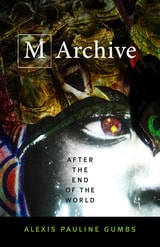
M Archive
After the End of the WorldAlexis Pauline Gumbs
Duke University Press, 2018
MUSE IN THE MACHINE
AMERICAN FICTION AND MASS PUBLICITYMARK CONROY
The Ohio State University Press, 2004

Machine Art and Other Writings
The Lost Thought of the Italian YearsEzra Pound
Duke University Press, 1996
The essays in this volume address Pound’s diverse aesthetic concerns, including his Vorticism and his criticism of Western metaphysics, his advancement of the machine as a new criterion for beauty, his encounter with the German Bauhaus movement, and his search for a type of writing ruled by mathematical rather than grammatical laws. Machine Art and Other Writings documents the wide proportions of Pound’s polemic against the abstractions of modernism and reveals the extent to which he was at odds with the metaphysical assumptions of his time. The volume, edited by Ardizzone, is the result of years of systematic and intensive study of Pound’s manuscripts, including glosses from the texts of his personal library. Proposing an unconventional approach to Pound studies that focuses on marginality and intertextuality, she subverts the canonical hierarchy of Pound’s works by revealing the power of texts considered marginalia.
General readers, students and scholars in the fields of European and American modernism, aesthetics, the history of technology, and art history, as well as Pound specialists and the many poets and writers influenced by Pound, will greet the publication of Machine Art and Other Writings with interest and anticipation.
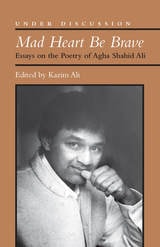
Mad Heart Be Brave
Essays on the Poetry of Agha Shahid AliKazim Ali, Editor
University of Michigan Press, 2017
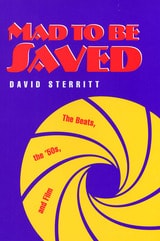
Mad to Be Saved
The Beats, the 50's, and FilmDavid Sterritt
Southern Illinois University Press, 1998
Film critic David Sterritt presents an interdisciplinary exploration of the Beat Generation, its intersections with main-stream and experimental film, and the interactions of all of these with American society and the culture of the 1950s. Sterritt balances the Beat countercultural goal of rebellion through both artistic creation and everyday behavior against the mainstream values of conformity and conservatism, growing worry over cold-war hostilities, and the "rat race" toward material success.
After an introductory overview of the Beat Generation, its history, its antecedents, and its influences, Sterritt shows the importance of "visual thinking" in the lives and works of major Beat authors, most notably Jack Kerouac, Allen Ginsberg, and William S. Burroughs. He turns to Mikhail Bakhtin's dialogic theory to portray the Beat writers-who were inspired by jazz and other liberating influences-as carnivalesque rebels against what they perceived as a rigid and stifling social order.
Showing the Beats as social critics, Sterritt looks at the work of 1950s photographers Robert Frank and William Klein; the attack against Beat culture in the pictures and prose of Life magazine; and the counterattack in Frank's film Pull My Daisy, featuring key Beat personalities. He further explores expressions of rebelliousness in film noir, the melodramas of director Douglas Sirk, and other Hollywood films.
Finally, Sterritt shows the changing attitudes toward the Beat sensibility in Beat-related Hollywood movies like A Bucket of Blood and The Beat Generation; television programs like Route 66 and The Many Loves of Dobie Gillis; nonstudio films like John Cassavetes's improvisational Shadows and Shirley Clarke's experimental The Connection; and radically avant-garde works by such doggedly independent screen artists as Stan Brakhage, Ron Rice, Bruce Connor, and Ken Jacobs, drawing connections between their achievements and the most subversive products of their Beat contemporaries.
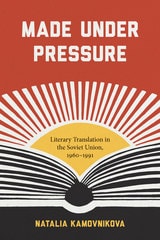
Made Under Pressure
Literary Translation in the Soviet Union, 1960–1991Natalia Kamovnikova
University of Massachusetts Press, 2019
Natalia Kamovnikova chronicles the literary translation process from the selection of foreign literary works to their translation, censorship, final approval, and publication. Interviews with Soviet translators of this era provide insight into how the creative work of translating and the practical work of publishing were undertaken within a politically restricted environment, and recall the bonds of community and collaboration that they developed.
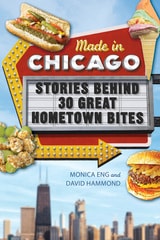
Made in Chicago
Stories Behind 30 Great Hometown BitesMonica Eng and David Hammond
University of Illinois Press, 2023
A BookRiot Most Anticipated Travel Book of 2023
Italian beef and hot dogs get the headlines. Cutting-edge cuisine and big-name chefs get the Michelin stars. But Chicago food shows its true depth in classic dishes conceived in the kitchens of immigrant innovators, neighborhood entrepreneurs, and mom-and-pop visionaries.
Monica Eng and David Hammond draw on decades of exploring the city’s food landscape to serve up thirty can’t-miss eats found in all corners of Chicago. From Mild Sauce to the Jibarito and from Taffy Grapes to Steak and Lemonade, Eng and Hammond present stories of the people and places behind each dish while illuminating how these local favorites reflect the multifaceted history of the city and the people who live there. Each entry provides all the information you need to track down whatever sounds good and selected recipes even let you prepare your own Flaming Saganaki or Akutagawa.
Generously illustrated with full-color photos, Made in Chicago provides locals and visitors alike with loving profiles of a great food city’s defining dishes.

Made with Words
May Swenson
University of Michigan Press, 1998
Made with Words includes a rich assortment of Swenson's prose, including several short stories, by turns amusing, provocative, and poetic, and inextricably bound with her poetic oeuvre; a one-act play entitled The Floor, produced in New York in the mid-sixties; interviews and book reviews that shed light on Swenson's poetic development as well as her literary and artistic tastes; and finally, a collection of Swenson's letters to the poet Elizabeth Bishop that reveal the intricacies of three decades of their personal and professional relationship. The critical and biographical introduction provides an engaging glimpse into the creative life and prose work of an important contemporary American poet.
Gardner McFall is Assistant Professor of Literature, Cooper Union for the Advancement of Science and Art. She is the author of The Pilot's Daughter; Naming the Animals; and Jonathan's Cloud.
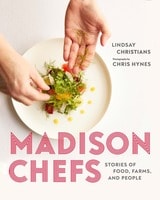
Madison Chefs
Stories of Food, Farms, and PeopleLindsay Christians and Chris Hynes
University of Wisconsin Press, 2021
Farm-to-table is a cliché, but its roots among the farmers and chefs of south-central Wisconsin are deep, vibrant, and resilient. From brats and burgers to bibimbap, Madison’s food scene looks substantially different than it did just a decade ago. Though the city has always been ahead of the locavore movement, a restaurant boom in the 2010s radically changed the dining landscape. Even when individual eateries close or chefs move on, their ideas, connections, and creativity have lasting power. Much larger cities have been unable to match the culinary variety, innovation, and depth of talent found in Wisconsin’s state capital.
Lindsay Christians’s in-depth look at nine creative, intense, and dedicated chefs captures the reason why Madison’s food culture remains a gem in America’s Upper Midwest. This beautifully illustrated book will leave you salivating—or making reservations.
Maestro
Love SonnetsRoger Armbrust
Parkhurst Brothers, Inc., 2021
Sense of presence leading to reverence,
not so much awaking as reverie
evolving to understanding, essence
of living within all.
Armbrust conveys this mood of reverence, reverie, and understanding throughout this collection.

Magic Lantern
Joan Aleshire
Four Way Books, 2026
Conceived of as a memoir in poems of late-life love and its betrayal, Magic Lantern traces the borders of loss and investigates the source of our strength to traverse them, finding the roots of resilience in ordinary interactions and illuminating the undramatic power of simple connections. "At a time of our lives when the only hands / we can expect to touch us this gently / will be wearing latex gloves," Aleshire recounts a tender moment before romantic rupture. "The technician in the ER said softly, / trying to attach your heart monitors, / You’re so hairy, I’m not sure / this will stick, but I thought / it didn’t matter how intimately / they handled you; my love / had covered, would cover / you, before and after them." When the realization of the beloved’s treachery obliterates this lucidity and generosity, the speaker feels violated and estranged from herself, reducing the narrative of the affair to “what we did / in the dark, until we became / the dark.” The private destabilization of this heartache pales but compounds the shadows of a world already rent by international war and domestic political upheaval, but Aleshire orients toward another light source: the rewarding labor of building community and the noble pursuit of seeking meaning itself. The title poem executes a beautiful metacommentary on the value of art, which is to say going to the effort, trying for trying’s sake. At a local filmmaker’s screening, the speaker marvels at the powerful impression the artist has rendered with black-and-white film, astonished by how “the depths and brights, / shadows and gleams... make us watching / feel more.” In these deeply compassionate and vulnerable poems, Aleshire draws our attention to the artistry of our lives, the luminosity we stroke and orchestrate through our meticulous care and enduring bonds. This is the light we see by. A transportative seventh collection, Magic Lantern draws the disordered overwhelm of the human experience into a dazzling, seamless sequence of images, setting the ordinary into motion so that it not only coheres, but glows.
Magical Muse
Millennial Essays on Tennessee WilliamsEdited by Ralph F. Voss
University of Alabama Press, 2002
Like Faulkner before him, Tennessee Williams gave universal appeal to southern characters and settings. His major plays, from Cat on a Hot Tin Roof and The Glass Menagerie to A Streetcar Named Desire and Night of the Iguana, continue to capture America's popular imagination, a significant legacy. Though he died in 1983, only recently have Williams's papers become available to the public, bringing to light a number of intriguing discoveries—letters, drafts, and several unpublished and unproduced plays. These recent developments make a reassessment of Williams's life and work both timely and needed.
The essays in this collection originated as presentations at the 27th annual Alabama Symposium on English and American Literature at The University of Alabama in 1999. The book addresses a wide range of topics, among them the influence of popular culture on Williams's plays, and, in turn, his influence on popular culture; his relationship to Hollywood and his struggles with censorship, Hollywood standards, and the competing vision of directors such as Elia Kazan; his depictions of gender and sexuality; and issues raised by recently discovered plays.
Anyone interested in American literature and drama will find this collection of fresh, accessible essays a rewarding perspective on the life, work, and legacy of one of the bright stars of American theatre.
Main Street and Empire
The Fictional Small Town in the Age of GlobalizationPoll, Ryan
Rutgers University Press, 2012
In Main Street and Empire, Ryan Poll addresses this need, arguing that the small town, as evoked by the image of “Main Street,” is not a relic of the past but rather a metaphorical screen upon which America’s “everyday” stories and subjects are projected on both a national and global scale.
Bringing together a broad selection of texts—from Thornton Wilder’s Our Town, Grace Metalious’s Peyton Place, and Peter Weir’s The Truman Show to the speeches of William McKinley, Ronald Reagan, Sarah Palin, and Barack Obama—Poll examines how the small town is used to imagine and reproduce the nation throughout the twentieth- and into the twenty-first century. He contends that the dominant small town, despite its innocent, nostalgic appearance, is central to the development of the U.S. empire and global capitalism.
Maine’s Lithographic Landscapes
Town and City Views, 1830-1870Earle G. Shettleworth Jr.
Brandeis University Press, 2020
During the nineteenth century, Americans celebrated their towns and cities through printed landscapes. In Maine, lithographs were commissioned from such leading artists as Fitz Henry Lane and talented, lesser known local artists, such as Esteria Butler. This book reproduces many of these works and provides insights into how these growing centers of commerce and industry viewed themselves and wished to be viewed by others.
It’s the perfect book for those who love Maine, both full-time residents and those who make it a beloved summer destination.
Published in association with the Bowdoin College Museum of Art on the occasion of the bicentennial of Maine statehood.
Making American Boys
Boyology and the Feral TaleKenneth B. Kidd
University of Minnesota Press, 2005
Making Conversation in Modernist Fiction
Elizabeth Alsop
The Ohio State University Press, 2019
If historically dialogue had been treated as a subordinate element in fiction—a tool for developing character or advancing plot—this book demonstrates that writers such as Henry James, Ernest Hemingway, James Joyce, William Faulkner, Virginia Woolf, and Gertrude Stein would increasingly emphasize it as a poetic structure in its own right. In this way, Alsop argues, modernist writers “make” conversation in radically new ways and for a diverse range of expressive and communicative ends. Over the course of five chapters that explore this previously overlooked avenue of modernist innovation, Making Conversation offers readers a radical new paradigm not only for understanding fictional talk but also for interpreting some of the most celebrated examples of early twentieth-century narrative.
Making Girls into Women
American Women's Writing and the Rise of Lesbian IdentityKathryn R. Kent
Duke University Press, 2003
Kent not only analyzes how texts represent queer erotics, but also theorizes how texts might produce them in readers. She describes the ways postbellum sentimental literature such as that written by Harriet Beecher Stowe, Louisa May Alcott, and Emma D. Kelley eroticizes, reacts against, and even, in its own efforts to shape girls’ selves, contributes to the production of queer female identifications and identities. Tracing how these identifications are engaged and critiqued in the early twentieth century, she considers works by Djuna Barnes, Gertrude Stein, Marianne Moore, and Elizabeth Bishop, as well as in the queer subject-forming effects of another modern invention, the Girl Scouts. Making Girls into Women ultimately reveals that modern lesbian identity marks an extension of, rather than a break from, nineteenth-century women’s culture.
Making Mark Twain Work in the Classroom
James S. Leonard, ed.
Duke University Press, 1999
The essays in Making Mark Twain Work in the Classroom reaffirm the importance of Twain in the American literature curriculum from high school through graduate study. Addressing slavery and race, gender, class, religion, language and ebonics, Americanism, and textual issues of interest to instructors and their students, the contributors offer guidance derived from their own demographically diverse classroom experiences. Although some essays focus on such works as A Connecticut Yankee in King Arthur’s Court and The Innocents Abroad, most discuss the hotly debated Adventures of Huckleberry Finn, viewed alternately in this volume as a comic masterpiece or as evidence of Twain’s growing pessimism—but always as an effective teaching tool.
By placing Twain’s work within the context of nineteenth-century American literature and culture, Making Mark Twain Work in the Classroom will interest all instructors of American literature. It will also provoke debate among Americanists and those concerned with issues of race, class, and gender as they are represented in literature.
Contributors. Joseph A. Alvarez, Lawrence I. Berkove, Anthony J. Berret, S.J., Wesley Britton, Louis J. Budd, James E. Caron, Everett Carter, Jocelyn Chadwick-Joshua, Pascal Covici Jr., Beverly R. David, Victor Doyno, Dennis W. Eddings, Shelley Fisher Fishkin, S. D. Kapoor, Michael J. Kiskis, James S. Leonard, Victoria Thorpe Miller, Stan Poole, Tom Reigstad, David E. E. Sloane, David Tomlinson
Making Meaning
"Printers of the Mind" and Other EssaysD. F. McKenzie
University of Massachusetts Press, 2002
The greatest bibliographer of our time, was how historian Robert Darnton described D. F. McKenzie. Yet until now many of McKenzie's major essays, scattered in specialist journals and inaccessible publications, have circulated mainly in tattered photocopies. This volume, edited by two of McKenzie's former students, brings together for the first time a wide range of his writings on bibliography, the book trade, and the “sociology of texts.” Selected by the author himself before his sudden death in 1999, the essays range from the material transmission of Shakespeare's plays in the seventeenth century to the connections among oral, manuscript, and print cultures.
Making Meaning reflects McKenzie's virtuosity as a traditional bibliographer and reveals how his thought-provoking scholarship made him a driving force in the genesis and development of the new interdisciplinary field of book history. His refusal to recognize the traditional boundary between bibliography and literary history re-energized the study of the social, political, economic, and cultural aspects of book production and reception.
The editors' introduction and headnotes situate McKenzie's innovative and controversial thinking in the debates of his time.
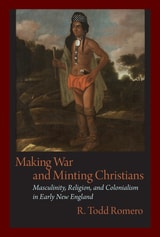
Making War and Minting Christians
Masculinity, Religion, and Colonialism in Early New EnglandR. Todd Romero
University of Massachusetts Press, 2011
In this book, R. Todd Romero traces the interaction of notions of gender, the practice of religion, and the conduct of warfare in colonial America. He shows how Native and Anglo-American ideas of manhood developed in counterpoint, in the context of Christian evangelization, colonial expansion, and recurrent armed conflict.
For the English, the cultivation of manliness became an important aspect of missionary efforts. Conversion demanded that the English “make men” of the Indians before they could “make them Christians,” a process that involved reshaping Native masculinity according to English patriarchal ideals that the colonists themselves rarely matched. For their part, Native Americans held on to older ways of understanding the divine and defining gender even as they entered English “praying towns” and negotiated the steep demands of the missionaries.
Evolving ideas of masculinity resonated with religious significance and shaped the meaning of warfare for Natives and colonists alike. Just as the English believed that their territorial expansion was divinely sanctioned, Indians attributed a string of victories in King Philip's War to “the Great God” and the perception that their enemies “were like women.” Trusting that war and manliness were necessarily linked, both groups engaged in ritual preparations for battle, believed deeply in the efficacy of the supernatural to affect the outcome of combat, and comprehended the meaning of war in distinctly religious ways.
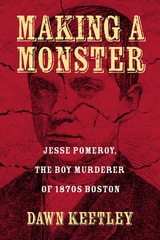
Making a Monster
Jesse Pomeroy, the Boy Murderer of 1870s BostonDawn Keetley
University of Massachusetts Press, 2017
In this book, Dawn Keetley details the story of Pomeroy's crimes and the intense public outcry. She explores the two reigning theories at the time—that he was shaped before birth when his pregnant mother visited a slaughterhouse and that he imitated brutal acts found in popular dime novels. Keetley then thoughtfully offers a new theory: that Pomeroy suffered a devastating reaction to a smallpox vaccination which altered his brain, creating a psychopath who revealed the human potential for brutality. The reaction to Pomeroy's acts, then and now, demonstrates the struggle to account for exactly those aspects of human nature that remain beyond our ability to understand.
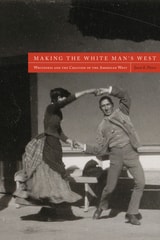
Making the White Man's West
Whiteness and the Creation of the American WestJason E. Pierce
University Press of Colorado, 2016
The West, especially the Intermountain states, ranks among the whitest places in America, but this fact obscures the more complicated history of racial diversity in the region. In Making the White Man’s West, author Jason E. Pierce argues that since the time of the Louisiana Purchase, the American West has been a racially contested space. Using a nuanced theory of historical “whiteness,” he examines why and how Anglo-Americans dominated the region for a 120-year period.
In the early nineteenth century, critics like Zebulon Pike and Washington Irving viewed the West as a “dumping ground” for free blacks and Native Americans, a place where they could be segregated from the white communities east of the Mississippi River. But as immigrant populations and industrialization took hold in the East, white Americans began to view the West as a “refuge for real whites.” The West had the most diverse population in the nation with substantial numbers of American Indians, Hispanics, and Asians, but Anglo-Americans could control these mostly disenfranchised peoples and enjoy the privileges of power while celebrating their presence as providing a unique regional character. From this came the belief in a White Man’s West, a place ideally suited for “real” Americans in the face of changing world.
The first comprehensive study to examine the construction of white racial identity in the West, Making the White Man’s West shows how these two visions of the West—as a racially diverse holding cell and a white refuge—shaped the history of the region and influenced a variety of contemporary social issues in the West today.
Maladies of the Will
The American Novel and the Modernity ProblemJennifer L. Fleissner
University of Chicago Press, 2022
What if the modern person were defined not by reason or sentiment, as Enlightenment thinkers hoped, but by will? Western modernity rests on the ideal of the autonomous subject, charting a path toward self-determination. Yet novelists have portrayed the will as prone to insufficiency or excess—from indecision to obsession, wild impulse to melancholic inertia. Jennifer Fleissner’s ambitious book shows how the novel’s attention to the will’s maladies enables an ongoing interrogation of modern premises from within.
Maladies of the Will reveals the nineteenth-century American novel’s relation to a wide-ranging philosophical tradition, highly relevant to our own tumultuous present. In works from Moby-Dick and The Scarlet Letter to Elizabeth Stoddard’s The Morgesons and Charles W. Chesnutt’s The Marrow of Tradition, the will’s grandeur and its perversity emerge as it alternately aligns itself with and pits itself against a bigger Will—whether of God, the state, society, history, or life itself. Today, when invocations of autonomy appear beside the medicalization of many behaviors, and democracy’s tenet of popular will has come into doubt, Maladies of the Will provides a map to how we got here, and how we might think these vital dilemmas anew.
Male Call
Becoming Jack LondonJonathan Auerbach
Duke University Press, 1996
Jonathan Auerbach shows that London’s personal identity was not a basis of his literary success, but rather a consequence of it. Unlike previous studies of London that are driven by the author’s biography, Male Call examines how London carefully invented a trademark “self” in order to gain access to a rapidly expanding popular magazine and book market that craved authenticity, celebrity, power, and personality. Auerbach demonstrates that only one fact of London’s life truly shaped his art: his passionate desire to become a successful author. Whether imagining himself in stories and novels as a white man on trail in the Yukon, a sled dog, a tramp, or a professor; or engaging questions of manhood and mastery in terms of work, race, politics, class, or sexuality, London created a public persona for the purpose of exploiting the conventions of the publishing world and marketplace.
Revising critical commonplaces about both Jack London’s work and the meaning of “nature” within literary naturalism and turn-of-the-century ideologies of masculinity, Auerbach’s analysis intriguingly complicates our view of London and sheds light on our own postmodern preoccupation with celebrity. Male Call will attract readers with an interest in American studies, American literature, gender studies, and cultural studies.
Male Sexuality under Surveillance
Office In American LiteratureGraham Thompson
University of Iowa Press, 2003
Mammal Pit
Lloyd Wallace
University of Chicago Press, 2027
A strange, cacophonous, and contemplative long poem following a posthumous narrator making meaning of life and death.
Lloyd Wallace’s book-length poem Mammal Pit uses the imaginative technologies of literature to try to say something true about being alive. Conceived as though spoken in a single, long breath by an ostensibly posthumous narrator, this soliloquy accrues fragments, images, impressions, jokes, and regrets as it progresses. The narrator recalls moments from his past life, running through the American South, crossing the long Ohio River into Pittsburgh, and zigzagging over to the oiled, silent hallways of the US Capitol, all while calling up and attempting to make sense of what it was to be alive in a human body surrounded by the heavy liquid of time. Studded with strange, exacting images—“Men dreaming of knives / In such excruciating detail / They wake up with paper cuts / Saliva wife”—Wallace’s debut collection attempts to ask the questions poetry is made to answer: What do you do with death? What do you do when it’s standing beside you? What can you do but hold its hand?
Wallace’s humorous and morbid romp across America and across the boundaries of life and death whirls language away from expected patterns and forms. Committed to the question of what it means to die, Wallace faces its inevitability and the fact that we are all doing it as we speak.
Mammal Pit is the winner of the 2027 Phoenix Emerging Poet Book Prize.
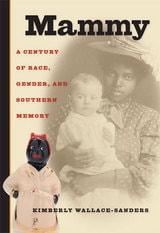
Mammy
A Century of Race, Gender, and Southern MemoryKimberly Wallace-Sanders
University of Michigan Press, 2008
---Choice
"In this insightful analysis of representations of mammy, Wallace-Sanders skillfully illustrates how this core icon of Black womanhood has figured prominently in upholding hierarchies of race, gender, and class in the United States. Far from being a timeless, natural, benign image of domesticity, the idealized mammy figure was repeatedly reworked to accommodate varying configurations of racial rule. No one reading this book will be able to see Gone with the Wind in the same way ever again."
---Patricia Hill Collins, University of Maryland
"Kimberly Wallace-Sanders' interdisciplinary approach is first-rate. This expansive and engaging book should appeal to students and scholars in American studies, African American studies, and women's studies."
---Thadious Davis, The University of Pennsylvania
Her cheerful smile and bright eyes gaze out from the covers of old cookbooks, song sheets, syrup bottles, salt and pepper shakers, and cookie jars, and she has long been a prominent figure in fiction, film, television, and folk art. She is Mammy, a figure whose provocative hold on the American psyche has persisted since before the Civil War.
But who is Mammy, and where did she come from? Her large, dark body and her round smiling face tower over our imaginations to such an extent that more accurate representations of African American women wither in her shadow. Mammy's stereotypical attributes---a sonorous and soothing voice, raucous laugh, infinite patience, self-deprecating wit, and implicit acceptance of her own inferiority and her devotion to white children---all point to a long-lasting and troubled confluence of racism, sexism, and southern nostalgia.
This groundbreaking book traces the mammy figure and what it has symbolized at various historical moments that are linked to phases in America's racial consciousness. The author shows how representations of Mammy have loomed over the American literary and cultural imagination, an influence so pervasive that only a comprehensive and integrated approach of this kind can do it justice.
The book's many illustrations trace representations of the mammy figure from the nineteenth century to the present, as she has been depicted in advertising, book illustrations, kitchen figurines, and dolls. The author also surveys the rich and previously unmined history of the responses of African American artists to the black mammy stereotype, including contemporary reframings by artists Betye Saar, Michael Ray Charles, and Joyce Scott.
Kimberly Wallace-Sanders is Associate Professor of the Graduate Institute of Liberal Arts and Women's Studies at Emory University. She is editor of Skin Deep, Spirit Strong: The Black Female Body in American Culture.
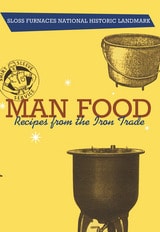
Man Food
Recipes from the Iron TradeKaren R. Sloss Furnaces Historical Landmark
University of Alabama Press, 2007
The secret history of manly eating in the Heart of Dixie
Man Food: Recipes from the Iron Trade is a flavorful tribute to Alabama’s industrial soul and culinary heart. Born from the legendary Sloss Furnaces in Birmingham—once the beating heart of the Magic City’s iron industry—this cookbook blends Southern tradition, foundry grit, and backyard hospitality into one unforgettable volume.
Collected from the pages of Pig Iron Rough Notes, a magazine once circulated among Alabama’s ironworkers, these recipes reflect the lives of men who forged metal by day and cooked with cast iron by night. Inside, you’ll find dishes like Brunswick Stew, Catfish Chowder, and Bean Hole Beans—hearty meals rooted in Alabama’s outdoors, work camps, and family kitchens.
With colorful stories, vintage illustrations, and a deep appreciation for cast-iron cooking, Man Food celebrates the “Gentlemen Cooks” of the South—men who knew that good food and good company were just as important as hard work. Whether you're a native Alabamian, a history buff, or a lover of Southern foodways, this book offers a delicious slice of Alabama culture.
Fire up your skillet, pour a cup of camp coffee, and taste the legacy of the Iron Trade—Alabama style.
Man from Nebraska
A PlayTracy Letts
Northwestern University Press, 2006
Manderley
POEMSRebecca Wolff
University of Illinois Press, 2001
In the Manderley of Rebecca, Daphne du Maurier's forbidding haven of mocking ghosts and secrets that refuse to remain buried, nothing is as it seems. So in this stunning debut collection by Rebecca Wolff, cities, partners, mothers, sisters, friends, and perfect strangers all disguise their true faces, while they who seek connection are "transported from one great gaping / hole in the fabric / of our knowledge to another."
No passage is too dark, no garden too tangled for the troubled dreamer of Manderley. Wolff turns a quicksilver gaze on a fluid world where both the real and the imaginary are transfigured. Tempering steely candor with a sophisticated delight in wordplay, these poems turn on a dime from the sensual to the eerie, the resigned to the hopeful, the comforting to the shocking. Each poem weaves together layers of dream, remembrance, and fantasy, distilling from romantic excess a gritty, spare language of truth-telling and surprise

Mandible Wishbone Solvent
Asiya Wadud
University of Chicago Press, 2024
The poetry of Mandible Wishbone Solvent is situated in the space of bridges, fragmentary overlays, spectral reach, and the desire to keep reaching. Asiya Wadud’s poems engage in this act, not to stake a claim or to fasten themselves, but to hold fragments together in order to offer possibilities for connection and extension. Throughout the collection lies an acknowledgment that any hold will drift, meander, and find new paths, with each separation making space for new entanglements. Drawing on a keen interest in tactility and ekphrasis, Wadud mines the repetition and extension that comes with any fractured state of existence and considers the nature of a residual and roving we.
Following this selection of lyrical, ekphrastic, fragmented poems, the book concludes with two prose pieces that dwell on the concepts of “isthmus” and “drift,” respectively, which offer further grounds for contemplation and provide a frame for the poems.
Many Californias
Literature from the Golden StateGerald W. Haslam
University of Nevada Press, 1999

Many Times, But Then
By Ann Lauterbach
University of Texas Press, 1979
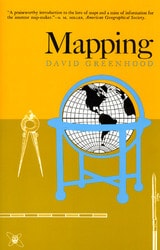
Mapping
David Greenhood
University of Chicago Press, 1964
"This book should be welcomed by all students of mapping, for it will take them in uncomplicated stages through the complexities of compiling a map. . . . Mr. Greenwood is to be congratulated on an excellent book."—C.J. Angus, Canadian Geographical Journal
"For the baggy and middle-aged who cannot afford skiing in Austria or sailing off Bimini, Greenhood invites his readers to a sort of intellectual excitement which neither skiing nor sailing could equal. . . . Unless you work professionally with maps to the degree that a navigator does, for instance, this book will fascinate and enthrall you."—Monroe Bush, American Forests
"A teacher who wishes to go into the classroom with a storehouse of knowledge and ideas will find this a remarkable book. It is easy to read, and each page contains information which can be fed into the work in progress no matter which area of the world is being studied."—Instructor
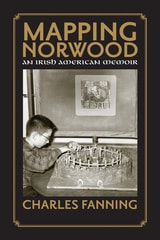
Mapping Norwood
An Irish-American MemoirCharles Fanning
University of Massachusetts Press, 2010
This memoir is an act of map making, of plotting out overlapping territories—topographical, temporal, and psychological. Centered on family life in a Massachusetts town from the 1920s to the 1960s, the author's investigation extends outward to include the Boston area from colonial times to the recent past, encounters with Boston's Museum of Fine Arts and with Harvard College, the American Civil War, and Ireland and Germany in the nineteenth century.
Charles Fanning re-creates the landscape of childhood and adolescence in a place and time both ordinary and rich with possibility. An expert on Irish immigration, he was born and raised in Norwood, Massachusetts, twelve miles outside of Boston, where Yankee and Irish cultures bumped against each other. The narrative traces his personal growth, shaped by family, school, baseball, radio drama, and art. He was the first in his family to attend college, and the book ends with his undergraduate experience at Harvard, class of 1964.
Along with this coming-of-age story, Mapping Norwood features forays back in time, including chapters on each of Fanning's parents and historical excavations and meditations on three ancestors. Guided by his own experience as a scholar, the pressure of these chapters is epistemological—the thrill of the hunt toward knowing. Fanning's great-grandfather, John Fanning, disappeared from the family in the late 1880s, and a chapter chronicles the discovery of “Walking John's” fifty years of hidden later life in East St. Louis, Illinois, where he died alone in 1946. Fanning's great-great-grandfather, Winslow Radcliffe, was a veteran of the 35th Massachusetts Infantry in the Civil War, and the author traces this regiment through the horrors of Antietam and Fredericksburg, by means of diaries and letters by four men from Winslow's company. The evidence gleaned helps explain Winslow's suicide after the war. An Irish immigrant ancestor, Phillip Fanning, came to Boston from County Monaghan just after the Great Famine of the late 1840s. Relying on historical research, Fanning imagines vividly the lives led by Phillip's family and thousands like them in the wake of Ireland's nineteenth-century catastrophe.
Mapping The Empty
Eight Artists And NevadaWilliam L. Fox
University of Nevada Press, 1999
Margaret Atwood’s Textual Assassinations
Recent Poetry and FictionEdited by Sharon Rose Wilson
The Ohio State University Press, 2005
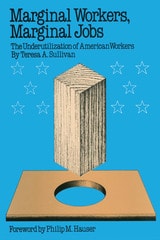
Marginal Workers, Marginal Jobs
The Underutilization of American WorkersBy Teresa A. Sullivan
University of Texas Press, 1978
Unemployment levels have received a great deal of attention and discussion in recent years. However, another labor category—underemployment—has virtually been ignored. Underutilized or underemployed workers are those who are experiencing inadequate hours of work, insufficient levels of income, and mismatch of occupation and skills. Marginal Workers, Marginal Jobs addresses two principal issues: how can we measure underemployment, and how can we explain its prevalence?
To answer the first question, Teresa Sullivan examines yardsticks in use, demonstrates their inadequacy, and develops a different measure that is easy to interpret and is usable by both demographers and economists. In answering the second, she analyzes 1960 and 1970 census data to determine the relative effects of population composition and job structure on levels of employment.
One of the important contributions of Sullivan's study is to distinguish between marginal workers and marginal jobs in explaining underutilization. Previous explanations, including the widely used dual market theory, have not stressed this analytic distinction. In addition, her work accounts separately for the various types of marginality and seeks to show the condition of workers who are marginal on more than one count—for example, those who are both young and black, or old and female.
A provocative study based on large samples of the U.S. population, this book raises important questions about a critical subject and makes a significant contribution to the theory of underutilization.
Marianne Moore, Elizabeth Bishop, and May Swenson
The Feminist Poetics of Self-RestraintKirstin Hotelling Zona
University of Michigan Press, 2002
In recent years critical studies of Bishop and Moore have flourished, a large percentage of them devoted to explorations of sexuality and gender. A gap is growing, however, between feminist repossessions of Moore and Bishop and recent readings of their antiessentialist poetics. On the one hand, these poets are appearing more frequently in the feminist canon, but the price of this inclusion is usually the suppression of their strategies of self-restraint. While Zona questions the poetic privileging of self-expression, she establishes contiguity between feminist poetry and developments in American poetry at large. In doing so she asserts the centrality of feminist poetry within discussions of contemporary American poetry, thereby challenging the common perception of feminist poetry as an "alternative" (which often means auxiliary) genre.
Kirstin Hotelling Zona is Assistant Professor of Poetry and Poetics, Illinois State University.
Marianne Moore, Subversive Modernist
By Taffy Martin
University of Texas Press, 1986
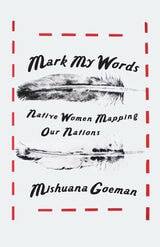
Mark My Words
Native Women Mapping Our NationsMishuana Goeman
University of Minnesota Press, 2013
Dominant history would have us believe that colonialism belongs to a previous era that has long come to an end. But as Native people become mobile, reservation lands become overcrowded and the state seeks to enforce means of containment, closing its borders to incoming, often indigenous, immigrants.
In Mark My Words, Mishuana Goeman traces settler colonialism as an enduring form of gendered spatial violence, demonstrating how it persists in the contemporary context of neoliberal globalization. The book argues that it is vital to refocus the efforts of Native nations beyond replicating settler models of territory, jurisdiction, and race. Through an examination of twentieth-century Native women’s poetry and prose, Goeman illuminates how these works can serve to remap settler geographies and center Native knowledges. She positions Native women as pivotal to how our nations, both tribal and nontribal, have been imagined and mapped, and how these women play an ongoing role in decolonization.
In a strong and lucid voice, Goeman provides close readings of literary texts, including those of E. Pauline Johnson, Esther Belin, Joy Harjo, Leslie Marmon Silko, and Heid Erdrich. In addition, she places these works in the framework of U.S. and Canadian Indian law and policy. Her charting of women’s struggles to define themselves and their communities reveals the significant power in all of our stories.
Mark Twain Speaking
Paul Fatout
University of Iowa Press, 1976
Mark Twain and Human Nature
Tom Quirk
University of Missouri Press, 2007
Mark Twain once claimed that he could read human character as well as he could read the Mississippi River, and he studied his fellow humans with the same devoted attention. In both his fiction and his nonfiction, he was disposed to dramatize how the human creature acts in a given environment—and to understand why.
Now one of America’s preeminent Twain scholars takes a closer look at this icon’s abiding interest in his fellow creatures. In seeking to account for how Twain might have reasonably believed the things he said he believed, Tom Quirk has interwoven the author’s inner life with his writings to produce a meditation on how Twain’s understanding of human nature evolved and deepened, and to show that this was one of the central preoccupations of his life.
Quirk charts the ways in which this humorist and occasional philosopher contemplated the subject of human nature from early adulthood until the end of his life, revealing how his outlook changed over the years. His travels, his readings in history and science, his political and social commitments, and his own pragmatic testing of human nature in his writing contributed to Twain’s mature view of his kind. Quirk establishes the social and scientific contexts that clarify Twain’s thinking, and he considers not only Twain’s stated intentions about his purposes in his published works but also his ad hoc remarks about the human condition.
Viewing both major and minor works through the lens of Twain’s shifting attitude, Quirk provides refreshing new perspectives on the master’s oeuvre. He offers a detailed look at the travel writings, including The Innocents Abroad and Following the Equator, and the novels, including The Adventures of Tom Sawyer, Adventures of Huckleberry Finn, and Pudd’nhead Wilson, as well as an important review of works from Twain’s last decade, including fantasies centering on man’s insignificance in Creation, works preoccupied with isolation—notably No. 44,The Mysterious Stranger and “Eve’s Diary”—and polemical writings such as What Is Man?
Comprising the well-seasoned reflections of a mature scholar, this persuasive and eminently readable study comes to terms with the life-shaping ideas and attitudes of one of America’s best-loved writers. Mark Twain and Human Nature offers readers a better understanding of Twain’s intellect as it enriches our understanding of his craft and his ineluctable humor.
Mark Twain and Medicine
"Any Mummery Will Cure"K. Patrick Ober
University of Missouri Press, 2003
Mark Twain has always been America’s spokesman, and his comments on a wide range of topics continue to be accurate, valid, and frequently amusing. His opinions on the medical field are no exception. While Twain’s works, including his popular novels about Tom Sawyer and Huckleberry Finn, are rich in medical imagery and medical themes derived from his personal experiences, his interactions with the medical profession and his comments about health, illness, and physicians have largely been overlooked.
In Mark Twain and Medicine, K. Patrick Ober remedies this omission. The nineteenth century was a critical time in the development of American medicine, with much competition among the different systems of health care, both traditional and alternative. Not surprisingly, Mark Twain was right in the middle of it all. He experimented with many of the alternative care systems that were available in his day—in part because of his frustration with traditional medicine and in part because he hoped to find the “perfect” system that would bring health to his family.
Twain’s commentary provides a unique perspective on American medicine and the revolution in medical systems that he experienced firsthand. Ober explores Twain’s personal perspective in this area, as he expressed it in fiction, speeches, and letters. As a medical educator, Ober explains in sufficient detail and with clarity all medical and scientific terms, making this volume accessible to the general reader.
Ober demonstrates that many of Twain’s observations are still relevant to today’s health care issues, including the use of alternative or complementary medicine in dealing with illness, the utility of placebo therapies, and the role of hope in the healing process.
Twain’s evaluation of the medical practices of his era provides a fresh, humanistic, and personalized view of the dramatic changes that occurred in medicine through the nineteenth century and into the first decade of the twentieth. Twain scholars, general readers, and medical professionals will all find this unique look at his work appealing.
Mark Twain and Metaphor
John Bird
University of Missouri Press, 2007
Metaphor theory, observes John Bird, is like Mark Twain: both seem simple upon first introduction. Now, in the most complete study to date of Twain’s use of figurative language, a veteran Twain scholar tackles the core of his writing and explores it with theoretical approaches that have rarely been applied to Twain, providing new insights into how he imagined his world—and the singular ways in which he expressed himself.
From “The Jumping Frog” to the late dream narratives, Bird considers Twain’s metaphoric construction over his complete career and especially sheds new light on his central texts: Roughing It; The Adventures of Tom Sawyer; Adventures of Huckleberry Finn; A Connecticut Yankee in King Arthur’s Court; Pudd’nhead Wilson; and No. 44,The Mysterious Stranger. He reconsiders “Old Times on the Mississippi” as the most purely metaphorical of Twain’s writings, goes on to look at how Twain used metaphor and talked about it in a variety of works and genres, and even argues that Clemens’s pseudonym is not so much an alter ego as a metaphorized self.
By offering insight into how Twain handled figurative language during the composing process, Bird reveals not only hidden facets of his artistry but also new aspects of works that we think we know well—including some entirely new ideas regarding Huck Finn that draw on the recent discovery of the first half of the manuscript. In addition to dealing with issues currently central to Twain studies, such as race and gender, he also links metaphor to humor and dream theory to further illuminate topics central to his work.
More than a study of Twain’s language, the book delves into the psychological aspects of metaphor to reveal the writer’s attitudes and thoughts, showing how using metaphor as a guide to Twain reveals much about his composition process. Applying the insights of metaphor theorists such as Roman Jakobson and Colin M. Turbayne, Bird offers readers not only new insights into Twain but also an introduction to this interdisciplinary field.
In lively prose, Mark Twain and Metaphor provides a vital way to read Twain’s entire corpus, allowing readers to better appreciate his style, humor, and obsession with dreams. It opens new ground and makes old ground fresh again, offering ways to see and resee this essential American writer.
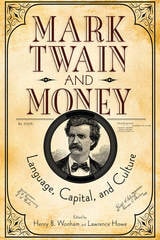
Mark Twain and Money
Language, Capital, and CultureEdited by Henry B. Wonham and Lawrence Howe
University of Alabama Press, 2017
Mark Twain and Money: Language, Capital, and Culture focuses on an overlooked feature of the story of one of America’s most celebrated writers. Investigating Samuel Clemens’s often conflicting but insightful views on the roles of money in American culture and identity, this collection of essays shows how his fascination with the complexity of nineteenth-century economics informs much of Mark Twain’s writing.
While most readers are familiar with Mark Twain the worldly wise writer, fewer are acquainted with Samuel Clemens the avid businessman. Throughout his life, he sought to strike it rich, whether mining for silver in Nevada, founding his own publishing company, or staking out ownership in the Paige typesetting machine. He was ever on the lookout for investment schemes and was intrigued by inventions, his own and those of others, that he imagined would net a windfall. Conventional wisdom has held that Clemens’s obsession with business and material wealth hindered his ability to write more and better books. However, this perspective fails to recognize how his interest in economics served as a rich source of inspiration for his literary creativity and is inseparable from his achievements as a writer. In fact, without this preoccupation with monetary success, Henry B. Wonham and Lawrence Howe argue, Twain’s writing would lack an important connection to a cornerstone of American culture.
The contributors to this volume examine a variety of topics, such as a Clemens family myth of vast landholdings, Clemens’s strategies for protecting the Mark Twain brand, his insights into rapidly evolving nineteenth-century financial practices, the persistence of patronage in the literary marketplace, the association of manhood and monetary success, Clemens’s attitude and actions toward poverty, his response to the pains of bankruptcy through writing, and the intersection of racial identity and economics in American culture. These illuminating essays show how pecuniary matters invigorate a wide range of Twain’s writing from The Gilded Age, Roughing It,The Adventures of Tom Sawyer, The Prince and the Pauper, and A Connecticut Yankee in King Arthur’s Court, to later stories like “The £1,000,000 Banknote” and the Autobiography.

Mark Twain and Orion Clemens
Brothers, Partners, StrangersPhilip Ashley Fanning
University of Alabama Press, 2003
One became America’s greatest writer. The other died in obscurity and failure. As brothers, they shaped each other's lives and work.
In a compelling way, Philip Fanning traces the fraternal relationship of Orion and Samuel Clemens from its beginning in Hannibal, Missouri, in the 1830s to Orion's death in Iowa in 1897. He demonstrates that Orion’s influence on the writer known as Mark Twain was profound, pervasive, and prolonged.
In some respects, Samuel defined himself against Orion’s formidable background. It was Orion who became the chief financial and spiritual support of the Clemens family following the father's controversial death in 1847. It was Orion who led the way for his brother into printing, journalism, and mine speculation. And it was Orion who served as Sam’s first real editor and literary mentor, recognizing and encouraging his younger brother’s talents as a writer.
The two siblings had much in common, and they often appeared to be codependent, so much so that their attitudes veered sharply from mutual admiration to mutual disdain and rivalry. Whereas Orion was self-effacing, easygoing, humble, and adventurous in his politics and progressive in his views, Twain was often ill-tempered and antagonistic toward those around him and conservative in his outlook. He frequently portrayed his older brother in autobiographical writings and letters as a buffoon and a laughingstock.
Fanning—who drew upon extensive archival sources, unpublished letters between the two brothers, and the Mark Twain Papers at the University of California, Berkeley—charts these divergences in their characters and in their fortunes. As Twain rose to become a national celebrity and a financial success, Orion's finances and self-esteem disintegrated, and Twain’s treatment of his brother became evermore harsh and mocking. Fanning’s study stands as both a biography of a fractious fraternal relationship and a work of scholarship that highlights for the first time how significantly Orion Clemens influenced Twain’s psychic and artistic economy.
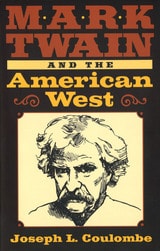
Mark Twain and the American West
Joseph L. Coulombe
University of Missouri Press, 2003
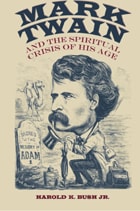
Mark Twain and the Spiritual Crisis of His Age
Harold K. Bush
University of Alabama Press, 2007
Discover the spiritual depths behind America’s greatest humorist.
Mark Twain is often pictured as a severe critic of religious piety, shaking his fist at God and mocking the devout. Such a view, however, is only partly correct. It ignores the social realities of Twain’s major period as a writer and his own spiritual interests: his participation in church activities, his socially progressive agenda, his reliance on religious themes in his major works, and his friendships with clergymen, especially his pastor and best friend, Joe Twichell. It also betrays a conception of religion that is more contemporary than that of the period in which he lived.
Harold K. Bush Jr. highlights Twain’s attractions to and engagements with the wide variety of religious phenomena of America in his lifetime, and how these matters affected his writings. Though Twain lived in an era of tremendous religious vigor, it was also a time of spiritual upheaval and crisis. The rise of biological and psychological sciences, the criticism of biblical texts as literary documents, the influx of world religions and immigrant communities, and the trauma of the Civil War all had dramatic effects on America’s religious life. At the same time mass urban revivalism, the ecumenical movement, Social Christianity, and occultic phenomena, like spiritualism and mind sciences, all rushed in to fill the voids. The rapid growth of agnosticism in the 1870s and 1880s is also clearly reflected in Twain’s life and writings. Thus Twain’s career reflects in an unusually resonant way the vast changes in American belief during his lifetime.
Bush’s study offers both a new and more complicated understanding of Twain and his literary output and serves as the cultural biography of an era.
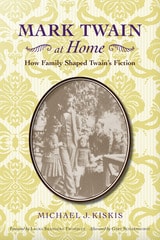
Mark Twain at Home
How Family Shaped Twain’s FictionMichael J. Kiskis, Foreword by Laura Skandera Trombley, Afterword by Gary Scharnhorst
University of Alabama Press, 2016
Mark Twain was the child of a loveless marriage and a homelife over which hovered the constant specter of violence. Informed by his difficult childhood, orthodox readings of The Adventures of Tom Sawyer and Adventures of Huckleberry Finn frame these canonical literary figures as nostalgic—autobiographical fables of heroic individualists slipping the bonds of domestic life.
Kiskis, however, presents a wealth of biographical details about Samuel Clemens and his family that reinterpret Twain’s work as a robust affirmation of domestic spheres of life. Among Kiskis’s themes are that, as the nineteenth century witnessed high rates of orphanhood and childhood mortality, Clemens’s work often depicted unmoored children seeking not escape from home but rather seeking the redemption and safety available only in familial structures. Similarly, Mark Twain at Home demonstrates that, following the birth of his first daughter, Twain began to exhibit in his writing an anxiety with social ills, notably those that affected children.
In vigorous and accessible descriptions of Twain’s life as it became reflected in his prose, Kiskis offers a compelling and fresh understanding of this work of this iconic American author.