Results by title
402 books match the query 'American poetry' and 13 start with m
Manthology
Poems on the Male ExperienceCraig Crist-Evans
University of Iowa Press, 2006
Many Gods and Many Voices
The Role of the Prophet in English and American ModernismLouis L. Martz
University of Missouri Press, 1998
In Many Gods and Many Voices distinguished scholar Louis L. Martz addresses works by Ezra Pound, T. S. Eliot, William Carlos Williams, H. D., and D. H. Lawrence, with brief treatment of the relation of Pound's Cantos to Joyce's Ulysses. In a graceful, lucid style, Martz argues that a prophetic tradition is represented in the Cantos, The Waste Land, Paterson, and H. D.'s Trilogy and Helen in Egypt, along with Lawrence's Plumed Serpent and the second version of Lady Chatterley's Lover. Pound's often- cited view that an epic is a poem that "includes history" does not define epic alone, for the books of biblical prophecy also contain history: the history of Israel's misdeeds and continuous redemption.
On the other hand, Martz suggests that the term prophecy should not be limited to works that foretell the future, arguing that the biblical prophet is concerned primarily with the present. The prophet is a reformer, a denouncer of evil, as well as a seer of possible redemption. He hears "voices" and transmits the message of those voices to his people, in the hope of moving them away from wickedness and toward the ways of truth. According to Martz, such was the mission that inspired Walt Whitman and that Whitman passed on to Pound, Eliot, Williams, and Lawrence. (H. D. found her own sources of inspiration in Greek and Egyptian lore.)
Martz's premise is that biblical prophecy, with its mingling of poetry and prose, its abrupt shifts from violent denunciation to exalted poetry, provides a precedent for the texture of these modernist works that will help readers to appreciate the mingling of "voices" and the complex mixture of elements. Examining their interrelationships and their common themes, Many Gods and Many Voices offers fresh insights into these modern writers.
Marianne Moore, Elizabeth Bishop, and May Swenson
The Feminist Poetics of Self-RestraintKirstin Hotelling Zona
University of Michigan Press, 2002
In recent years critical studies of Bishop and Moore have flourished, a large percentage of them devoted to explorations of sexuality and gender. A gap is growing, however, between feminist repossessions of Moore and Bishop and recent readings of their antiessentialist poetics. On the one hand, these poets are appearing more frequently in the feminist canon, but the price of this inclusion is usually the suppression of their strategies of self-restraint. While Zona questions the poetic privileging of self-expression, she establishes contiguity between feminist poetry and developments in American poetry at large. In doing so she asserts the centrality of feminist poetry within discussions of contemporary American poetry, thereby challenging the common perception of feminist poetry as an "alternative" (which often means auxiliary) genre.
Kirstin Hotelling Zona is Assistant Professor of Poetry and Poetics, Illinois State University.
Merrill, Cavafy, Poems, and Dreams
Rachel Hadas
University of Michigan Press, 2000
The second half of the book combines explorations of various corners and horizons of the poetry scene, including neglected American poets and Hadas's thoughts on her own poetics and career. "Two Letters from New York" and "Tangled Web Sites" take bemused looks at literary or cultural landscapes. Hadas also looks inward: to dreams and dreamwork, to her dead mother's address book, to the emblematic drilling of a well in a country house. The range of selections includes essays, interviews, memoir, criticism, and a few of Hadas's own poems.
Rachel Hadas is the author of eleven books of poetry, essays, and translations. Her most recent book is Halfway Down the Hall: New and Selected Poems. She has received a Guggenheim Fellowship in Poetry and an American Academy-Institute of Arts and Letters Award in Literature, and is a member of the American Academy of Arts and Sciences. She is Professor of English at the Newark campus of Rutgers University.
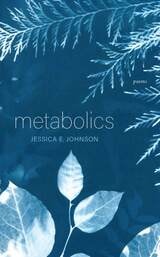
Metabolics
PoemsJessica E. Johnson
Acre Books, 2023
Metabolics, a book-length poem, borrows the movements of metabolic pathways to consider how nature accomplishes both balance and deep transformation. In visual figures and prose blocks that bridge the divide between poetry and nonfiction, Jessica E. Johnson employs scientific idioms to construct an allegory about a family in the Pacific Northwest. The region becomes a character in its own right, with cedars, moss, and heavy cloud knitting the mother, father, boy, and girl into their setting.
This far-reaching volume also serves as a study of the ecologies of contemporary parenting, with adults and children affected by “feeds” both on screen and off as their bodies metabolize food, the environment, and excess feelings such as rage. From climate change to kombucha to smartphones and curated produce, the smallest details of daily life in “Plasticland” catalyze a larger examination of selfhood: “Despite so many attempts to resolve this tension, sometimes you are you and also sometimes mother just as light can be both particle and wave.”
Modern American Poetry, 1865-1950
Alan Shucard
University of Massachusetts Press, 1990
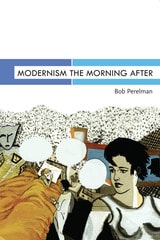
Modernism the Morning After
Bob Perelman
University of Alabama Press, 2017
Modernism the Morning After is a superb, lively, engaging series of essays and talks, dating from 1995 to 2016, by the eminent scholar, critic, and poet Bob Perelman. Throughout his career, Perelman has focused on the persistence of modernist ambition in poetry, with all of its admirable articulations and tragicomic short-circuits. Poetry, it turns out, is not simply “news that stays news,” as Ezra Pound postulated. Instead, as Perelman demonstrates, poetry often gropes toward whatever news can be found in the broader contexts of public speech—the cultural commons, the almost-real or much-too-real language of people and our hyperactive media.
Working in a variety of modes from the poetic to the dramatic to the conversational, and ranging across an expansive historical register from Dickinson, Whitman, and Dunbar in the nineteenth century to Kenneth Goldsmith and Stephen Colbert in the twenty-first, Perelman’s readings are unfailingly illuminating and, in many cases, his witty expositions take us strikingly close to the original intent of the text concerned.
Perelman also places intermittent, yet artful, pressure on some basic questions about the very nature of poetry. What does the transcription of poems tell us about them? How do hoaxes like the Ern Malley affair compel us to reconsider fundamental assumptions about what constitutes “authentic” poetry? How does the bathetic register relate to tones and idiom in recent poetic production? In Modernism the Morning After, Perelman writes as a poet, teacher, and critic, addressing a broad audience of readers and writers without choosing between them, inviting all to consider along with him modernism’s future through a dynamic consideration of its past.
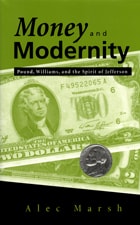
Money and Modernity
Pound, Williams, and the Spirit of JeffersonAlec Marsh
University of Alabama Press, 1998
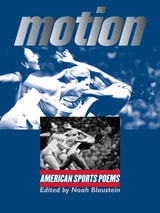
Motion
American Sports PoemsNoah Blaustein
University of Iowa Press, 2001
Sports have long served as inspiration for poetry-the ancient Greeks wrote odes in praise of their athletes-so it is little surprise that in a culture as obsessed with athletes as our own sports would exert an influence on contemporary poets. Motion: American Sports Poems rescues sports from our society's focus on superstars, multimillion-dollar contracts, and gold medals to capture champions and losers, competitors and spectators in moments that are anything but fleeting.
As Noah Blaustein points out in his preface, among the many parallels made between sports and poetry is the idea of transcendence. Forged from the most basic elements of sport-energy, movement, and rhythm-the poems in this anthology reflect something universal: sport as metaphor, sport as struggle, sport as the battleground for mythic figures and local heroes.
The often celebrated sports-baseball, boxing, football, and basketball-are here along with unexpected pastimes like surfing, skateboarding, tennis, soccer, karate, rock climbing, bowling, and curling. Young and old, black and white, male and female, the poets in this anthology celebrate everyone who has come together in the shimmy and shake and sweat of sport.
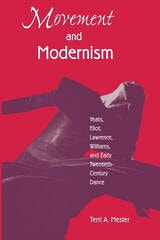
Movement and Modernism
Yeats, Eliot, Williams, and Early Twentieth-Century DanceTerri A. Mester
University of Arkansas Press, 1997
Mrs. Ramsay's Knee
Idris Anderson
Utah State University Press, 2008
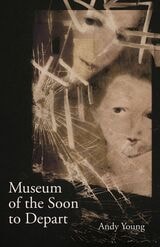
Museum of the Soon to Depart
Andy Young
Carnegie Mellon University Press, 2024
In Museum of the Soon to Depart, poet Andy Young searches for her place in history as it unfolds around her through revolution, plague, and natural disaster. As curator of her museum, she navigates her own and others’ suffering through intense observation, from the inner mechanisms of grief and illness to the solace of distance provided by photography. The material of the poet’s own life and events on the world stage intertwine, resulting in poems with a staggering range, inhabiting language in ways that ultimately point to its limits.
My Poetics
Maureen N. McLane
University of Chicago Press, 2024
In My Poetics, Maureen N. McLane writes as a poet, critic, theorist, and scholar—but above all as an impassioned reader. Written in an innovative, conversable style, McLane’s essays illuminate her own poetics and suggest more generally all that poetics can encompass. Ranging widely from romantic-era odes and hymns to anonymous ballads to haikus and haibuns to modernist and contemporary poetries in English, My Poetics explores poems as speculative instruments and as ways of registering our very sense of being alive. McLane pursues a number of open questions: How do poems generate modes for thinking? How does rhyme help us measure out thought? What is the relation of poetry to its surroundings, and how do specific poems activate that relation?
If, as Wallace Stevens wrote, “poetry is the scholar’s art,” My Poetics flies under a slightly different banner: study and criticism are also the poet’s art. Punctuated with McLane’s poems and drawing variously on Hannah Arendt, Percy Bysshe Shelley, Roland Barthes, Bruno Latour, and other writers and poets, My Poetics is a formally as well as intellectually adventurous work. Its artful arrangement of readings and divagations shows us a way to be with poems and poetics.