Results by title
112 books match the query 'Americans' and 9 start with m
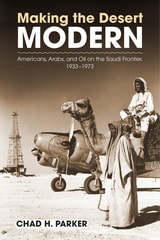
Making the Desert Modern
Americans, Arabs, and Oil on the Saudi Frontier, 1933–1973Chad Parker
University of Massachusetts Press, 2015
In 1933 American oilmen representing what later became the Arabian American Oil Company (Aramco) signed a concession agreement with the Saudi Arabian king granting the company sole proprietorship over the oil reserves in the country's largest province. As drilling commenced and wells proliferated, Aramco soon became a major presence in the region. In this book Chad H. Parker tells Aramco's story, showing how an American company seeking resources and profits not only contributed to Saudi “nation building” but helped define U.S. foreign policy during the early Cold War.
In the years following World War II, as Aramco expanded its role in Saudi Arabia, the idea of “modernization” emerged as a central component of American foreign policy toward newly independent states. Although the company engaged in practices supportive of U.S. goals, its own modernizing efforts tended to be pragmatic rather than policy-driven, more consistent with furthering its business interests than with validating abstract theories. Aramco built the infrastructure necessary to extract oil and also carved an American suburb out of the Arabian desert, with all the air-conditioned comforts of Western modern life. At the same time, executives cultivated powerful relationships with Saudi government officials and, to the annoyance of U.S. officials, even served the monarchy in diplomatic disputes. Before long the company became the principal American diplomatic, political, and cultural agent in the country, a role it would continue to play until 1973, when the Saudi government took over its operation.
Mark Twain in Paradise
His Voyages to BermudaDonald Hoffman
University of Missouri Press, 2006
This book is the first comprehensive study of Clemens’s love affair with Bermuda, a vivid depiction of a celebrated author on recurring vacations. Donald Hoffmann has culled and clarified passages from Mark Twain’s travel pieces, letters, and unpublished autobiographical dictation—with cross-references to his fiction and infrequently cited short pieces—to create a little-known view of the author at leisure on his fantasy island.
Mark Twain in Paradise sheds light on both Clemens’s complex character and the topography and history of the islands. Hoffmann has plumbed the voluminous Mark Twain scholarship and Bermudian archives to faithfully re-create turn-of-the-century Bermuda, supplying historical and biographical background to give his narrative texture and depth. He offers insight into Bermuda’s natural environment, traditional stone houses, and romantic past, and he presents dozens of illustrations, both vintage and new, showing that much of what Mark Twain described can still be seen today.
Hoffmann also provides insight into the social circles Clemens moved in—and sometimes collected around himself. When visiting the islands, he rubbed shoulders with the likes of socialist Upton Sinclair and multimillionaire Henry H. Rogers; with Woodrow Wilson and his lover, socialite Mary Peck; as well as with the young girls to whom he enjoyed playing grandfather.
“You go to heaven if you want to,” Mark Twain wrote from Bermuda in 1910 during his long last visit. “I’d druther stay here.” And because much of what Clemens enjoyed in the islands is still available to experience today, visitors to Bermuda can now have America’s favorite author as their guide. Mark Twain in Paradise is an unexpected addition to the vast literature by and about Mark Twain and a work of travel literature unlike any other.
Mark Twain, Travel Books, and Tourism
The Tide of a Great Popular MovementJeffrey Alan Melton
University of Alabama Press, 2008
With the publication of The Innocents Abroad (1869), Mark Twain embarked on a long and successful career as the 19th century's best-selling travel writer. Jeffrey Melton treats Twain's travel narratives in depth, and in the context of his contemporary travel writers and a burgeoning tourism culture. As Melton shows, Twain's five major travel narratives--The Innocents Abroad, Roughing It, Life on the Mississippi, A Tramp Abroad, and Following the Equator--demonstrate Twain's mastery and reinvention of the genre.
Mark Twain, the World, and Me
"Following the Equator," Then and NowSusan K. Harris
University of Alabama Press, 2020
A scholar accompanies Twain on his journey around the world
In Mark Twain, the World, and Me: “Following the Equator,” Then and Now, Susan K. Harris follows Twain’s last lecture tour as he wound his way through the British Empire in 1895–1896. Deftly blending history, biography, literary criticism, reportage, and travel memoir, Harris gives readers a unique take on one of America’s most widely studied writers.
Structured as a series of interlocking essays written in the first person, this engaging volume draws on Twain’s insights into the histories and cultures of Australia, India, and South Africa and weaves them into timely reflections on the legacies of those countries today. Harris offers meditations on what Twain’s travels mean for her as a scholar, a white woman, a Jewish American, a wife, and a mother. By treating topics as varied as colonial rule, the clash between indigenous and settler communities, racial and sexual “inbetweenness,” and species decimation, Harris reveals how the world we know grew out of the colonial world Twain encountered. Her essays explore issues of identity that still trouble us today: respecting race and gender, preserving nature, honoring indigenous peoples, and respecting religious differences.

Mayan Drifter
Chicano Poet in the Lowlands of AmericaJuan Herrera
Temple University Press, 1997

Moscow Yankee
Myra Page
University of Illinois Press, 1995
of a Ford plant sends Andy and two companions to Moscow to find work in
a Soviet automotive plant, where he meets Natasha, an exemplar of the
"new Soviet woman." Based on Myra Page's own experiences in Moscow during
the first Five-Year Plan, Natasha is a portrait of women's contradictory
social position in the early periods of socialist construction. At the
core of this novel is a firsthand look at the developing forces and changing
relations of production forces that bring about the conversion of Andy
into a "Moscow Yankee." While revealing the political and economic policies
that would inevitably lead to the demise of Soviet-style socialism, Moscow
Yankee refutes the notion that egalitarian societies cannot succeed
because they fail to take into account the individualism and greed of
"human nature." Barbara Foley's introduction analyzes the Soviet Socialist
construction in Page's novel and the politics of the novelistic form in
relation to Moscow Yankee.
Originally published in 1935
"A picture of Americans lured
to Moscow by hope in the 'great experiment,' and of others driven there
by the depression, and of still others attracted by the simple desire
to get good engineering jobs, Moscow Yankee; has a decided
value . . . a sense of life, stirring in the chaos of destruction and
reconstruction." -- The New York Times Book Review
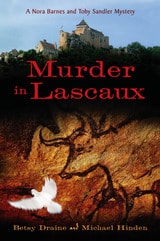
Murder in Lascaux
Betsy Draine and Michael Hinden
University of Wisconsin Press, 2014
The cave of Lascaux may be closed to the public, but five scholars a day are allowed inside, and Nora Barnes has finagled an appointment. True, she may have fudged a bit in her letter to the authorities, but she does teach art history, and she isn’t about to miss her chance to see the world’s most famous prehistoric paintings. Nora and her high-spirited husband, Toby, are visiting the Dordogne, in the southern French region of the Aquitaine. Aware that the Dordogne’s renown for cave art is matched only by its reputation for delicious cuisine, the couple has also signed up for a cooking class at a nearby château, but they soon find that more than food is on their minds.
During their tour of the cave, another visitor is murdered. When the local inspector pegs Nora and Toby as suspects, they embark on a mission to solve the crime, tracing strange links between a Cro-Magnon symbol and a thirteenth-century religious cult. As they match wits with the crusty inspector, Nora finds herself immersed in the notebooks of a forgotten artist who once lived in the château. In sifting through the artist’s papers and uncovering old secrets, she begins to piece together the motives for the murder. But has she cooked up more trouble than she can handle?
Best Books for General Audiences, selected by the Public Library Reviewers
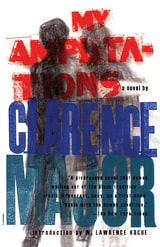
My Amputations
Clarence Major
University of Alabama Press, 1986
Originally published in 1986, this new edition returns to print a classic, influential work of American fiction
The author of the acclaimed novel Reflex and Bone Structure returns here in My Amputations to the question of identity, the double, adventure, detection, and mystery, but with more hypnotic power and range. In My Amputations he has his protagonist, Mason Ellis (who may just be “a desperate ex-con” or a wronged American novelist out to right the wrong done to him), jump through flaming loops like a trained dog, so to speak. In other words, there seems to be no end to the troubles Mason Ellis faces.
His story takes him from the South Side of Chicago, to New York, with a stint in Attica prison, across America and Europe and into the primal depths of Africa. Mason, all the while, tries to convince the reader that he is the important American writer he says he is. Upon his release from prison he sets out to prove his claim. After an audacious bank-robbery and a couple of burglaries that are hilarious, he goes into hiding to escape the malice of one of his cohorts, and eventually flees to Europe. The irony is that he is now as much the runner as the seeker. After encounters with a Zuni ex-folksinger, kidnappers, the New York underworld, literary groupies, an Italian swordsman, a violent German secret society, and an anti-bellum cotillion in rural Greece, he finds himself face to face (behind a mask) with his own destiny.
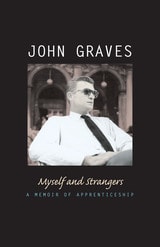
Myself and Strangers
A Memoir of ApprenticeshipBy John Graves
University of Texas Press, 2005
In Myself and Strangers, John Graves, the highly regarded author of Goodbye to a River and other classic works, recalls the decade-long apprenticeship in which he found his voice as a writer. He recounts his wanderings from Texas to Mexico, New York, and Spain, where, like Hemingway, he hoped to find the material with which to write books that mattered. With characteristic honesty, Graves admits the false starts and dead ends that dogged much of his writing, along with the exhilaration he felt when the words finally flowed. He frankly describes both the pleasures and the restlessness of expatriate life in Europe after World War II—as well as his surprising discovery, when family obligations eventually called him home to Texas, that the years away had prepared him to embrace his native land as the fit subject matter for his writing. For anyone seeking the springs that fed John Graves' best-loved books, this memoir of apprenticeship will be genuinely rewarding.